Feb 26, 2026
Do I Need a Financial Model For a Pre-Seed Deck? (2026 Guide)
Most advice about pre-seed financial models is wrong. It either tells you to build a 50-tab, 5-year projection that belongs in a Series C data room, or it tells you to skip the numbers entirely because "it's all made up anyway." Both extremes kill deals.
Here's the reality: investors know your Year 4 revenue projections are fiction. But they still ask for a model. Why? Because they aren't looking for a crystal ball. They are looking for operational discipline. They want to see how you think about your business, how you plan to spend their capital, and whether the math behind your idea actually works.
If you are building your pre-seed pitch deck slides and wondering how to handle the financials without wasting weeks in Excel, this guide is for you.
Quick Takeaways:
You do need a financial model at pre-seed, but it should focus on process, not precision.
Investors use the model to assess your unit economics, burn rate, and capital efficiency.
A 5-year plan is useless. A detailed 12–18 month runway calculation is critical.
Your pitch deck needs one visual summary slide; save the spreadsheet for the data room.
Spending too much time formatting slides instead of building your model is a common misstep.
The Short Answer: Do You Need a Pre-Seed Financial Model?
Yes, having a financial model for a pre-seed deck is highly recommended to prove your understanding of the business. However, it should focus on key assumptions, unit economics, and cash burn rather than detailed long-term projections. It serves as a tool to demonstrate operational discipline, justify your raise amount, and highlight key drivers to investors.
You wouldn't build a product without talking to customers, and you shouldn't ask for a million dollars without stress-testing the assumptions behind the business. The model is where you do that testing.
Why Investors Ask For a Financial Model Early On
At the pre-seed stage, you are selling a narrative. But even the best narrative falls apart if the fundamental math doesn't work. Investors ask for a model to answer three specific questions:
How long will our money last? They need to know your expected monthly burn rate and runway.
What milestones will this capital achieve? If you are raising $500k, investors want to see exactly what you will accomplish (e.g., launching the MVP, securing 10 paid pilots) before you run out of cash and need to raise again.
Do you understand the levers of your business? They want to see that you grasp the relationship between customer acquisition cost (CAC), pricing, and hiring.
If your model shows that you need to hire 15 enterprise sales reps to hit $10k in Monthly Recurring Revenue (MRR), the business is fundamentally broken. The model exposes these flaws before the checks are written.
Pro Tip: Never submit a model that assumes hockey-stick growth without a corresponding increase in expenses. If revenue triples in Month 6, your customer support and server costs should reflect that scale. Investors always look for this disconnect.
Process Over Precision: What Actually Matters
It is easy to get paralyzed by the fear of getting the numbers wrong. Let that go. At the earliest stages, especially in 2026, the process of building the model matters far more than the precise output.
When you build a model, you are forced to make decisions. You have to decide how much to pay a lead engineer. You have to estimate how much you'll spend on ads to get one user. You have to define how long your sales cycle is. Building the model takes these abstract ideas out of your head and puts them on paper.
This is the exact reason why pitch decks fail when founders outsource the fundamental thinking. You can delegate the slide design, but you cannot hand off the business logic. You must own the assumptions.
What Should a Pre-Seed Financial Model Include?
You do not need a Wall Street-grade DCF analysis. A clean, well-structured spreadsheet covering the next 12 to 18 months is your target. Focus on these core components.
Monthly Burn Rate and Runway
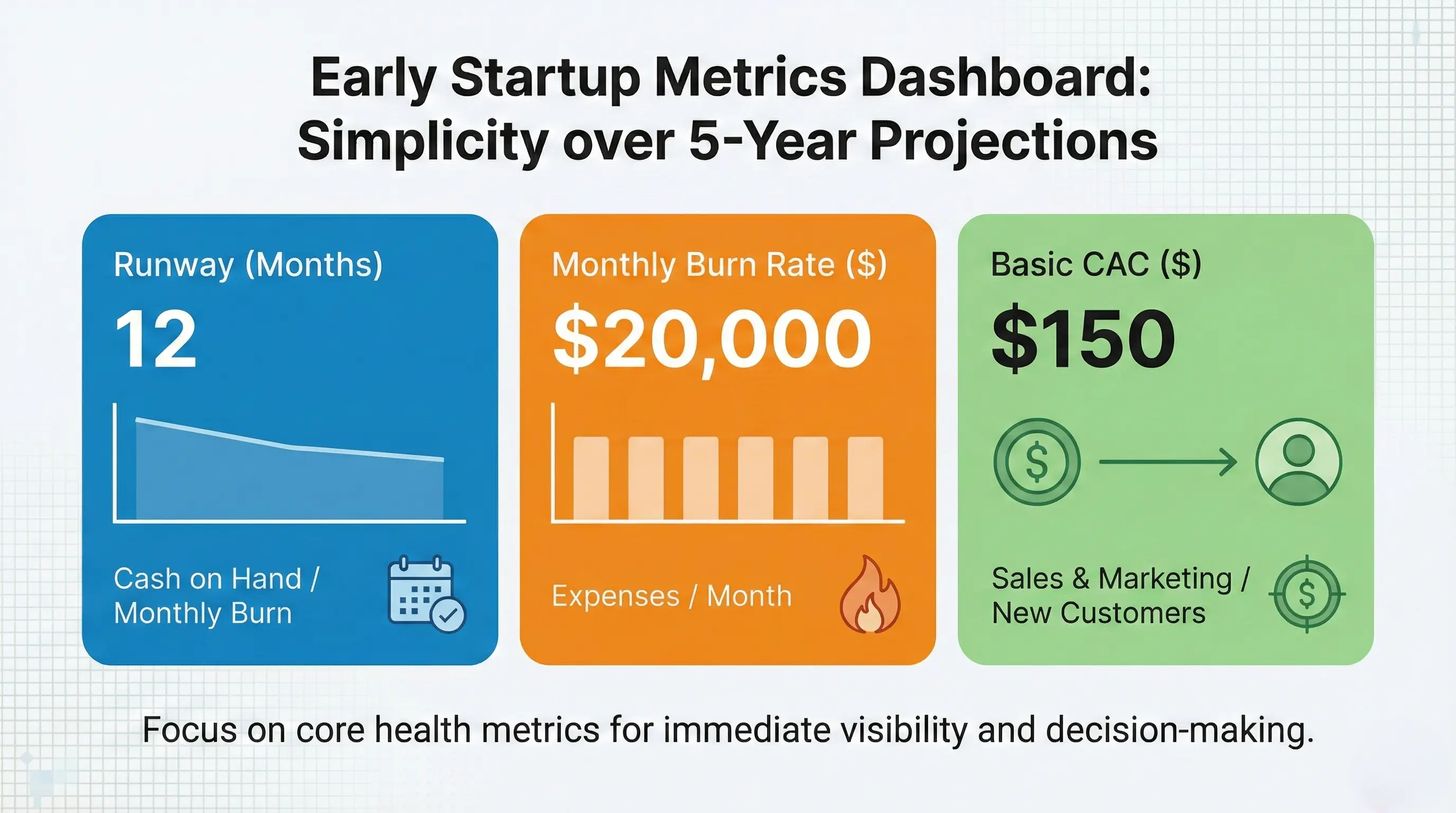
This is the most critical tab in your entire document. Your burn rate is the amount of cash you lose every month while building the product. Your runway is how many months you have before the bank account hits zero.
Calculate your gross burn (total monthly expenses) and net burn (expenses minus any early revenue). If you are raising $750k, and your net burn is $50k a month, you have 15 months of runway. Investors want to see that sequence clearly mapped out.
Customer Acquisition Cost (CAC) and Unit Economics
Even if you are pre-revenue, you need a hypothesis for your unit economics. Unit economics are the direct revenues and costs associated with a single customer.
How much will you charge them?
How much will it cost to deliver the product (hosting, materials, onboarding)?
How much will you spend on sales and marketing to acquire them?
If your CAC is higher than the lifetime value (LTV) of the customer, you do not have a business yet. Show a realistic path to making the math work on a per-unit basis.
The Hiring Roadmap
Personnel is often the largest expense for an early-stage software company. Your model must include a clear hiring plan. List the exact roles you plan to hire, the month you plan to hire them, and their fully loaded salaries (including taxes and benefits). A common mistake is forecasting rapid user growth without forecasting the necessary customer success or engineering hires to support that growth.
Clear Milestones for the Next 12-18 Months
Tie the numbers to physical reality. By Month 6, the model should reflect the launch of the MVP. By Month 12, it should reflect hitting your initial revenue target. This shows investors that the capital is directly funding specific, value-creating milestones.
The Pitch Deck vs. The Data Room Model
There is a distinct difference between what you show during the pitch and what you provide during due diligence. This is a crucial distinction that trips up many founders moving from a seed vs pre-seed pitch deck.
In the Pitch Deck: Include a single, highly visual summary slide. This slide should highlight the total amount you are raising, the primary allocation of funds (e.g., 60% engineering, 30% go-to-market, 10% operations), your expected runway, and the key milestones that capital will unlock. Keep it clean. Do not paste a spreadsheet screenshot onto a slide.
In the Data Room: Provide the full, detailed spreadsheet. This is what investors will dig into after the initial meeting. Ensure it is well-formatted, with assumptions clearly separated from calculations, and easy for a third party to navigate.
Common Pre-Seed Funding Mistakes to Avoid
The market is less forgiving than it was a few years ago. Avoid these unforced errors when putting your numbers together:
Overvaluing the Startup Setup
For early-stage startups with little revenue, valuation is often calculated as a function of the round size. A common rule of thumb is targeting 10-15% dilution. If you dictate a massive valuation without the traction to back it up, investors will pass before even opening your model.
Messy Cap Tables
A clean capitalization table is non-negotiable. If you have promised 1% equity here and 3% there without documenting it properly, due diligence will become a nightmare. Use standard tools to keep this clean from day one.
Focusing on Design over Logic
You should be deep in the spreadsheet figuring out your unit economics, not spending three days trying to align boxes in presentation software. This is where Figma vs Canva pitch deck debates miss the point. If the logic is flawed, beautiful design will not save you.
[TABLE: Pre-Seed Pitch Deck vs. Data Room Financials]
Element | Pitch Deck Summary Slide | Data Room Financial Model |
|---|---|---|
Format | Visual chart or simple bullet points | Spreadsheet (.xlsx or Google Sheets) |
Duration Covered | High-level summary of the next 12-18 months | Month-by-month breakdown for 18-24 months |
Detail Level | Broad categories (e.g., "Engineering", "Sales") | Granular (e.g., "Full Stack Developer Tier 1") |
Purpose | Show capital efficiency and key milestones | Prove the math and test assumptions |
Fast-Tracking Your Pre-Seed Execution
Building a startup requires intense focus. Your time as a founder should be spent validating assumptions, talking to early users, and refining the business logic in your financial model. Every hour you spend fighting with slide layouts or trying to make your charts look cohesive is an hour you aren't moving the business forward.
This is why top founders rely on Zyner. For a flat monthly fee, Zyner provides an unlimited design subscription built specifically for startups. You handle the business model and the data; a dedicated team of senior designers handles the execution.
Instead of starting from pre-seed pitch deck templates and wrestling them into submission, you can drop your raw text and data into a Slack channel, and receive a polished, investor-ready deck that actually looks like a million bucks. And because the design process is handled async, you get your time back.
Your competitors aren't waiting. Neither should you.
5 Frequently Asked Questions
What is a financial model for a startup?
A startup financial model is a tool used to identify startup costs, track Key Performance Indicators (KPIs), manage ongoing expenses, and project future revenues. At the pre-seed stage, it functions less as a predictive tool and more as a stress test for the founder's assumptions about unit economics and cash burn.
What should a pre-seed pitch deck include?
A typical pre-seed deck includes the core narrative elements: the problem, the solution, "why now?", market size, competition, the team, and market validation. It should also include an "ask" slide detailing the fundraising amount and a high-level summary of how those funds will be allocated to achieve specific milestones.
Do pre-seed companies have revenue?
Most pre-seed companies are considered "pre-revenue," meaning they are still developing their product and have not yet started generating income from sales. Investors at this stage are funding the journey to product-market fit or the launch of an initial Minimum Viable Product (MVP).
How do you value a startup in Pre-seed?
For early-stage startups with little revenue, valuation is often calculated as a function of the round size and expected dilution. A common rule of thumb is setting the valuation to target roughly 10% to 15% founder dilution for the capital raised. The focus is on finding a number that lets the team build without giving away the company too early.
How much is a pre-seed round usually?
Pre-seed rounds typically range from $500,000 to $1,500,000, though this varies significantly depending on the industry, the founder's track record, and the capital intensity of the business model. This funding is generally used to reach the seed stage, which typically requires a working product and early signs of traction.