Feb 24, 2026
Startup Storytelling Frameworks: A Pre-Seed Founder's Guide
You've built the MVP. You know the market size. You have the total addressable market calculated down to the decimal. You get into the room with an investor, you run through your slides, and… nothing. They nod politely, tell you you're "too early," and pass.
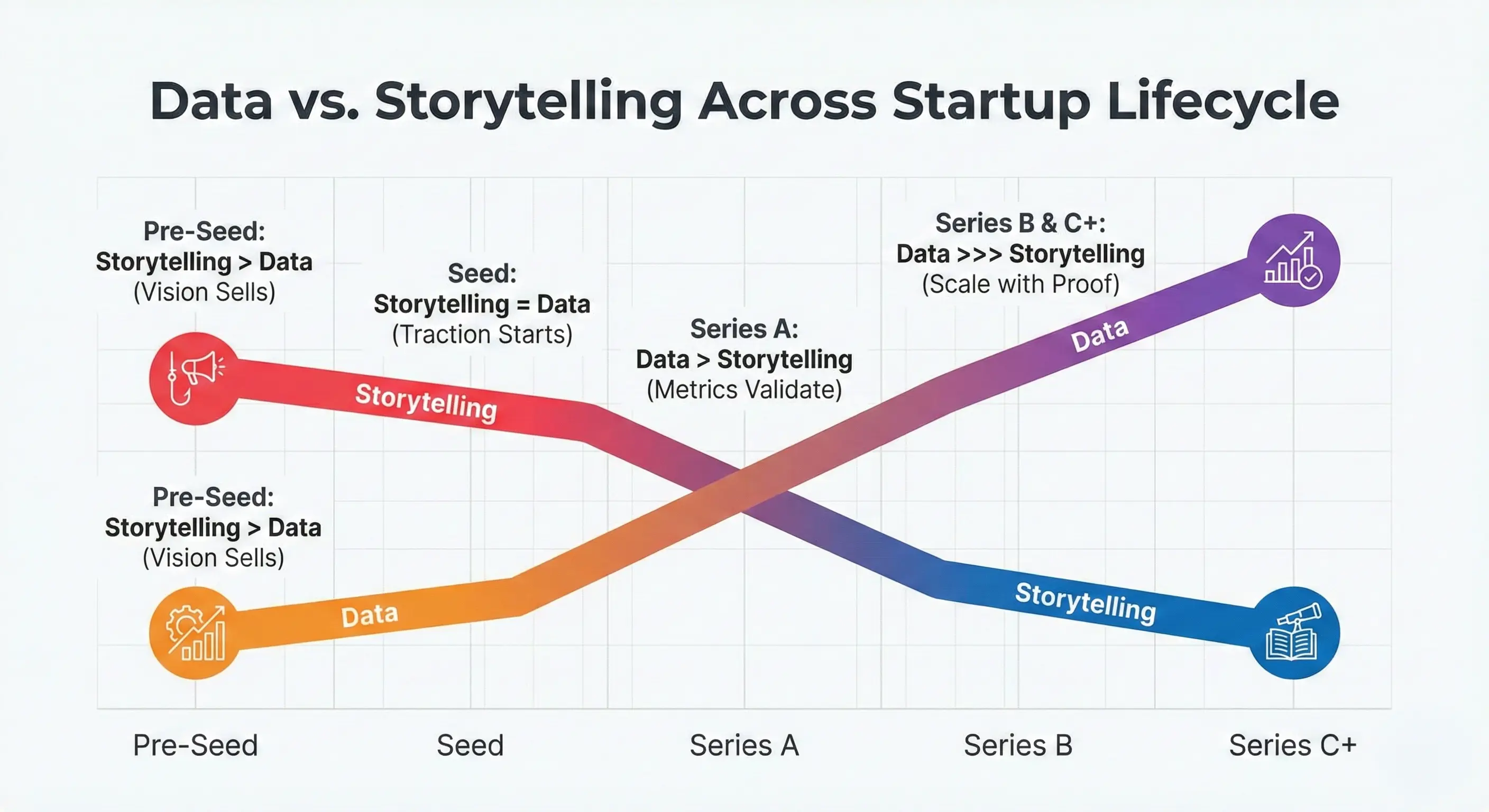
What went wrong? You had the data and the vision. The reality is, at the pre-seed stage, data only gets you in the door. You are essentially asking intelligent people to write a large check based on a hypothesis. To cross the gap between "we have a vision" and "we have zero traction," you don't need more data. You need a story.
Storytelling frameworks for startups aren't marketing buzzwords for copywriters. They are structural engines designed to make an investor feel the problem before you sell them the solution.
Quick Takeaways:
Pre-seed fundraising depends heavily on the founder's narrative to substitute for hard revenue traction.
Generic copywriting formulas like AIDA won't work for high-stakes pitch decks because you need structural tension.
The best frameworks start with a massive, unavoidable shift in the market (The "Why Now").
Visual storytelling matters just as much as what you say because a crowded slide kills a great narrative.
Founders who master the 6-Part Pitch Arc close rounds significantly faster than those who just list features.
Why Storytelling is the Ultimate Pre-Seed Advantage
When you have zero traction, your story is your only asset. You are selling a future state of the world that doesn't exist yet, and asking someone to bet on you explicitly building it.
Investors don't invest in spreadsheets; they invest in inevitability. They need to believe that a massive problem exists, that the current solutions are broken, and that your team is the only logical group to fix it. This requires tension. Without tension, there is no story: just a list of facts.
Storytelling creates that tension. It forces the audience to experience the pain of the status quo. When you frame your startup through a structured narrative using proven startup storytelling frameworks, you stop defending your lack of revenue and start selling the size of the opportunity. It aligns the emotional brain (believing in the mission) with the logical brain (validating the market constraints). This alignment is the silent driver behind every successful seed round. Start thinking of your narrative not as marketing language, but as the underlying architecture of your company's potential.
The 5 Most Effective Startup Storytelling Frameworks
If you search for storytelling frameworks online, you'll be buried in copywriting formulas built for selling $10 ebooks. Things like the AIDA model or basic Features-Advantages-Benefits lists won't secure a $2M seed round.
You need frameworks engineered for fundraising and high-stakes pitches. Here are the five that actually move the needle for early-stage founders.
1. The "Problem-Agitate-Solve" (PAS) Framework for Pitch Decks
You've likely seen the PAS framework used in cold emails or landing pages, but it is brutally effective in the first three slides of a pitch deck. Its power amongst startup storytelling frameworks lies in not just stating a problem, but making the audience feel the active pain of it.
Problem-Agitate-Solve (PAS) is a narrative framework that first identifies a core customer problem. It then heightens the stakes by demonstrating the secondary consequences (agitation), and introduces the product as the definitive solution.
Here is how you apply it to a pitch deck:
Problem (Slide 1): State the undeniable truth. "Enterprise sales reps spend 40% of their day updating CRMs."
Agitate (Slide 2): Twist the knife. Don't just leave it at time wasted. "Because of this, companies leak $2.3M annually in missed follow-ups, and rep turnover is at an all-time high." You are moving from a minor annoyance to a board-level crisis.
Solve (Slide 3): Enter your startup. "We built an AI agent that updates Salesforce autonomously based on call transcripts, saving reps 3 hours a day."
This framework is best used when your target market is already aware they have a problem, but they don't realize how much it's actually costing them. You are waking them up.
2. The Pixar Framework for Vision Casting
The "Pixar Pitch," formalized by former Pixar storyboard artist Emma Coats, is famous for its simplicity. While it sounds basic, it is the absolute best of the startup storytelling frameworks for breaking down a highly complex, technical vision into an accessible story.
The structure goes like this: Once upon a time there was [Status Quo]. Every day, [The Pain]. One day [The Catalyst]. Because of that, [Your Solution]. Because of that, [The Value]. Until finally [The Impact].
This works because it forces you to establish the status quo and then explicitly identify the catalyst for change. If you are building deep tech or complex B2B infrastructure, investors often get lost in the jargon. The Pixar framework forces you to speak in human terms.
Once upon a time... (The Status Quo): "Healthcare clinics relied on manual data entry."
Every day... (The Pain): "Nurses stayed three hours late just charting patient notes."
One day... (The Catalyst / Why Now): "Generative AI made real-time clinical summarization possible."
Because of that... (Your Solution): "We built a voice-to-text ambient scribe."
Until finally... (The Impact): "Nurses leave at 5 PM, and clinics increase patient throughput by 15%."
Use this framework when you need to explain the "Why Now." What technological or cultural shift just happened that makes your solution possible today, when it wasn't three years ago?
3. The Before-After-Bridge (BAB) for Customer Transformation
If your pre-seed startup is heavily product-led, and your pitch relies on a demo, the Before-After-Bridge framework is your strongest asset. Compared to other startup storytelling frameworks, it focuses entirely on the transformation of the user.
The Before-After-Bridge framework contrasts a customer’s current, painful reality (Before) with an idealized, friction-free future state (After), positioning a specific product or service as the only way to cross the gap (Bridge).
Before: Paint a vivid picture of the current hell. Be specific. "Right now, to launch a custom mobile app, you need a $100k budget, an iOS engineer, an Android engineer, and 6 months of build time."
After: Show the promised land. "Imagine if a marketing manager could type a prompt and deploy a native iOS and Android app to the App Store in under 48 hours, for $500 a month."
Bridge: Show the product doing the work. "That's exactly what our platform does. Let me show you how." (Enter demo).
This is highly effective for product demos because it sets the context before you ever show a feature. By the time they see the interface, they already understand the value it creates.
4. The 6-Part Investor Narrative Arc
When founders sit down to build a pitch deck, they usually follow a checklist: Problem, Solution, Market Size, Competition, Team, Ask.
The problem with a checklist is that the slides don't connect. The 6-Part Investor Narrative Arc turns your deck into a cohesive, high-stakes story. This is the exact structure we use at Zyner when designing decks for YCombinator startups that need to raise fast.
The Shift: Start with a massive change in the world. (e.g., "Remote work is no longer temporary; it's the default.")
The Enemy: Name the obstacle preventing people from adapting to this shift. (e.g., "But legacy HR software was built for centralized offices.")
The Tool (Solution): Introduce your product as the weapon to defeat the enemy.
The Proof: Show whatever traction, waitlist, or qualitative data you have.
The Future: Paint the 10-year vision. If this works, how big does it get?
The Invitation (Ask): You aren't asking for a handout; you are inviting them to join the movement.
This framework works because it places the investor in a moving stream. You are showing them that a massive shift is happening with or without them, and offering them a ticket to ride the wave.
Pro Tip: Never make your competitor "The Enemy." The enemy should be the old way of doing things, the friction, or the status quo. If your enemy is a specific company, you are just fighting over market share. If your enemy is a paradigm, you are creating a new category.
5. The "Golden Circle" (Why-How-What) for Founder-Market Fit
Simon Sinek's Golden Circle is famous, but founders rarely apply it correctly in the context of early-stage investing. At the pre-seed stage, investors are betting on the jockey, not the horse. They are investing in why you are building this.
Startups fail all the time. Investors know your V1 product will likely pivot. By starting with the "Why" (your core belief and mission), you prove that you have the resilience to survive the pivot.
Why: Your core belief. "We believe human creativity shouldn't be bottlenecked by clunky design software."
How: The approach you take to manifest that belief. "We achieve this by radically simplifying the interface and automating the repetitive tasks."
What: The actual software you built. "We built an AI-powered vector graphics editor."
If you lead with the "What," you sound like every other SaaS tool. If you lead with the "Why," you sound like a visionary founder who cannot be stopped.
Choosing the Right Framework for Your Next Pitch
Not every framework works for every scenario. Match the structure to your specific hurdle.
Storytelling Framework | Best Used For | Primary Focus | Best Pitch Deck Section |
|---|---|---|---|
Problem-Agitate-Solve (PAS) | Waking up an audience to a hidden cost | Highlighting active pain | Slides 1-3 (The Hook) |
Pixar Framework | Explaining complex tech simply | Establishing the "Why Now" catalyst | The Vision / Market Shift |
Before-After-Bridge (BAB) | Product-led startups demonstrating value | Customer transformation | Setting up the Product Demo |
6-Part Investor Arc | Securing institutional funding | Creating a cohesive grand narrative | the Entire 10-Slide Deck Structure |
The Golden Circle | Proving Founder-Market Fit | Core belief and resilience | The Team / "Why Us" Slide |
Translating Your Story into Visuals with Startup Storytelling Frameworks
You can craft the perfect 6-Part Narrative Arc, load it with hard-hitting PAS slides, and still watch investors tune out. Why? Because a brilliant verbal story dies instantly if the pitch deck design is a mess.
If a slide has four paragraphs of text, three charts, and a complex architecture diagram, the investor stops listening to you. They start reading the slide. Once they start reading, the narrative momentum flatlines.
At Zyner, we design pitch decks for high-growth startups every single day. The most common mistake we fix is untangling a founder's brain dump into a clean, visual hierarchy.
Visual storytelling is just as critical as narrative storytelling.
One idea per slide. If you are explaining the "Agitate" phase, don't put the "Solution" on the same slide.
Heavy contrast. Use bold typography to highlight the single metric that matters.
Information hierarchy. The headline of your slide should be the takeaway, not a generic label. Don't title a slide "Market Size." Title it "The $40B Creator Economy is Unmonetized."
If you're unsure how to structure the slides visually, review our Best Pre-Seed Pitch Deck Templates for Startups. It provides a concrete look at how a narrative maps to actual slide layouts.
How to Tell a Compelling Story With Zero Traction
The most common question pre-seed founders ask is: "How do I tell a story when I have zero revenue and no users?"
When you lack quantitative traction (like revenue or active users), you must substitute it with qualitative proof, intense founder-market fit, and speed of execution.
Substitute revenue with Insight. What secret do you know about this market that the incumbents don't? Did you spend 10 years working in the industry? Did you interview 250 potential customers? That raw data is your traction.
Substitute MRR growth with Velocity. Investors want to see a slope, not a single data point. If you built a waitlist of 500 targeted enterprise buyers in two weeks using just a Notion page, that narrative of velocity is stronger than a company that took a year to get 10 paying customers.
Your story isn't about what you have done. It is about the inevitable trajectory you are currently on.
The Bottom Line: Your Competitors Aren't Waiting
A great product with a terrible story will almost always lose to a good product with an incredible story.
At the pre-seed stage, the market is ruthless. You have 60 seconds to convince an investor or an early hire that your vision of the future is the correct one. The frameworks outlined here give you the structural tension required to win those 60 seconds. This is true whether you lean on the 6-Part Investor Arc to structure your deck or the Golden Circle to prove your founder-market fit.
Stop pitching facts and start building narratives.
You've got the story. The next step is making sure it looks exactly as good as it sounds when you put it on a screen. If your pitch deck design is holding back your narrative, don't waste weeks wrestling with Figma. Partner with Zyner for professional branding and design services to get a dedicated design team to build a high-conversion, visually stunning deck. Book an intro call today and let's get you funded with the right startup storytelling frameworks. The right design paired with the right startup storytelling frameworks makes all the difference.
Frequently Asked Questions (FAQ)
What is the best storytelling framework for startups?
The 6-Part Investor Narrative Arc (Shift, Enemy, Tool, Proof, Future, Invitation) is widely considered the best storytelling framework for startups actively fundraising. It structures the entire pitch deck as a cohesive story rather than a disjointed list of facts, directly aligning with how venture capitalists evaluate outsized opportunities.
How do you structure a startup pitch deck story?
To structure a startup pitch deck story effectively, avoid treating the deck as a checklist. Instead, map your slides to a narrative arc: start by identifying an undeniable macro shift in the market, introduce the specific problem preventing people from adapting, reveal your product as the catalyst for change, show market validation, and end with an invitation to join the vision.
Why is storytelling important for early-stage founders?
Storytelling is critical for early-stage founders because it acts as a substitute for hard traction. Before a startup has significant revenue or user data to prove product-market fit, a compelling narrative is the only mechanism a founder has to align investors, early hires, and alpha customers around a shared belief in a future state.
What is the 3-part startup story framework?
The 3-part startup story framework simplifies the narrative into three components. These are The Problem (the painful status quo), The Spark (the exact moment or insight that caused the founder to realize a better way was possible), and The Solution + Mission (the product built to fix the problem and the long-term vision driving it). Like other startup storytelling frameworks, it relies on tension.
How do you tell a story with zero traction?
To tell a story with zero traction, founders must lean heavily on founder-market fit and qualitative proof. If you lack revenue, highlight proprietary insights gained from extensive customer interviews, deep industry expertise, or rapid execution speed. Frame these elements as early indicators of inevitable future success. This allows you to deploy startup storytelling frameworks successfully, even without historical data.