Feb 25, 2026
Venture capital in 2026 moves with brutal efficiency. Investors review hundreds of decks a week and make initial pass-or-take decisions in less than three minutes. If you bring a seed-stage narrative to a pre-seed investor, you sound delusional. If you bring a pre-seed deck to a seed round, you sound unproven.
Most founders fail to raise their targeted rounds because they do not understand the functional differences between a seed vs pre-seed pitch deck. They recycle the same ten slides, update a few charts, and expect a bigger check.
That approach burns runway.
You need to understand exactly what investors expect at each stage. Your narrative, your data, and your design must align with the specific risk profile of the round you are raising.
Quick Takeaways
Pre-seed is vision; seed is proof. Pre-seed decks sell the founder and the problem. Seed decks sell the early product-market fit and the traction.
Check sizes dictate expectations. Pre-seed rounds typically range from $250k to $1M. Seed rounds stretch from $1M to $3M+.
The "Solution" slide evolves. At pre-seed, your solution is a concept or a Figma mockup. At seed, your solution is a functioning product with active users.
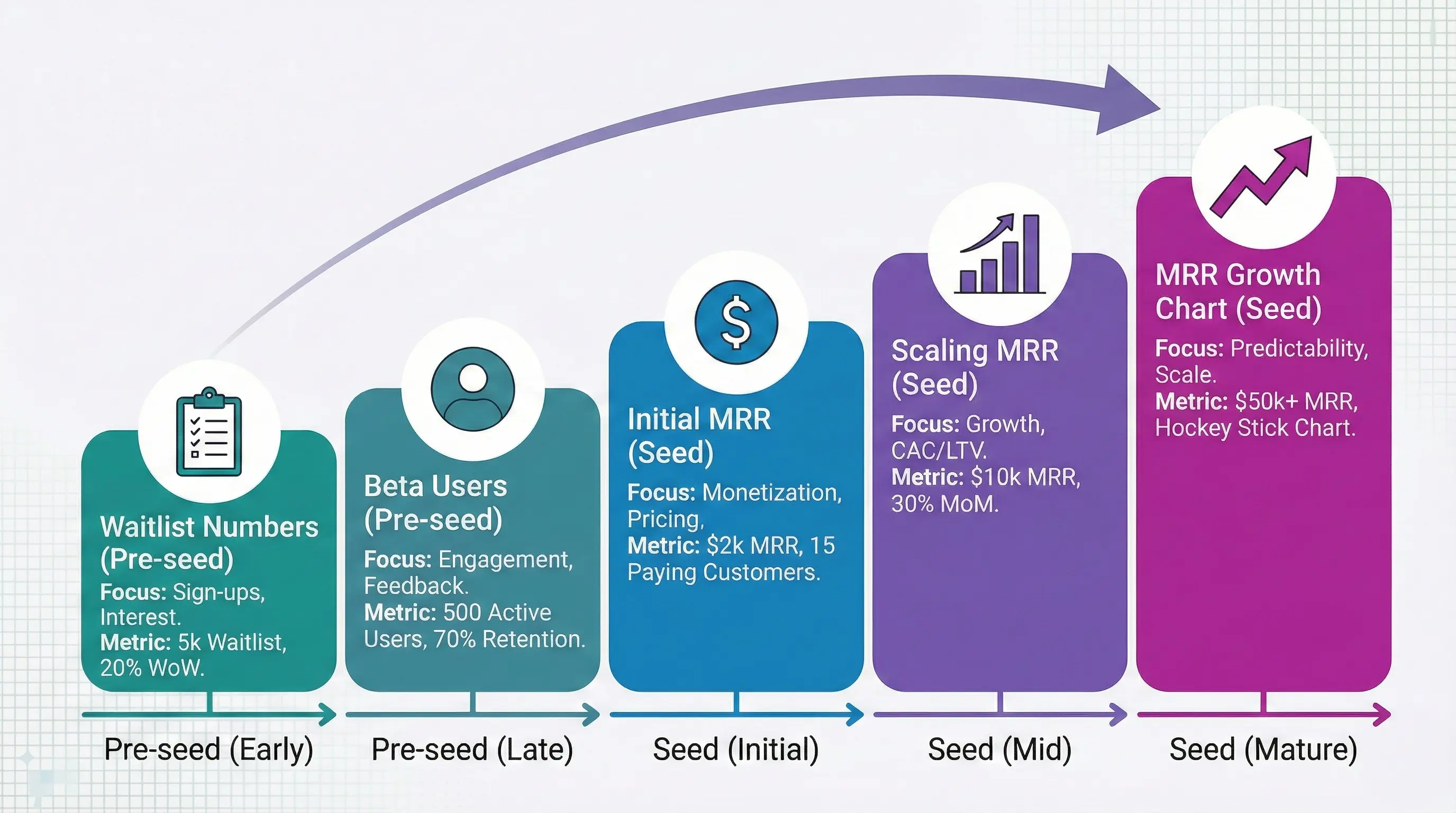
Traction hits differently. A pre-seed traction slide highlights a waitlist or pilot interest. A seed traction slide demands monthly recurring revenue (MRR) and retention data.
Design signals execution speed. A messy, confusing deck tells investors you will build a messy, confusing company. Clear design builds trust immediately.
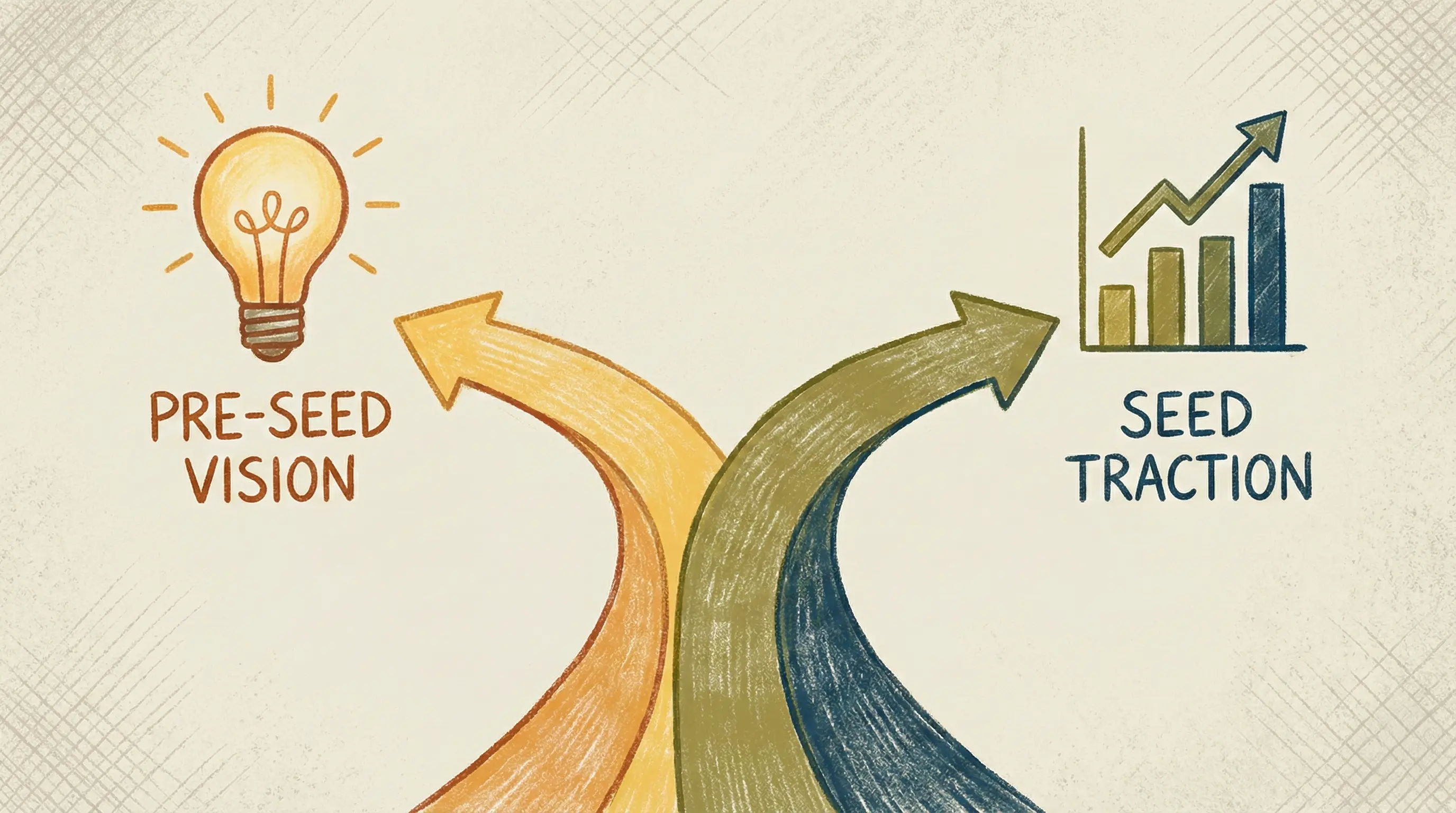
The Core Difference in a Seed vs Pre-Seed Pitch Deck: Selling the Dream vs. Proof
A pre-seed pitch deck focuses on selling your vision and founder capabilities to secure $250k to $1M in capital. In contrast, a seed pitch deck proves early product-market fit to raise $1M to $3M. Investors evaluating a seed vs pre-seed pitch deck look for distinct metrics: pre-seed requires a compelling problem statement and founder-market fit, while seed demands hard traction data like user retention and revenue.
When you are at the pre-seed stage, your company is an experiment. The product likely does not exist yet. You might have best pre-seed pitch deck templates to guide you, but you lack hard performance data. The investor is betting on your unique insight into the market. They are answering one question: Can this team build version one?
When you reach the seed stage, the experiment has yielded results. You have built an MVP. Users are interacting with it. You are generating revenue, or at least showing strong retention signals. The investor is now answering a different question: Can this business scale?
If you pitch a seed investor with a deck entirely focused on a theoretical problem, they will pass. They need to see the proof that your solution actually works in the real world.
Key Differences at a Glance: Seed vs Pre-Seed Pitch Deck
To understand exactly how these two funding stages differ, look at their core components.
Feature | Pre-Seed Pitch Deck | Seed Pitch Deck |
|---|---|---|
Primary Focus | Founder capabilities and market vision | Early traction and product-market fit |
Typical Raise | $250k to $1M | $1M to $3M+ |
Product Stage | Idea, prototype, or early MVP | Functioning product with active users |
Key Metric | Founder-market fit, pilot interest | MRR, user retention, growth rate |
The "Big Ask" | Capital to build the first product | Capital to scale go-to-market efforts |
Pro Tip: Never blur the lines between these rounds. If you say you are raising a seed round but have zero revenue and no product, you immediately lose credibility. Call it a pre-seed round and own your stage.
What Belongs in a Pre-Seed Pitch Deck?
At the pre-seed stage, you do not have a balance sheet to hide behind. The deck must inspire. It must convince an investor that a massive problem exists and that you are the exact right person to solve it.
The structure of a pre-seed deck typically spans 10 to 12 slides. It leans heavily on the narrative.
The Problem: Describe a painful, expensive issue affecting a specific group of people. Use concrete examples.
The Solution: Explain how your idea solves this problem faster, cheaper, or better.
The Market: Define the total addressable market (TAM), but focus sharply on your initial wedge. Who buys this first?
Why Now?: Explain the macroeconomic, cultural, or technological shift that makes your solution possible today. Why did this not exist three years ago?
The Team: Highlight your unfair advantages. Show why your specific background makes you the inevitable winner in this space.
Business Model: Detail how you plan to make money. Keep it simple.
3The Ask: State exactly how much capital you need and what specific milestones the money will unlock over the next 12 to 18 months.
Without hard data, the visual quality of your deck does heavy lifting. When your product is just an idea, design bridges the gap between concept and reality. A premium, high-contrast deck signals that you care about the details. If you need inspiration, look at KPI-Driven Design Blueprints to see how high-growth startups structure their visual narratives.
What Belongs in a Seed Pitch Deck?
A seed deck builds upon the foundation of the pre-seed narrative but aggressively shifts the spotlight toward execution. You are no longer selling a hypothesis. You are selling a nascent business.
While the fundamental slides (Problem, Solution, Team) remain, the seed deck introduces intense scrutiny on Traction, Go-To-Market, and Unit Economics.
Consider our work with Plexe AI. When they set out to raise their recent round, they already had an autonomous agent platform built for enterprises. Their challenge was not proving the concept; it was visualizing their complex text-to-model workflow to maintain momentum. We helped them translate that dense technical reality into a clear digital presence, supporting their successful $2.1M Seed funding round.
The seed deck requires proof elements:
Traction: Show month-over-month growth. Highlight active users, revenue, and engagement.
Customer Acquisition Cost (CAC): Prove you understand how much it costs to acquire a user.
Lifetime Value (LTV) Projections: Show the long-term potential of an acquired user.
Go-To-Market Strategy: Detail your exact distribution channels. "We will run Facebook ads" is not a strategy. "We have secured three partnerships with regional distributors" is a strategy.
[Source: Standard venture capital return expectations report showing early stage growth benchmarks.]
Slide-by-Slide: Evolving a Seed vs Pre-Seed Pitch Deck
To successfully transition from a pre-seed to a seed pitch deck, you must rewrite the core slides. You cannot simply update the font. The underlying substance must mature.
The Solution Slide
Pre-Seed: You rely on high-fidelity Figma mockups or a basic clickable prototype. The goal is to show the investor what the product will feel like.
Seed: You show the actual product in use. You include screenshots of the live interface. Better yet, you show the product solving a problem for a real customer.
The Traction Slide
Pre-Seed: Traction is a waitlist of 5,000 emails. Traction is three letters of intent (LOIs) from mid-market companies. Traction is a viral tweet.
Seed: Waitlists no longer count. A seed traction slide demands real usage metrics. Investors want to see a chart showing consistent revenue growth across the last six months. They want to see a flat or upward-trending retention curve.
The Go-To-Market (GTM) Slide
Pre-Seed: Your GTM slide outlines your hypotheses for acquiring users. It covers the channels you plan to test, such as content marketing or direct outbound sales.
Seed: You show what actually worked. You present the channel that is already driving users and explain exactly how the new capital will pour fuel on that specific fire.
The Financials Slide
Pre-Seed: You provide a rough runway calculation. You show how the $500k you are raising will last 18 months and cover engineering salaries.
Seed: You present a clear financial model. You show historical spend, projected revenue, and how unit economics will improve as you scale.
Common Mistakes When Building a Seed vs Pre-Seed Pitch Deck
Founders constantly sabotage their fundraising efforts with unforced errors. Whether you are building a seed vs pre-seed pitch deck, avoid these traps.
Mistake 1: Ignoring the 30-Second Rule Investors skim decks. They do not read them. If an investor cannot understand your core value proposition within 30 seconds of opening the PDF, they will close it. Keep your slides clean. Write strong headlines for every slide that tell the story even if the reader ignores the bullet points.
Mistake 2: The "No Competition" Fallacy Founders love to claim they have no competitors. This immediately flags you as naive. If a problem is worth solving, someone else is trying to solve it. Alternatively, your biggest competitor is the status quo (e.g., people using Excel instead of your software). Map the competitive field honestly.
Mistake 3: Terrible Visual Design A pitch deck is an exercise in communication. If your slides are cluttered with bad alignments, clashing colors, and tiny text, you are communicating chaos. When you are raising millions of dollars, the aesthetic presentation of your vision matters. If your deck looks cheap, investors will value your company cheaply.
Look at how BeSimple AI approached their branding. They needed to communicate the massive scale of their audio data repository. We built them a clean, high-conversion digital experience that translated complex backend capabilities into a premium brand, supporting their $3M Seed funding round. Good design acts as a multiplier for good data.
Mistake 4: Burying the Ask Founders often get to the end of their presentation and vaguely mention they are looking for money. Be painfully explicit. State exactly how much you are raising, what vehicle you are using (SAFE vs. priced round), and what the funds will achieve.
Stop Wrestling With Slides. Go Build Your Company.
Your runway is your most precious asset. Every hour you spend fighting with text boxes in Google Slides is an hour you are not talking to customers, shipping code, or refining your unit economics.
Designing a compelling, high-converting pitch deck requires a specific skill set. It requires the ability to distill complex business logic into striking visual narratives. When you are trying to close a critical funding round, "good enough" design is a liability.
You need senior design talent that understands the startup ecosystem. Zyner provides an unlimited design subscription service built specifically for founders.
For a flat monthly rate, you get a dedicated project manager and senior designers who handle your pitch decks, branding, and full Framer website builds. You pause or cancel anytime. Stop burning time on slide layouts. Let Zyner design the deck that gets the "yes", so you can get back to building the business. See more insights on our blog.
Frequently Asked Questions (FAQs)
What is the difference between pre-seed and seed stage?
The pre-seed stage is focused on idea validation and building the initial product prototype, usually funded by friends, family, and early angels. The seed stage occurs when a startup has early product-market fit, a functioning product, and initial revenue or strong user retention, typically funded by early-stage venture capital firms.
Am I raising seed or pre-seed?
If you do not have a live product or paying customers, you are raising a pre-seed round. If you have active users, consistent revenue growth, and are looking for capital to scale your initial distribution channels, you are ready to raise a seed round.
How much is a pre-seed round?
When comparing a seed vs pre-seed pitch deck, the capital needed dictates the structure. A typical pre-seed round in 2026 ranges from $250k to $1M. The exact amount depends heavily on your industry, your geographic location, and the founder's previous track record. This capital is designed to give you 12 to 18 months of runway to build the MVP.
What should be in a pre-seed pitch deck?
A pre-seed pitch deck should include 10 to 12 slides focused on the vision and team. Essential slides include the Problem, the Solution, the Target Market, the Business Model, the Team's unfair advantages, and the specific Ask for capital. It relies heavily on narrative rather than historical data.
How many slides should a seed deck be?
When comparing a seed vs pre-seed pitch deck, the seed deck should be concise, typically ranging between 12 and 15 slides. It must include all the core narrative slides from a pre-seed deck, but must also add solid data slides covering Traction, Go-To-Market execution, Customer Acquisition Cost, and a clear Financial Model.