Feb 24, 2026
You have spent weeks perfecting your product. You have poured your soul into building a minimum viable solution that genuinely shifts the needle for early adopters. You finally secure a meeting with a seed fund, send over your deck, and—crickets. The brutal reality of raising at the earliest stages is that most pitch decks fail to get past the second slide. Not because the business is flawed, but because the founder is thinking in presentation slides instead of economic inevitability.
Investors at the pre-seed stage are not funding past performance; they are funding a carefully constructed narrative about future velocity. When that narrative is buried under walls of text, lazy market sizing, or a complete lack of visual clarity, they stop reading. They have 100 other decks in their inbox. Cognitive friction is the fastest route to a rejection.
This guide breaks down exactly why pre-seed pitch decks fail, how to stress-test your own narrative, and why the right design structure is actually a business advantage.
Quick Takeaways:
The Narrative Gap: Decks fail when they list features instead of solving an extremely urgent, specific problem.
The Backward Test: Start reading your deck from the "Ask" slide backward. If the financials, team, and go-to-market do not mathematically force that number, the ask is fiction.
Cognitive Overload is a Default No: Crammed slides force investors to squint and process too much data at once. If your core message is not instantly scannable, the deck fails.
Design is Strategy: Clean, professional pitch deck design lowers cognitive load and signals founder competence.
Traction vs. Admin: Registering an LLC is administration, not traction. Investors want to see proof of customer hunger.
7 Reasons Pre-Seed Pitch Decks Get Rejected
Most pre-seed pitch decks fail because they lack clarity, fail to demonstrate genuine customer demand, and are overcrowded with information. At this early stage, investors are betting on the team and the narrative. If you cannot communicate those clearly, the rest of the deck does not matter.
Here are the primary reasons pre-seed pitch decks fail:
Lack of Clarity and Too Much Information: Decks are often packed with too much text, making them hard to read and failing to explain the product clearly within seconds. They try to explain too many problems and too many solutions.
Missing or Weak Customer Traction: Pre-seed founders often fail to show they have researched or validated their idea, presenting "traction" that is actually just administrative (like trademarking a name).
Unrealistic Market Sizing (TAM): Founders regularly rely on "top-down" math to justify a massive Total Addressable Market without defining a realistic, actionable Serviceable Obtainable Market (SOM).
Missing the Core "Pain": Decks frequently fail to clearly articulate the deep, urgent problem being solved. They cannot convince investors that customers cannot live without the solution.
Poor Go-to-Market (GTM) Strategy: A weak or generic GTM strategy ("we will use SEO and partnerships"), rather than a tactical, founder-led plan to reach customers, signals a team that does not know how to sell.
"Pitching in PowerPoint" vs. Narrative: Founders often focus on explaining product features instead of telling a cohesive, compelling story about market shifts and inevitability.
Too Much Technical Detail: Spending too much time in the weeds of the technology—rather than the business impact and the unit economics—loses investor interest fast.
Let's break down how to avoid these common traps.
The Cognitive Overload Problem: Why Design Actually Matters
There is a misconception among early-stage founders that because they are at the "pre-seed" stage, their deck does not need to look good. The logic goes: We are too early for polish. The idea should speak for itself.
This is fundamentally wrong. Design is not about adding polish; it is about reducing friction.
An investor reviewing your deck is tired. They have reviewed a dozen others that day. [IMAGE: A split screen showing a cluttered, text-heavy slide on the left, and a clean, perfectly structured Zyner slide on the right]. When a slide has three different font sizes, unaligned text boxes, and a paragraph explaining what a simple chart could show in five seconds, you force the investor's brain to work harder just to consume the information.
If they have to work hard to understand what you do, they will not do the work to figure out why it matters.
Pro Tip: Never use more than 15-20 words per slide if you are presenting live. Even if you are sending the deck ahead of time as a read-through, enforce ruthless editing. Use bolding to guide the eye to the key metric.
This is why top-tier YC-backed companies treat their presentation design as core infrastructure, not an afterthought. They do not spend founder hours tweaking Figma files; they leverage dedicated UI/UX design services or unlimited design subscriptions to ensure the visual narrative is flawless.
The Ultimate Stress Test: Running Your Deck Backwards
Most founders write their pitch decks linearly. They start with the problem, move to the solution, show the market size, introduce the team, and end with the financial ask. Because you build the story forward, it is easy to trick yourself into thinking the logic flows perfectly.
You need a better stress test. Try analyzing your pitch deck backward.
The Backward Pitch Test starts at the end of the presentation and works in reverse to expose economic inconsistencies and wishful thinking with brutal efficiency.
Here is how the backward test breaks down a failing narrative:
Step 1: Examine the Ask (Slide 10)
Start at your final slide. If you are asking for $1.5M, ask yourself: Are the financial projections mathematically forcing this exact number, or is it just the culturally standard pre-seed amount right now?
If your hiring plan, burn rate, and growth targets only require $600k to reach the next milestone, your ask is a lie. Investors notice this instantly. The mismatch registers as opportunism or inexperience.
Step 2: Interrogate the Projections (Slide 9)
Look at your financial projections that sit right before the ask. Do they actually justify the capital required?
Financial projections fail when they are arithmetic instead of causal. A revenue curve that goes up and to the right is decorative, not predictive, if it does not explain what is driving the growth. If the projections do not clearly show how the $1.5M converts into customer acquisition and retention, the ask above it collapses.
Step 3: Check the Team (Slide 8)
Now, look at the team. If the financial projections assume 12-month enterprise sales cycles navigating complex healthcare compliance, does the team actually have enterprise healthcare sales experience?
Saying "Former Google Engineer" does not mitigate enterprise execution risk. The team slide must prove that this specific group of people is uniquely capable of executing the exact financial outcomes claimed in the previous slide. If they cannot, the deck fails here.
Step 4: Validate the Competition & GTM (Slides 7 & 6)
If your Go-to-Market strategy assumes rapid, low-friction adoption and cheap customer acquisition, but your competition slide claims you have "no direct competitors," the logic breaks.
Markets with no competition are usually markets with no urgency. Startups do not fail because they cannot build the product; they fail because they cannot reach the customer efficiently. Listing "content marketing" and "strategic partnerships" is not a GTM strategy—those are tactics.
Pro Tip: A real GTM strategy is specific. "We are manually onboarding our first 100 users by scraping LinkedIn for VP of Sales titles at series A SaaS companies and running highly targeted cold email sequences offering a free audit."
If you run your deck backward and the story breaks, do not blame the market. Fix the narrative.
Stop Pitching in PowerPoint, Start Pitching a Narrative
A pitch deck is a tool for telling a story about economic inevitability. It is not a place to list features.
When pre-seed founders get obsessed with the product they have built, they spend five slides explaining the intricacies of their "underlying magic" (their technical moat). The reality is that early-stage investors will compress your margin assumptions to zero if that magic does not directly solve a bleeding-neck problem for the customer.
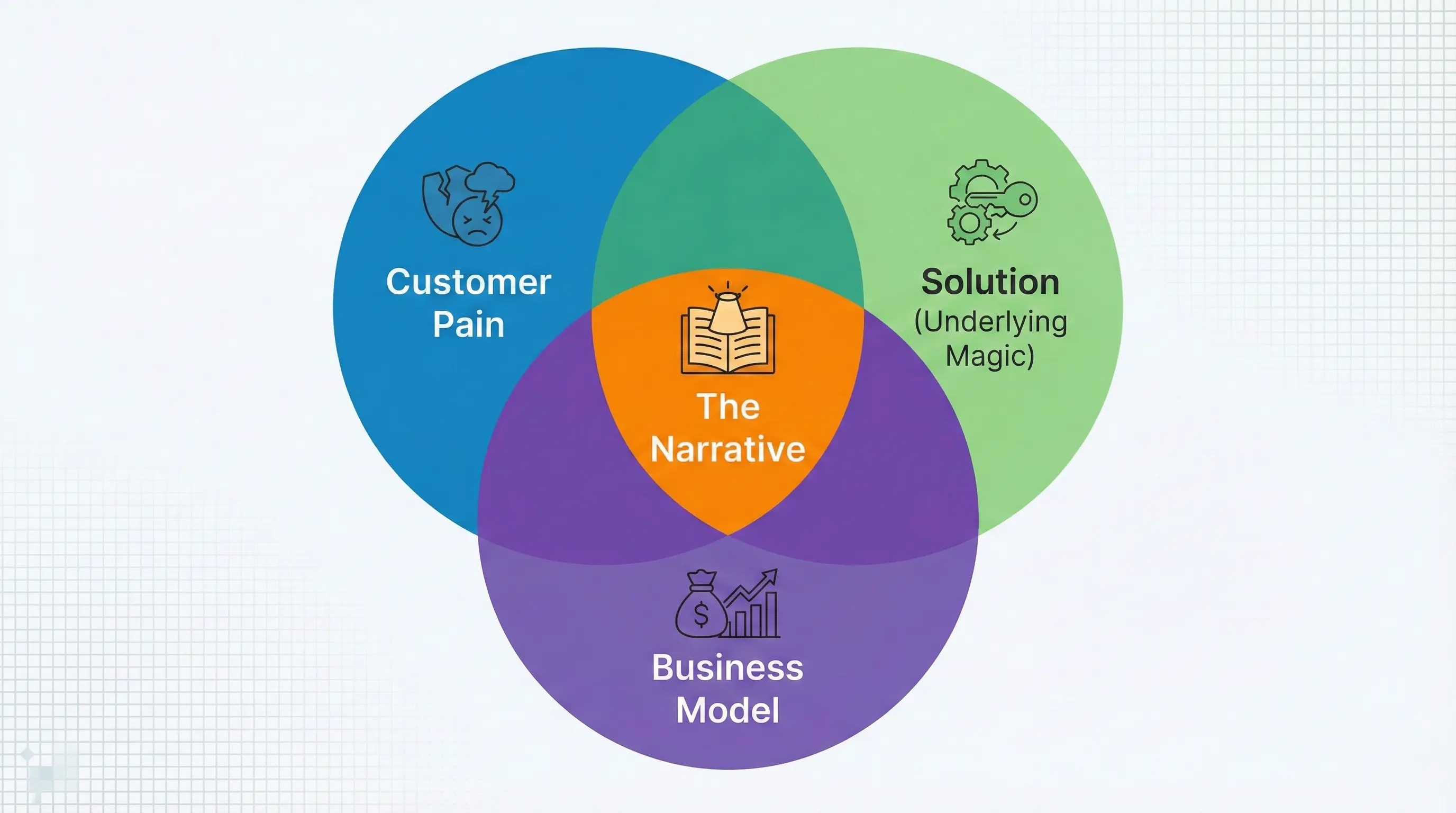
A strong narrative connects these items seamlessly:
The Problem is so severe that it is costing the customer time, money, or reputation today.
The Solution resolves that exact problem. It is not an "everything app." It does one thing exceptionally well.
The Business Model proves that the solution is valuable enough that customers will pay for it efficiently.
If your value proposition promises massive impact, but your business model prices the product like a nice-to-have, low-tier SaaS tool, the economics do not clear. You are telling an inconsistent story.
Need to see what a highly targeted, successful startup narrative looks like? Reviewing successful YC Application Accepted Applications is one of the best ways to train your brain to write concisely about value rather than features.
The Go-to-Market Trap: Why Founders Get It Wrong
The Go-to-Market (GTM) slide is the most common point of failure in a pre-seed deck. Specifically, it fails because founders confuse distribution channels with a repeatable systemic advantage.
At the pre-seed stage, investors know you do not have a massive marketing budget. They want to see founder-led sales. They want to know you are willing to do things that do not scale to get the first 50 paying customers in the door.
Failing GTM Slide Examples:
"We will run Facebook ads to our target demographic."
"We will lean heavily into SEO and start a blog to drive inbound traffic."
"We are building an affiliate program and hoping the product goes viral."
Winning pre-seed GTM Slide Examples:
"I have a waitlist of 400 IT managers from my previous enterprise role who have verbally committed to beta testing."
"We scraped a database of 5,000 specific clinic owners and are running customized cold outreach, returning a 7% meeting booked rate."
You must prove that you understand your Brand Strategy well enough to know exactly who your early adopters are and exactly how you will physically put the product in their hands.
Real Traction vs. Fake Traction
Traction is the ultimate de-risker for early-stage investors. But pre-seed founders often misunderstand what constitutes actual traction.
Registering a domain name, setting up an LLC, trademarking a logo, or spending three months refining a wireframe is not traction. It is administration.
What Investors Count as Real Pre-Seed Traction:
Metric | Value Level | Why It Matters |
Live Revenue (MRR) | Extreme | Proves someone is willing to swipe a credit card for the solution today. |
Signed LOIs (B2B) | High | Letters of Intent prove enterprise demand and willingness to pilot. |
Active Usage (DAU/MAU) | High | Proves the product is sticky and solves a genuine daily problem. |
Beta Waitlist | Medium | Proves the messaging resonates, but does not prove willingness to pay. |
Customer Interviews | Low/Baseline | Proves the founder has actually spoken to users, establishing problem validation. |
If you have zero traction, you must overcompensate with an incredibly strong team, a unique insight into the market, and a flawless narrative.
How to Fix Your Deck Fast Without Wasting Runway
If you have realized your deck is failing the backward test, is visually overwhelming, or is lacking a tight narrative, you have a distinct operational problem.
You are a founder. Your time should be spent talking to users and shipping code. You should not be spending three weeks fighting with Figma gradients, hunting for icons, or trying to make your data tables look clean.
But you also cannot afford the 4-8 week onboarding timeline and massive upfront retainers of a traditional design agency.
This is where a dedicated, flat-rate design subscription changes the leverage equation for early-stage startups.
The Superior Approach to Pitch Deck Production
Instead of hiring slow, out-of-touch freelancers or trying to manage junior designers, modern startups use Zyner's Unlimited Design Subscription.
Founders pay a flat monthly fee and get access to a dedicated team of senior designers and a project manager. You get unlimited design requests and revisions. This covers critical pre-seed founder needs:
Re-formatting and redesigning the narrative flow of the pitch deck for maximum investor scannability.
Designing high-conversion landing pages in Framer.
Building out polished product UI screens for the deck to prove technical competence.
Establishing an initial brand identity that looks Series A ready from day one.
The real advantage? Speed. Zyner onboards startups in 24-48 hours. By removing the design bottleneck, founders typically execute go-to-market iterations 2-4x faster than their competitors. You drop a slack message, and the design problems get solved, allowing you to get back to building the business.
When your deck looks better, reads clearer, and removes cognitive friction for the investor, your odds of securing that next meeting skyrocket.
Conclusion: Stop Pitching Features
A failing pitch deck is rarely the result of a bad startup idea. It is almost always the result of a bad presentation strategy.
If you are currently failing to secure second meetings, run the Backward Pitch Test today. Brutally audit your ask, your financials, and your team structure. Are they aligned? Are your slides clear, or are they causing cognitive overload? Stop pitching features in PowerPoint, and start pitching a cohesive narrative of economic inevitability.
The investors are waiting for a clear signal in the noise. Make sure your deck is the one they can actually read.
Looking to fix your deck's visual friction without wasting three weeks of founder runway? Explore Zyner's Unlimited Design Subscription today.
FAQs: Pitching Investors at Pre-Seed
What is the most common reason pitch decks fail?
The most common reason pitch decks fail is a lack of clarity and narrative focus. They overwhelm investors with dense text and technical features instead of clearly articulating a severe customer pain point, the specific solution, and a realistic go-to-market strategy.
How do you test a startup pitch deck?
You test a startup pitch deck by running it backwards. Start at the final "Ask" slide, and trace the logic backward through the financials, the team, and the go-to-market strategy to verify that every preceding slide mathematically and logically justifies the final funding amount.
What do investors look for in a pre-seed deck?
Pre-seed investors look for three core signals: an exceptionally strong, capable founding team; a massive, clearly defined market opportunity with real urgency; and evidence of founder-led traction or deep customer insight. They want to see velocity and clear communication.
How many slides should a pitch deck have?
A pre-seed pitch deck should typically have between 10 to 15 slides. Keeping the deck concise forces the founder to prioritize the narrative and avoid over-explaining features, which reduces cognitive load for the investor.
Why do investors reject startups?
Investors reject startups primarily due to a weak founding team, a flawed or unrealistic business model, small market potential, lack of focus, or an inability to clearly communicate the value proposition, which registers as a lack of execution capability.