
Robert Sansom helped build one of the UK's most active angel networks. Then he took a board seat at a Cambridge startup called Ubisense. That move, from angel investor to active board director, is exactly what early-stage founders miss when they think about raising from angel networks. It's not just money. It's the whole picture.
The Ubisense cambridge angel investor story is one of the clearest examples of how early-stage UK funding is supposed to work: the right network, the right structure, and investors who actually show up after the wire clears. If you're a pre-seed founder trying to figure out who to approach, how UK angel networks operate, and what makes Cambridge such a productive funding environment, this piece breaks it all down.
Quick Takeaways
Cambridge Capital Group made its first investment in Ubisense in March 2006, making it one of the earliest institutional angel backers of the company
Robert Sansom, a founder of Cambridge Angels, joined Ubisense as a board director in 2006, representing the hands-on model that UK angel investors are known for
Ten Sails provided Ubisense with seed funding plus active business development support, not just capital
Cambridge Angels is a network of 60+ high-net-worth investors focused on tech companies in the Cambridge cluster
Ubisense listed on AIM, then was acquired by Investcorp in 2018, delivering profitable exits to early angel investors including Cambridge Capital Group members
For pre-seed founders, the lesson is clear: target networks where investors take board seats, add operational value, and stay involved beyond the initial cheque
What Is Ubisense? A Quick Background
Ubisense is a Cambridge-based enterprise software and sensor platform specialising in real-time location data. The company uses ultra-wideband (UWB) technology to track the precise position of physical objects, tools, vehicles, and people inside complex industrial environments: manufacturing plants, aerospace assembly lines, and commercial vehicle facilities.
Founded in Cambridge, UK, the company built its early reputation on delivering something specific and measurable: the ability to see exactly where things are, in real time, inside facilities where that visibility translates directly into productivity and safety gains. Its customers have included major aerospace and automotive manufacturers who needed to manage high-variability production processes.
As of 2026, Ubisense operates as a private company. Investcorp acquired it in 2018, and the business is now 100% funded by private equity. Before that acquisition, however, Ubisense had a funding journey that took it from early angel backing in Cambridge all the way through an AIM listing and a post-IPO equity round in 2017.
That journey started with the people and networks described in this article.
Who Are the Cambridge Angels?
Cambridge Angels is a network of high-net-worth investors who focus on early-stage technology companies based in or near Cambridge, UK. The network has over 60 members, drawn from entrepreneurs, academics, and senior business professionals with deep roots in the Cambridge technology ecosystem.
The group is one of the UK's most active and well-connected angel communities. Members back companies at the seed and pre-seed stages, typically in sectors where Cambridge has genuine research and commercial strength: engineering, materials, medtech, biotech, AI, machine learning, robotics, and B2B digital services. Investments are often made as syndicates, meaning multiple angels co-invest in a single deal.
Cambridge Angels is closely associated with the broader Cambridge Capital Group network, but the two are distinct entities. Cambridge Capital Group is an angel network that has operated for 25 years, invested more than £50 million across 100+ startups, and has a formal application process for founders seeking investment. Cambridge Angels, meanwhile, refers more specifically to the investor community built around Cambridge's technology cluster, including notable figures like Robert Sansom, who founded the Angels group and maintained active board-level involvement in portfolio companies including Ubisense.
[IMAGE: Cambridge Science Park aerial view showing the density of the UK tech cluster]
How Ubisense Got Its Early Funding
The Ubisense funding story is worth knowing in detail because it shows how layered early-stage angel investment actually is. It wasn't a single cheque from a single source. It was a combination of a formal angel network, a seed-stage vehicle with operational expertise, and hands-on investor involvement that continued long after the initial round.
Cambridge Capital Group made its first investment in Ubisense in March 2006. That placed CCG among the earliest institutional backers of the company and aligned with the group's typical thesis: back deep tech companies in the Cambridge cluster at the seed and early growth stages, then support them through to exit.
At roughly the same time, Ten Sails provided seed funding to Ubisense. Ten Sails wasn't a passive capital provider. The firm brought active business development support alongside its investment, with Richard Myint playing a direct role in the company's early-stage development. This dual-track approach (money plus operational help) is a model that pre-seed founders should actively seek out. Capital alone rarely moves a company forward as fast as capital combined with someone who has done this before and will roll up their sleeves.
Robert Sansom's Role at Ubisense
Robert Sansom, a founder of the Cambridge Angels network, joined Ubisense as a board director in 2006. His involvement wasn't symbolic. Taking a board seat means attending meetings, shaping strategy, weighing in on hiring decisions, and being accountable for outcomes alongside the founding team.
Sansom's presence at Ubisense is the clearest illustration of what distinguishes an active angel investor from a passive one. Active angels, especially those embedded in networks like Cambridge Angels, bring a combination of their own experience, their connections across the Cambridge ecosystem, and their credibility with future investors. When a founder's next funding round shows a serious operator in the board seat, it changes the signal the company sends to the market.
[IMAGE: Cambridge Angels network event or angel investment meeting setting]
What Ten Sails Brought Beyond Capital
Ten Sails' contribution to Ubisense highlights something founders consistently undervalue at the pre-seed stage: business development support. Richard Myint's involvement in Ubisense's early development wasn't about running operations; it was about helping the company figure out how to go to market, where to focus, and how to build early commercial traction.
This matters because most pre-seed startups don't fail due to bad technology. They fail because they don't know how to sell, position, or prioritise. An investor who can help with those problems is worth more than a passive investor writing a larger cheque. If you're approaching angel networks, ask specifically about what operational support looks like post-investment. It's one of the highest-value questions you can ask. You can read more about how the active vs passive angel investor distinction plays out in practice before you start approaching networks.
What Cambridge Angels Actually Look For
Cambridge Capital Group's portfolio tells a clear story about where the group focuses. The sectors that show up repeatedly (engineering, materials, medtech, biotech, AI/ML/robotics, B2B digital services) are not accidental. They reflect what the Cambridge cluster is genuinely strong at: research-led, technically defensible businesses with clear commercial applications.
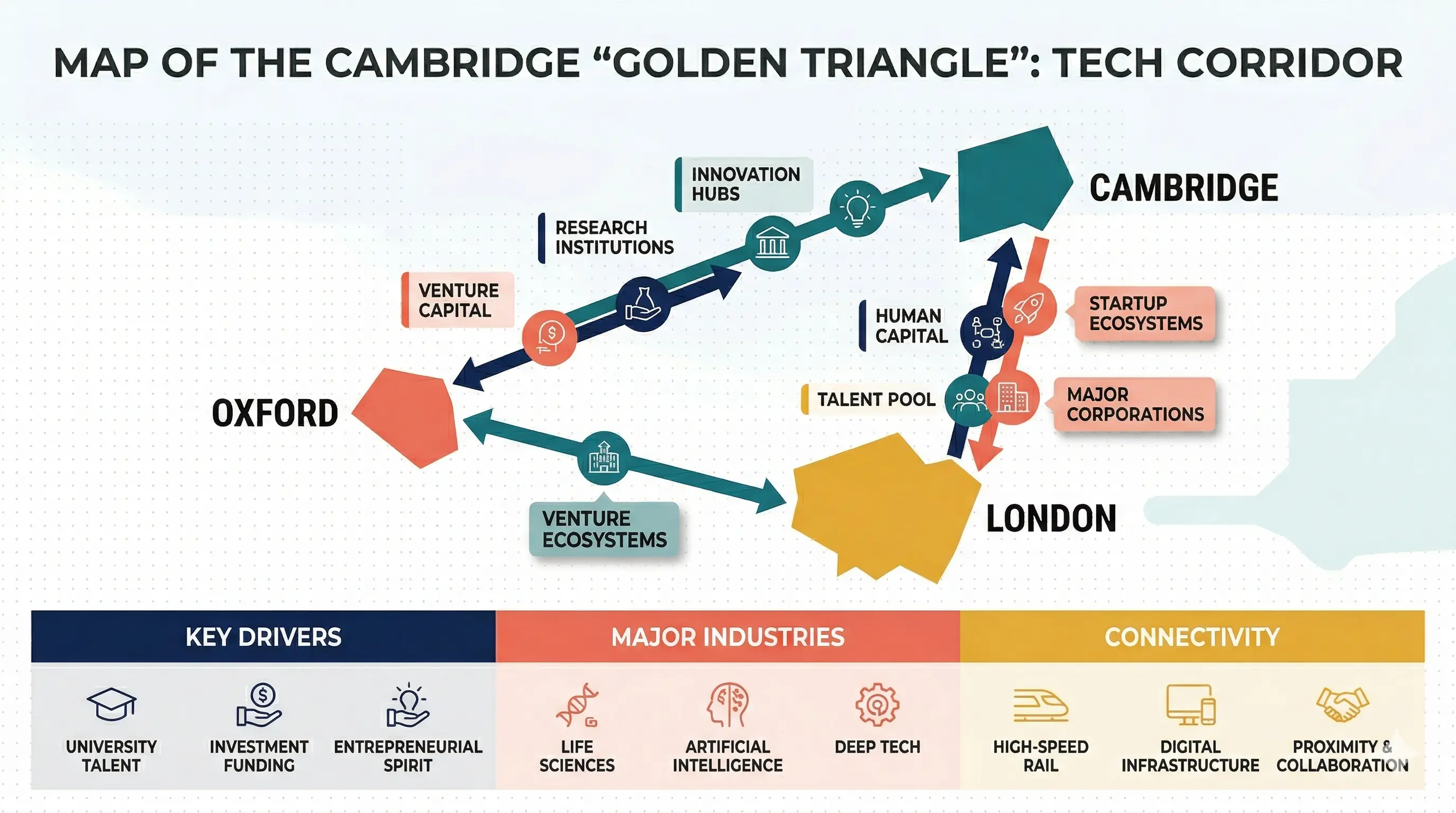
CCG operates across what it calls the "Golden Triangle": the Cambridge-London-Oxford corridor. This matters for founders who are based outside Cambridge but want to access the network. The group's investor base includes members from London, the Channel Islands, and other parts of England, but the deal flow they prefer is grounded in the technology ecosystems of this triangle.
In terms of stage, CCG focuses on seed, startup, and early growth opportunities. They are not writing Series A or Series B cheques. They are the investors who back founders when the company is still mostly a hypothesis: when the team has a clear idea, a technical foundation, and needs capital and credibility to start proving it commercially.
Pro Tip: The Golden Triangle (Cambridge-London-Oxford) isn't just geography. It's a signal. If your startup is based inside it, you can mention that specifically when approaching CCG or similar UK angel groups. Location credibility is real when it comes to cluster-based investors.
You can dig deeper into industries angel investors focus on to see how your sector maps to active UK and global angel communities.
Ubisense's Later Funding and Exit
Understanding the full arc of Ubisense's funding history is useful for founders thinking about long-term capital strategy.
After the early angel rounds, Ubisense raised additional funding and eventually listed on AIM (the London Stock Exchange's market for growing companies). The AIM listing gave early investors, including Cambridge Capital Group members, a liquidity event. CCG noted in their 2024 company update that Ubisense "listed on AIM and provided a good exit for members."
Following the listing, Ubisense completed a post-IPO equity round in 2017. Then, in 2018, Investcorp acquired the company. As of 2026, Ubisense is a current Investcorp portfolio company, now 100% privately held under private equity ownership.
The transition from angel-backed Cambridge startup to AIM-listed company to PE-owned enterprise is a full funding lifecycle. For pre-seed founders, the early chapters of that story are the relevant ones: the angel network investment, the active board director, the seed operational support, and the eventual path to a credible exit for investors who took a chance at the very beginning.
What Pre-Seed Founders Can Take from the Ubisense Story
The Ubisense funding journey isn't just a historical case study. It contains real tactical lessons for any pre-seed founder approaching UK angel investors in 2026.
1. Target networks with operational depth, not just capital pools. Cambridge Capital Group and Ten Sails weren't passive cheque writers. They brought industry knowledge, commercial connections, and board-level oversight. Founders who treat angel investors as ATMs leave most of the value on the table.
2. A board seat is a signal, not a burden. When Robert Sansom took a board seat at Ubisense, it sent a message to every subsequent investor: this company has serious oversight. If an experienced operator is willing to stake their reputation on it, that's worth more than most marketing claims.
3. Seek investors who offer business development support alongside funding. Ten Sails brought Richard Myint in to help Ubisense think through commercial traction. If you're raising at pre-seed and your biggest challenge is go-to-market rather than product, look for this explicitly.
4. Cambridge cluster credibility is transferable. Being embedded in a recognised technology cluster, and getting backing from a network associated with that cluster, opens doors with investors who are unfamiliar with your company but trust the ecosystem it comes from.
5. Your pitch deck is the first filter. Before Robert Sansom took a board seat, before Ten Sails wrote a cheque, someone at Ubisense put together a compelling pitch that made investors want to engage. Nothing else in the process happens without that. Make sure your pre-seed pitch deck slides are doing the job they need to do.
How to Approach Cambridge Angels as a Pre-Seed Founder
If the Ubisense story has you thinking about Cambridge-based angel investment, here's how to actually move forward.
Cambridge Capital Group has a formal application process. You can apply directly via their website at cambridgecapitalgroup.co.uk. They invest in early-stage technology companies based in the Golden Triangle. If your startup fits the sector profile (engineering, AI, medtech, B2B SaaS, deep tech) and you're in or near Cambridge, London, or Oxford, you're in the right geography.
Know the difference between warm and cold outreach. CCG's network is built on relationships. A cold application to the website can work, but a warm introduction from a founder they've already backed, a university connection, or a Cambridge ecosystem partner (accelerators, law firms, advisors) moves significantly faster. Spend time mapping your network before you email.
Use LinkedIn strategically. Cambridge Angels members are often publicly identifiable via LinkedIn. You can research who has invested in companies similar to yours, who has previously backed companies in your sector, and whose background suggests they'd understand your market. A well-constructed connection request with clear context outperforms a cold email to a general inbox. The full process for using LinkedIn to find angel investors is worth going through before you start.
Start with directories to build your target list. Before approaching any specific network, build a comprehensive list of UK angel investors and groups relevant to your sector. The best angel investor directories for startups are a good starting point for this research. Cambridge Capital Group should be on your shortlist alongside other UK networks active in your vertical.
Know what you're choosing between. Angel networks and accelerators solve different problems. Cambridge Angels gives you capital, credibility, and investor relationships. An accelerator gives you a programme, cohort, and sometimes a smaller cheque. For some founders, the right answer is both, in the right sequence. The breakdown in angels vs accelerators at pre-seed will help you decide which path fits your situation.
Pro Tip: Your pitch deck is doing the first impression before you even get on a call. Cambridge Capital Group holds quarterly pitch events where founders present directly to the investor group. If your deck is unclear, your story won't survive the room. Treat the materials as seriously as the meeting.
Conclusion
Ubisense didn't get funded because it had the best technology in the UK. It got funded because it found the right investors in the right network at the right moment: people who understood the Cambridge cluster, who were willing to take board seats and stay involved, and who brought more than capital to the table.
That's the standard you should be holding your investor search to. Not "who will give me money" but "who will give me money and actually help me build." The Cambridge Angels ecosystem, and Cambridge Capital Group specifically, represents one of the UK's strongest examples of that model in action.
The angel investors who backed Ubisense in 2006 saw a good exit when the company listed on AIM. That outcome didn't happen by accident. It happened because the early capital structure was built right, the board was engaged, and the company had investors who cared whether it succeeded.
Find that kind of investor. Build that kind of relationship. The rest of the raise gets easier from there.
Frequently Asked Questions
Who are the Cambridge Angels?
Cambridge Angels is a network of 60+ high-net-worth investors based in and around Cambridge, UK. The group focuses on early-stage technology companies in sectors including engineering, AI, medtech, biotech, and B2B digital services. Members co-invest in syndicates and often take active roles in portfolio companies, including board directorships. Robert Sansom, one of the group's founders, exemplified this model through his board seat at Ubisense.
How did Ubisense raise its first funding?
Ubisense received early funding from Cambridge Capital Group, which made its first investment in the company in March 2006. Ten Sails also provided seed capital and active business development support, with Richard Myint contributing to the company's early commercial development. Robert Sansom of Cambridge Angels joined as a board director in 2006. These early rounds gave Ubisense both capital and the operational guidance it needed to scale.
What does Cambridge Capital Group invest in?
Cambridge Capital Group invests in seed, startup, and early growth-stage technology companies based in the UK's Golden Triangle (Cambridge, London, and Oxford). The group focuses on deep tech sectors where the Cambridge cluster has genuine strength: engineering, materials science, medtech, biotech, AI and machine learning, robotics, and B2B digital services. As of 2025, CCG has invested more than £50 million across more than 100 startups.
Is Cambridge Angels the same as Cambridge Capital Group?
They are related but distinct. Cambridge Capital Group is a formal angel investment network with a structured application process, 80+ investor members, and a 25-year track record of investing in the Cambridge tech cluster. Cambridge Angels refers more broadly to the investor community built around Cambridge's technology ecosystem, including prominent individuals like Robert Sansom who are active across multiple networks and portfolio companies. Some members participate in both.
What should a founder prepare before approaching UK angel investors?
Before approaching any UK angel network, have three things ready: a clear, well-designed pitch deck that tells your story in under 15 slides; a short investor memo or one-pager covering market size, your solution, traction so far, and how you'll use the capital; and a target list of investors who have actually backed companies in your sector. Warm introductions matter more than cold outreach in networks like Cambridge Capital Group. You can find more about where to find angel investors to build your initial list.