
Growth Manager

Most founders spend weeks hunting for investors before they send a single email. They patch together names from Twitter, scrape LinkedIn, and eventually hit a Crunchbase paywall that wants $2,400 a year just to show contact details. There's a better way.
A good database of angel investors puts thousands of filtered, contactable investors in front of you in hours, not weeks. The problem is that not all databases are built the same. Some are free but shallow. Some have massive investor counts but outdated emails. Some are platforms where investors actively want to hear from you; others are lists you're cold-blasting with a 1% reply rate.
This guide breaks down the best options available in 2026 so you can pick the right one for your stage and get your fundraise moving.
Quick Takeaways
Angel Match and Angels Partners are the strongest paid options for serious fundraising, with 110,000+ and 120,000+ investors respectively.
OpenVC is the best free option if you want investors who actually accept cold inbound.
Ramp offers a completely free downloadable investor list, good for a quick start.
Crunchbase is powerful for research but costs $2,400/year and is overkill for most early-stage founders.
Warm introductions consistently outperform cold outreach. Use databases to identify targets, then find connection paths wherever possible.
Match your platform choice to your stage: free tools for testing, paid tools for scaling.
Every database has stale data. Always verify contact details before sending.
What Is a Database of Angel Investors?
A database of Angel Investors is a searchable, filterable collection of individual investors and investment firms, including their contact details, investment focus, geographic preferences, stage preferences, and past deals. Founders use these databases to build a targeted list of investors to pitch during a fundraising round.
The best databases go beyond a static spreadsheet. They include CRM features, email outreach tools, and filters that let you narrow down 100,000+ investors to the 50 or 100 who actually invest in your sector, stage, and geography. As of March 2026, several strong options exist across a wide price range, including a few solid free ones.
The Best Databases of Angel Investors in 2026
Here are the platforms worth your time, ranked by overall usefulness for startup founders.
1. Angel Match
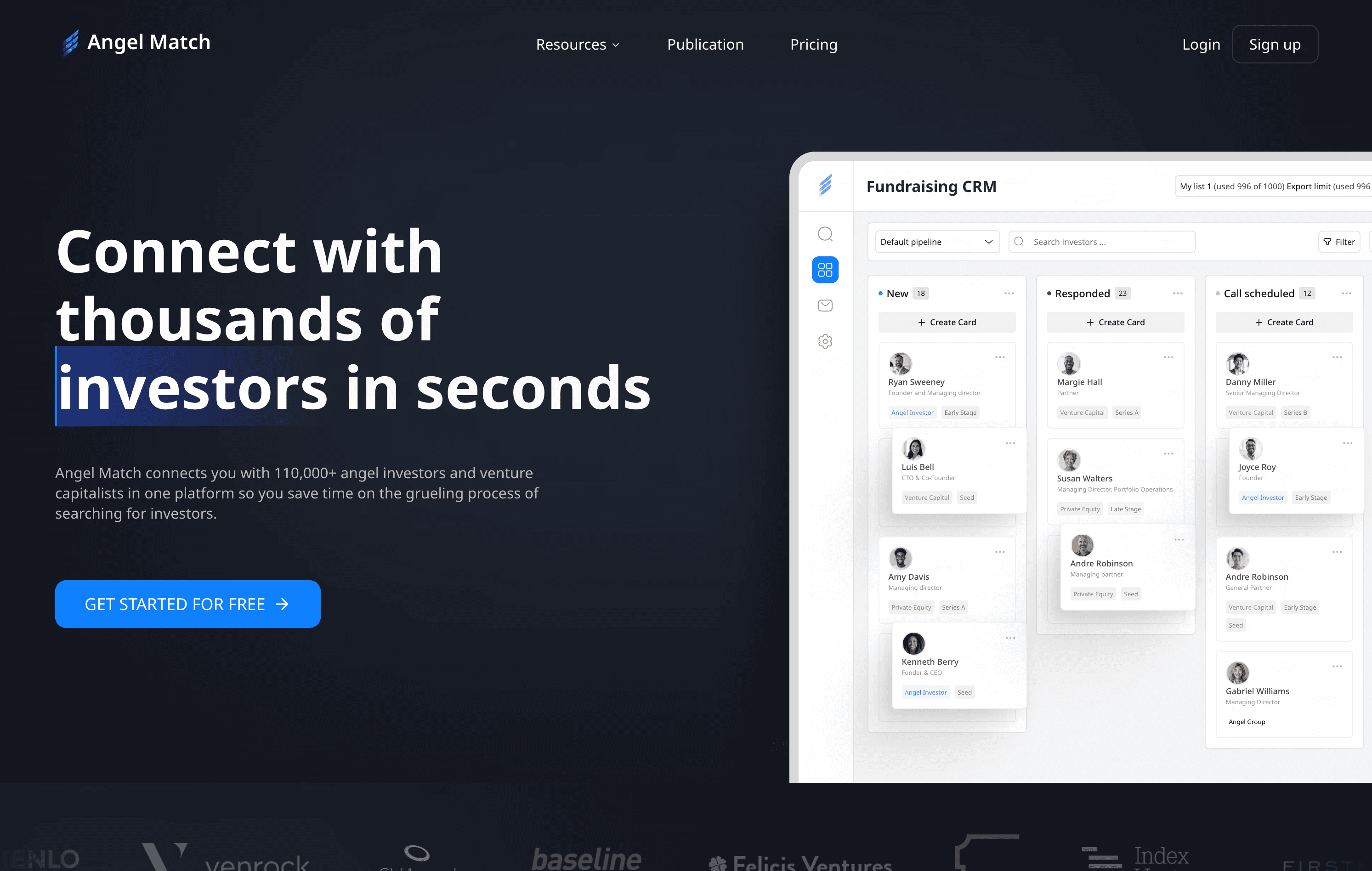
Angel Match is purpose-built for startup founders doing investor research and outreach. The database includes 110,000+ angel investors and venture capitalists, each with profiles that cover email addresses, social media links, past investments, investment stage, industry focus, and geography.
What sets it apart from a raw list is the built-in CRM and email outreach functionality. You can filter investors, build a shortlist, export contacts as a CSV, or email directly from the platform. There's also a fundraising pipeline view so you can track where each conversation stands.
Angel Match offers a 3-day free trial. After that, it's a paid subscription with monthly cancel flexibility.
Best for: Seed-stage founders who are ready to do high-volume, personalized outreach and want everything in one place.
2. OpenVC
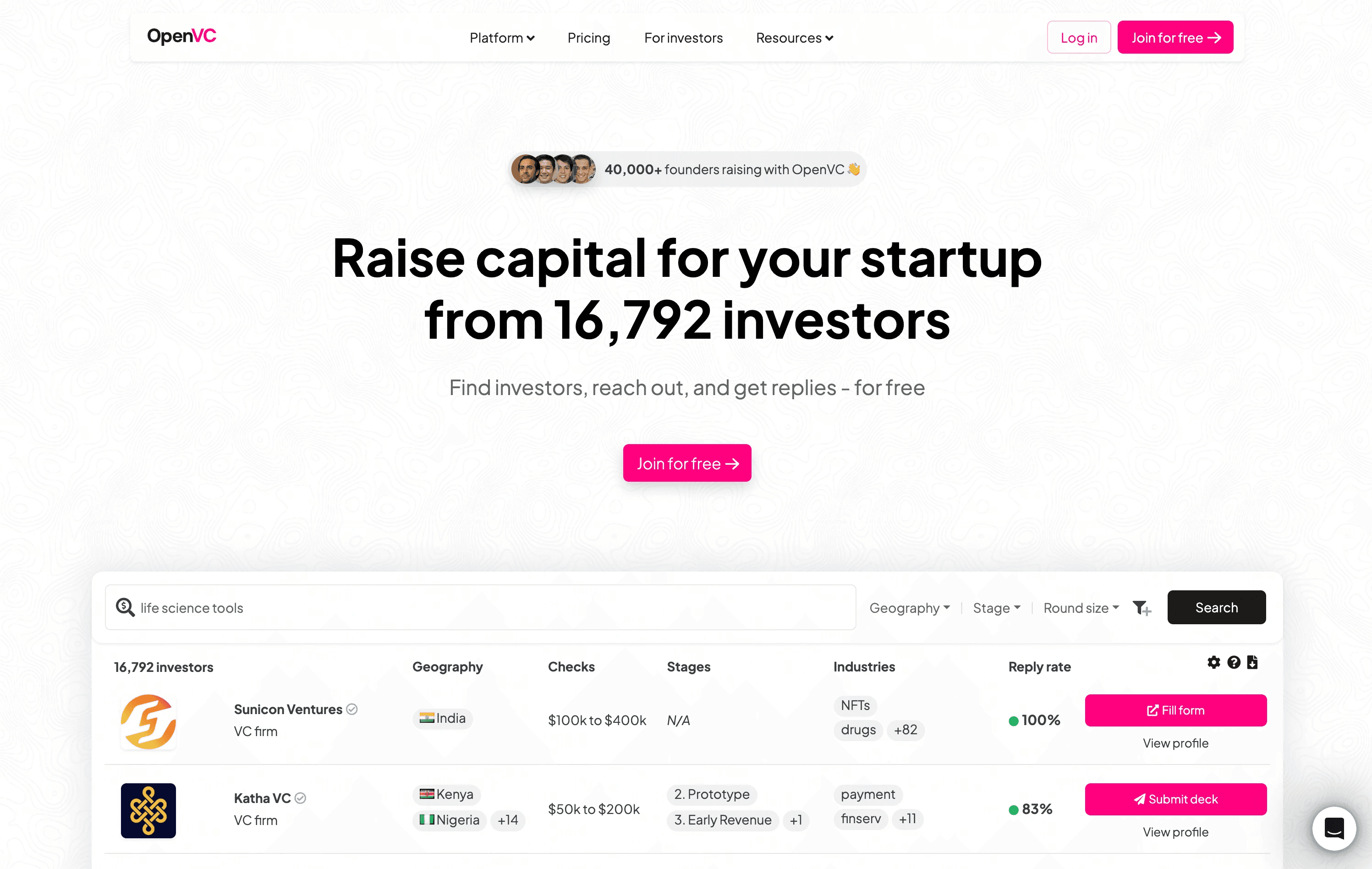
OpenVC is free and built around one strong insight: the investors listed here have explicitly opted in to receiving cold inbound from founders. That's a meaningful distinction. You're not spraying emails at people who never asked to hear from you. You're reaching investors who have raised their hand.
The list is regularly updated and filterable by geography, check size, and investment stage. OpenVC also publishes a downloadable dataset for founders who want to work offline or import into their own CRM. The community is active, and the OpenVC founder has a visible presence in startup communities if you have questions.
It's not as large as paid platforms (no 100K+ database here), but the quality-to-cost ratio is hard to beat for early-stage founders who are still testing their pitch.
Best for: Pre seed and seed founders on a tight budget who want to reach investors who welcome cold outreach.
3. Angels Partners
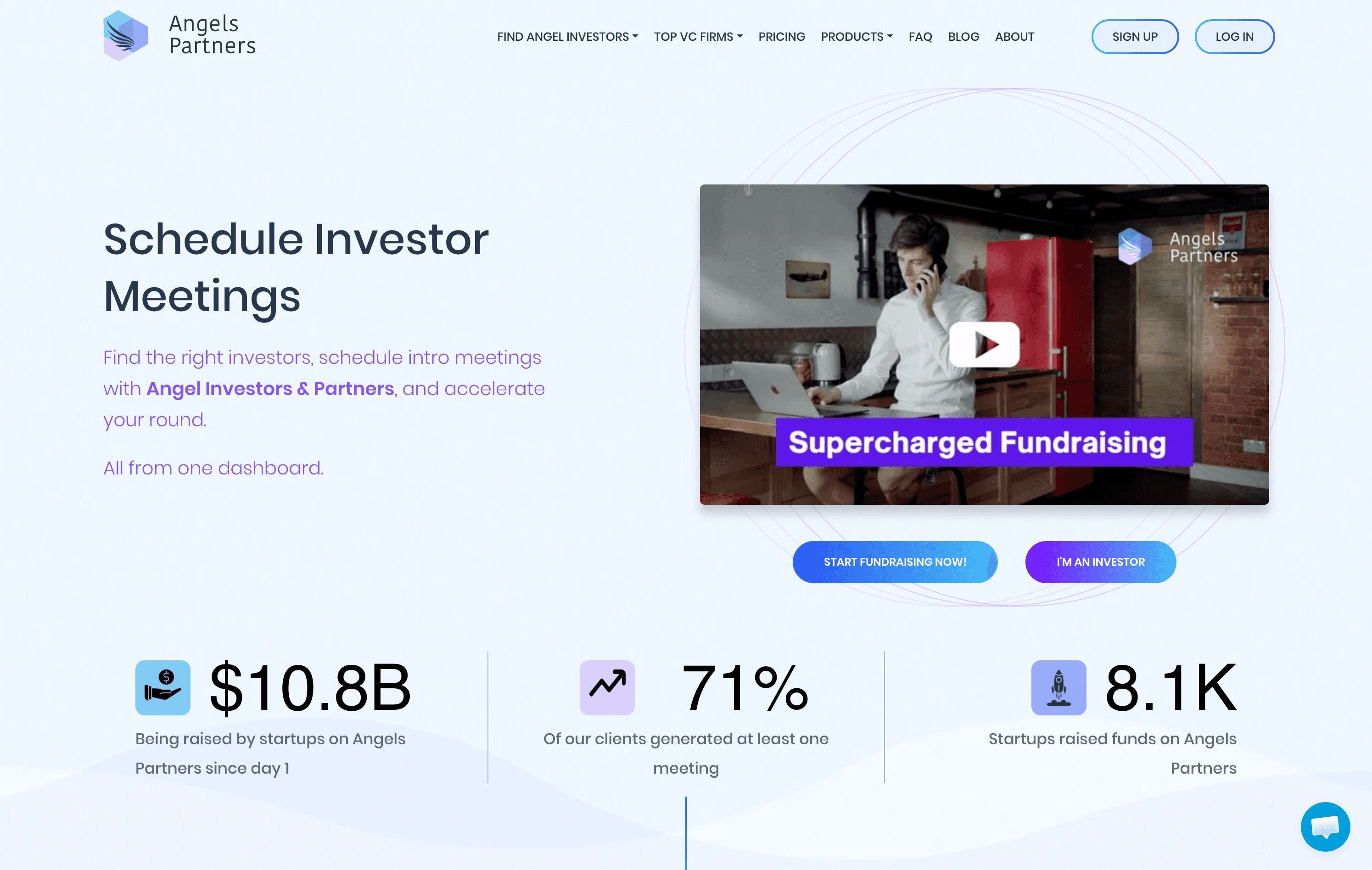
Angels Partners is one of the larger databases available, with over 120,000 investors listed: 40,000 angel investors plus 69,000 VC partners, VC funds, and family offices. The platform has been used by 8,100+ startups and claims $10.7 billion being raised by startups on the platform since launch.
The features go well beyond a static list. You get AI-powered investor matching, a LinkedIn plugin that maps your existing network to find warm introduction paths, document sharing with engagement tracking (so you can see who opened your deck and for how long), and automated outreach sequencing. That's a full fundraising workflow, not just a database.
The warm introduction tool is particularly worth calling out. Cold email response rates for investor outreach are low; anything above 5-10% is considered solid. A warm intro from a mutual connection can push that significantly higher. Angels Partners tries to bridge that gap programmatically.
Best for: Seed or Series A founders who want AI-assisted matching and warm intro automation alongside a large investor database.
4. Ramp's Free VC and Angel Investor Database
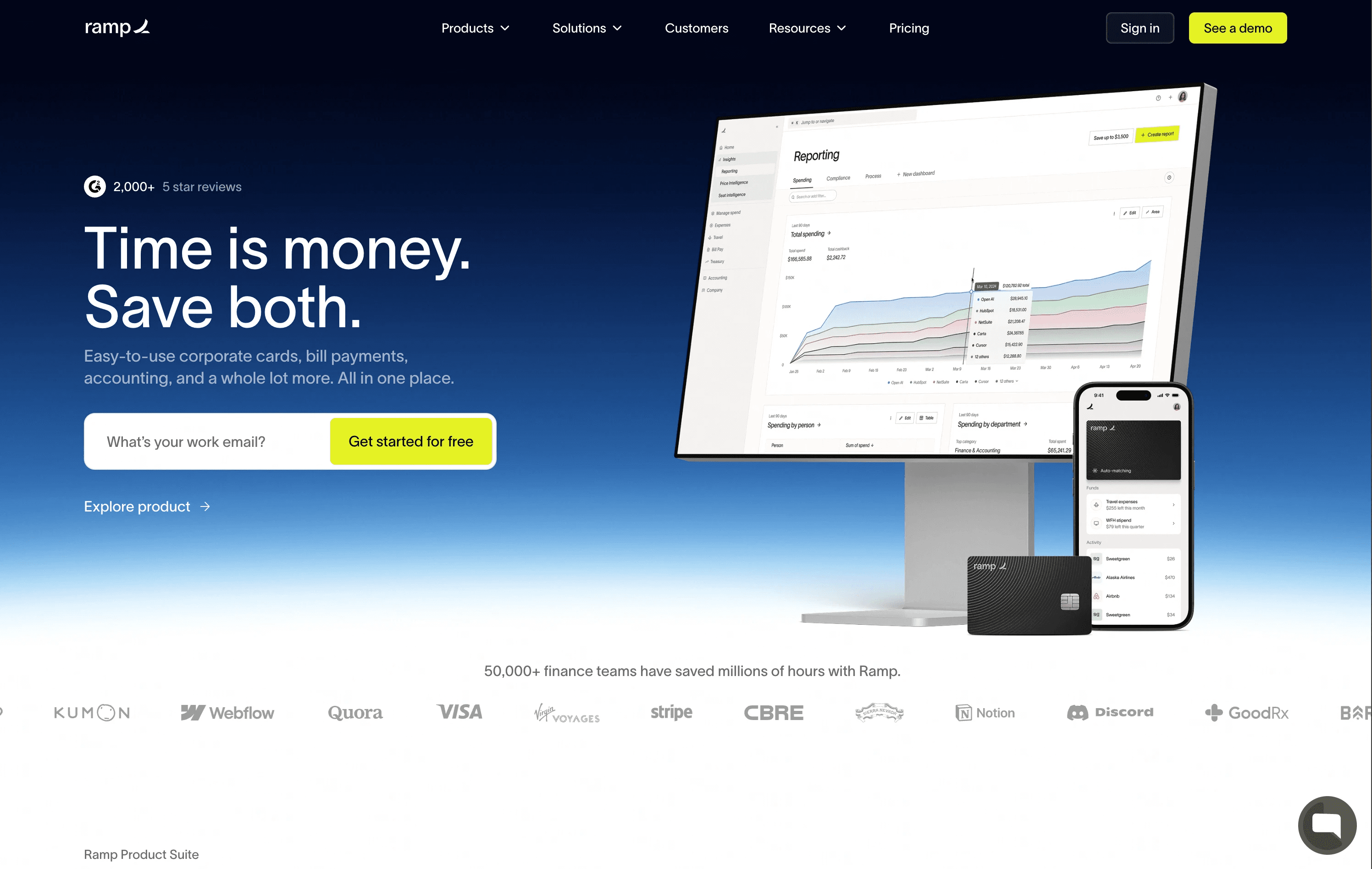
Ramp offers a free downloadable investor database, no subscription required. You fill in a short form with your work email and company name, and you get a curated list of venture capitalists and startup investors filtered by industry, stage, and location.
It's not as large or dynamic as the paid platforms. There's no CRM, no email tool, no real-time filtering. But it costs nothing, and for a founder who just needs a starting list to work from, it does the job.
Think of this as a launchpad. Download it, clean it up, cross-reference against LinkedIn, and start with the 20-30 most relevant names before investing in a paid tool.
Best for: Founders in the earliest stages of fundraising who want a free starting point before committing to a paid platform.
5. Crunchbase
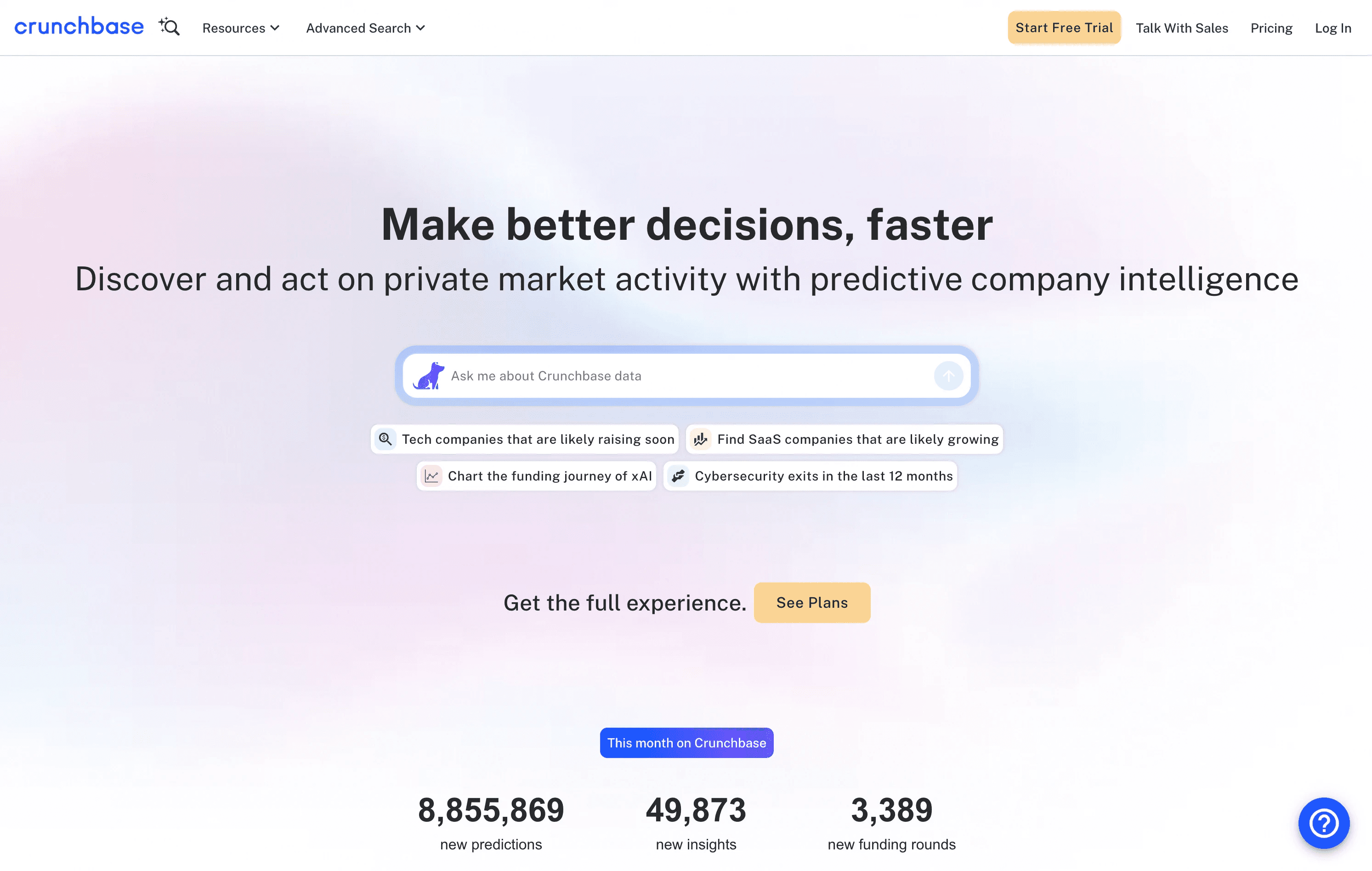
Crunchbase is the most comprehensive investor research tool on this list. It covers not just individual angels but also VC firms, funding rounds, acquisitions, company data, and market intelligence. If you want to understand who invested in your competitors or trace the investment history of a specific fund, Crunchbase is the best place to do it.
The catch is the price. As of 2026, the Pro plan runs $49/month billed annually ($588/year) and the Business plan is $199/month billed annually, roughly $2,400/year. You need at least the Pro tier to access contact exports at any meaningful scale. The free tier shows company profiles but withholds the details that make outreach possible.
For most pre seed or seed founders, Crunchbase is overkill for pure list-building. Where it earns its cost is in research: understanding investor thesis, checking their recent activity, verifying whether they're actively writing checks right now.
Best for: Series A founders or those doing serious investor research who need depth of data beyond just contact lists.
6. Angel Capital Association Directory
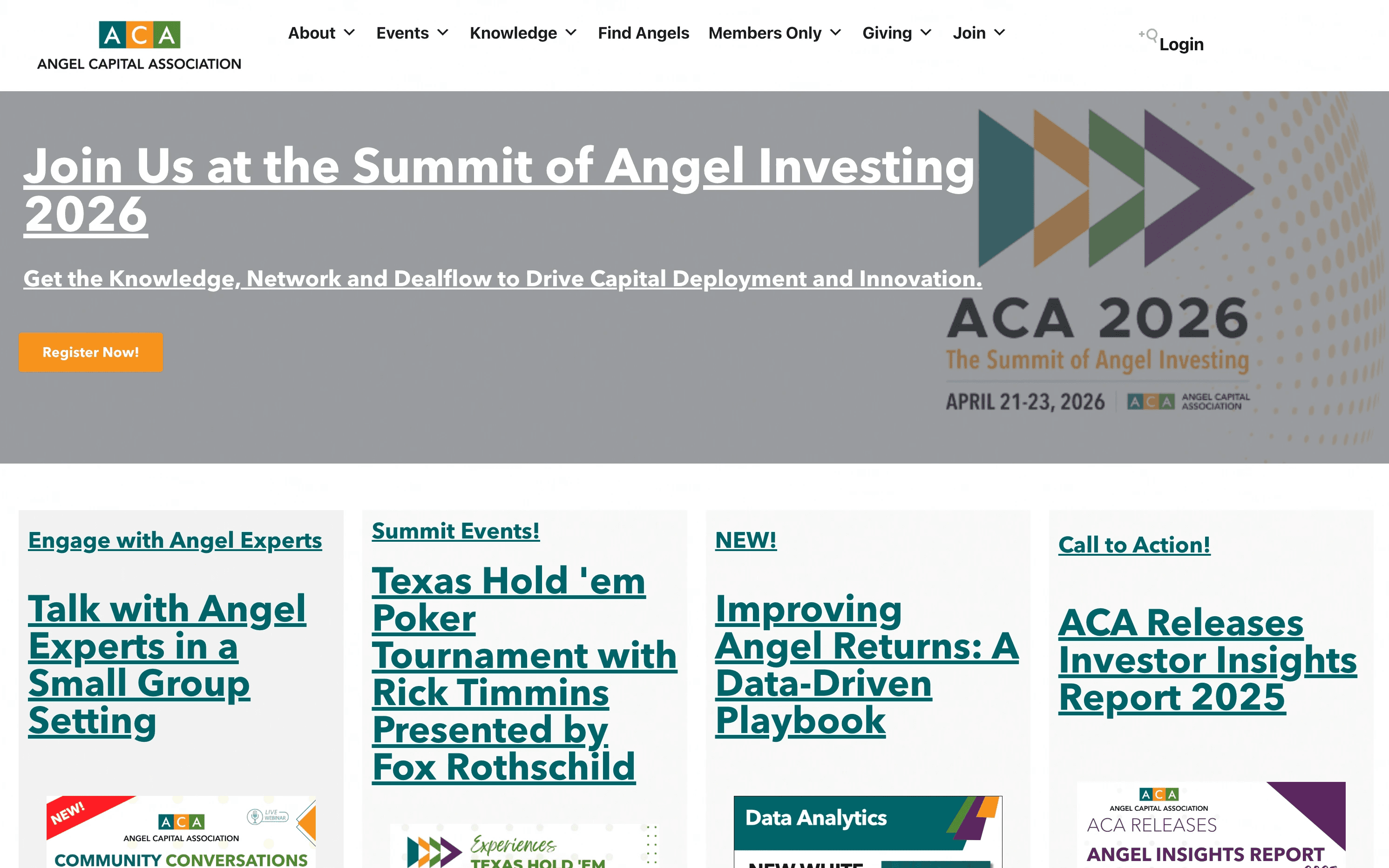
The Angel Capital Association (ACA) runs the largest professional organization for angel investors in the United States. Their member directory is searchable and includes accredited angel investors and angel investment groups across the country.
This is less useful as a cold outreach tool and more useful for identifying organized angel groups in a specific region or industry. Many founders overlook angel groups entirely, focusing only on solo angels and VCs. That's a mistake. Groups like Tech Coast Angels, Keiretsu Forum, and Golden Seeds collectively deploy significant capital and often have structured application processes that bypass the cold email problem.
Best for: US-based founders looking for angel groups (not just solo angels) in their region.
7. AngelList
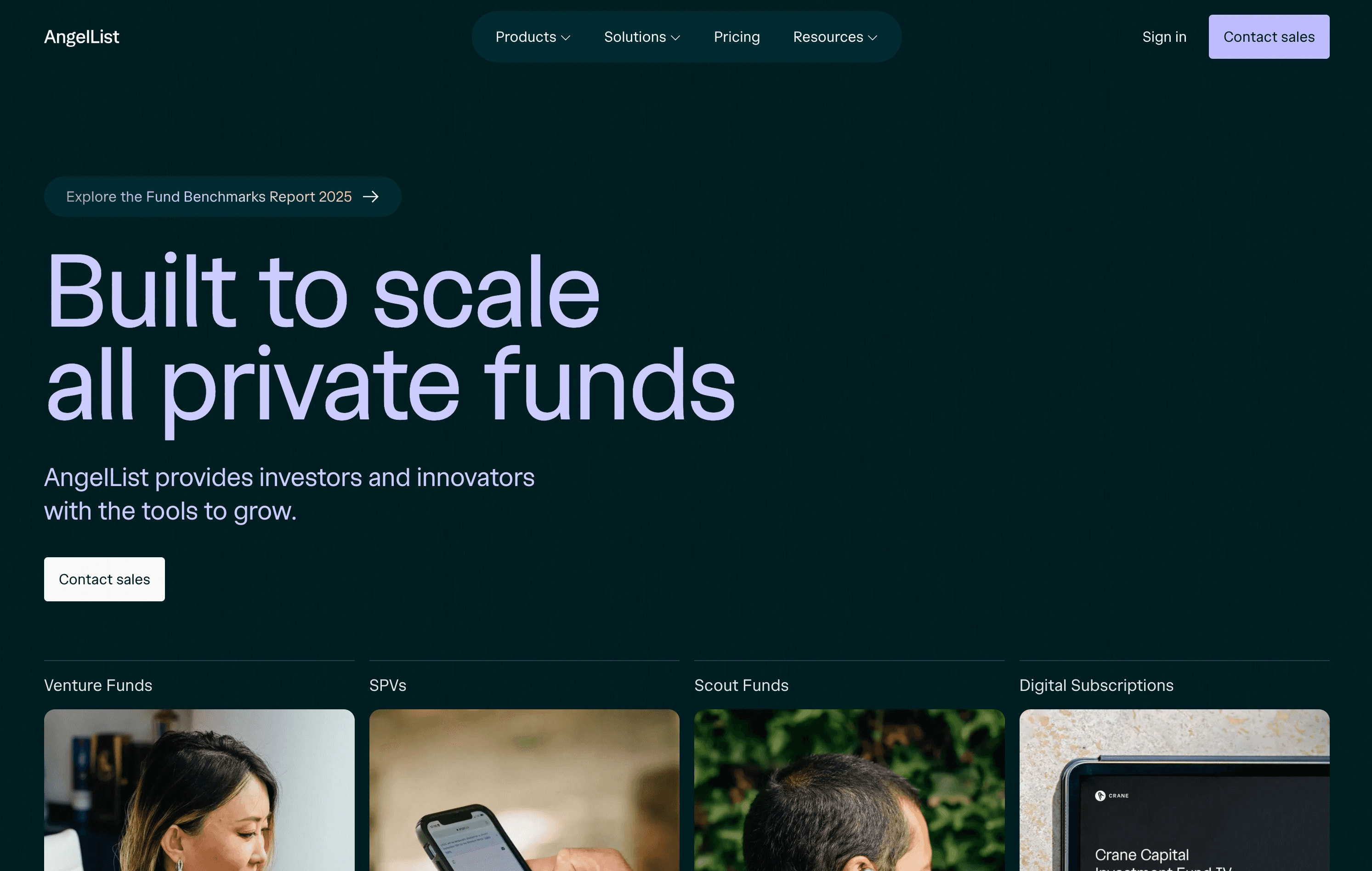
AngelList was originally the go-to social network for startup fundraising. Today it has shifted focus. The platform now primarily serves fund managers, rolling funds, SPVs, and syndicates. It's a fund administration and investment infrastructure platform, not a founder-facing investor directory.
That said, AngelList still has active investor profiles and some deal flow tools. If you're building a rolling fund or working with a syndicate lead, it's relevant. For a founder who just wants to find an angel investor's email, there are better starting points.
Best for: Founders working within the AngelList ecosystem or seeking introduction through fund managers already on the platform.
Side-by-Side Comparison
Platform | Database Size | Pricing | Best For | Warm Intro Support | CRM Built-In |
|---|---|---|---|---|---|
Angel Match | 110,000+ | Paid (free trial) | High-volume outreach | No | Yes |
OpenVC | Varies (free opt-in list) | Free | Cold-friendly investor list | No | No |
Angels Partners | 120,000+ | Paid | AI matching + warm intros | Yes (LinkedIn plugin) | Yes |
Ramp Database | Undisclosed | Free | Quick-start list | No | No |
Crunchbase | Millions of records | $588/yr (Pro) / ~$2,400/yr (Business) | Deep investor research | No | No |
ACA Directory | US angel groups | Free (limited) / Member | Finding angel groups | No | No |
AngelList | 20,000+ funds/syndicates | Varies | Fund ecosystem access | Via syndicates | Partial |
How to Choose the Right Database for Your Stage
Not every founder needs the same tool. Here's a simple framework.
Pre seed (testing your pitch): Start with free tools. Download Ramp's database, filter it manually, and run 20-30 personalized emails. Use OpenVC to reach investors who have opted into cold inbound. Your goal at this stage isn't to blast 500 people; it's to learn what messaging gets a response.
Seed (scaling what works): Once you've validated your pitch and know which investor profiles respond, upgrade to a paid platform. Angel Match or Angels Partners will give you the volume, filtering depth, and CRM infrastructure to run a proper process. Crunchbase Pro at $49/month (billed annually) is worth considering once you need research depth, but the outreach-focused platforms above are more useful for building and working a contact list.
Series A (doing full diligence): At this stage you want Crunchbase for research depth alongside one of the outreach-focused platforms. You're not just looking for emails now; you're building a strategic investor map and understanding fund cycles, portfolio conflicts, and typical check sizes.
Pro Tip: Whatever platform you use, never email more than 30-40 investors in the same week. Investor communities are small and connected. If you're getting rejected at volume, word travels. Keep your outreach window tight and create momentum, don't create noise.
Does Cold Outreach to Angel Investors Actually Work?
Yes. But the numbers are sobering.
A well-researched, personalized cold email to an angel investor typically converts at 2-5% to a first call. That means for every 100 emails you send, you might get 2-5 conversations. Of those, a small fraction will lead to a check. This is why experienced fundraisers tell you to talk to 200+ investors in a round.
That math makes a database necessary. You can't reach 200 qualified investors by hand without one.
What cold outreach can't replicate is the trust transfer of a warm introduction. When a mutual connection introduces you to an investor, your reply rate can jump to 40-60%. That's not a small difference. It's the reason founders who have a strong network close rounds faster and on better terms.
The smart approach: use a database to identify your ideal 150-200 investors, then work backward to find connection paths. LinkedIn, your existing investors, co-founders, accelerator networks, even portfolio founders of the target investor. You won't find a warm path to everyone. But even converting 20-30% of your cold list to warm introductions will change your conversion math significantly.
A database of angel investors is the map. Your network is the road.
Tips for Getting the Most Out of Any Angel Investor Database
Verify before you send. Every database has some percentage of outdated email addresses, changed roles, or investors who are no longer active. Before launching a sequence, spot-check 10-15 contacts manually. A high bounce rate will damage your sender reputation and hurt deliverability for everyone else on your list.
Personalize based on portfolio. Generic intros get ignored. Look up 2-3 of the investor's past investments and connect your startup to the thesis they've already demonstrated. "I noticed you backed [Company X] in 2022, and we're solving the same pain point on the [B2B / consumer / enterprise] side" is far more compelling than "I'd love to tell you about my startup."
Keep your fundraising window short. Investor community is small and communicative, as Ramp's own fundraising guide notes. Running a tight 6-8 week process, rather than drip-feeding outreach over months, creates momentum and signals that others are looking at your deal. Momentum matters.
Track your pipeline. Whether you use the built-in CRM of Angel Match or Angels Partners, a Notion database, or a simple spreadsheet, track every investor: status, last contact, what they said, and next action. Fundraising is a sales process. Without a pipeline, you'll lose track of follow-ups and leave conversations to go cold.
Frequently Asked Questions
What is the best database of angel investors for startups?
For most seed-stage founders, Angel Match and Angels Partners are the strongest paid options in 2026, with 110,000+ and 120,000+ investors respectively and built-in CRM and outreach tools. For founders on a budget, OpenVC is the best free option because investors on the platform have opted in to receiving cold pitches.
Is there a free angel investor database?
Yes. OpenVC offers a free, filterable list of investors who accept cold inbound. Ramp also offers a free downloadable investor database that covers venture capitalists and angel investors filtered by stage and industry. Both are solid starting points before investing in a paid tool.
How do I find angel investors for my startup?
Start by building a targeted list using one of the platforms above. Filter by your industry, stage, and geography. Then prioritize investors who have backed similar companies in the past. Pursue warm introductions through LinkedIn, your accelerator network, or other founders where possible. Cold outreach works, but warm intros convert at significantly higher rates.
Is Crunchbase worth it for finding angel investors?
For early-stage founders doing pure list-building and outreach, the Pro plan at $49/month (billed annually) can make sense for research, but the platform is better suited for understanding fund thesis, tracking recent deals, and identifying portfolio conflicts than for pure outreach. Platforms like Angel Match and Angels Partners give you better outreach infrastructure at a comparable or lower price point.
What is AngelList used for today?
As of 2026, AngelList primarily serves fund managers, SPV leads, and syndicates rather than individual founders looking for investor contacts. It's an excellent tool if you're raising through a rolling fund or working with an AngelList syndicate, but it's no longer a straightforward investor directory for founders doing direct outreach.