When you are a pre-seed founder holding nothing but a slide deck and a hypothesis, getting your first infusion of capital feels impossible. Usually, founders face a fork in the road: do you relentlessly pitch wealthy individuals for small checks, or do you apply to a structured startup program?
Founders frequently ask, "are angel investors better than accelerators for pre-seed?" The reality is that both paths offer funding, but what they demand in return—and the type of support they provide—are radically different. One offers capital with immense freedom; the other offers high-pressure structure at a massive premium.
If you are trying to figure out which route to pursue, this guide breaks down the cap table math, the pros and cons, and exactly how to decide if are angel investors better than accelerators for pre-seed funding based on your specific situation.
Quick Takeaways
Angel investors offer highly flexible capital, moving quickly without commanding massive equity chunks (typically 0.1% to 1% per check).
Accelerators act as highly structured "bootcamps" (usually 12 weeks), providing intense mentorship and ending in a Demo Day.
Accelerators are significantly more expensive than angels, typically demanding 5% to 10% of your company's equity for relatively small cash injections.
If you simply need cash to build a product and already understand your go-to-market strategy, angels are generally the better route.
If you lack a strong network, need intense strategic validation, and want an institutional "stamp of approval," accelerators are the better choice.
Angel Investors vs Accelerators: The Core Difference
Before asking are angel investors better than accelerators for pre-seed, you must understand the mechanical differences between the two entities. It is also critical to understand the differences between an angel investor vs a VC, as institutional capital operates distinctly from both accelerators and individual angels.
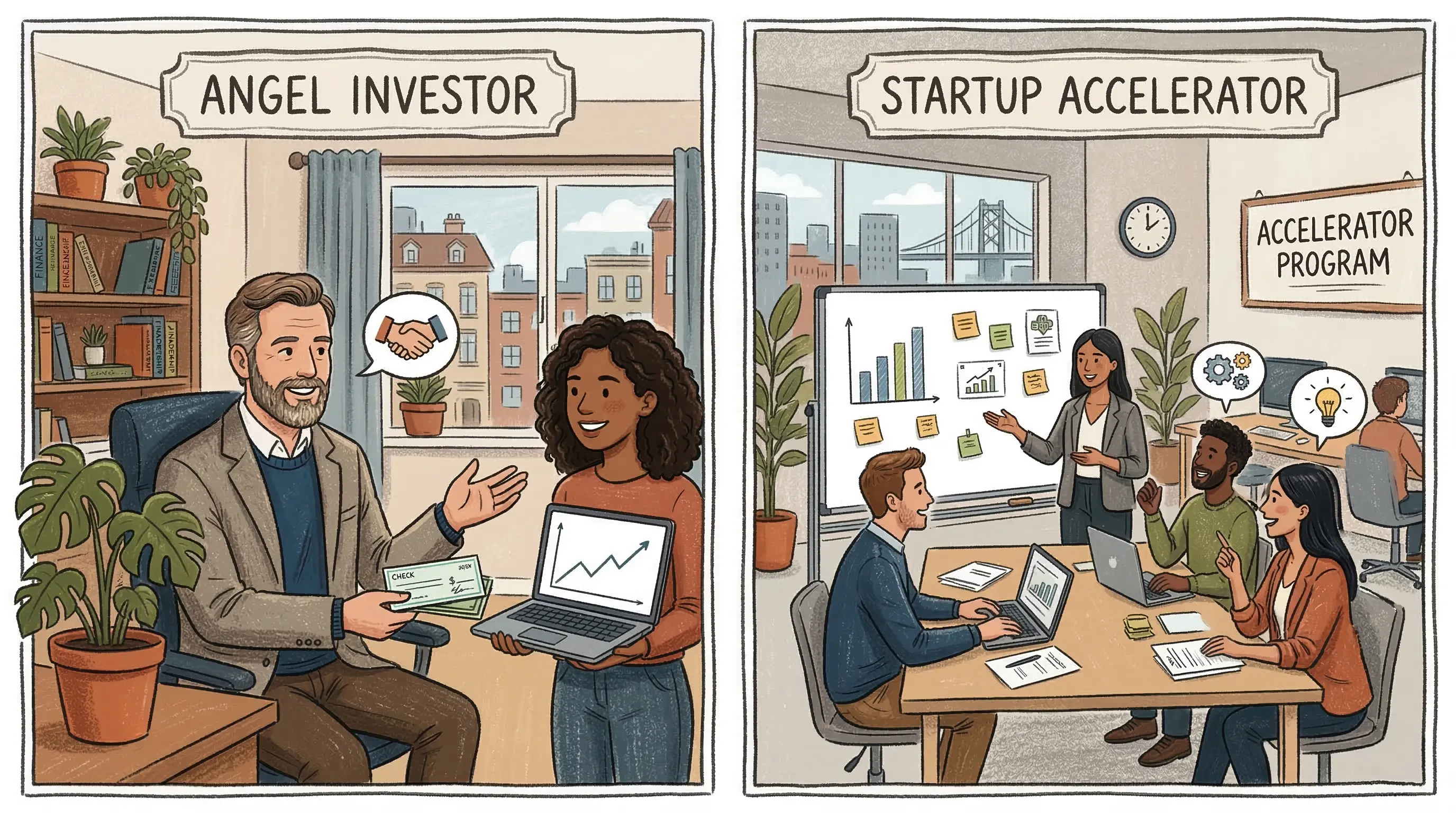
An angel investor is a wealthy individual (often a former founder or executive) investing their own personal money. They typically write checks between $5,000 and $100,000. They operate independently, although they may invest alongside others in a syndicate. When they invest, they give you the money and step back. They do not force you to attend weekly classes, hit specific milestones, or operate on a rigid timeline.
A startup accelerator (like Y Combinator, Techstars, or 500 Global) is an institutional organization that runs cohort-based programs. They accept a batch of startups, invest a set amount of capital, and require founders to participate in an intense, highly structured curriculum (usually lasting 3 to 6 months). The program culminates in a "Demo Day," where startups pitch to a room full of venture capitalists.
Are Angel Investors Better Than Accelerators for Pre-Seed?
So, are angel investors better than accelerators for pre-seed? For most founders who already have a baseline understanding of how to build a company, yes. Angel investors are generally better for pre-seed if you need flexible, fast capital and tailored mentorship without high equity loss.
However, accelerators are better if you are entering the tech ecosystem with zero network, need intense validation to figure out your business model, and rely on the prestige of an accelerator brand to get your foot in the door for a future Seed round.
To determine the answer to "are angel investors better than accelerators for pre-seed" for your specific startup, you have to look at the cap table math.
The Cap Table Math: Who Takes More Equity?
The most critical factor in the are angel investors better than accelerators for pre-seed debate is equity dilution. Accelerators are incredibly expensive.
When you join a top-tier accelerator, they typically take between 5% and 10% of your company. While deals vary, a standard accelerator might offer $125,000 for 7% equity. That means you are parting with a massive, permanent chunk of your company before you even have paying customers. If your startup goes on to reach a $100 million valuation, that 12-week program essentially cost you $7 million.
Angel investors, conversely, price their rounds based on the valuation you set (or via a SAFE note with a valuation cap). If you raise a $250,000 pre-seed round at a $5 million post-money valuation cap, you are selling 5% of your company in total, but that 5% is split among multiple angels providing double the capital an accelerator might offer.
You cannot undo a bad equity deal. Once an accelerator takes 7%, that equity is gone forever, even if their mentorship turns out to be worthless.
The Pros and Cons of Angel Investors
Choosing the angel path offers immense strategic freedom.
Pros of Angel Investors:
Speed and Agility: Angels can hear your pitch on Tuesday and wire funds on Friday.
Lower Dilution: Because they don't demand massive fixed percentages, you can preserve your equity for future institutional rounds.
Founder Autonomy: Angels do not dictate your timeline. If you need 8 months instead of 3 months to build your MVP, they will not drop you from an arbitrary program.
Cons of Angel Investors:
Variable Value-Add: Some angels are incredibly helpful; others go completely silent after the wire hits your bank account. To mitigate the risk of variable value-add, you must learn how to identify active vs passive angel investors before adding them to your cap table.
No Manufactured Urgency: Without the pressure of a looming Demo Day, solo founders can easily lose momentum and languish.
When weighing if are angel investors better than accelerators for pre-seed, remember that angels provide the exact amount of freedom that many first-time founders accidentally use to fail slowly.
The Pros and Cons of Startup Accelerators
Accelerators are a pressure cooker designed to force rapid growth or rapid failure.
Pros of Startup Accelerators:
The Networking Platter: You get instant access to an alumni network of thousands of successful founders and investors.
Manufactured Momentum: The 12-week sprint toward Demo Day forces you to ship product and talk to customers relentlessly.
The Stamp of Approval: Graduating from a top-tier accelerator (like YC) instantly signals to Series A venture capitalists that you are a vetted, highly competent founder.
Cons of Startup Accelerators:
Incredibly Expensive: Giving up 7% to 10% for relatively small capital is a permanent, high-cost decision.
High Distraction Factor: Mandatory weekly meetings, speaker series, and cohort updates can distract you from actually building your product.
The Danger of Prestige: Many founders assume getting into an accelerator guarantees success, leading to fatal complacency when Demo Day does not yield immediate investment.
Do You Have to Choose? The Hybrid Approach
When founders ask are angel investors better than accelerators for pre-seed, they falsely assume the choice is binary. It is not.
The most strategic founders use a hybrid approach. They raise a small "friends, family, and early angels" round first—perhaps $50,000 to $100,000. If you pursue this route, figuring out how many angel investors you should contact to hit that initial $100,000 milestone is critical. They use this angel capital to hire an initial engineer, build a working MVP, and secure their first ten paying customers.
With that traction in hand, they then apply to a top-tier accelerator. Having a working product and revenue makes them vastly more competitive for acceptance into elite programs. They used the flexibility of angels to buy the traction necessary to access the network of the accelerator.
Look the Part Before You Apply
Whether you decide to blanket hundreds of angels with cold emails or apply to a massive accelerator program, your presentation determines your success.
Accelerators and angels alike are visually biased. When they ask for your pitch deck, they are evaluating whether you look like a professional organization or a hobbyist. A disorganized, amateur brand identity immediately signals that your future product execution will be equally amateur. Beyond visual design, ensuring you have organized your files and know what a data room for a startup requires will signal operational maturity. This is exactly where Zyner helps pre-seed founders.
Instead of parting with 7% of your company just to get "pitch deck help" from an incubator, Zyner provides unlimited design subscriptions for startups. For a flat monthly fee, our top-tier designers create investor-ready pitch decks, brand identities, and UI/UX assets. You get the institutional polish of a Series B company while maintaining ultimate control over your cap table.
Frequently Asked Questions
Do accelerators take equity?
Yes, almost all startup accelerators take equity in exchange for capital and participation in their program. The industry standard typically ranges from 5% to 10% equity, usually structured via a SAFE (Simple Agreement for Future Equity) or convertible note.
Is Y Combinator an angel investor or VC?
Y Combinator operates as an accelerator, but structurally acts more like an early-stage institutional venture capitalist. They invest standard deal amounts into batches of startups in exchange for a fixed equity percentage, unlike individual angel investors who invest personal capital variably.
Should I raise from angels before an accelerator?
Raising a small amount of capital from angel investors before applying to an accelerator is often a highly strategic move. Having early angel capital allows you to build an MVP and show initial traction, making your accelerator application significantly more competitive.
What is the difference between an incubator and an accelerator?
Incubators are open-ended programs designed to help very early-stage founders refine an idea without a set timeline, often without taking equity. Accelerators are time-bound, cohort-based programs (usually 3 to 6 months) that invest capital, take equity, and end in a formal pitch event.