The hardest pill for a first-time founder to swallow is that a brilliant idea doesn't automatically guarantee funding. Capital follows leverage, not just ambition. If you're building a boutique consulting firm or a local bakery, your chances of landing angel investment approach zero. But if you're building a scalable software solution that automates that firm or a food-tech logistics network that serves a thousand bakeries, you immediately command an angel investor's attention.
The modern startup ecosystem is ruthlessly Darwinian. Investors are hunting for paradigm shifts—businesses that can capture massive market share with low marginal costs. As we step into 2026, the landscape has stabilized from the hyper-inflated valuations of the early decade. Today's angel investors are deploying capital with precision, focusing almost entirely on practical, high-impact technologies that demonstrate immediate utility and clear paths to profitability.
If you're preparing to fundraise, predicting where the puck is going is critical. You need to know what industries are angel investors most active in right now, not just to pick a sector, but to understand how to frame the business you are already building.
Quick Takeaways: Top Industries for Angel Investment in 2026
If you want the immediate answer to "what industries are angel investors most active in right now," here is the current data for 2026. The overwhelming majority of early-stage private capital is concentrated in these five sectors:
Artificial Intelligence & Enterprise SaaS: Specifically applied AI tools that automate complex business workflows, improve enterprise decision-making, and drastically reduce operational costs.
Life Sciences, Healthcare, & Biotech: Digital health diagnostics, modernized patient care platforms, and biotech advancements leveraging complex data models to solve compounding health issues.
Fintech & Financial Services: B2B financial software, decentralized infrastructure, and neo-banking platforms designed to scale efficiently at the Seed and Series A stages.
Deep Tech & Sustainability: "Hard tech" involving robotics, commercial space applications, and climate/green energy solutions tackling existential planetary risks.
Consumer Tech & Retail: E-commerce infrastructure, user-driven fashion tech, and modernized food/beverage technology that reimagines the direct-to-consumer experience.
Understanding these categories is only the first step. To successfully pitch an angel investor, you must understand exactly why these industries are magnets for capital, and what specific attributes make them so defensible.
The Fundamentals: Why Angels Prefer These Specific Sectors
Before diving into the granular breakdown of these five industries, we need to clarify the fundamental mechanics of angel investing. Angel investors take on staggering amounts of risk. A significant percentage of their portfolio companies will fail entirely, returning nothing. To offset those total losses, the companies that do succeed must win massively—generating 10x, 50x, or even 100x returns on the initial check. While the return profiles differ between an angel investor vs a VC, both require exponential scalability to justify their initial risk.
To achieve those explosive multiples, an industry must possess three key characteristics:
1. Zero Marginal Cost Scaling
A service business scales linearly: to double your revenue, you usually have to double your headcount to handle the work. A software or tech-enabled business scales exponentially. Once a platform or core algorithm is built, acquiring customer number 10,000 costs virtually the same as acquiring customer number 10. This hyper-scalability is why software-as-a-service (SaaS) and AI consistently dominate angel portfolios. The upside is theoretically limitless.
2. Defensibility and Intellectual Property
Investors hate crowded, easily replicable markets. They want a moat. Deep tech, biotech, and advanced AI models require intense technical expertise to build. That difficulty is the moat. If a competitor can clone your entire business model over a weekend using off-the-shelf tools, an angel investor immediately sees the risk. Strong intellectual property, proprietary datasets, or uniquely complex engineering acts as a shield against larger competitors.
3. Outsized Margin Potential
A business with tight margins leaves very little room for error. Angel investors favor industries where the gross margins are exceptionally high (often 80% or more in software). High margins mean the company can aggressively reinvest cash flow back into growth, research, and marketing without needing to constantly raise dilutive bridging rounds.
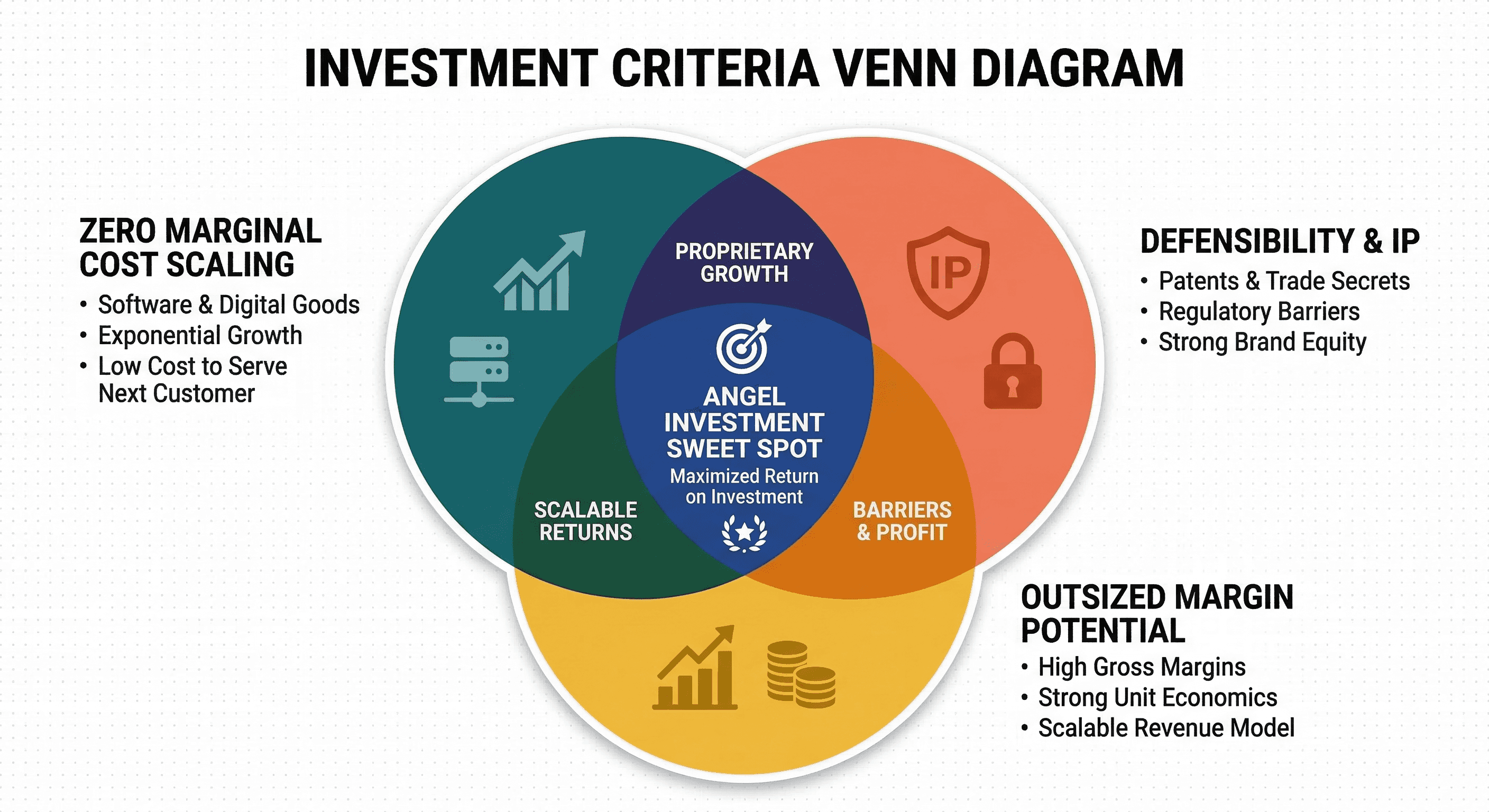
These three pillars explain why you’ll rarely see an angel investor fund a new restaurant concept, but you’ll see them aggressively bid on a startup building the algorithmic supply chain software used by that restaurant.
The Top 5 Industries Angel Investors Are Actively Funding in 2026
The data tells a clear story. While anomalies exist, the vast majority of active angel syndicates and high-net-worth individuals are writing their checks into the following five domains. When researching these highly active sectors, utilizing the best angel investor directories for startups allows you to strictly filter backers by their precise vertical.
1. Artificial Intelligence & Enterprise Software (SaaS)
We are firmly entrenched in the applied AI era. The novelty of conversational chatbots has faded; instead, 2026 is defined by the integration of AI models into boring, high-friction enterprise problems. Angel investors are heavily backing founders who use artificial intelligence to automate intensive, manual tasks, improve B2B decision-making, and create entirely new user experiences in legacy industries.
This isn't just "SaaS with an AI wrapper." Investors are looking for native AI solutions that fundamentally rethink a workflow. Whether it is generative design tools for architecture, predictive maintenance algorithms for manufacturing, or AI-driven legal discovery, the core focus is productivity. If your software can prove that it allows a mid-sized company to operate like an enterprise giant with half the headcount, angels will fight to fund it. For these highly complex industries, it is critical to know how to identify active vs passive angel investors, as you will specifically need "active" investors with deep domain expertise rather than silent capital.
2. Life Sciences, Healthcare & Biotech
Healthcare is notoriously slow to innovate due to heavy regulation and systemic complexity. However, the sheer size of the total addressable market makes it a primary focus for early-stage capital. Specifically, biotech, pharmaceuticals, diagnostics, and digital health software are seeing massive influxes of angel funding.
What angels look for here is the integration of technology with biology. Think predictive diagnostics powered by machine learning, platforms that drastically reduce the time and cost of running clinical trials, or digital health tools that finally prioritize preventative patient care over reactive treatment. While the technical risk and regulatory hurdles in life sciences are incredibly high, the potential payoff—both financially and in terms of human impact—commands a massive premium in the angel community.
3. Fintech and Financial Services
Fintech remains a powerhouse. While consumer-facing financial apps (like basic budget trackers) are largely played out, B2B fintech is thriving. Angels are hunting for startups building the quiet infrastructure that powers modern finance.
This includes enterprise software that simplifies cross-border payroll, automated compliance and risk management platforms, and modern B2B payment rails. Angel investors are particularly active in the Seed and Series A stages within fintech, backing founders who have deep domain expertise in banking, lending, or regulatory frameworks. They know that incumbent financial institutions are slow and heavily burdened by legacy tech, leaving massive gaps for agile startups to exploit.
4. Deep Tech & Sustainability
"Deep tech" refers to startups tackling substantial scientific or engineering challenges. This is the realm of robotics, commercial space exploration, advanced materials, and next-generation green energy solutions. Five years ago, many angels avoided deep tech because of the lengthy research and development (R&D) cycles and the massive capital requirements needed before achieving commercial viability.
Today, that sentiment has flipped. Investors recognize that software alone cannot solve the existential threats facing the physical world. There is a surging interest in sustainability and climate tech—ranging from carbon capture materials to agricultural robotics that increase yield while reducing water usage. Angels entering this space often have highly specialized technical backgrounds themselves and are willing to take on significant scientific risk for the chance to fundamentally alter a global industry.
5. Consumer Tech and Retail
While enterprise software dominates the narrative, consumer technology continues to attract serious angel capital. However, the standard for a consumer app is higher than ever. Investors are largely ignoring minor iterative improvements in favor of radical innovations in e-commerce infrastructure, fashion tech, and food/beverage technology.
The focus here is on the user-driven market. Angels want to see products that completely alter how a consumer discovers, purchases, or interacts with physical goods. This might mean augmented reality (AR) fitting rooms for online retailers, highly specialized supply chain networks for perishable goods, or platforms that transform passive consumers into active participants in a brand's product development lifecycle. If you have overwhelming evidence of rabid, organic user adoption, angel investors will take the meeting.
Reframing Your Startup: How to Position Yourself If You Aren't in a "Hot" Industry
A common point of anxiety for founders is reading a list like this and realizing, "My company doesn't fit neatly into any of these boxes." You might be building a logistics company, a real estate brokerage, or an educational platform. Does this mean you cannot raise angel funding?
Absolutely not. It simply means you need to rethink your framing.
Angel investors don't invest in categories; they invest in the leverage those categories represent. Your job is to demonstrate that your business utilizes scalable technology to fundamentally alter the economics of your traditional industry.
You aren't just building a trucking company; you are building an AI-driven routing platform that happens to own its first fleet to prove the model. You aren't just opening a chain of modern clinics; you’ve developed proprietary patient-triage software that makes those clinics 300% more efficient than the industry standard. Utilizing strong startup storytelling frameworks allows you to effortlessly reframe a localized service business into a highly scalable technology narrative.
How Zyner Helps You Prove the Tech
At Zyner, we work with founders every day who need to translate a deep industry insight into a scalable technology product. The difference between looking like a slow-growth service business and a high-growth tech startup entirely depends on your product execution.
If you are a domain expert in a localized industry, you know exactly where the inefficiencies lie. But an angel investor won't fund your vision until you have a tangible product that proves the software works. We act as an extension of your founding team, taking your raw insight and architecting a highly scalable Minimum Viable Product (MVP).
Whether you need a complex data dashboard, a dual-sided marketplace app, or a sophisticated enterprise workflow tool, our engineering team builds it with a focus on speed to market and technical defensibility. We don't just write code; we help you frame your startup as a true technology play, ensuring that when you do step into a pitch meeting, the investor sees a scalable product, not just a service pitch.
The Geography of Capital: Local vs. Global Focus
It is also important to note that what industries angel investors fund is strongly correlated with where those investors are located. While the rise of remote pitching and Zoom meetings has democratized fundraising significantly, geographic clusters still heavily influence investor appetite.
For example, if you are building an advanced biotech platform, the angel syndicates and early-stage funds heavily concentrated in Boston or San Diego will understand your regulatory roadmap intuitively. If you are building a B2B SaaS platform for the entertainment industry, Los Angeles-based angels will immediately grasp the pain point you are solving.
Investors like to invest in what they understand. When researching what industries are angel investors most active in right now, overlay that data with geography. Incorporating this geographic data when mapping where pre-seed founders find angel investors will dramatically increase your meeting efficiency. When targeting investors in a specific city or tech hub, LinkedIn's free geographic filters make it straightforward to identify active local angels without needing a paid database subscription. If you are operating outside a major tech hub, platform filters on directories like AngelList and OpenVC allow you to find investors globally by your exact niche. Do not waste crucial time pitching a hardware robotics startup to an angel syndicate whose entire portfolio consists of mobile consumer apps. Do the targeted research necessary to find the individuals who conceptually understand the leverage your industry offers.
Conclusion
Securing early-stage capital is a grueling process. The most reliable way to increase your odds of success is to align the problem you are solving with the mechanics of how angel investors make money. They need massive total addressable markets, highly defensible technology, and the ability to scale without breaking the balance sheet.
Whether you are deep in the AI trenches, modernizing healthcare, or bringing deep tech sustainability to life, your core objective remains the same: Prove that your solution can scale exponentially.
If you have the industry expertise but lack the technical co-founder needed to build that scalable architecture, you don't have to stall your progress. Book a free discovery call with Zyner today, and let us help you turn your industry insight into the exact type of technical product angel investors are actively searching for.
Frequently Asked Questions (FAQ)
What is the most profitable industry for angel investors?
Historically, enterprise software (SaaS) and technology infrastructure yield the highest volume of successful exits for angel investors. The exceptionally high gross margins and the ability to scale globally with minimal variable costs make software highly profitable when it achieves product-market fit. However, isolated successes in biotech and deep tech can occasionally yield massive, outsized returns that dwarf standard software exits, albeit with significantly higher failure rates.
Do angel investors only invest in tech?
No, angel investors do not exclusively invest in technology, but the vast majority of angel capital flows toward tech-enabled businesses. An angel investor's goal is to achieve a massive return on investment to offset the high risk of early-stage failure. To achieve that return, they need a company that can scale exponentially. Technology is the most reliable vehicle for achieving that non-linear growth. While an angel might invest in a consumer packaged goods (CPG) brand or a massive real estate development, "pure tech" remains the dominant focus.
How do I find angel investors who specialize in my specific industry?
The most effective strategy is to look at the Cap Tables (capitalization tables) of successful startups within your specific niche that are two or three stages ahead of you. Trace back who funded their Seed or Pre-Seed rounds. You can use platforms like Crunchbase, AngelList (now Wellfound), and LinkedIn to identify these individuals. Additionally, finding industry-specific incubators, highly targeted industry podcasts, and regional angel syndicates focused on your sector will yield much warmer introductions than generalized outreach.
How early do angel investors typically invest in these industries?
Angel investors usually engage at the earliest stages—often Pre-Seed or Seed. In high-activity industries like AI or Deep Tech, angels may write checks when a company is little more than a strong founding team and a technical prototype. However, due to the high risk involved, they require overwhelming evidence of rapid scalability and a defensible market advantage before committing capital.
Do angel investors lead rounds or follow other investors?
While some large angel syndicates or highly experienced individual angels will lead a round and set the valuation terms, the majority prefer to follow. They often wait for a lead investor—such as a specialized micro-VC or a prominent angel—to establish the terms and conduct the initial due diligence. Once a strong lead is secured, it becomes significantly easier to fill out the rest of the round with additional angel capital.