

Only 1% of pitch decks ever secure investor funding. That number is easy to dismiss until you're the founder who spent three months refining your narrative, booked the meeting, and watched a distracted investor scroll through your slides in under four minutes.
The deck didn't fail because your idea was bad. It failed because design and story are doing heavy lifting investors never consciously notice but always feel. A pitch deck design agency changes that equation. The right one doesn't just make your slides look polished. It helps you communicate a fundable story with the visual credibility to match.
This guide covers what a pitch deck design agency actually does, how to measure the ROI, and which agencies are worth your time in 2026. For early-stage founders, it also covers something most listicles skip: what happens to your brand, website, and product UI after the raise, and why that should factor into who you hire now.
Quick Takeaways
A pitch deck design agency combines investor-focused narrative structure with professional visual design. It's not just a design task.
Professionally designed pitch decks give founders a 50% higher chance of investment compared to DIY presentations.
Founders evaluating agencies should weigh experience, pricing model, communication style, and post-delivery support, not just portfolio aesthetics.
Zyner is the strongest choice for early-stage startups because it covers the full creative scope: deck, brand, website, and product UI under one flat subscription.
Most pitch deck-only agencies charge $1,650 to $10,000 per project. Then you're back to zero when you need revisions or the next deliverable.
A practical checklist and storytelling framework in this article will help you evaluate any agency before signing.
What Is a Pitch Deck Design Agency?
A pitch deck design agency is a specialist creative partner that combines investor-focused narrative strategy with professional visual design to help founders present their startup in a way that secures attention, follow-up meetings, and funding. Unlike a freelance designer who executes what you specify, a pitch deck design agency brings its own framework for what a pitch deck is for, how slides should flow, and what visual language signals credibility versus amateurism.
The work usually covers: slide structure and sequencing, visual identity applied to the deck, data visualization, copywriting or copy direction, and revision cycles based on investor feedback. Some agencies also offer pitch coaching. Some offer full brand and web services as part of their scope. Most don't.
You'll usually get a better result and a clearer quote if you arrive with a rough draft. A studio pricing a deck with a set slide order is quoting the same scope as the next studio, which makes their numbers comparable. Start by deciding which slides to include, then check how long a pitch deck should be at your stage.
The distinction matters because a designer who can make things look good is not the same as a team that understands why investors skip to slide 8 before they read slide 2.
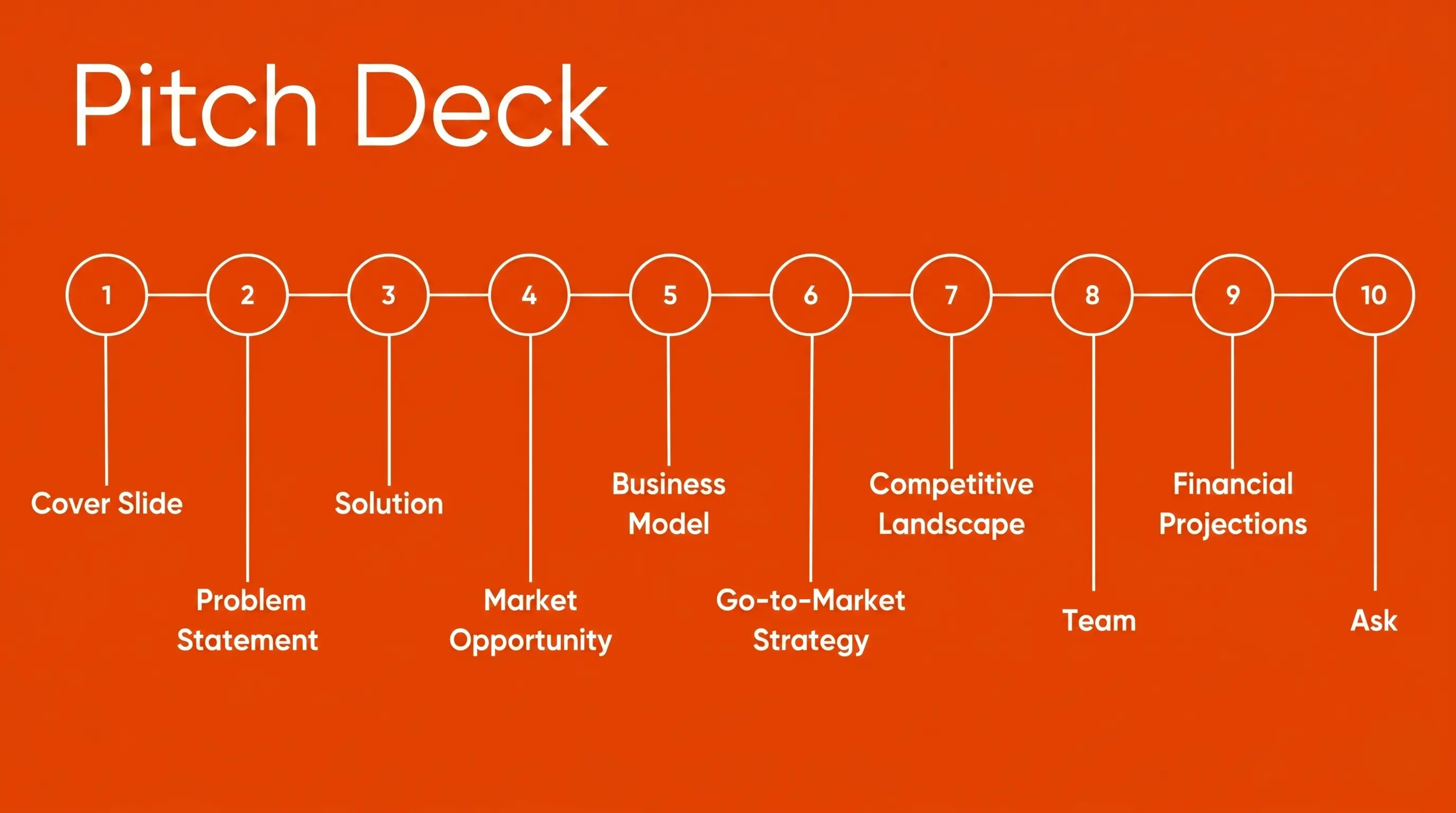
The ROI of Hiring a Pitch Deck Design Agency
The numbers on professionally designed pitch decks are harder to pin down precisely, but the directional evidence is consistent. Startups with professionally designed pitch decks have a 50% higher chance of investment compared to those using unrefined presentations. Visual pitch materials secure 43% more follow-up meetings compared to written plans.
Those figures make intuitive sense when you consider how investors actually process information. They spend an average of three minutes per deck during initial screening. In that window, they're not reading; they're forming an impression. Design quality is a proxy for founder quality. A polished deck signals that this founder can execute, delegate, and communicate clearly. A rough deck signals the opposite, even if the underlying business is strong.
There's a cost-of-not-doing-it calculation too. A single wasted investor meeting costs you months of follow-up cycles. Founders who re-pitch the same investors with a revised deck after they've already formed a negative impression rarely recover that relationship.
The design debt problem most founders don't see coming. Professional pitch deck design creates a credibility expectation. The investor leaves your meeting, opens your website, clicks to your product demo, and sees a Canva logo and a Webflow template that doesn't match anything in the deck. That gap between the deck's polish and everything else in the brand is design debt. It raises questions investors rarely voice but always factor in. The smartest founders think about this before they hire anyone.
Why It Makes Sense to Hire a Pitch Deck Design Agency
Most early-stage founders are already doing six jobs. They're in sales conversations, managing product sprints, interviewing candidates, reviewing cap tables, and writing investor updates, often in the same week. Design should not be the seventh job.
DIY pitch decks built in Canva or Google Slides have a ceiling. The ceiling isn't aesthetic; it's time. Every hour you spend pushing boxes around slides is an hour you're not talking to customers or investors. And the output still won't match what a senior designer produces in four focused hours.
Where that ceiling sits depends on your stage. At pre-seed, with a simple story and a small round, a well-chosen template and a few focused days can get you a deck that's good enough for first meetings. The pre-seed pitch deck templates we've collected are a reasonable place to start. The case for an agency gets stronger once your product needs custom visuals, or once your time is worth more in investor conversations than in Figma.
Freelancers sit in the middle. They're cheaper than agencies on a per-project basis, and a good one can produce solid work. But freelancers are disconnected contributors. They don't have a framework for investor narrative. They charge hourly. Scope creep is common. When you need a revision at 11pm the night before the pitch, you're on your own.
A pitch deck design company brings a repeatable process, a team that covers strategy and execution together, and accountability that a solo contractor can't provide. For founders at seed stage, where fundraising quality directly determines survival; that reliability is worth the price differential.
Pro Tip: Before you hire any agency, ask to see three funded decks from companies in your stage and sector. Not finished decks. Funded ones. That's the only portfolio metric that matters.
Best Pitch Deck Design Agencies for Startups in 2026
All the agencies below do solid work. The question for most founders isn't which one is objectively best. It's which one fits your stage, your budget, and what you'll need in the six months after the raise.
1. Zyner: Best Pitch Deck Design Agency for Early-Stage Startups
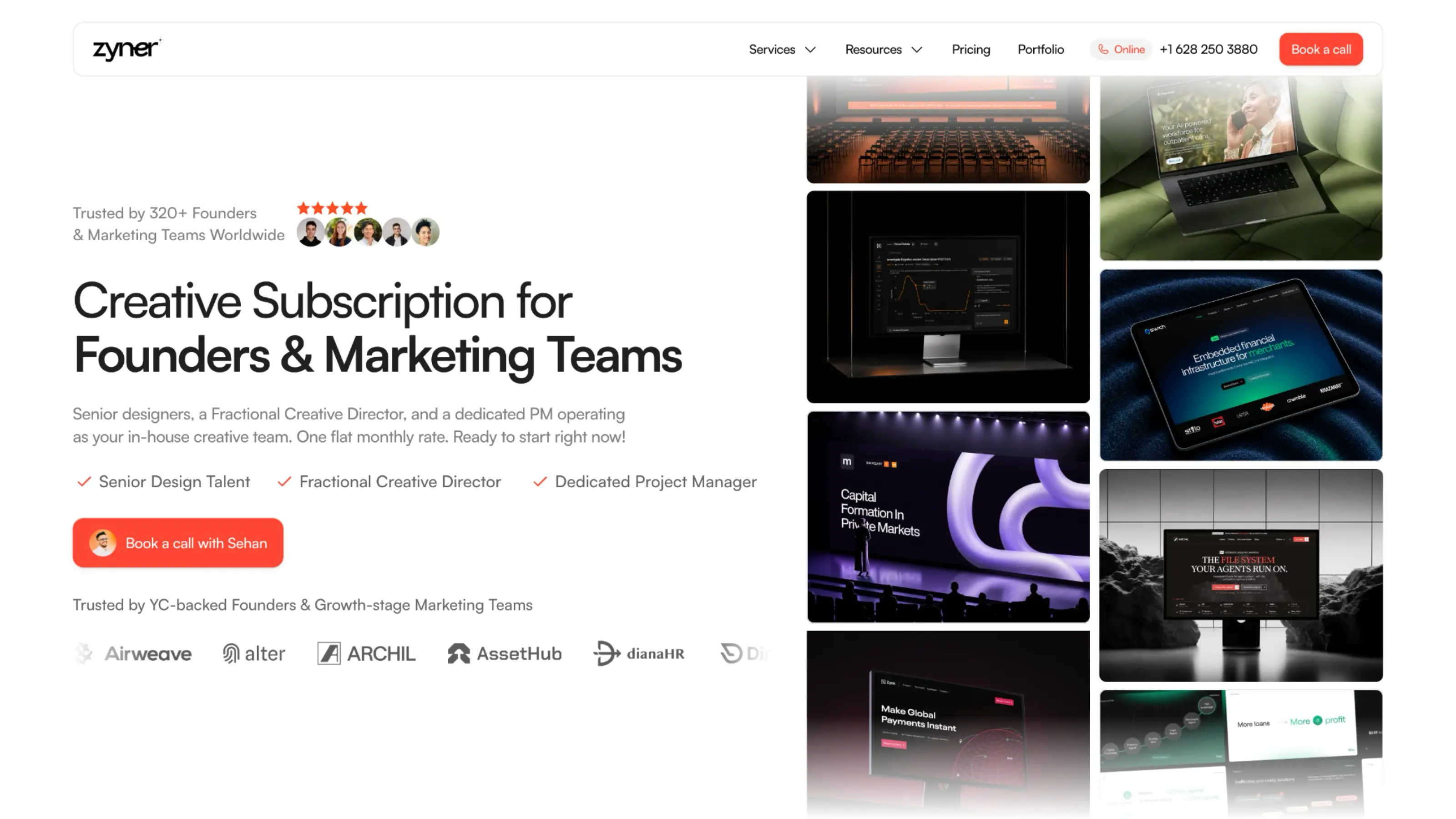
Zyner is not a pitch deck-only agency. That distinction is worth understanding before reading anything else about it.
Most design agencies for pitch decks take a single brief, deliver a single deck, and end the relationship. Zyner operates as a full-service design partner on a flat monthly subscription. That means your pitch deck gets designed by the same senior team who will build your brand identity, your landing page, your product UI, and your investor update graphics, all without re-onboarding, re-briefing, or re-negotiating scope.
Why this matters for early-stage startups specifically: investors don't only look at the deck. They check your website. They look at your product screenshots. They form a holistic impression of whether your startup looks like a real company. If your deck is polished but your site is rough, the deck's credibility leaks. Zyner closes that gap because the same team handles everything.
Zyner has worked with 320+ startups across multiple YCombinator cohorts, including W22, W23, W24, W25, S24, S25, F24, and X25. Pitch deck design is one of the most requested services across their client base. The team onboards within 24 to 48 hours and works through Slack, so there's no agency overhead or lengthy kickoff process.
Services Offered:
Branding Services: Logo Design, Brand Identity, Brand Collateral, and more.
Design Systems: Component Libraries, UI Kits, Typography, and more.
Web Design: Landing Pages, Full Websites, Framer Development, and more.
Product Design: App UIs, Prototyping, Mobile UI, Web UI, and more.
Ad Creatives: Static Creatives, Motion Creatives, Meta ads, LinkedIn Ads and more.
Social Media Creatives: Posts, Reels, Stories, Videos, Carousels and more.
Presentation Designs: Business Presentations, Webinar Slides and more.
Pitch Deck Design: Fundraising Decks, Sales Decks, Data Rooms and more.
Illustration Design: Icons, Characters, Illustration Systems, and more.
Print Design: Flyers, Events, Billboards and more.
Packaging & Merchandise: Apparel & Merch, Brand Collateral and more.
Motion Design: Product Animations, Explainer Animations, UI/UX motion and more.
Launch Video: Launch Videos, Demo Videos, Promo Videos and more.
Pricing: From $4,995 per month on an annual plan (also available quarterly at $5,195/month and monthly at $5,495/month). All plans include unlimited requests and revisions, a dedicated project manager, and senior design talent.
Best for: Pre seed to Series A startups who want one design partner for fundraising and everything that follows.
2. Superside
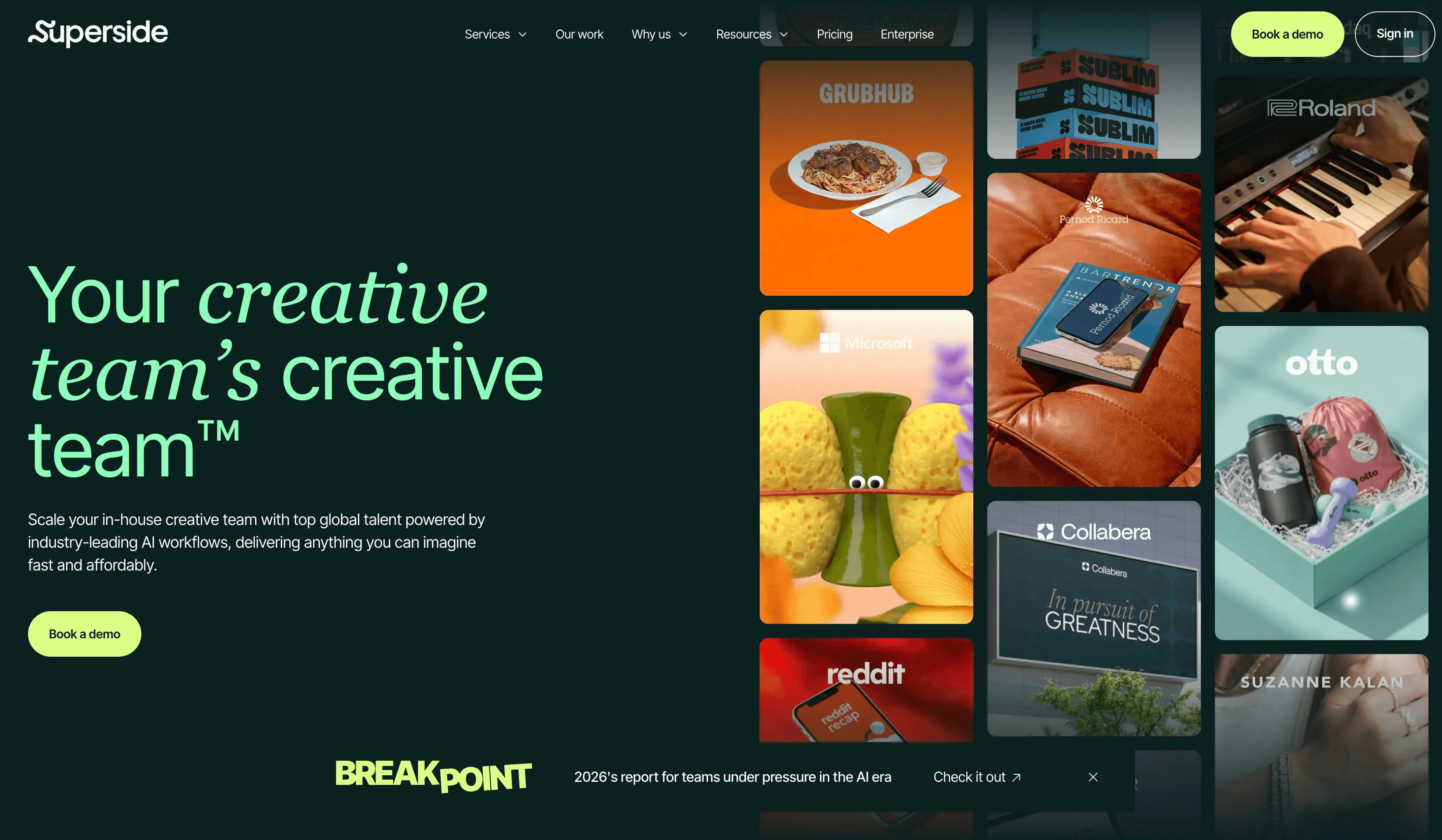
Superside is the best-known subscription design platform at the enterprise end of the market. Their 700-person creative team draws from the top 1% of global design talent, and their pitch deck work is consistently high quality.
The tradeoff is price. Superside's subscription model starts at $10,000 per month. For founders pre-series B, that's likely more than the design budget allows. Superside is best suited to mid-market and growth-stage companies with ongoing, high-volume creative needs across multiple channels.
Pricing: From $10,000/month
Best for: Mid-market and enterprise companies needing high-volume creative output
Prznt Perfect: Best for deep-tech companies with complex stories to tell
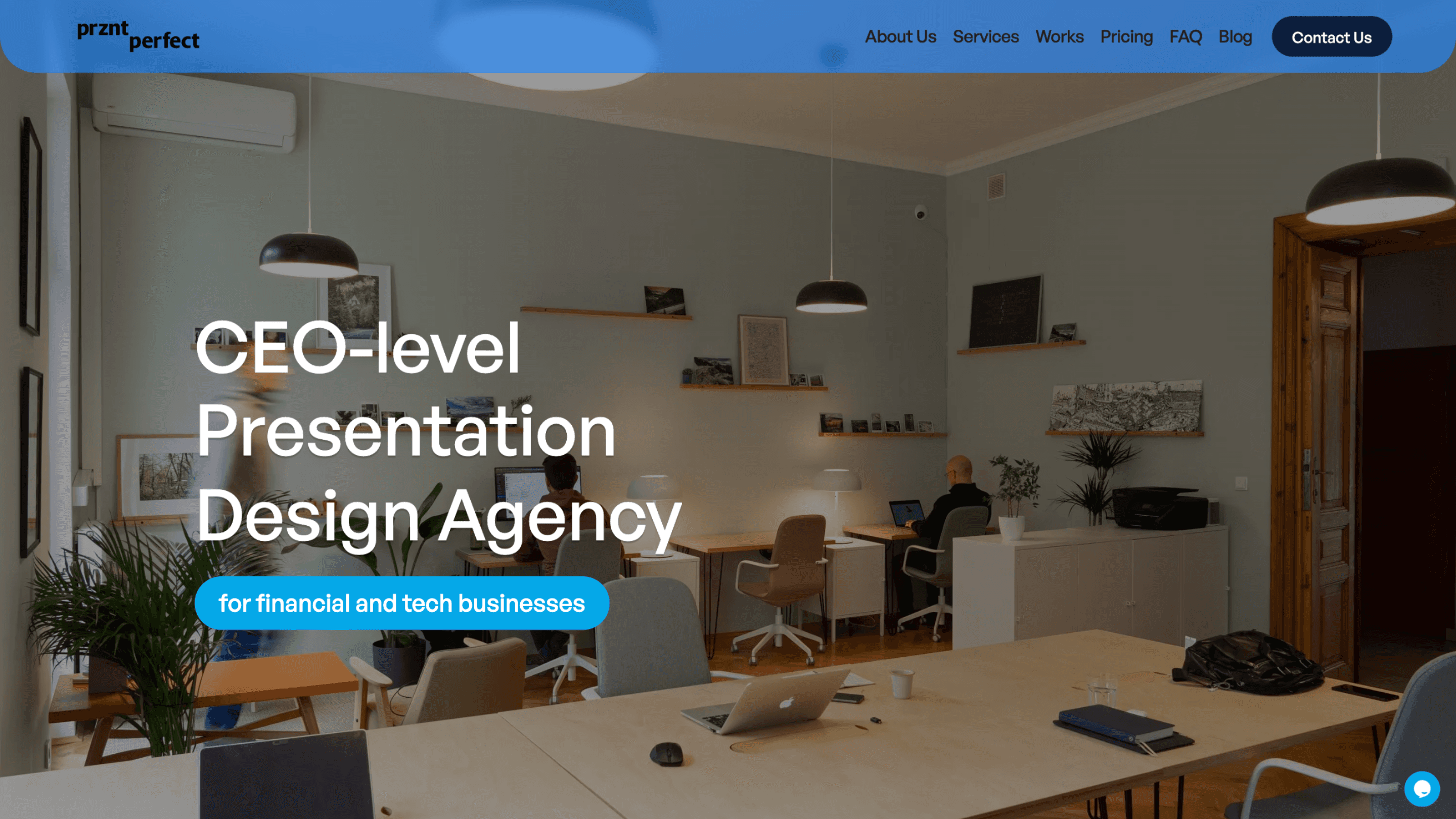
Prznt Perfect designs presentations and brand identities for financial and deep-tech B2B companies, and most of its work is in semiconductors and cybersecurity. The founder has a PhD in computer science and a background in IT R&D and university teaching. Clients include Morse Micro, a Wi-Fi HaLow chipmaker, and the agency says its pitch decks have helped raise $2.3 billion.
Besides investor decks, the studio designs conference and keynote presentations, brand identities and editable PowerPoint templates that your team keeps using after the project ends. It works in two-week design sprints. Companies with a technical product and settled positioning get the most from it. B2C brands and pre-seed startups will get less.
Pricing: From $2,950/month (one two-week sprint)
Best for: Semiconductor, wireless, quantum and security companies preparing for an investor round or a conference keynote
The model is project-based. Founders share their raw slides, the team structures the narrative for investor impact, then delivers polished, custom design.
4. Slidebean
Slidebean is an AI-assisted pitch deck platform that offers both a self-serve tool and a full-service design option. Their annual software plan starts at $149, making it one of the most accessible options for very early-stage founders with near-zero design budgets. Their full-service deck design is priced separately at higher tiers.
The tradeoff is that their process is template-driven. If your startup has a distinct visual identity or needs a custom narrative structure, you'll hit the ceiling of what their model can deliver.
Pricing: From $149/year for self-serve
Best for: Pre-seed founders who need a deck fast on a minimal budget
5. Pitch Deck Creators
Pitch Deck Creators is a Switzerland-based pitch deck agency that covers both design and writing, with $120M+ raised across their client base. They offer pitch deck design, pitch deck writing as a separate service, and a 100% satisfaction guarantee with unlimited revisions until the deck is right. Turnaround is typically 48 hours for initial delivery, with the full project completed within 7 days. The team works across 50+ industries, with clients including Turso, LaunchXR, and Prosper.
Pricing: Upon request (book a discovery call on their site)
Best for: Startups that need both design and writing support, and want fast turnaround with guaranteed revisions
Quick Comparison
Agency | Model | Starting Price | Best For |
|---|---|---|---|
Subscription | $4,995/month | Early-stage startups (full design partner) | |
Subscription | $10,000/month | Mid-market and enterprise | |
Sprint subscription | $2,950/month | Deep-tech and financial B2B | |
SaaS + Service | $149/year | Budget-constrained pre-seed | |
Project | Upon request | Design + writing, 7-day delivery |
How to Choose the Best Pitch Deck Design Agency
There are four things that actually separate good agencies from expensive disappointments. Everything else (the website, the case study videos, the founder testimonials) is noise until these four check out.
Experience
Not general design experience. Startup pitch deck experience. There's a significant difference between a team that has designed beautiful presentations for enterprise sales and a team that understands why your traction slide needs to come before your product slide in certain investor contexts.
Ask directly: "Can you show me three decks from pre seed or seed stage companies that went on to close their round?" If they can't or won't, move on. The portfolio on their homepage is marketing. The funded decks are the proof.
Red flag: agencies whose only startup work is pitch deck redesigns for companies that were already publicly successful. That's survivorship bias, not demonstrated skill.
Pricing
The project-based vs. subscription distinction matters more than the headline number. A project-based pitch deck design service charges you per deliverable. When your lead investor asks for a revised financial model slide three weeks later, that's a new project. When you need a different version for strategic investors vs. financial ones, that's another project.
A subscription model like Zyner's means unlimited revisions and a team that's already up to speed on your company every time you come back with a change. Over a six-month fundraising cycle, the math often favors the subscription.
Pro Tip: Ask any project-based agency what happens if you need significant changes after delivery. If the answer involves additional billing, factor that into the total cost before comparing prices.
Communication
Design is a feedback loop. How the agency handles that loop determines whether the process is smooth or miserable. Ask: Do they work asynchronously via Slack or email? What's the expected turnaround for a revision request? Do you get a dedicated contact or does every message go into a queue?
Agencies that use Slack and Loom for async communication tend to move faster than those relying on email threads and scheduled calls. For founders operating across time zones or at odd hours, async-first communication is not a nice-to-have.
Support
A good pitch deck design company doesn't consider the engagement over when the files are delivered. The real test comes when an investor asks for a follow-up asset, requests a print version, or wants the deck reformatted for a specific presentation context.
Ask whether the agency assigns a dedicated project manager or account manager to your account. Ask what post-delivery support looks like. The answer will tell you whether they think about you as a client or as a completed transaction.
Agency Evaluation Checklist
Use this before signing with any pitch deck design company. Score each item as Pass, Partial, or Fail.
Portfolio includes funded decks from startups at your stage (not just pretty decks)
Agency can articulate narrative strategy, not just visual execution
Pricing model is clearly documented with no scope ambiguity
Revision policy is explicit: how many rounds, at what cost
Turnaround time commitment is in writing
Communication channel matches how you work (Slack, email, portal)
Dedicated project manager or named contact for your account
IP ownership of final files is confirmed in the contract
References from funded founders are available on request
Agency's scope covers what you need beyond the deck (brand, web, product) or they've clearly scoped it out
A credible agency will have clean answers to all ten. If three or more come back vague, that's your answer.
Why Storytelling Is the Real Difference in Pitch Decks
Most founders think investor presentations are about showing traction. Investors think about them differently. They're reading for story pattern recognition, specifically, whether this founder sees the world the way the investor does.
A funded deck tells a three-layer story: the world is changing in a way that creates a specific gap, you are uniquely positioned to close that gap, and the evidence that you're already doing it is real. Every slide feeds one of those three layers. When a slide doesn't serve any of them, it creates noise.
Here's something a lot of pitch deck design services don't acknowledge: investors don't read decks linearly. Research on investor behavior shows they typically go to the problem slide first, then jump to the team slide, then check traction before looping back to the solution. [VERIFY: behavioral pattern widely cited in fundraising literature] Design that supports this non-linear scanning: clear slide hierarchy, self-contained callouts, a team slide that establishes founder-market fit quickly, performs better than design that assumes the investor will read every word in order.
Common storytelling mistakes that great agencies catch:
Leading with the product instead of the problem (investors don't care about features until they care about the pain)
Burying traction in slide 14 (if you have it, show it early)
Making the problem too abstract (a specific example of a real customer experiencing the pain beats a market size stat as an opener)
Presenting the team without founder-market fit context (why are you the ones to solve this?)
Those four aren't the only ones. The full breakdown of 13 pitch deck mistakes founders make adds problems like lazy market sizing and a missing ask, each with a fix you can apply before an agency sees the deck. If the story itself isn't clear yet, work through how to structure a startup story for investors first.
A good pitch deck design agency gets involved in the narrative before opening Figma. If an agency goes straight to visual concepts without asking how you got to this problem and why investors should believe your team can solve it, that's a signal their value is in aesthetics, not outcomes.
Pro Tip: Before any agency briefing, write a one-paragraph answer to this question: "Why will this startup exist in ten years and why is this team the reason?" If your deck doesn't make that paragraph visually obvious, the narrative work isn't done yet.
The Full-Partner Advantage
There's a version of hiring a pitch deck design agency that most founders don't consider until it's too late: what happens after the raise.
You close a seed round. The investor updates go out. Three enterprise prospects you've been warming up ask for your website link. Two candidates for your first engineering hire research your company on LinkedIn and then visit your product page. A journalist asks for a press kit.
All of that surfaces the same brand. If the pitch deck was designed by one agency, the logo by a Fiverr freelancer, and the website by a developer who did their best with what you gave them, you have a fragmented visual identity at exactly the moment you need to look like a real company.
Founders who use a full design partner before and through the raise don't have that problem. Everything (deck, brand, site, product UI) comes from the same creative team with the same visual logic. That coherence isn't invisible to investors. It signals execution.
That's what Zyner is built for. Pre-seed and seed-stage startups that want one creative partner from first pitch through launch and beyond. Book a call to see what that looks like for your specific stage and get 2000$ off!
The Deck Gets You in the Room. Everything Else Gets You the Check.
A great pitch deck design agency gives you the credibility to get in the room. But investors are doing due diligence before and after that meeting: on your site, your LinkedIn, your product, your brand.
Much of that checking happens in your data room. Once an investor is interested, they'll usually ask for your cap table and financial statements, and a disorganized folder can stall a round the deck just opened. If you set up a startup data room before the deck goes out, you can answer that request the same day.
Founders who treat the pitch deck as an isolated deliverable are solving half the problem. The ones who use the deck as the starting point for a coherent creative identity, and find a partner who can build all of it, are the ones who look like fundable companies at every touchpoint.
Choose the agency that helps you look like what you're building, not just what you're pitching.
Frequently Asked Questions
What does a pitch deck design agency do?
A pitch deck design agency combines investor narrative strategy with professional visual design to help founders create presentations that secure funding. Beyond aesthetics, a strong agency structures your story, sequences your slides for how investors actually read decks, and produces a visually credible output that signals founder quality. Some agencies also offer revisions after investor feedback and copywriting support.
How much does it cost to hire a pitch deck design agency?
Pricing varies widely by model. Project-based agencies typically charge between $1,650 and $10,000 per deck depending on scope, slide count, and copy support. Subscription models like Zyner start at $4,995 per month and include unlimited design requests across all your creative needs, not just the deck. Enterprise platforms like Superside start at $10,000 per month. For very early-stage founders with minimal budgets, AI-assisted tools like Slidebean start at $149 per year.
How long does it take to get a pitch deck designed?
Most professional pitch deck design services deliver a first draft within five to ten business days, with full completion (including revisions) taking two to four weeks depending on the scope and feedback cycles. Some agencies like Deckworks guarantee delivery within two weeks. Subscription-based partners like Zyner can onboard within 24 to 48 hours and start delivering designs within the first week.
What is the difference between a pitch deck design agency and a freelancer?
A pitch deck design agency brings a team, a repeatable process, and accountability. A freelancer brings individual skill and lower hourly rates. The practical difference: agencies have frameworks for investor narrative and multiple people checking the output; freelancers execute your brief. For a high-stakes pitch, the process discipline of an agency typically outweighs the cost savings of a freelancer.
Do I need more than a pitch deck for my fundraise?
Yes. Investors review your website, product, and brand before and after every meeting. If your deck is polished but the rest of your digital presence looks unfinished, the credibility gap raises silent questions. The smartest founders work with a design partner who covers the full creative scope: deck, brand, site, and product, so every touchpoint tells the same story.
If the product is the weakest of those four and you would rather hire specifically for it, we rank agencies that specialize in product UI/UX by what they publish as a minimum and how much of their work is design rather than build.


