

Most founders spend months perfecting their pitch deck. The slides are polished. The story arc is tight. The financials look clean. Then an investor says, "Great pitch. Can you send over your data room?" The scramble begins.
A data room for startups is not a formality. It is the second act of your fundraising process. It is where a warm "we're interested" either turns into a term sheet or quietly goes cold. Investors use it to verify what you just told them. How you organize it, what you include, and how quickly you can share it all signal whether your company is a well-run operation or a work in progress.
This guide covers everything: what a data room is, when you need one, exactly what to put in it, which virtual data room tools are worth your money in 2026, and how to set one up so investors spend time evaluating your business rather than hunting for files.
Quick Takeaways
A startup data room is a secure, organized online repository for sensitive business documents shared during fundraising, due diligence, partnerships, or M&A.
The pitch deck opens the door. The data room closes the deal. They serve different purposes.
Build your data room before you start fundraising, not after an investor asks for it.
Investors typically read your cap table and financial statements first, not your pitch deck.
The best virtual data room tools for startups in 2026 range from free (Carta Launch, Papermark) to $250/month (SecureDocs) depending on your stage and security needs.
Organize with a clear folder structure, set granular permissions, enable document tracking, and update it monthly.
Never share your data room link too early. Gate it behind real interest signals.
What Is a Data Room for Startups?
A data room for startups is a secure online space where founders store and share sensitive business documents with investors, lawyers, and strategic partners. It centralizes everything a potential investor needs during due diligence: financials, legal documents, cap table, intellectual property records, contracts, and more.
The concept comes from traditional investment banking, where parties would gather in a physical room to review confidential files during M&A transactions. Today, a virtual data room (VDR) replaces that with an encrypted digital environment that includes access controls, document tracking, watermarking, and audit logs, all accessible remotely.
Think of it as your company's financial and legal filing system, organized specifically for outside review.
Data Room vs. Pitch Deck: What's the Difference?
These two things are often confused, but they do completely different jobs.
Your pitch deck is a sales document. It tells a compelling story about the problem you're solving, the market opportunity, your traction, and why your team can win. It is designed to create excitement and generate interest. It lives at the top of the funnel.
Your data room is a verification document. It exists to prove that the story in your deck is accurate. Investors use it to stress-test your numbers, check your legal structure, review your cap table, and identify anything that might become a problem post-investment.
One gets you in the room. The other gets you the check.
They also call for different skills. Your own team can build the data room, because the work is gathering accurate documents and naming them clearly. The deck is harder to get right in-house, since its design has to carry your argument in the few minutes an investor spends on it.
If yours needs that level of polish before you raise, see what a pitch deck design company charges and how long it takes, and keep the data room work with your team.
Pro Tip: Never send your full data room to a cold investor who has not expressed genuine interest. Share your pitch deck first. Only open your data room once there is real momentum: a second or third meeting, or an investor who has explicitly asked for more information.
When Does a Startup Need a Data Room?
Fundraising (Pre Seed, Seed, and Series A)
This is the most common use case. Whenever you are raising capital, serious investors will conduct due diligence before writing a check. Even at the pre-seed stage, having an organized data room signals that you are operationally mature. According to the Accelerator at WGU Labs, which has made 25 investments since 2019, companies that stand out combine a strong pitch with a well-organized data room.
A pre seed data room does not need to be exhaustive. Even with only a year or less of financial history, investors want to see how you think about your business trajectory and how you are deploying capital.
Series A and Beyond
At this stage, investor scrutiny increases significantly. Monthly KPI reports, board minutes, detailed financial models, and cap table history all come into play. The data room shifts from a simple repository into a living workspace that needs to be maintained and updated regularly.
Mergers, Acquisitions, and Partnerships
When another company wants to acquire you, partner with you, or take a strategic stake, they will run a structured due diligence process. This requires a comprehensive, legally airtight data room with advanced access controls, watermarking, and audit trails that meet compliance standards like SOC 2 and GDPR.
Any Time You Want to Be Ready
The best time to build a data room is before an investor asks for one. Set it up when you have a free week, keep it updated, and you will never find yourself scrambling when fundraising momentum picks up. Investors who have to wait days for basic documents often cool off in that window.
What Should Be in a Startup Data Room?
The Essentials: Documents Every Investor Expects
1. Pitch Deck Include the most recent version. Even investors who have already seen it appreciate having a reference copy in the room.
2. Cap Table Your capitalization table shows who owns what percentage of the company, including founders, employees (stock options), and existing investors. Use a clean, downloadable format. Platforms like Carta make this easy to export or link directly. Any cap table that is confusing, out of date, or hard to read creates immediate friction.
3. Financial Statements Include historical financials (income statement, balance sheet, cash flow statement) and forward-looking projections for the next two to three years. Projections should be ambitious but grounded. Format them so investors can download and run their own scenarios with the numbers.
4. Legal Documents Articles of incorporation, certificate of formation, bylaws, and any board resolutions. Also include any existing shareholder agreements, investor rights agreements, and previous term sheets or SAFEs/convertible notes.
5. Intellectual Property (IP) Documentation Patents (granted or pending), trademarks, and copyright registrations. Also include IP assignment agreements confirming that any IP created by founders or employees is owned by the company, not individuals. Missing IP assignments are a surprisingly common deal-stopper.
6. Team Bios and Org Chart Short bios for founders and key hires, including relevant experience, previous companies, and LinkedIn profiles. Investors back people as much as ideas.
7. Customer Contracts Representative customer agreements (redacted if needed for confidentiality). These demonstrate that you have real, paying relationships rather than verbal commitments.
8. Market Research Third-party research, industry reports, or proprietary data supporting your market size claims. If you made a specific market claim in your pitch deck, back it up here.
Next-Level Documents (Include If You Have Them)
These are not always present at pre-seed, but they strengthen your case significantly at seed and Series A:
Product roadmap: Shows where the product is headed and how you're prioritizing development.
Sales pipeline: Gives investors a view of future revenue potential and product-market fit progress.
Customer references: Qualitative validation from real customers. Even two or three strong reference contacts can carry significant weight.
Traction metrics: Month-over-month growth, churn rate, NPS, DAU/MAU, ARR, or whatever your north star metric is.
Exit strategy: A high-level view of potential acquisition targets or IPO considerations. This matters more at later stages, but even a brief section shows you are thinking long-term.
Copy-Ready Folder Structure
Here is a clean folder structure you can use as a starting point:
Use consistent file naming. "01_Audited_Financials_FY2025.pdf" is far more professional than "Final_FINAL_v3.pdf."
What Investors Actually Read First (And Why It Matters)
Here is something most founders do not know: investors rarely start with your pitch deck when they open your data room. They already know the story. What they want to verify is the foundation beneath it.
Most experienced investors go to the cap table first. They want to know who owns what, whether there are any red flags in the ownership structure (excessive founder vesting cliffs, messy option grants, unclear equity allocations), and whether the company is financeable from a cap table standpoint.
The second stop is usually financials. Not to read a narrative, but to stress-test the numbers. How much runway do you have? What is your burn rate? Are your revenue projections tied to assumptions that hold up?
The practical implication: these two documents need to be your most polished, most accessible, and most up-to-date. If your cap table is confusing or your financial model has obvious errors, it creates doubt about everything else in the room, regardless of how strong the rest of the documents are.
Pro Tip: Use document-level tracking in your VDR to see exactly which files investors open, how long they spend on each one, and whether they come back. An investor who opens your financial model three times in a week is a strong pipeline signal. This is not just data collection; it is a follow-up strategy.
Best Virtual Data Room Tools for Startups in 2026
The right tool depends on your stage, your deal complexity, and your budget. Here is a breakdown of the top options, with verified pricing as of early 2026.
Tool | Best For | Starting Price | Standout Feature |
|---|---|---|---|
Carta Launch | Pre-seed founders already on Carta | Free (under 25 stakeholders / under $1M raised) | Cap table + data room in one platform |
Papermark | Budget-conscious founders, technical teams | Free (basic); paid plans from ~$39/month | Open-source, self-hosting option, page-by-page analytics |
SecureDocs | Seed to Series A, quick setup | $250/month (flat-fee, unlimited users and storage) | 10-minute setup, flat pricing with no hidden fees |
Digify | Startups needing strong document tracking | Starts at ~$130/month | Engagement tracking, watermarking, ISO 27001 certified |
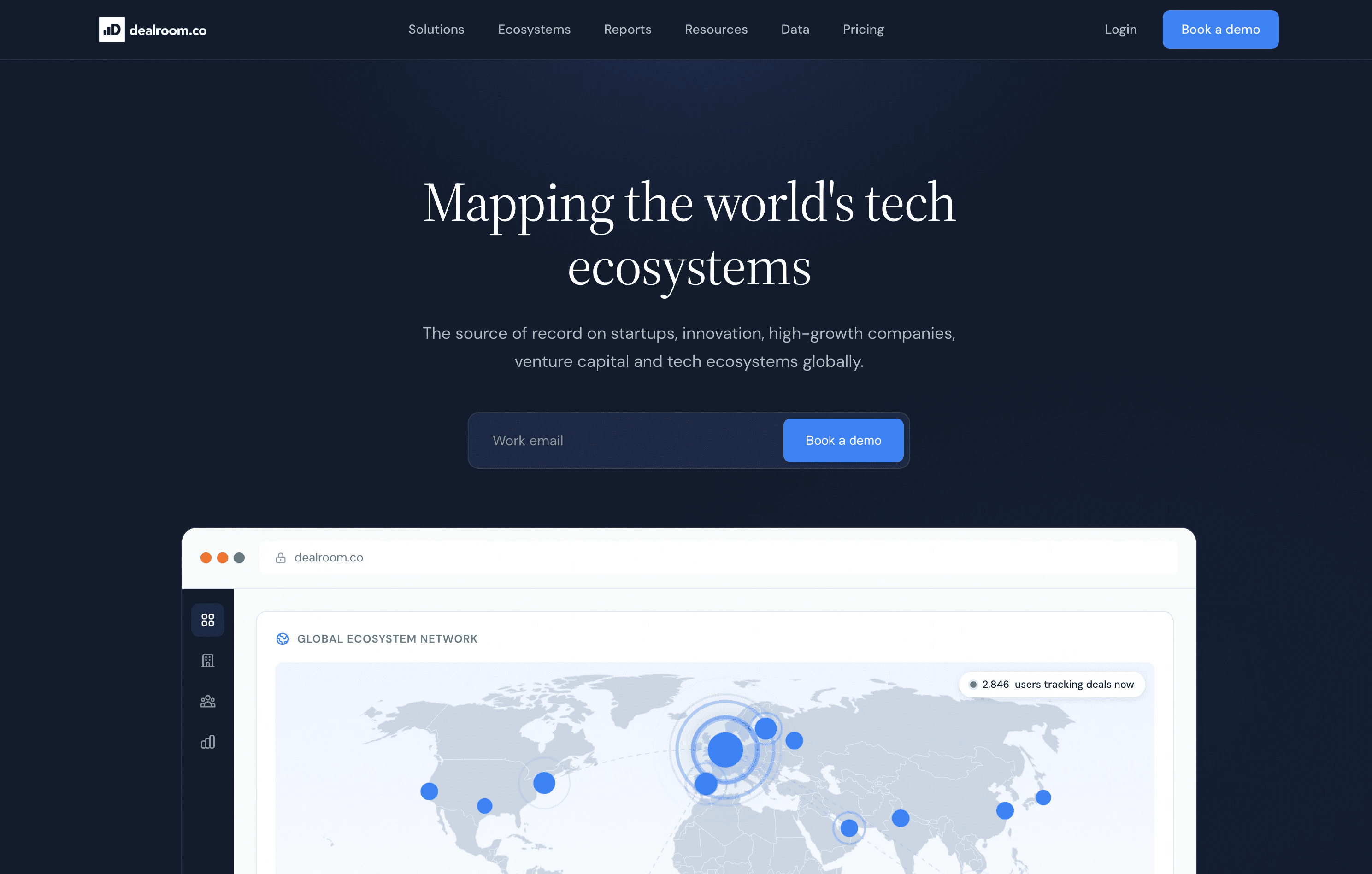
DealRoom | Series B+ or M&A transactions | Starts at $1,250/month (billed annually) | Combines project management with due diligence |
Firmex | Complex deals, larger teams | Custom pricing (typically from $150/month) | Strong security for legal and financial workflows |
Carta Launch
Carta Launch is the easiest starting point for most pre-seed founders. If you are already on Carta managing your cap table, you get a free data room included. It is limited in features but more than sufficient for early fundraising. Carta Launch is available to companies with fewer than 25 stakeholders and under $1M raised.
Papermark
Papermark is an open-source alternative that has attracted significant adoption among cost-sensitive founders. The free tier works for basic document sharing, though you'll want the paid plan for active fundraising to remove Papermark branding and access page-by-page analytics. Technical founders can self-host for roughly $15 to $30 per month on infrastructure costs alone.
SecureDocs
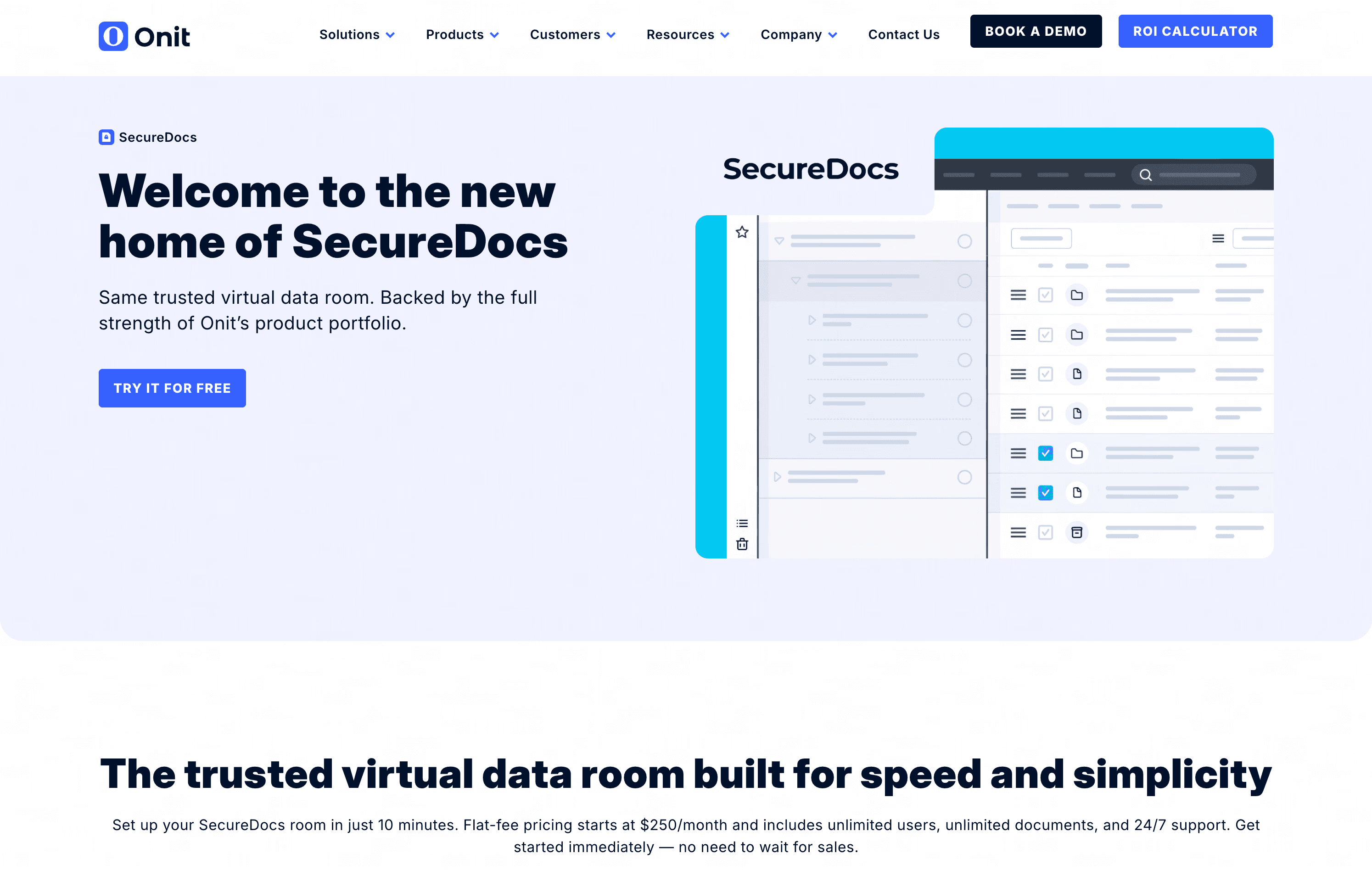
SecureDocs is the strongest option if you want a purpose-built VDR that can be operational in ten minutes with no learning curve. The $250/month flat-rate pricing includes unlimited users and unlimited storage, which makes it predictable. It holds a 4.8/5 rating on G2 based on user reviews. The tradeoff is that it lacks more advanced features like white-labeling and deep workflow automation.
Digify
Digify is trusted by over 600,000 professionals in 138 countries, according to the company, and is a common choice among founders who want strong engagement tracking alongside standard VDR security. It is ISO 27001, GDPR, and HIPAA certified. The pricing is higher than SecureDocs and less transparent, so confirm the current rate directly with them.
DealRoom
Firmex
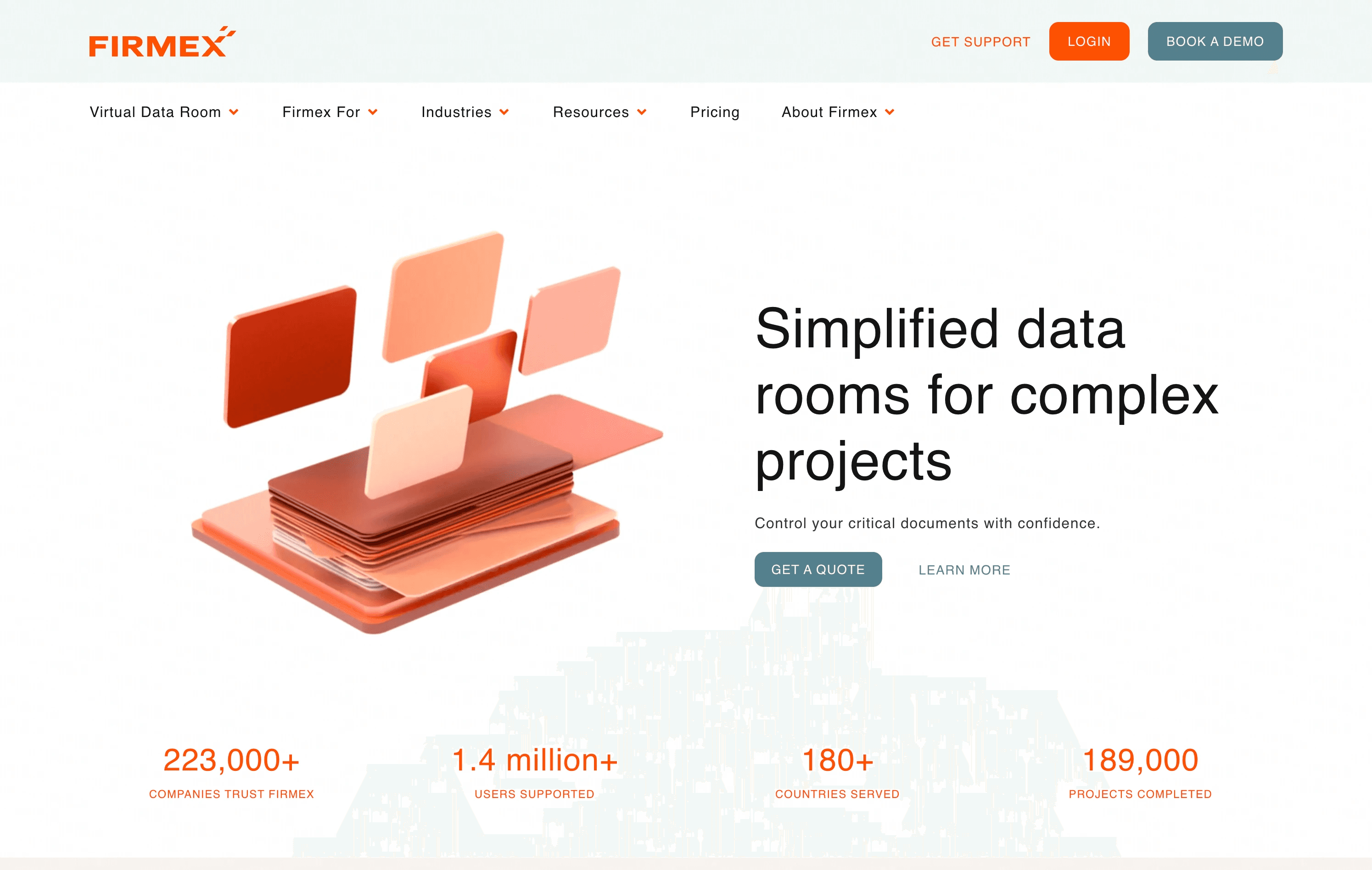
DealRoom and Firmex are enterprise-tier products better suited to late-stage companies running formal M&A processes. For most startups in the pre-seed to Series A range, their cost and complexity are not justified.
How to Set Up Your Data Room: A Step-by-Step Process
Choose your platform. Match the tool to your stage. Pre seed: Carta Launch or Papermark. Seed to Series A: SecureDocs or Digify. M&A: DealRoom or Firmex.
Build your folder structure. Use the template above or adapt it for your business. Consistency and clarity matter more than sophistication.
Name your files properly. Use a numbering system and descriptive names. "03_Shareholder_Agreement_2024.pdf" is infinitely better than "agreement_final2.pdf."
Upload your documents. Start with the essentials. Do not wait until every document is perfect. A mostly-complete data room is better than no data room.
Set permissions by user. Not every investor needs access to every folder. Legal documents may be restricted to later-stage investors or legal counsel only. Use role-based access controls.
Enable document tracking. Turn on audit logs and activity notifications. You want to know exactly who viewed what and when.
Add watermarks for sensitive documents. Financial models, cap tables, and customer contracts should have dynamic watermarks showing the viewer's email address. This discourages unauthorized sharing.
Test the experience. Before you share the link with any investor, run through it as if you were the investor. Is the navigation intuitive? Are all files accessible? Does the room reflect well on your company?
Keep it updated. Set a monthly reminder to refresh financials, add new contracts, and update traction metrics. A stale data room is a liability during active fundraising.
Pro Tip: Do a practice run with a trusted advisor or founder peer before opening your room to investors. Have them flag anything confusing, missing, or unprofessional. What is obvious to you may not be obvious to someone reviewing it cold.
Common Data Room Mistakes Founders Make
Mistake | Why It Hurts | What to Do Instead |
|---|---|---|
Using Google Drive or Dropbox | No audit trails, no granular permissions, no watermarking. Looks unprofessional for serious investor review. | Use a purpose-built VDR with access controls and document tracking. |
Disorganized file naming and structure | Investors who cannot find documents quickly lose patience. Operational messiness reflects on your business. | Use a consistent naming convention and logical folder hierarchy from day one. |
Sharing the link too early | Giving data room access before an investor has shown real interest wastes your time and theirs. | Require at minimum a second meeting or explicit "tell me more" before sharing. |
Outdated documents | Six-month-old financials or a cap table from a previous round creates confusion and erodes trust. | Update the room monthly. Date your documents clearly. |
No permission controls | Sending a single link with no restrictions means anyone can share it with anyone. | Set individual user permissions so you control exactly who sees what. |
Missing IP assignment agreements | Investors and acquirers will flag unassigned IP as a legal risk. This can delay or kill deals. | Ensure all founders and early employees have signed IP assignment agreements before fundraising. |
Frequently Asked Questions
Is Google Drive good enough for a startup data room?
Google Drive is not adequate for serious investor due diligence. It lacks audit trails, granular permission controls, watermarking, and the compliance certifications that investors and lawyers expect during due diligence. It is fine for internal team collaboration. For fundraising or M&A, use a purpose-built virtual data room. Platforms like Carta Launch, Papermark (free tier), and SecureDocs provide the security and tracking features Google Drive does not.
Do I need a data room if I'm pre-revenue?
Yes. Even without revenue, investors expect to see your incorporation documents, cap table, financial projections, team bios, and IP documentation. A well-organized data room at the pre-revenue stage signals operational maturity and makes due diligence faster. The WGU Labs Accelerator notes that pre-seed and seed-stage companies with strong data rooms stand out precisely because most early-stage founders have not prepared one.
What is the best free data room for startups?
Two strong free options exist in 2026. Carta Launch offers a free data room for companies with fewer than 25 stakeholders and under $1M raised. It integrates directly with your cap table. Papermark offers a free tier for basic document sharing with tracking, though the Papermark branding appears on shared links until you upgrade. For founders who need more control, Papermark's open-source version can be self-hosted at infrastructure cost only.
How do I share my data room with investors?
Create a unique access link or individual user invitations for each investor or investment firm. Use your VDR's permission settings to control what each party can see. Never share a single open link publicly. Send access directly after confirming genuine interest. Include a brief note explaining what is in the room and flagging any particularly relevant documents (e.g., "Section 02 has our most recent financial model with updated projections"). Use tracking notifications to see when they open it.
How often should I update my data room?
At minimum, monthly. Financial statements, runway figures, and traction metrics go stale quickly. Any time you close a new customer contract, complete a new financing, or hire a key person, update the relevant documents. During an active fundraising round, check the room weekly. Treat it like a living document, not a one-time deliverable.