Latest Update:
Best UI UX Design Agencies in San Francisco 2026 (Ranked)

Growth Manager

Search for a UI/UX design agency in San Francisco and you get two kinds of results. Directory listings ranked by review volume, and agency-written lists where the author happens to come first.
This one puts Zyner first too. We think that is defensible for the reader we write for, and we have flagged it in our own profile so you can discount it as you see fit.
What we tried to do differently is check things. Every office address below was verified against the company's own website on September 4, 2026. Price bands and team sizes come from Clutch. Client names come from each agency's own work pages, read the same day. Where a firm publishes nothing, we say "not published" instead of writing "custom."
One column is worth explaining before you scroll. Clutch reports what share of each firm's business is UX/UI work. Neuron and 415Agency are at 100%. ArcTouch is at 20%. That single number tells you whether you are hiring a design specialist or buying design as a line item inside a bigger build, and it changes who shows up to your kickoff.
Quick takeaways
"San Francisco" describes four different arrangements: a headquarters, one studio among several, a rented meeting room, and a mailing address. Check which one you are buying.
Published minimums here run from $10,000 to $100,000. Three firms publish nothing.
Clutch's UX focus percentage separates specialists from generalists faster than any portfolio review.
The people who pitch are frequently not the people who design. Ask before you sign, not after.
A project engagement and a design subscription answer different questions. The deciding factor is whether your design queue has an end date.
What a UI/UX design agency does
A UI/UX design agency designs how people use a digital product: websites, apps, dashboards, internal software.
UX is the logic. Where things live, what happens when you click, whether a first-time user finishes the task without help. UI is the surface layer of that: layout, type, color, components, states.
Most agencies claim both. The ones worth hiring start with research, and they can show you what they changed after the research contradicted the original brief. If you want the mechanics, we wrote a step-by-step guide to the UI/UX design process.
Does your UI/UX agency need to be in San Francisco?
Usually not. It depends what you are buying.
Three situations make a local team genuinely worth the premium. In-person user research where you need to watch someone's hands and face rather than their video tile. Multi-stakeholder workshops where the real deliverable is eight people leaving the room agreeing. Hardware work, where somebody has to hold the thing.
Outside those, a shared timezone does most of the work a shared city was supposed to do. A designer in Denver and a designer in the Mission both make your 10am standup.
The premium is measurable. Clutch hourly rates for the San Francisco firms in this list cluster at $150 to $199. Comparable teams elsewhere routinely publish $50 to $99. On a 400-hour engagement, that is a $40,000 difference for the same hours.
The 10 best UI/UX design agencies in San Francisco
Ranked for growth-stage startups and product teams, which is who we write for. An enterprise procurement lead would order this differently, and should.
1. Zyner

Location | 44 Montgomery Street, San Francisco, CA 94104. Design team works remotely. |
Entry price | Subscription. Ask for current terms. |
UX share of business | Part of a wider creative scope |
Best for | Product UI/UX alongside brand, web, and campaign work |
Design demand at a growing company rarely arrives as one clean project. Product screens, a fundraising deck, three landing pages, and a launch video can land in the same month. Sent to four different vendors, they come back in four different visual languages, and somebody on your team spends their week reconciling them.
Zyner runs as a creative subscription. Requests go through Slack. Senior designers do the work, a fractional creative director holds the direction steady across everything, and a project manager runs the queue. UI/UX design sits alongside brand identity, Framer websites, presentations, motion, and campaign creative.
The model suits a continuing queue rather than a defined project with an end date. If you have one product problem and a clear finish line, a project agency from this list will serve you better, and we would tell you that on the call.
Also covers: brand identity, Framer web design and development, pitch decks, motion, social and ad creative.
Recent work: Linesight, Archil, Kaigo Health, Swift Ventures.
Watch out for: we publish this article, so treat our placement accordingly. Apply the same checks you would apply to anyone else here, starting with the work and the specific people who would be assigned to you.
Book a call if your design queue does not have an end date.
2. 415Agency
Location | San Mateo on the company site. Clutch and Expertise.com list San Francisco. |
Entry price | $10,000+, $100 to $149/hr (Clutch) |
Team size | 10 to 49 |
UX share of business | 100% |
Best for | Products used by patients, clinicians, and care teams |
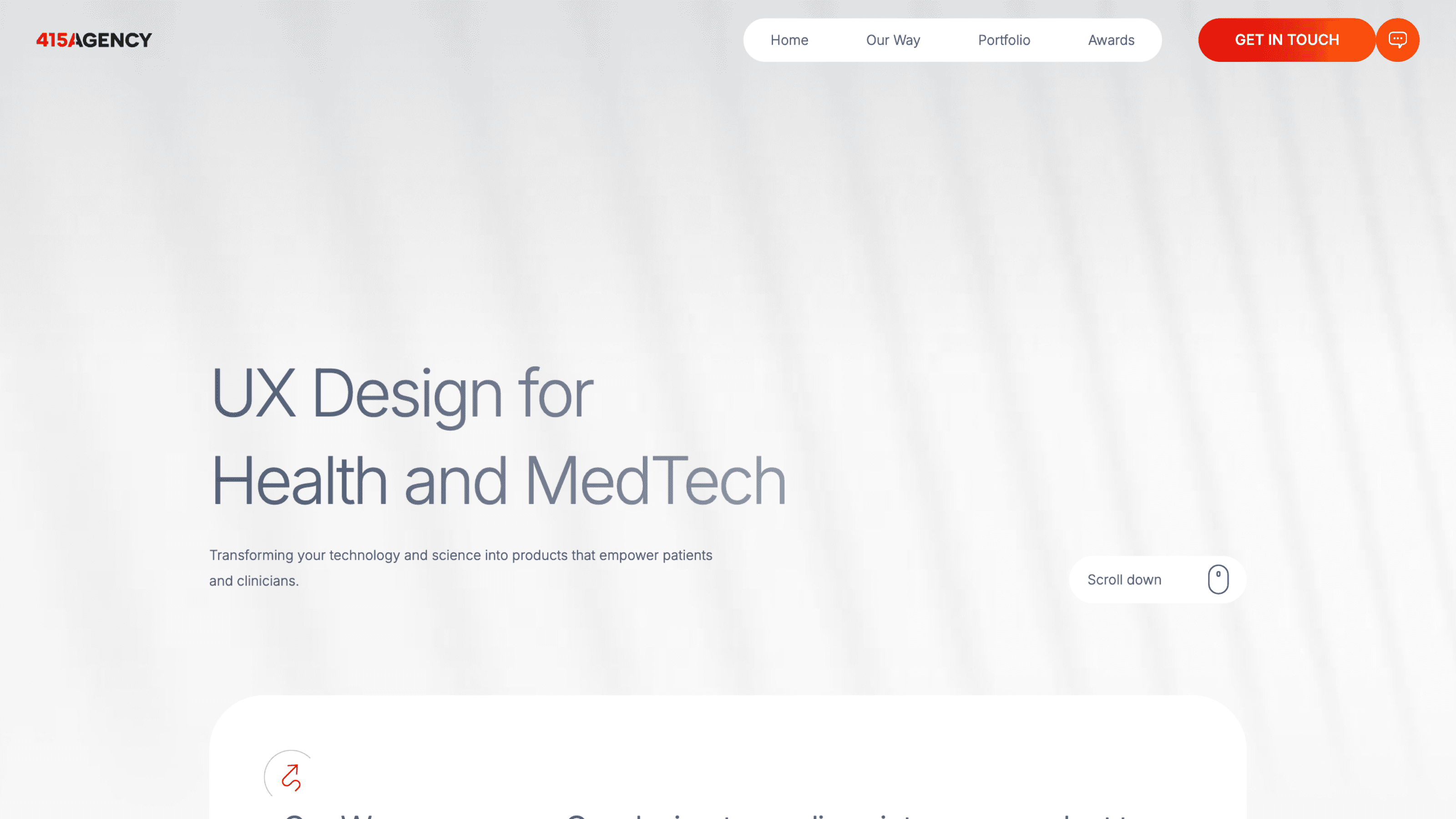
415Agency stays inside health and does not pretend otherwise. Their site talks about clinical workflow analysis, care coordination, connected devices, human factors, and the FDA, HIPAA, and EU MDR constraints that shape all of it.
Two things make them unusual here. Clutch puts them at 100% UX focus, so you are not buying design as an add-on to a development contract. And their $10,000 minimum is the lowest published on this list, which puts a specialist within reach of a company that cannot commit $50,000.
They list awards from UX Magazine, AIGA, European Healthcare Design, and Awwwards, which tells you the work is credible in both design and health circles.
Also covers: clinical workflow and task analysis, human-factors work, accessibility reviews, product documentation.
Watch out for: the location conflict is unresolved. Their own site says San Mateo while two directories say San Francisco, so ask directly if it matters to you. Separately, a general UX engagement does not automatically produce submission-ready evidence. Get the regulatory deliverables named as line items.
3. DesignMap

Location | San Francisco. Expertise.com lists 700 Alabama Street. |
Entry price | Not published |
Team size | Three senior partners |
Best for | Enterprise software teams stuck on direction rather than execution |
DesignMap is three senior partners with no handoff to a junior team. Their framing is that design is a leadership problem before it is a deliverable, and engagements start with the decision the leadership team is avoiding.
The client list backs the positioning. They worked on ExactTarget's platform direction before Salesforce acquired it for $2.5 billion. They partnered with Docker's design leadership through hypergrowth, including Docker Hub. CloudGenix, acquired by Palo Alto Networks, was another. Cisco Meraki, Google's Area 120 incubator, and Octave Bioscience round it out.
Hire them when the honest problem is that four executives want four different products. Do not hire them to draw screens you have already specified.
Also covers: design leadership coaching, changing how internal product teams work.
Watch out for: three partners means real capacity limits. Ask about availability before you build a roadmap around their involvement, and note that they publish no pricing at all.
4. Neuron
Location | 650 California Street, Floor 7, San Francisco, CA 94108 |
Entry price | $25,000+, $150 to $199/hr (Clutch) |
Team size | 10 to 49 |
UX share of business | 100% |
Best for | Dense SaaS, internal tools, data-heavy interfaces |
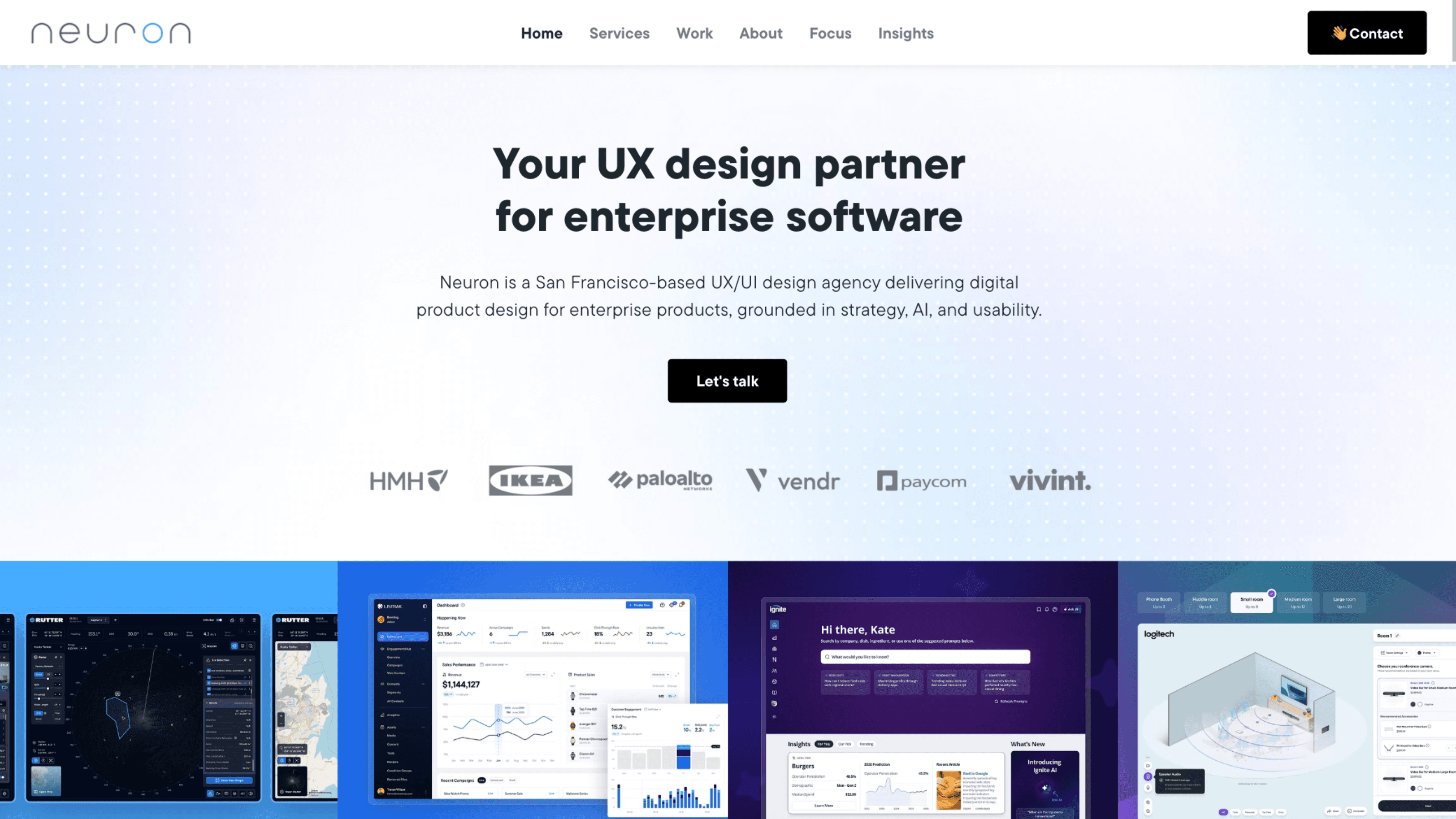
Neuron works on software people sit in front of for eight hours a day. Marketing automation, medical device sales CRMs, SaaS procurement workflows, publishing DesignOps. Named work includes Listrak, AcuityMD, and Houghton Mifflin Harcourt.
Their capability list runs past interface design into UX audits, data visualization, design systems, usability testing, accessibility, and front-end engineering. For a product with forty screens and a permissions model, that depth matters more than visual polish.
They rank first in this SERP, and the mechanics are worth noticing if you are also doing SEO: a real street address marked up in LocalBusiness schema, a published phone number, and structured review data.
Also covers: product strategy, user research, DesignOps, journey mapping, usability analysis.
Watch out for: the 4.9 rating across 15 reviews comes from Neuron's own published data, not an independent audit, so read the underlying Clutch reviews yourself. And ask which research activities are included and who recruits participants. Research scope is where these engagements expand.
5. Punchcut
Location | 150 California Street, 9th Floor, San Francisco, CA 94111 |
Entry price | Not published on Clutch |
Team size | 50 to 249 |
UX share of business | 25% |
Best for | One product across phone, desktop, TV, car, and wearable |
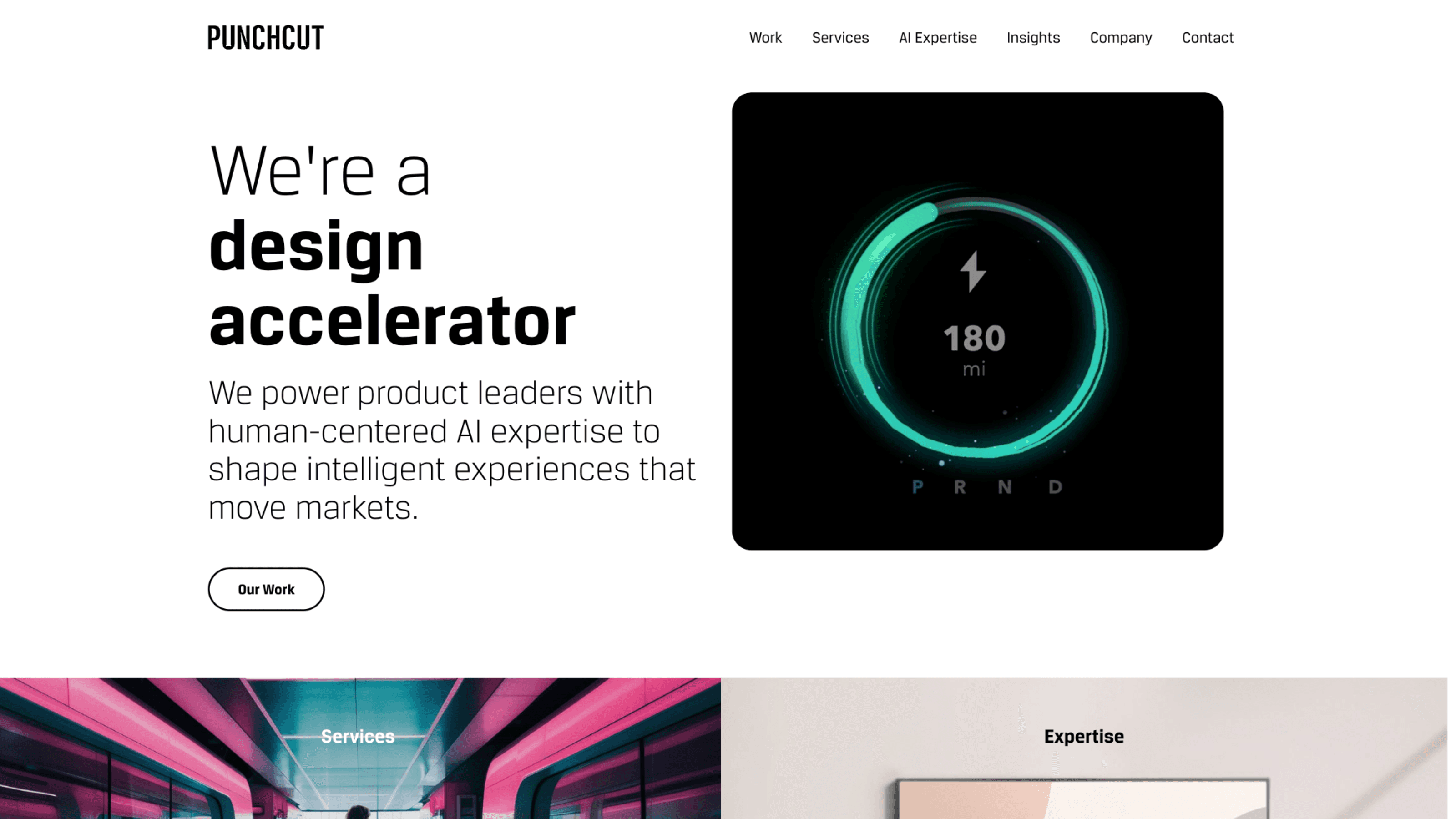
Punchcut was founded in San Francisco and stayed. Their focus is interfaces that behave consistently across device types, which is a materially different problem from designing one web app well.
The work shows it: Fitbit wearables, AWS SageMaker Studio, Nissan automotive interfaces, LG connected-home robots. They organise their practice by sector rather than by deliverable, covering AI, enterprise, finance, health, immersive, media, mobility, and technology.
Also covers: design systems, prototyping, spatial and emerging-interface work.
Watch out for: their Clutch profile withholds both pricing and hourly rate, and captured contact records have shown a Washington DC address alongside the San Francisco one. Confirm where your assigned team actually sits. At 25% UX focus they also do a lot of adjacent work, so ask what share of your engagement is interface design.
6. Clay
Location | 300 Broadway, San Francisco |
Entry price | $50,000+, $150 to $199/hr (Clutch) |
Team size | 10 to 49 |
UX share of business | 30% |
Best for | Scale-ups redoing brand, site, and product at once |
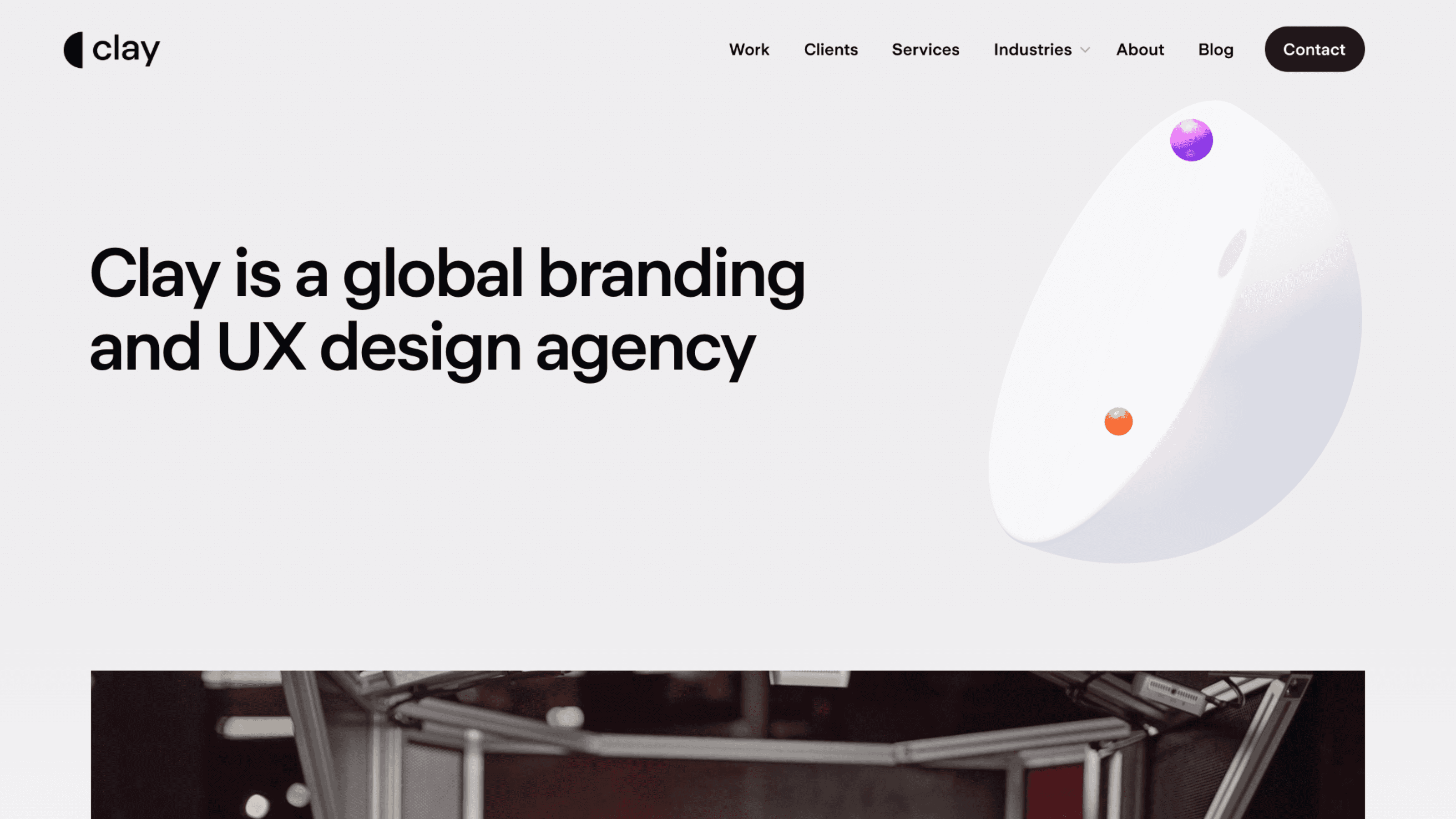
Clay makes the marketing site, the onboarding flow, and the product interface look like one company built them. That coherence is the reason to pay their rate.
The client list is the strongest here by conventional measures: Slack, Stripe, Coinbase, Google, Meta, Amazon, Sony, Uber, Samsung, Toyota, Okta, Snapchat, Fiverr, Credit Karma, Marqeta, VMware, T-Mobile, Cisco.
At 30% UX focus, a meaningful share of what they sell is brand and web rather than product design. That is exactly right if you want everything moving together, and wasteful if you only need the product fixed.
Also covers: brand strategy and identity, web design and development, motion, content.
Watch out for: you are paying for breadth whether or not you use it. A contained usability study or a single feature redesign does not need Clay, and their $50,000 minimum will price it accordingly.
7. Ramotion
Location | Remote-first. San Francisco meeting space at 28 Geary Street. |
Entry price | $50,000+, $150 to $199/hr (Clutch) |
Team size | 10 to 49 |
UX share of business | 40% |
Best for | Teams that need a documented system, not just screens |
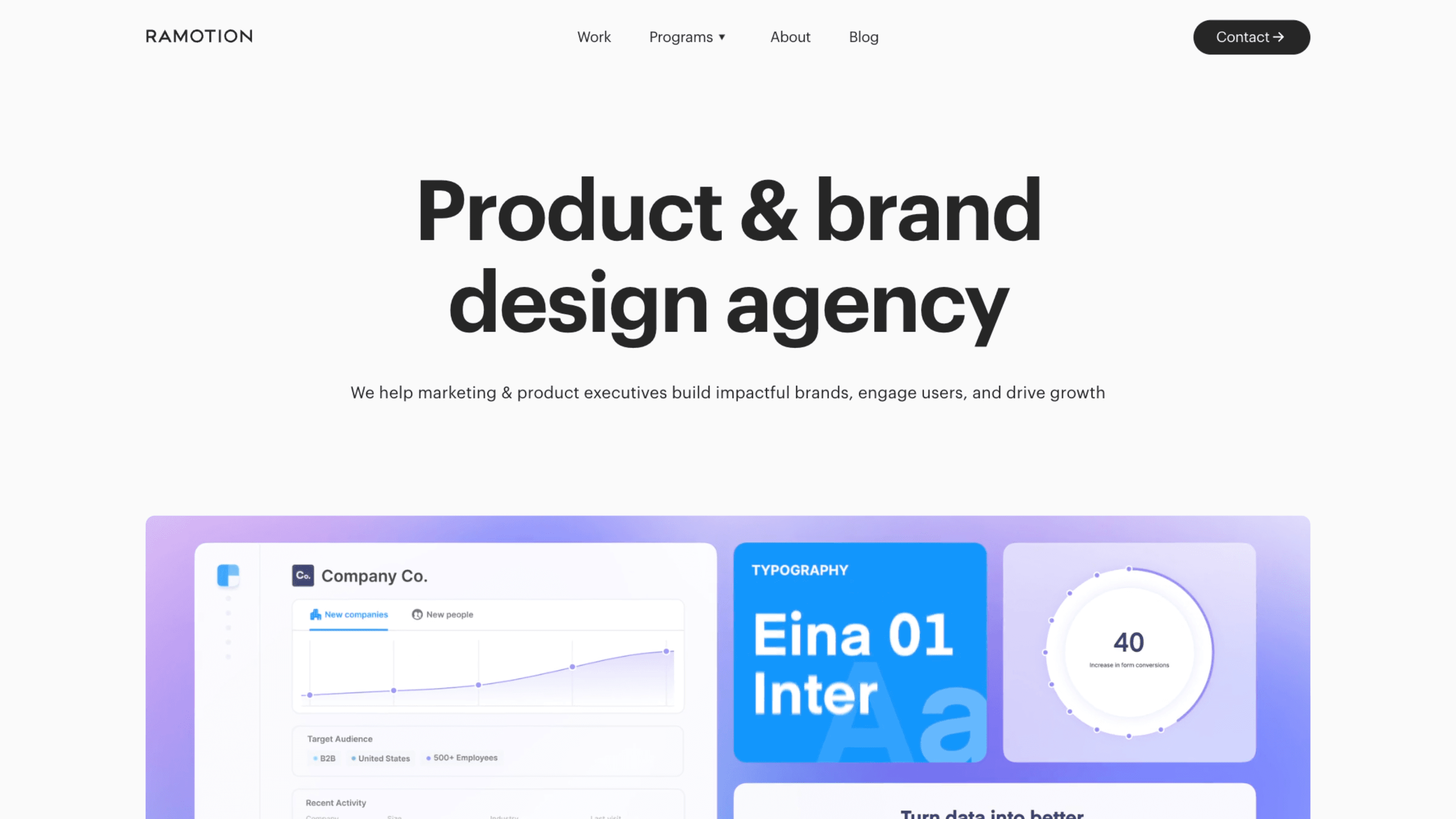
Ramotion builds visual systems that survive contact with a growing engineering team. Their process runs discovery, information architecture, wireframes, interface design, prototypes, system documentation, and developer handoff.
The documentation is the part worth paying for, and it is the part most agencies quietly leave out of the scope. Their client list includes Netflix, Stripe, Adobe, Mozilla, Salesforce, Okta, Crunchbase, Citrix, Descript, Redis, Streamlit, and Turo.
Also covers: brand identity, website design, front-end support, motion.
Watch out for: remote-first means the San Francisco address is a meeting space, which they say openly. Confirm whether the proposal includes research recruitment, copywriting, and implementation support, or ends at handoff. Those three exclusions account for most scope disputes in system work.
8. Delve

Location | 2225 3rd Street, San Francisco, CA 94107. Also Boston, Madison, Philadelphia. |
Entry price | $50,000+ (Clutch). Hourly undisclosed. |
Team size | 50 to 249 |
UX share of business | 30% |
Best for | Products where software meets a physical device or a regulator |
Delve runs strategy, research, design, and engineering across four studios and roughly 200 people. Their range extends past screens into industrial design and regulated medical work, which very few firms on this list can say.
The portfolio reflects it: Dexcom, Biomeme, Lazurite, BD, Breas, alongside consumer work for Converse, Fiskars, and Erewhon.
Worth a call if your product has a physical component or a compliance pathway. Oversized for a pure SaaS interface.
Also covers: industrial design, mechanical and software engineering, research, service design.
Watch out for: San Francisco is one office of four, so ask which studio staffs your project and where the working team sits day to day. At 30% UX focus, design is one service inside a broader product development business.
9. ArcTouch
Location | 548 Market Street, San Francisco |
Entry price | $100,000+, $50 to $99/hr (Clutch) |
Team size | 250 to 999 |
UX share of business | 20% |
Best for | Funded teams that want one partner from design through launch |
ArcTouch pairs product design with engineering, which closes the handoff gap where most product timelines slip. They can carry a product from discovery through interface design, development, QA, and launch. Named clients include SKIMS, Trupanion, 3M Filtrete, and Common Sense Media.
Read the two numbers together. The $100,000 minimum is the highest here and the $50 to $99 hourly rate is the lowest, which tells you these are large engagements rather than expensive ones. You are buying a lot of hours, most of them engineering.
Also covers: mobile and web development, connected products, backend, accessibility, QA, launch support.
Watch out for: ArcTouch now operates as an AKQA studio, which places it inside WPP. That brings scale and changes the ownership picture, so ask how it affects team continuity. At 20% UX focus this is a development company that designs, and their proposal should price discovery, design, development, QA, and support as separate lines. Otherwise you cannot compare them to a design-only firm.
10. IDEO
Location | 350 Florida Street, San Francisco, CA 94110 |
Entry price | Custom, not published |
Team size | 500 to 1,000 |
Best for | Organizations that have not decided what to build |
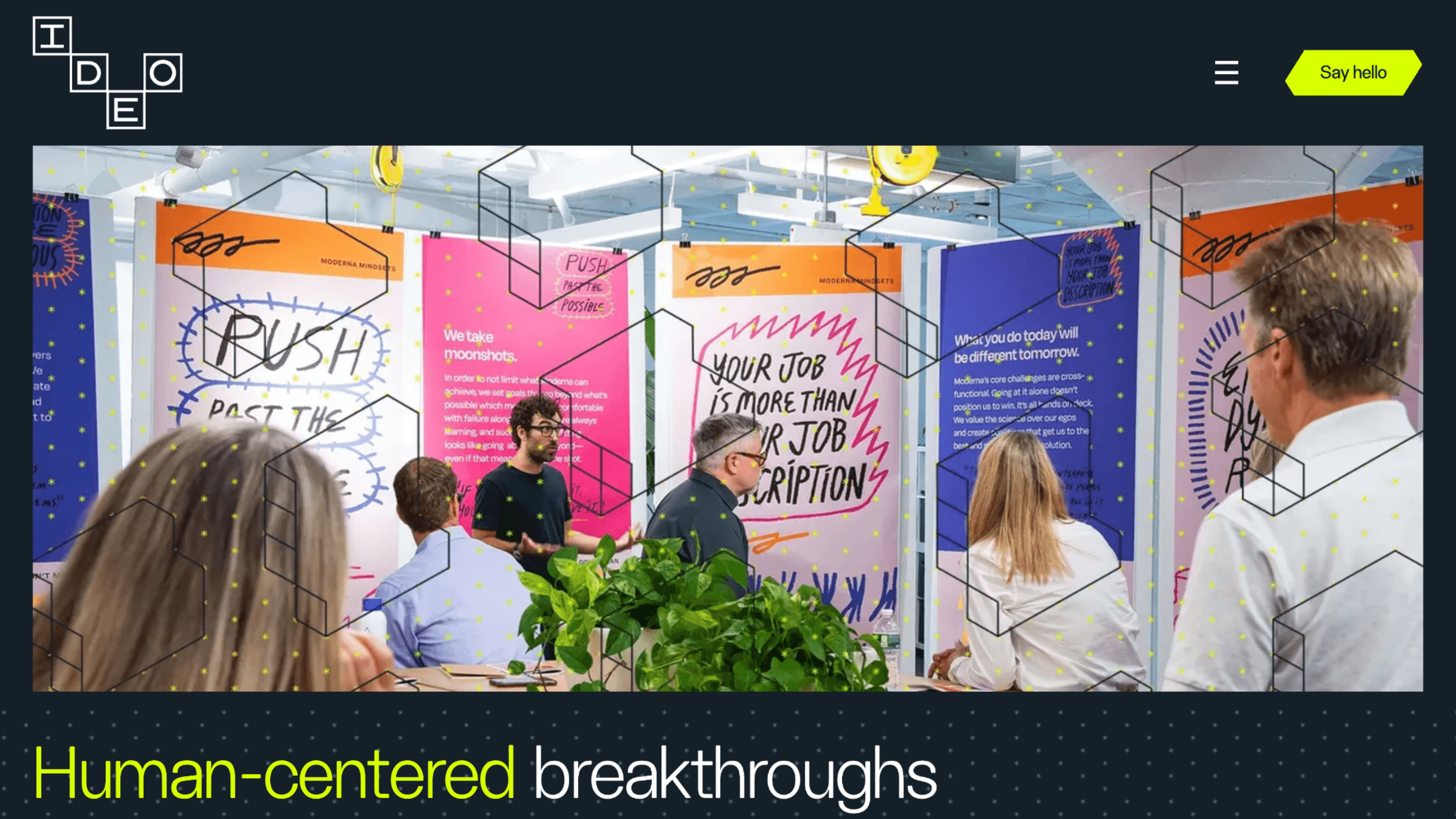
IDEO is the wrong hire when you have a spec. It is the right hire when the real question is which of five directions the company should commit to and nobody internally can settle it.
They wrote the design thinking playbook the rest of the industry now uses, and the San Francisco studio hosts events and workshops with local leadership across strategy, technology, and product.
Also covers: innovation and business strategy, service design, organizational design, capability building.
Watch out for: the output can be strategic rather than buildable. Ask what percentage of the budget goes to research and strategy versus designed artifacts, and be specific about what your engineering team receives at the end. Pricing is fully custom, so expect the process itself to take time.
Comparison table
Agency | Verified location | Entry price | Hourly | Team | UX focus | Choose them when |
|---|---|---|---|---|---|---|
Zyner | 44 Montgomery St, SF | Subscription | n/a | Senior team + PM | Part of wider scope | Design requests keep arriving across disciplines |
415Agency | San Mateo (directories say SF) | $10,000+ | $100-$149 | 10-49 | 100% | Your product is clinical or regulated health |
DesignMap | San Francisco | Not published | Not published | 3 partners | Strategy-led | Leadership cannot agree on what to build |
Neuron | 650 California St, SF | $25,000+ | $150-$199 | 10-49 | 100% | The product is dense B2B software or internal tooling |
Punchcut | 150 California St, SF | Not published | Not published | 50-249 | 25% | One product spans phone, TV, car, wearable |
Clay | 300 Broadway, SF | $50,000+ | $150-$199 | 10-49 | 30% | You are rebranding and redesigning at once |
Ramotion | Remote, SF meeting space | $50,000+ | $150-$199 | 10-49 | 40% | Design has drifted and needs a documented system |
Delve | 2225 3rd St, SF | $50,000+ | Undisclosed | 50-249 | 30% | Software is attached to hardware or an FDA pathway |
ArcTouch | 548 Market St, SF | $100,000+ | $50-$99 | 250-999 | 20% | You want one partner through to shipped code |
IDEO | 350 Florida St, SF | Custom | Not published | 500-1,000 | Strategy-led | The strategic question is genuinely unsettled |
Price bands, team sizes, and UX focus percentages come from Clutch. Addresses come from each company's own website. Both checked September 4, 2026. These are comparison inputs, not quotes.
How we picked these ten
We started from the firms that appear repeatedly across San Francisco UX rankings and directory listings, then applied four filters.
A verifiable local presence. Every address here was checked against the company's own website on September 4, 2026. Where a firm's site and the directories disagree, as with 415Agency, we say so instead of picking the answer that suits the list.
Currently operating as an independent brand. We excluded YML, which merged with Code and Theory in 2023. We kept ArcTouch and noted that it now operates as an AKQA studio, because the work continues under that name.
Published evidence of the work. Client names in each profile come from the agency's own portfolio pages, read the same day. We did not repeat claims we could not see on a primary source.
Relevance to a growth-stage product team. This is who we write for. Firms that only serve enterprise procurement are here with that limitation stated rather than left off.
Pricing and team size come from Clutch, which normalizes those figures across providers. We did not test these agencies as a client. This is desk research, and you should still take your own references.
What to budget by stage
Public minimums tell you where the door is. They do not tell you what your money buys.
Under $25,000. A UX audit, a research sprint, or one contained flow redesigned and tested. Realistic entry points at this level are 415Agency and Neuron. This buys clarity, not a finished product.
$25,000 to $50,000. A focused product redesign, or a design system for a small product. You will get a senior designer for a defined period rather than a full team.
$50,000 to $150,000. A full product design engagement with research, interface design, prototyping, and a documented handoff. This is where Clay, Ramotion, and Delve operate.
$150,000 and up. Design plus engineering, multi-platform work, or an enterprise platform. ArcTouch's minimum sits here and IDEO's strategic engagements typically exceed it.
If your need is continuous rather than a single project, run the comparison over twelve months instead of per project. Four separate $30,000 engagements plus the internal coordination they each require is a different purchase from a retained team, even when the annual total looks similar.
How to choose
Portfolio and reviews are where everyone starts. They are also where most people stop, which is why these engagements go wrong in month three rather than week one.
Process
Ask how a project starts. You want to hear about research, discovery, and specifically what they do when the research contradicts the brief. A team that goes straight to wireframes is designing from your assumptions, and your assumptions are the thing you are paying to have tested.
Then ask for a real example. Not the methodology slide. An actual project where the plan changed and why.
Portfolio
Look for case studies with a stated problem and a stated outcome, not galleries of finished screens. Check whether the work resembles yours in complexity rather than in industry. A beautiful consumer app tells you very little about whether a team can handle a permissions model and a settings hierarchy.
The Clutch UX focus percentage is a useful cross-check here. A firm at 100% has been solving interface problems all year. A firm at 20% has been mostly doing something else.
Scope
Write down what you will need over the next six months. If that list includes brand, a website, and a pitch deck alongside product design, an agency that only does interfaces leaves you managing three vendors and reconciling their work yourself. That reconciliation is real work, and nobody prices it.
References
Ask for two or three and ask them about the difficult parts. How scope changes got priced. What happened when feedback ran late. Whether the senior people who pitched stayed involved after kickoff. None of that appears on a testimonials page.
Checklist before you sign
Run through this before anything is signed.
Decide whether you need UI/UX only, or brand and web and launch collateral too.
Set your budget range before an agency shapes the scope around what you will pay.
Ask to meet the people who will do the work, and get their names in the statement of work.
Confirm you own the source files, component library, and research artifacts at the end.
Get the revision policy in writing, and what counts as a scope change.
Agree on response times and review cadence before kickoff.
Read the contract for charges around travel, research recruitment, and post-launch support.
Call two or three references and ask them about the difficult parts.
Check they understand runway, shifting priorities, and limited review time.
If in-person matters, name which sessions happen in person and put it in the proposal.
Questions to ask before you hire
Who exactly works on this, and can I meet them first? The most useful question here. Senior people pitch, junior people execute, and the gap between the two is where most disappointment lives.
What does discovery look like for a project like mine? A real answer names methods, participant counts, and outputs. A vague one means discovery is a line item rather than a practice.
How do scope changes get priced? Every project changes. You are asking what happens when it does, and whether you find out before or after the invoice.
What is the first useful deliverable, and when? Push on "useful." A prototype you can test beats a mood board you can admire.
What are you not good at? Strong teams answer this quickly. An agency that claims to do everything well has not thought about it.
What do you need from us? Good partners have requirements of their own: one decision-maker, access to users, feedback inside a week. Silence here means they have not planned for your side of the work.
Which parts of this happen in San Francisco? If you are paying Bay Area rates, get specific about which sessions are in person and who is in the room.
Making the decision
The right agency for a six-person startup is almost never the right agency for a 500-person company, and most of the frustration in this category comes from ignoring that.
Be honest about three things. What stage you are at. What your design queue actually looks like over the next six months rather than the next six weeks. How much of your team's time can go to managing someone external. Those answers cut this list to two or three names within an hour.
If you have one defined product problem with a clear finish line, hire a project agency from this list and use the brief above to compare them properly.
If design requests keep arriving across product, brand, web, and launch, a retained or subscription arrangement covers more ground with fewer relationships to manage. That is the case Zyner is built for, and we will tell you on a call if your situation points elsewhere.
Frequently asked questions
What is the difference between UI and UX design?
UX is how a product works: flows, structure, whether someone can finish what they came to do. UI is how it looks and responds, meaning layout, type, color, components, and states. Most product problems are UX problems wearing UI clothing, which is why redesigning the visuals rarely fixes a drop-off. Our guide to user experience covers this properly.
How much do UI/UX design agencies in San Francisco cost?
Published Clutch minimums among these firms run from $10,000 to $100,000, and hourly rates from $50 to $199. Three publish nothing. Expect $150 to $199 an hour from an established San Francisco design specialist, and treat every directory figure as a starting point rather than a quote.
How do I verify that an agency's San Francisco office is real?
Look for a street address with a floor or suite number, search that address to see how many other companies list it, and ask where the people assigned to your project sit rather than where the company is registered. Then ask which meetings happen in person and get it written into the proposal.
Should I hire locally or go remote?
Local earns its premium for in-person user research, multi-stakeholder workshops, and anything involving physical hardware. For most software work a shared timezone gets you the same outcome for less money. Several firms here are remote-first with a San Francisco presence and say so openly, which is the honest version of the arrangement.
What does the "UX focus" percentage mean?
Clutch reports what share of each firm's business comes from UX/UI work. Neuron and 415Agency are at 100%, so design is the whole business. ArcTouch is at 20%, so design is one service inside a development company. Neither is better in the abstract. It tells you what kind of team shows up and where their attention sits.
How long does a UI/UX project take?
There is no useful universal number. A research sprint, a contained workflow redesign, a multi-platform overhaul, and a design-plus-build engagement are four different purchases. Ask each agency to show the phases, the dependencies, how much review time they assume from your side, and what specifically would extend the schedule.
Is a design subscription better than a traditional UX agency?
They answer different questions. A project agency fits work with a defined end point. A subscription fits a queue that keeps refilling across disciplines. Compare the assigned team, the capacity, the turnaround, and the file ownership rather than the monthly number.
Can a UI/UX agency also handle branding and pitch decks?
Some can. Clay and Ramotion connect brand with product work, and both have the Clutch UX percentages to show that design is only part of what they sell. Zyner covers UI/UX, brand, websites, decks, motion, and campaign creative under one subscription. Specialists like DesignMap and Neuron deliberately stay narrow, so check the boundary rather than assuming it is included.