
Most startups burn money on design in one of three ways: they hire a freelancer who disappears mid-project, they pay agency retainer fees for output that takes two weeks, or they watch their non-designer founder spend 10 hours in Canva trying to make a pitch deck look credible.
There's a better model. Unlimited graphic design subscriptions let you pay a flat monthly fee for as much design work as you need, with no per-project billing, no surprise invoices, and no three-week lead times. In 2026, dozens of services now offer this model, and choosing the right one can save you hundreds of hours and, depending on your alternatives, hundreds of thousands of dollars.
This guide breaks down how unlimited graphic design works, what to look for in a service, and which providers are actually worth your money if you're building a startup.
Quick Takeaways
Unlimited graphic design services charge a flat monthly rate for as many design requests as you need, completed one at a time.
For startups, the right service pays for itself quickly: no hiring overhead, no freelancer inconsistency, and no agency bloat.
Zyner is the best option for startup founders who need pitch decks, brand identity, and web design from a team that already knows how to move at startup speed.
Other strong options include Design Pickle (best for high-volume teams), Penji (best budget entry point), ManyPixels (best price-to-quality ratio), and Kimp (best for video + graphics bundles).
Before choosing a service, check four things: startup experience, pricing flexibility, workflow compatibility, and quality of support.
A dedicated project manager and Slack-based communication are non-negotiable if you're running a lean team.
Unlimited design is not for one-off projects. It pays off when you have ongoing, recurring design needs.
What Is Unlimited Graphic Design?
Unlimited graphic design is a subscription model where you pay a flat monthly fee and can submit as many design requests as you want. A dedicated design team works through your requests sequentially, delivering each one before moving to the next, with unlimited revisions until you're satisfied.
The key mechanic: you're not paying per project or per hour. You're buying access to a design team for a fixed monthly rate. The more you submit, the more value you extract from the subscription.
Most services work through an online platform or Slack. You drop a request, a designer picks it up, delivers a first draft within 24 to 48 hours, and iterates based on your feedback until the work is done. Then they move to the next item in your queue.
How Does Unlimited Graphic Design Work?
Subscribe to a plan and complete onboarding. Most services start within 24 to 72 hours.
Submit a request through the platform, Slack, or email. Be specific: include brand guidelines, reference images, and context.
Receive a first draft within 24 to 48 hours for most design types.
Request revisions until the work matches what you need.
Move to your next request once the current one is approved.
The queue is the system. Because requests are completed one at a time, the total number of finished designs per month depends on the complexity of your requests and how quickly you give feedback.
Why Founders Are Ditching Freelancers and Agencies
Freelancers and agencies aren't bad. They're just the wrong tool for most early-stage startups looking for an unlimited graphic design solution.
Freelancers are great for one-off projects with clear scope. But when you need a pitch deck revised three times in a week, social assets for a product launch, and a brand refresh all running in parallel, freelancers become a coordination problem. You're managing multiple people, chasing deadlines, and hoping the output is consistent. Often it isn't.
Agencies deliver high-quality work. They're also slow and expensive. A typical agency takes three to ten days just to kick off a project. Their pricing is opaque. And you're usually assigned to a junior team while the senior creatives pitch new clients.
An in-house designer solves the consistency problem but creates a cost problem. Hiring a senior designer takes four to eight weeks and costs $70,000 to $120,000 in annual salary alone before benefits, equipment, and overhead.
Unlimited graphic design subscriptions cut through all of that.
Unlimited Subscription | Freelancer | In-House Designer | Agency | |
|---|---|---|---|---|
Monthly cost | $500 to $5,500 flat | Variable, often higher at volume | $6,000 to $10,000+ | $3,000 to $20,000+ |
Onboarding time | 24 to 72 hours | Days to weeks | 4 to 8 weeks | 3 to 10 days |
Consistency | High (same team) | Low (varies by person) | High | Medium |
Revisions | Unlimited | Billed separately | Unlimited | Limited by scope |
Pause/cancel | Yes | N/A | No (employment) | No (contract) |
Startup-specific experience | Varies by service | Varies | Varies | Rarely |
What to Look for in an Unlimited Graphic Design Service
Not all subscriptions are equal. Before you commit to any service, evaluate it on four criteria.
1. Experience With Startups
This is the one most buyers skip, and it's the one that matters most.
Generic design services can make things look good. But can they design a fundraising pitch deck that tells your story clearly? Do they know how to build a brand identity from scratch with no existing assets? Have they worked with YC-backed companies under real deadline pressure?
Startup design is different from marketing design for established businesses. The stakes are higher (investors make split-second judgments), the context changes fast (your product and positioning evolve weekly), and the brief is often incomplete (founders know what they want but haven't fully articulated it yet).
Look for services that explicitly call out startup experience, show pitch deck and branding work in their portfolio, and have references from early-stage companies.
2. Pricing and Flexibility
Flat monthly pricing is the baseline. The questions you need answered before signing:
Can you pause or cancel without penalty?
Is there a long-term contract or lock-in?
What's included in the base plan vs. locked behind higher tiers?
Are there hidden fees for expedited delivery or specific file formats?
Runway pressure is real. A service that lets you pause when things slow down and scale back up when a launch hits is worth significantly more to a seed-stage startup than one with rigid annual contracts.
Pro Tip: Always check what's specifically excluded from the base plan. Pitch decks, web design, and custom illustrations are often gated to mid or premium tiers on lower-cost services. If those are your main use cases, the "affordable" entry plan may not cover you.
3. Team Culture and Workflow Fit
A design subscription is a working relationship, not a transaction. The best ones feel like having an in-house design partner. The worst ones feel like filing tickets into a void.
Key questions: Do they communicate over Slack? Is there a dedicated project manager you can reach directly, or does everything go through a generic support queue? How do they handle unclear briefs? Do they ask clarifying questions, or just deliver something and hope for the best?
For lean startup teams that move fast and communicate async, a Slack-first service with a dedicated project manager removes almost all the coordination overhead.
4. Support and Communication Quality
Design services live and die by revision loops. If the feedback process is clunky (attaching annotated screenshots in email threads, for example), it adds hours of friction every week.
Look for:
A dedicated point of contact or project manager
Clear turnaround SLAs for first drafts and revisions
A platform that makes annotation and feedback simple
Responsiveness when questions come up mid-project
Checklist: How to Evaluate Any Unlimited Design Service Before You Sign Up
Before committing to any service, run through this list:
[ ] Do they have demonstrated experience with startup clients?
[ ] Do they show pitch deck and brand-from-scratch work in their portfolio?
[ ] Can you pause or cancel anytime without penalty?
[ ] Is your most common request type (pitch decks, web design, illustrations) included in the base plan?
[ ] Is there a dedicated project manager, not just a support team?
[ ] Do they communicate via Slack or a platform you already use?
[ ] What is the first draft turnaround time (ideally 24 to 48 hours)?
[ ] Are revisions truly unlimited, or are there hidden caps?
[ ] Is there an onboarding process to learn your brand before work begins?
[ ] Can you speak to a current client or see a relevant case study?
The Best Unlimited Graphic Design Services in 2026
Here are the top unlimited graphic design services worth your consideration this year, ranked by fit for startup founders.
1. Zyner: Best for Startups
Starting price: $4,995/month (annual)
Turnaround: Within first week, ongoing delivery
Best for: Pre seed to Series A startups that need design across branding, pitch decks, and web
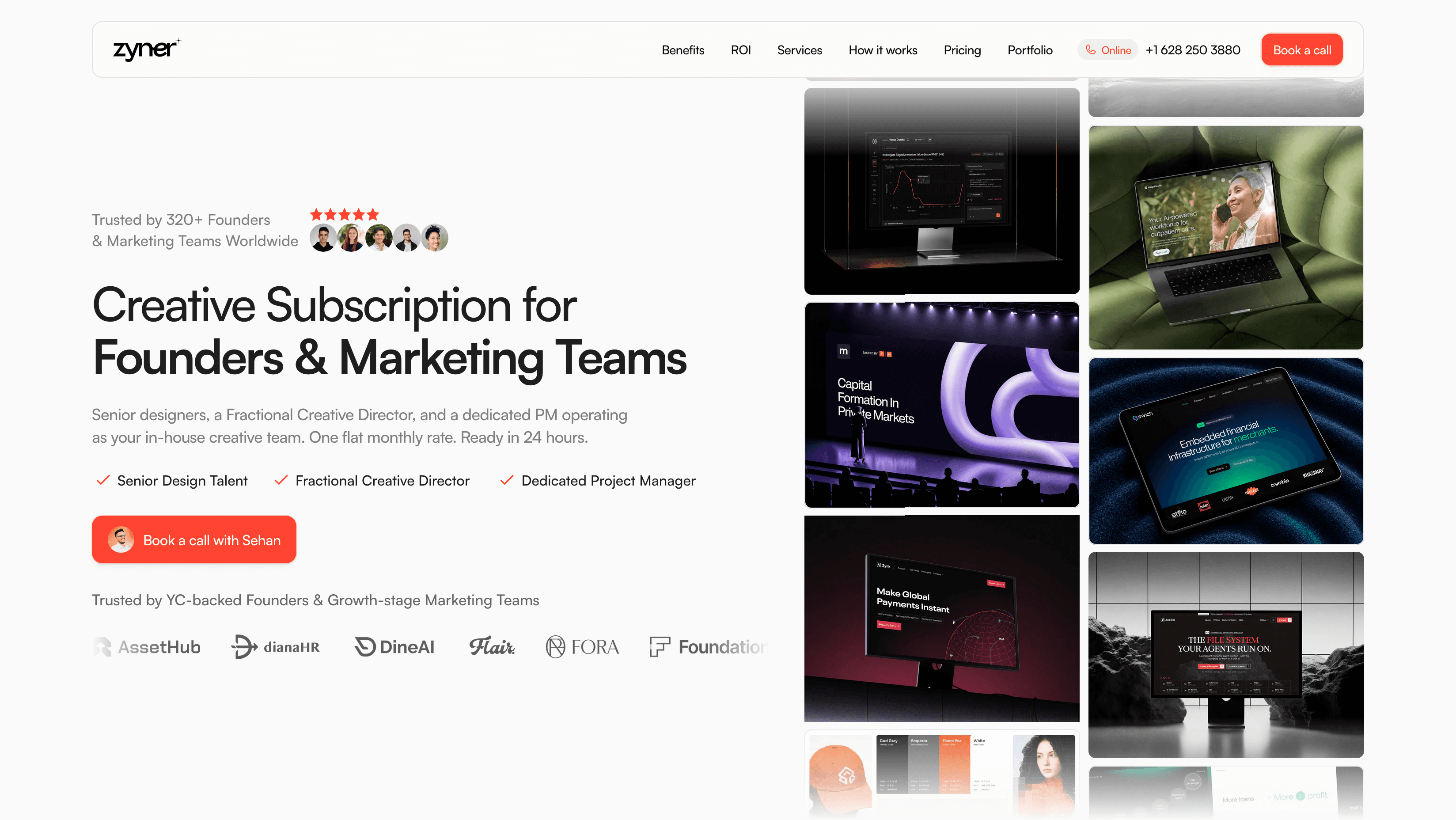
Zyner is the only unlimited design subscription built specifically for startups. Where most services are designed for marketing teams at established businesses producing social graphics and ad creatives at volume, Zyner is built for the full range of creative work a startup actually needs: brand identity from scratch, fundraising pitch decks, UI/UX for web and mobile, full website builds in Framer, and motion design.
The model is different too. Every client gets a dedicated project manager who handles all communication and coordination, plus a great design team. You don't manage designers directly. You drop requests in Slack, and the team picks them up, executes, and iterates until the work is right.
Zyner has worked with 320+ startups, including multiple YC-backed companies across W22, W23, W24, W25, S24, S25, F24, and X25 cohorts. That's not marketing copy: it means the team already knows what a good fundraising deck looks like, what investors respond to, and how fast startup timelines actually move.
Founders who switch to Zyner from in-house or freelance typically save $250,000 to $450,000 annually compared to maintaining a two to four person internal design team. Onboarding takes 24 to 48 hours, and the team begins shipping work within the first week.
What's included: Brand identity, pitch decks, UI/UX design, Framer web development, motion design, social media creatives, print and packaging, and more. Unlimited requests and revisions under one flat monthly rate.
Pricing:
Monthly: $5,495/month
Quarterly (most popular): $5,195/month
Annual (best value): $4,995/month
Pros:
Purpose-built for startups, not generic businesses
Senior designers paired with a dedicated project manager
Covers pitch decks, branding, web dev, UI/UX, and motion in one subscription
Slack-based, async-friendly workflow
Pause or cancel anytime
24 to 48 hour onboarding
Cons:
Higher price point than general-purpose design subscriptions
Best fit for startups with ongoing, multi-category design needs rather than single-purpose requests
Services Offered:
Branding Services: Logo Design, Brand Identity, Brand Collateral, and more.
Design Systems: Component Libraries, UI Kits, Typography, and more.
Web Design: Landing Pages, Full Websites, Framer Development, and more.
Product Design: App UIs, Prototyping, Mobile UI, Web UI, and more.
Ad Creatives: Static Creatives, Motion Creatives, Meta ads, LinkedIn Ads and more.
Social Media Creatives: Posts, Reels, Stories, Videos, Carousels and more.
Presentation Designs: Business Presentations, Webinar Slides and more.
Pitch Deck Design: Fundraising Decks, Sales Decks, Data Rooms and more.
Illustration Design: Icons, Characters, Illustration Systems, and more.
Print Design: Flyers, Events, Billboards and more.
Packaging & Merchandise: Apparel & Merch, Brand Collateral and more.
Motion Design: Product Animations, Explainer Animations, UI/UX motion and more.
Launch Video: Launch Videos, Demo Videos, Promo Videos and more.
2. Design Pickle: Best for High-Volume Teams
Starting price: ~$1,349/month
Turnaround: 24 hours for first drafts
Best for: Marketing teams with high-volume, recurring asset needs
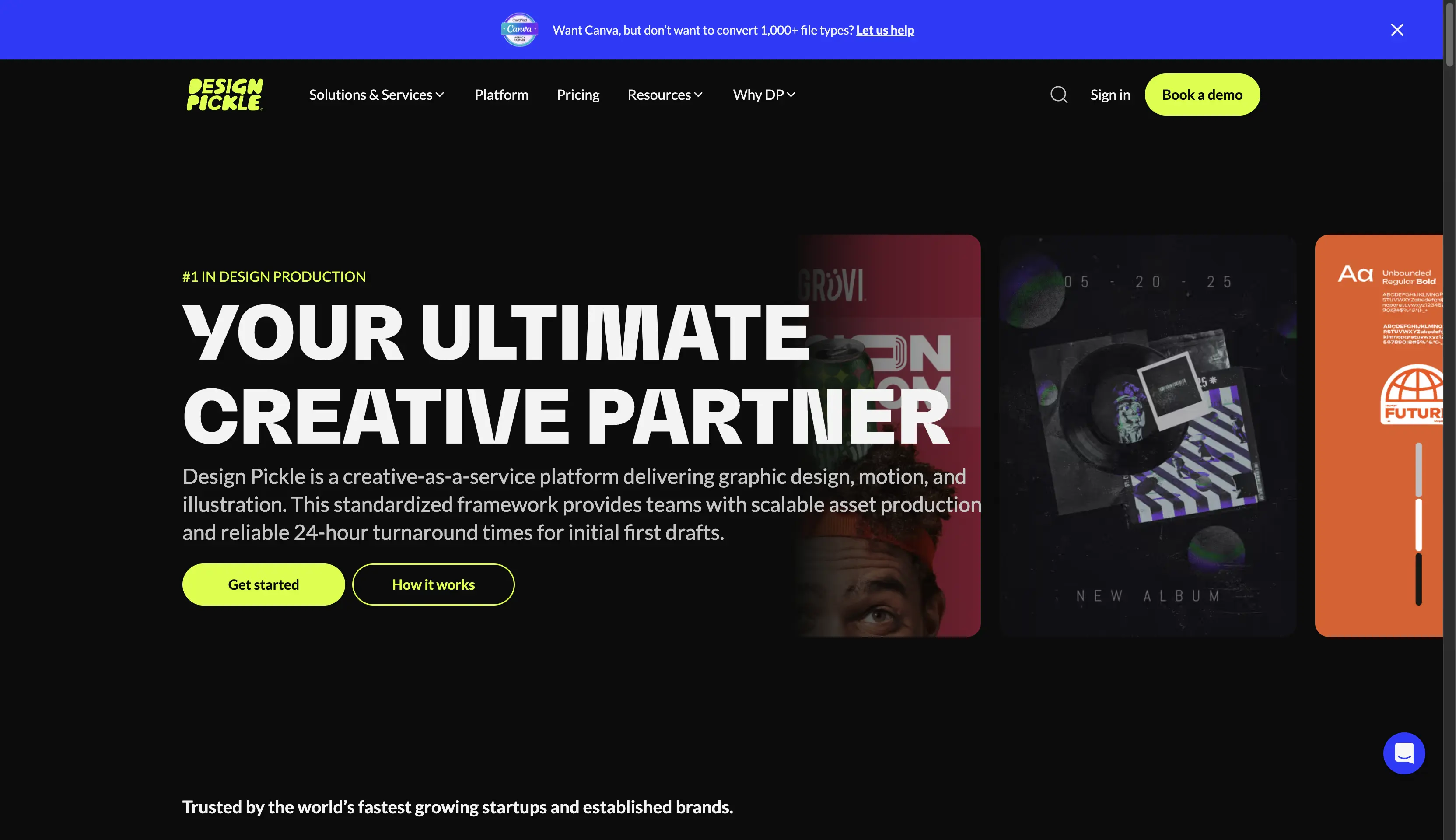
Design Pickle is the largest and most established player in the unlimited design subscription space. Founded in 2015 and headquartered in Scottsdale, Arizona, the company has completed over 3 million creative requests and serves businesses ranging from small teams to large enterprises.
The service uses a proprietary platform for request management and feedback, with annotation tools that make revision cycles faster than most competitors. Plans scale from standard graphic design to motion graphics and video editing at higher tiers.
Design Pickle's biggest strength is reliability at volume. If you need consistent output at speed, social graphics, ad creative variants, presentations, and banners, their system is built for that kind of throughput. First drafts arrive within 24 hours, and customer-reported data shows teams triple their creative production after switching.
Where it falls short for startups: it's built for teams with established brands and ongoing marketing operations, not for founders who need to build a brand from zero or design a pitch deck that raises a round. The service is also priced at the higher end for marketing-team-oriented features that early-stage founders often don't need.
Pros: Large, established team; 24-hour first drafts; strong platform with annotation tools; broad scope including motion and video at higher tiers
Cons: Not startup-specific; higher pricing for full feature access; less suited to brand-from-scratch or fundraising design work
3. Penji: Best Budget Entry Point
Starting price: $499/month
Turnaround: 24 to 48 hours
Best for: Early-stage teams testing the subscription model with limited budgets
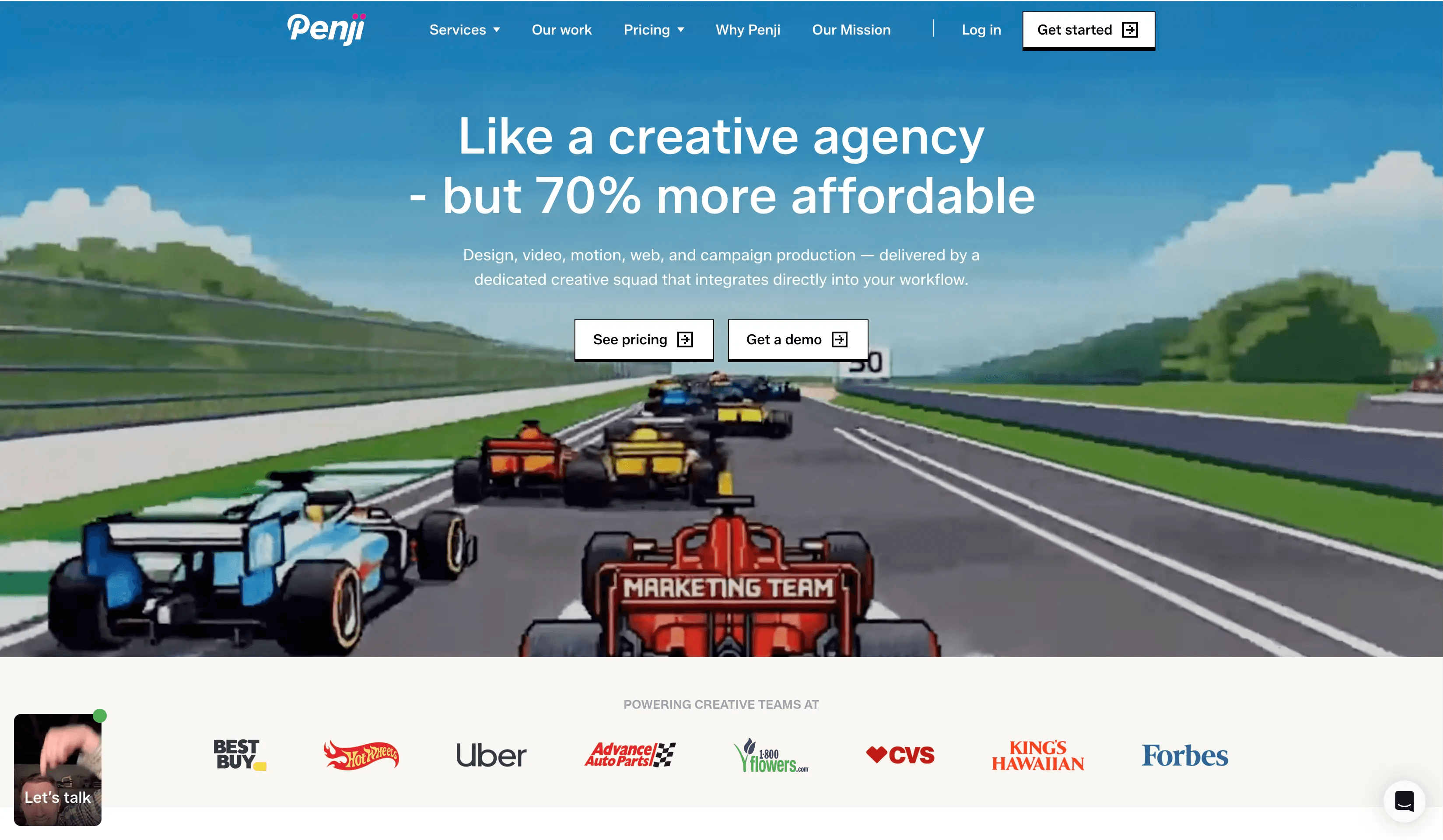
Penji offers the most accessible entry point among established unlimited design services. At $499/month for the base plan, it's roughly half the price of Design Pickle's entry tier and covers the essentials: social media graphics, basic marketing assets, and simple brand collateral.
The service pairs you with a designer based on your project type, and most reviews highlight consistent quality for straightforward requests. The 30-day money-back guarantee is one of the most generous in the category, making it genuinely low-risk to try.
The trade-offs are real, though. The base plan doesn't include pitch decks, web design, complex illustrations, or project management. Those features live behind the mid-tier ($995/month) and agency-tier ($1,497/month) plans. For a seed-stage founder who needs branding and pitch deck work, the entry plan won't cut it, and the higher tiers close the price gap with more capable alternatives.
Pros: Lowest entry price in the category; 30-day money-back guarantee; fast 24-hour turnaround; covers 120+ design categories at higher tiers
Cons: Base plan excludes pitch decks, web design, and project management; quality varies for complex work; not specifically built for startup needs
4. ManyPixels: Best Price-to-Quality Ratio
Starting price: $599/month
Turnaround: 24 hours
Best for: Startups and small teams needing broad design coverage at a competitive price
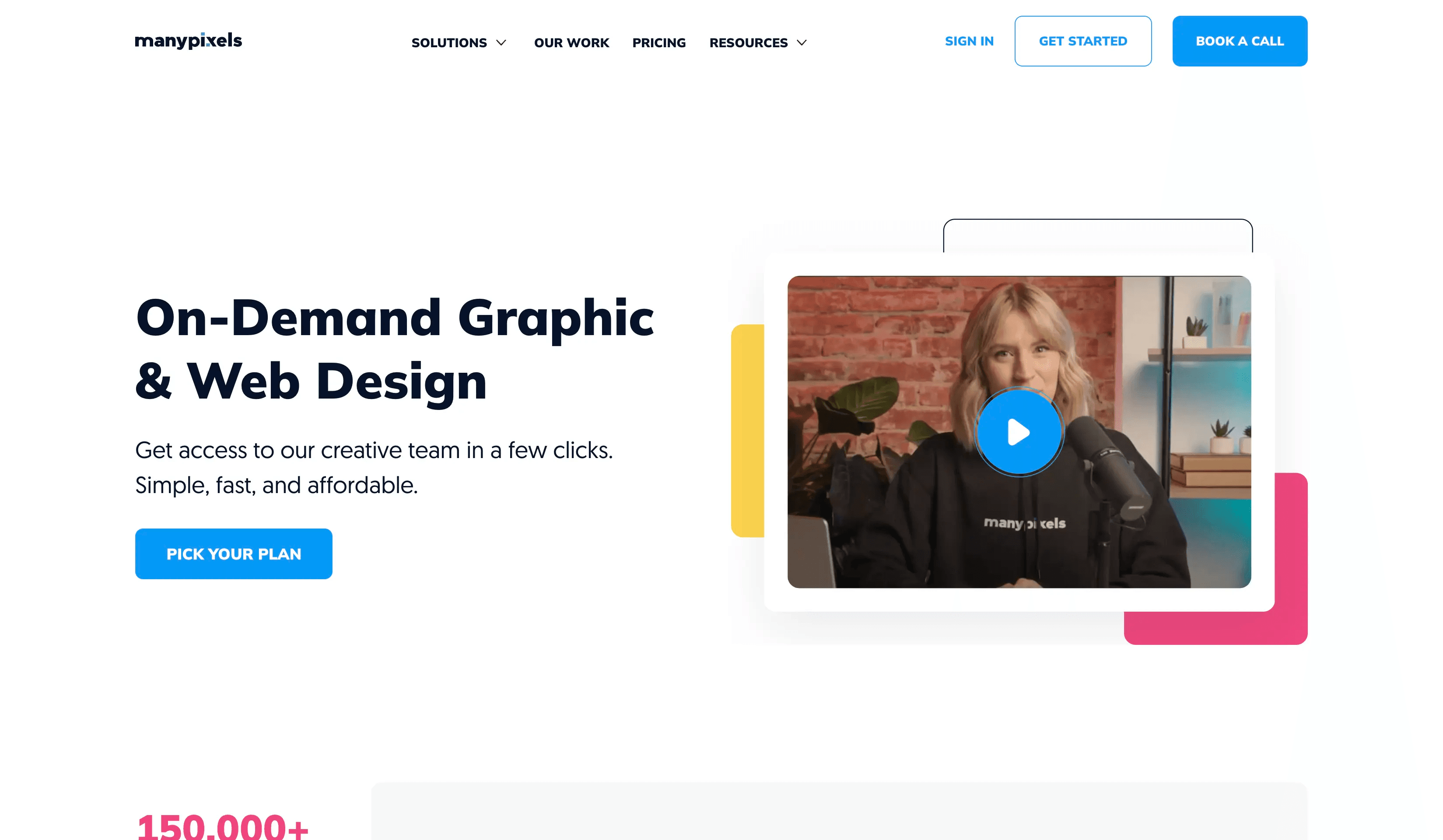
ManyPixels has built a strong reputation for covering a wide scope of design types at a lower price point than most competitors. The standout: website design is included even in the lowest-tier plan, which is genuinely unusual. Most services gate web design to premium tiers.
The team is relatively small (30+ full-time designers), which some clients cite as a quality advantage. Unlike services that use large pools of variable-quality freelancers, ManyPixels' tighter team model produces more consistent output. The service has earned a 5.0-star rating on G2 and a 4.8-star rating on Trustpilot across 100+ reviews.
The main limitation: ManyPixels is a generalist service, strong for marketing assets and web design, but not purpose-built for the specific design challenges startups face in fundraising or early brand development. Their Dedicated Designer plan adds Slack sync for real-time communication, but it's priced higher than the base offering.
Pricing tiers: Advanced, Business, and Dedicated Designer.
Pros: Broad scope including web design at all tiers; consistent quality through a smaller, dedicated team; strong ratings on G2 and Trustpilot; competitive pricing
Cons: Not startup-specific; Slack communication only on higher plans; less experienced with pitch decks and fundraising design
5. Kimp: Best for Graphics and Video Bundles
Starting price: ~$897/month (graphics); ~$1,297/month (graphics + video)
Turnaround: 24 hours for graphics, 2 to 4 days for video
Best for: Teams with heavy video and social media needs
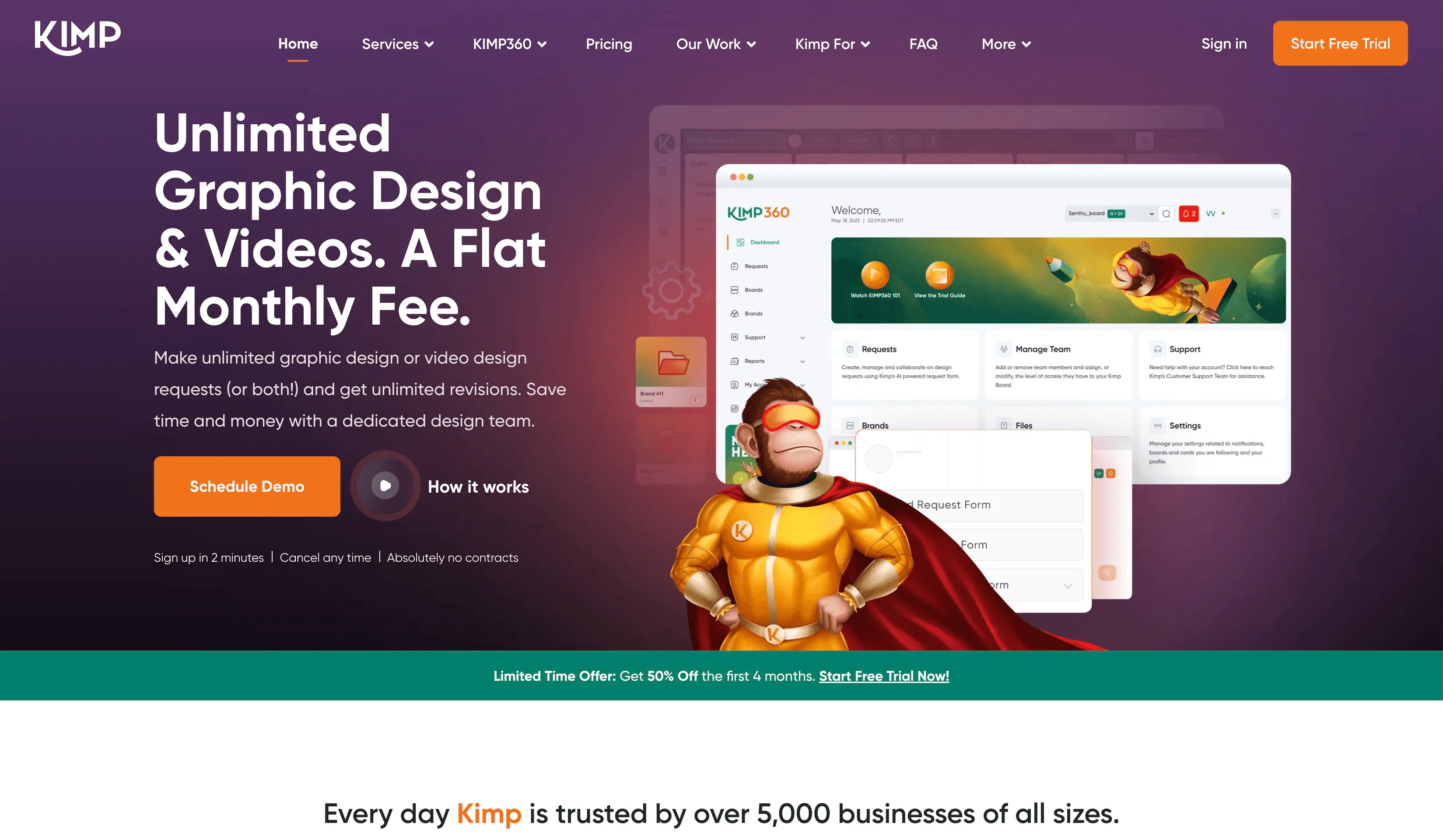
Kimp's core advantage is the graphics-plus-video bundle. If your team regularly produces both static graphics and short-form video content (social reels, product animations, promo clips), Kimp handles both in one subscription without needing to manage separate vendors.
The founders have been in graphic design since 2003 and launched Kimp as a subscription service in 2019. They work with unlimited users on all plans, which suits small marketing teams with multiple contributors submitting requests.
The trade-offs: Kimp's pricing for graphics alone is higher than ManyPixels or Penji for similar scope. The value equation only works if you're consistently using both video and graphics. Some reviewers also note that quality can vary due to the hybrid team model, which draws from a large pool of designers rather than a tight dedicated team.
Pros: Best combined graphics and video subscription in the category; unlimited users on all plans; long track record since 2003; Slack integration
Cons: Expensive for graphics-only use; quality variability with large team pool; not built specifically for startup or fundraising design needs
Service Comparison at a Glance
Service | Starting Price | Best For | Pitch Decks | Startup Focus | Slack-Based |
|---|---|---|---|---|---|
$4,995/mo (annual) | Startups end-to-end | Yes | Yes, only service built for it | Yes | |
~$1,349/mo | High-volume marketing teams | Yes (higher tiers) | No | Yes | |
$499/mo | Budget-conscious teams | Yes (mid tier+) | No | No (proprietary platform) | |
$599/mo | Broad design at competitive price | Limited | No | Yes (higher plans) | |
$897/mo | Graphics + video bundles | No | No | Yes |
How to Choose the Best Unlimited Graphic Design Agency for Your Startup
The right service depends on where you are and what you need most right now.
Pre Seed: You're building your brand from scratch and probably pitching investors in the next three to six months. Design quality directly affects how credible you look to investors and early customers. You need a service that can do brand identity, pitch deck design, and a landing page from a single subscription. Budget is tight, but a weak pitch deck is more expensive than a quality design service.
Seed: You have a brand but it probably needs tightening. You're running marketing campaigns, building out your product UI, and potentially preparing a Series A deck. You need a service with breadth: social assets, web updates, product design support, and presentation design, all moving simultaneously (or sequentially, within the same subscription). Reliability and speed matter more than price at this stage.
Series A and beyond: You're scaling a marketing function and need consistent, high-volume creative output. You may have internal designers but need supplemental bandwidth. Services like Design Pickle or ManyPixels serve this use case well.
In almost every case, the question to ask is: what's the most expensive design mistake I could make right now? For pre-seed founders, it's raising a round with a weak pitch deck. For seed-stage companies, it's launching to a market with a brand that doesn't build trust. Choose a service whose core expertise matches your biggest design risk.
Is Unlimited Graphic Design Worth It?
Yes, for most startups with ongoing design needs.
The math works at almost any stage. A mid-tier unlimited graphic design subscription at $500 to $1,500/month is less than 25% of the cost of hiring even a junior in-house designer, with no recruiting time, no benefits overhead, and no long-term commitment.
The break-even point comes down to volume. If you're producing five or fewer simple design pieces per month, you might be better served by a per-project freelancer. If you consistently need ten or more deliverables (social graphics, ad creatives, presentation updates, landing page changes), a flat-rate subscription saves money almost immediately.
For founders who need pitch decks, brand identity, and web presence built from scratch, the calculation is even clearer. Agencies charge $5,000 to $25,000 for a single pitch deck. A monthly subscription that covers the deck plus everything else for the same period is often a fraction of that cost.
Pro Tip: Track your design output for one month before signing up for any service. Count how many requests you actually submitted (to freelancers, internally, or not at all because you didn't have resources). That number tells you exactly which price tier you need and whether the subscription model makes sense for your volume.
Frequently Asked Questions
What is unlimited graphic design?
Unlimited graphic design is a subscription service where you pay a flat monthly fee and submit as many design requests as you need. A dedicated team completes requests one at a time, with unlimited revisions on each, before moving to the next in your queue. There are no hourly rates, no per-project fees, and no surprise invoices.
How much does unlimited graphic design cost?
Pricing ranges from approximately $499/month at the entry level (Penji) to $5,495/month for startup-focused services (Zyner). Mid-range generalist services like ManyPixels and Kimp typically fall between $599 and $1,300/month depending on the plan and whether video is included. Enterprise services like Superside start at $5,000/month and above.
What types of designs are included in a graphic design subscription?
Most services cover social media graphics, marketing assets, ad creatives, presentations, and branding collateral. Higher-tier plans often add custom illustrations, pitch deck design, web design, and video editing. Startup-focused services like Zyner include all of these plus UI/UX design and Framer web development under a single subscription.
What's the difference between unlimited graphic design and hiring a freelancer?
Freelancers are paid per project or per hour and are best for one-off work with defined scope. Unlimited graphic design subscriptions charge a flat monthly fee for ongoing work with no per-project billing. Subscriptions offer more predictable costs, consistent quality from a dedicated team, and built-in revision cycles, while freelancers offer more flexibility for single specialized projects.
Can startups benefit from unlimited graphic design subscriptions?
Yes, particularly at the seed stage and beyond. Pre-seed founders often need brand identity, pitch deck design, and a landing page within a short window. Services like Zyner, which are built specifically for startups, can deliver all of this within a single subscription, at a fraction of the cost of an agency and with far more consistency than a freelancer arrangement.