Feb 26, 2026
Investors spend roughly two to three minutes looking at a pre-seed pitch deck before making a decision. That's 180 seconds to validate your market, prove your traction, demonstrate your team's competence, and persuade them to hand over a check.
In those 180 seconds, design isn't just decoration. It is the packaging of your logic. If the packaging is messy, hard to read, or generic, investors assume your logic is, too.
But as an early-stage founder, you are caught in a classic trap. You have zero margin for error but very little cash. Do you spend 50-100 hours wrestling with a DIY pitch deck template? Or do you spend thousands on pitch deck designers when you barely have runway?
The answer depends entirely on why you are building the deck. Are you validating an idea with peers, or are you sitting across the table from a seed fund?
Here's the honest, no-BS reality of when to use a template—and when professional design is the only way to close your round.
Quick Takeaways:
DIY templates are great for early validation and rapid prototyping.
Professional designers do not just make slides pretty; they execute bespoke storytelling that yields up to a 50% higher success rate in funding.
The hidden cost of DIY templates is founder setup time. Expect to spend 50-100 hours making a generic template look custom.
Pre-seed founders should use templates to test their narrative, then switch to professional design before meeting with institutional investors.
A top-tier pitch deck is an investment in securing your runway, not a marketing expense.
The Real Cost of DIY Pitch Deck Templates
If you are a pre-seed founder working out of your garage (or a shared WeWork desk), a $0 template from Canva, Figma, or Pitch looks like a lifesaver. You download it, plug in your bullet points, and assume you are ready to raise.
Here's the problem. DIY pitch deck templates are fast to start, very low cost, and excellent for initial validation. But they come with a massive hidden cost: a drastic decrease in the quality of the output, along with the time you spend on them.
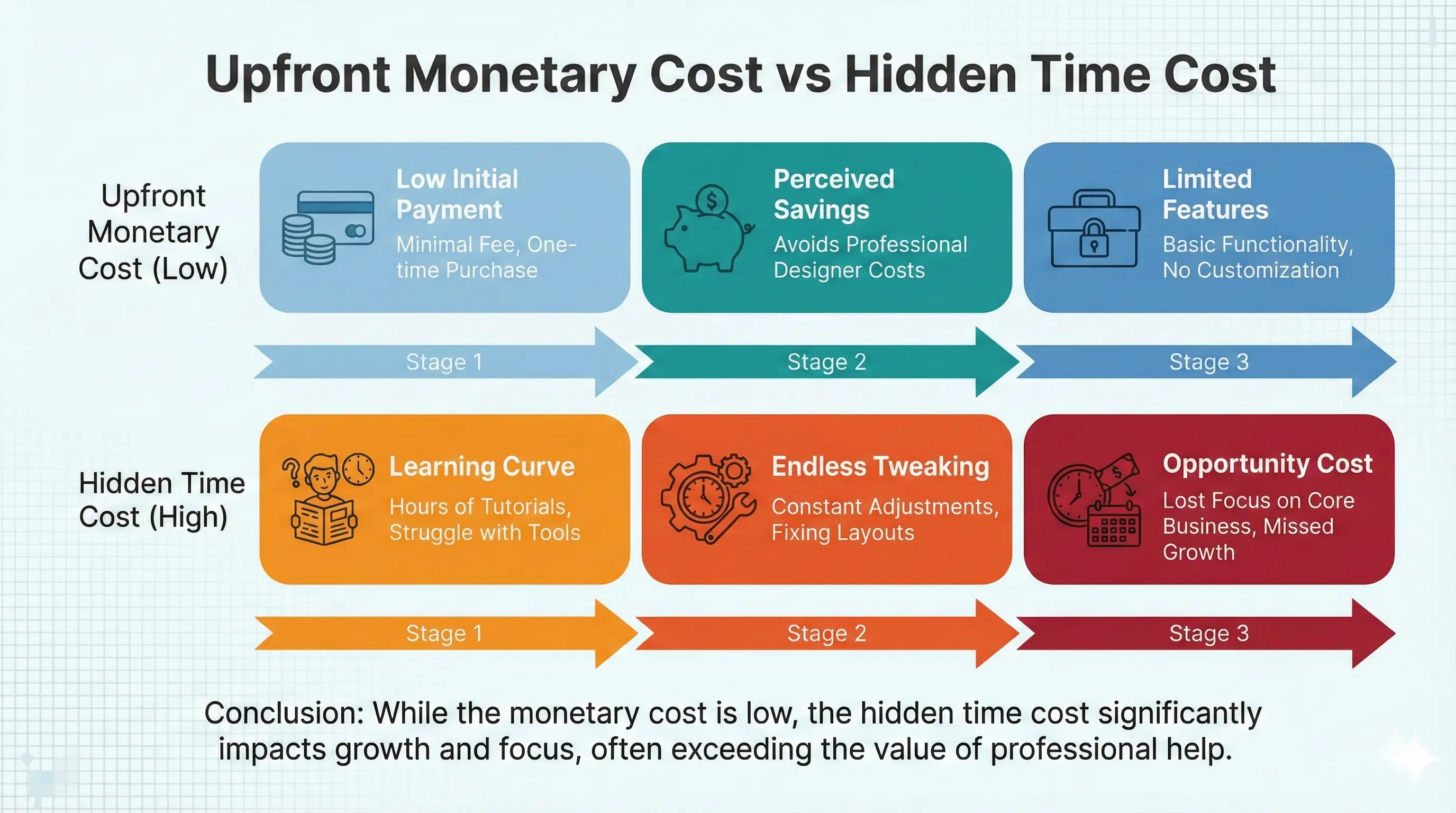
Founders routinely report spending between 50 and 100 hours fighting with templates. They tweak fonts. They try to make complex financial models fit into pre-built three-column layouts. They struggle to edit vector icons that don't match their brand.
Every hour you spend aligning text boxes is an hour you are not talking to customers, refining your MVP, or networking with angels.
Furthermore, templates carry the risk of looking aggressively generic. Because these files are widely accessible, there is a high probability an investor will see your slides and instantly recognize the exact same template they saw pitch number three use yesterday. This lack of uniqueness dilutes your brand's personality, making your presentation entirely forgettable.
Best For: Early-stage validation, rapid prototyping, and founders with zero budget who are just testing ideas with friends and family.
What Professional Pitch Deck Designers Actually Do
There is a misconception that pitch deck designers just hop into PowerPoint and make your existing slides look prettier. That is not design. That is formatting.
Professional pitch deck designers offer bespoke storytelling, high-level design, and increased investor credibility. This combination often yields roughly a 50% higher success rate in securing funding.
They don't just pick colors. They look at your narrative flow. They take a dense, text-heavy slide about your go-to-market strategy and translate it into a single, instantly readable data visualization. They build an emotional through-line that connects your problem statement directly to your solution.
When you hire a professional setup, you get:
Custom storytelling tailored to investors: They know how VCs read decks, stripping out the fluff and highlighting the traction.
High-end visual design: Your brand identity is enforced flawlessly. Colors, typography, and data visualization all communicate competence.
Improved credibility: A deck that looks like it cost $10,000 signals to investors that you take your business seriously.
Time back: You hand over the raw story. They hand back the finished product.
The downside? It's expensive. A traditional agency or specialist can cost anywhere from $2,000 to over $5,000 for a single deck, and the back-and-forth collaboration can take weeks.
Best For: Seed to Series A+ rounds, high-stakes fundraising, or founders prioritizing their time.
The Middle Ground: Pay-by-Slide and Branding Options
If you have a rock-solid narrative but lack the budget for a $5,000 agency, you have a third choice.
The "pay-by-slide" or hybrid approach works perfectly for founders who know their story but lack an eye for layout. You provide the raw content and the exact slide-by-slide narrative. A designer then takes your content and standardizes it against a custom brand identity.
This approach minimizes the expense of hiring a storytelling consultant while circumventing the amateur look of a standard template.
When to DIY vs. When to Hire a Designer (The Pre-Seed Framework)
If you are stuck on the fence, use this framework to decide.
Use a DIY Template If:
You have zero runway and cannot afford to spend a single dollar on presentation materials.
You are not actively raising capital yet.
You are creating an internal document to align your co-founders on the vision.
You are pitching to a close friend or a highly technical angel investor who explicitly told you they only care about your API documentation.
Ready to start testing your narrative? Check out our Pre-Seed Pitch Deck Templates.
Hire a Professional Designer If:
You are actively setting up meetings with institutional Seed funds or VCs.
Your product is highly visual, consumer-facing, or relies heavily on brand trust.
You are spending more than 10 hours a week tweaking slides instead of building your product.
You need to distill a highly complex technical concept into a simple, beautiful visual.
Stop Burning Founder Time on Slide Design
Let's be honest. Hiring an in-house senior designer to build your decks and assets will take 4 to 8 weeks of interviewing and cost you $100k+ in salary. Hiring a traditional agency means dealing with rigid contracts, high retainers, and slow turnaround times.
Your next move is a design subscription.
With Zyner, you aren't just getting pitch deck designers. You get an unlimited design team—from branding to Framer websites to pitch decks—for a single flat monthly rate. We onboard startups in 24 hours. You drop a request in Slack, and our senior designers deliver.
We have built brands and pitch decks for over 320 startups across multiple YC cohorts. We know what VCs want to see.
Stop wrestling with Figma. Let us do what we do best, so you can focus on growth.
What Are the Most Common Pitch Deck Mistakes?
When founders try to design their own decks, they usually fall into the exact same traps. If you do opt for a DIY approach, avoid these critical errors.
1. The Wall of Text Your deck is not a business plan. It is a visual aid designed to secure a follow-up meeting. If a slide contains more than 30 words, investors will read the slide instead of listening to you. If you have to reduce the font size to make your text fit, you have too much text. Cut it.
2. Missing the "Ask" Astonishingly, many founders create a beautiful 15-slide deck and forget to actually ask for money. Your final slide must clearly state exactly how much you are raising, what milestone that capital will help you achieve, and how long your runway will last.
3. Unreadable Financials Pre-seed founders often take a screenshot of a massive Excel spreadsheet and paste it onto a slide. It is entirely illegible on a screen. Investors don't need to see your office supply budget for Year 3. They need a clean, high-level chart showing your projected revenue, customer acquisition costs, and burn rate.
Want to know exactly what elements you are missing? Read our guide on Why Pitch Decks Fail.
Conclusion: Your Deck is an Investment, Not an Expense
Founders often view professional design as a luxury to purchase after they raise money. That is backward thinking.
If a well-designed deck increases your chance of closing a $500,000 pre-seed round, the design itself is not an expense. It is a high-yield investment. The companies that ignore design today will be the ones struggling to command investor attention tomorrow.
You have the vision. You have the traction. Now you just need the packaging.
Don't let a bad template ruin a great business model.
Frequently Asked Questions
What is the 10/20/30 rule for pitch decks?
The 10/20/30 rule, popularized by Guy Kawasaki, states that a presentation should have no more than 10 slides, last no longer than 20 minutes, and use a font size of no less than 30 points. While this is an excellent baseline to prevent founders from aggressively overloading their decks, modern pre-seed decks often run 12-15 slides to accommodate necessary traction and market data.
What is the best format for a pitch deck?
The best format for a pitch deck is a widely accessible, non-editable file format, universally sent as a PDF. Never send investors a raw Keynote or PowerPoint file. PDFs ensure that your carefully chosen fonts, layouts, and startup storytelling frameworks display exactly as intended, regardless of the device the investor uses to open the file.
Is Pitch better than Canva for pitch decks?
Pitch is generally better tailored for pitch deck creation than Canva. Pitch was built specifically for modern presentation workflows, offering better collaborative features, deep integrations with data tools, and startup-focused templates. Canva is a broader graphic design tool that is excellent for social media but can feel clunky when managing complex slide layouts or data visualizations.
Which platform is best for PPT making?
For purely building PowerPoint presentations, standard Microsoft PowerPoint remains the industry standard for older-school enterprises. However, most startups prefer Figma, Pitch, or Google Slides. We strongly recommend Figma for startups because it allows for infinite canvas flexibility, precise vector editing, and seamless asset hand-offs to professional designers.
How do I structure my pre-seed pitch deck slides?
A strong pre-seed structure follows a narrative arc. Start with the Problem, introduce your Solution, explain the Market size, show your Product, reveal your Business Model, highlight your Traction, introduce your Team, and end with your Ask. Read our comprehensive guide on Pre-Seed Pitch Deck Slides for a full breakdown.