You just finished a great pitch. The investor was nodding, asking smart questions, and seemingly engaged with your vision. Then, two days later, you get the email: "We love the team, but it is just too early for us right now. Keep us updated."
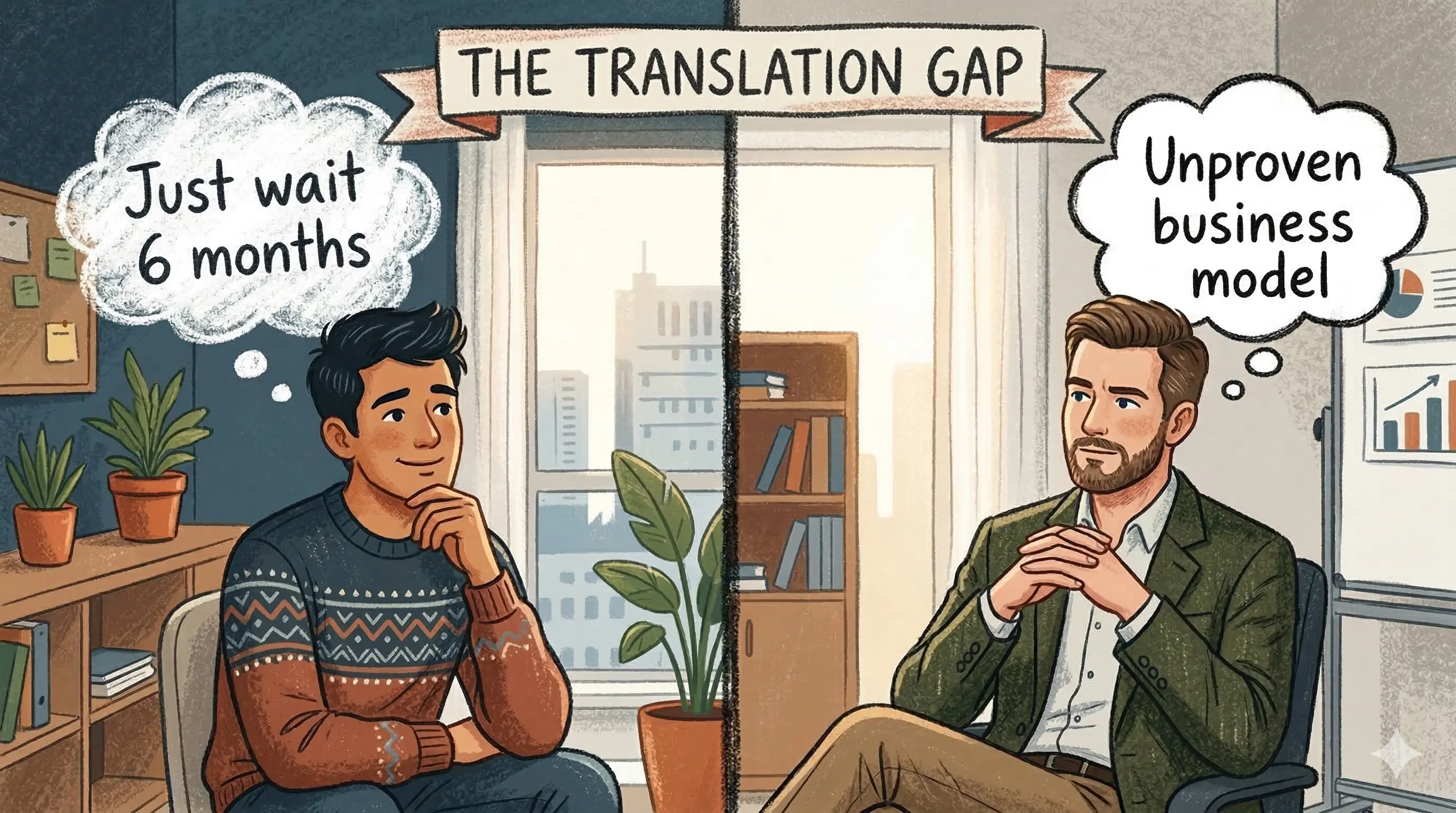
If you are a first-time founder, you might take that response at face value. You might think, "Okay, we just need to wait six months and build more features." This is a critical mistake. When you start analyzing why investors said too early, you quickly realize it is rarely about the calendar. It is about risk.
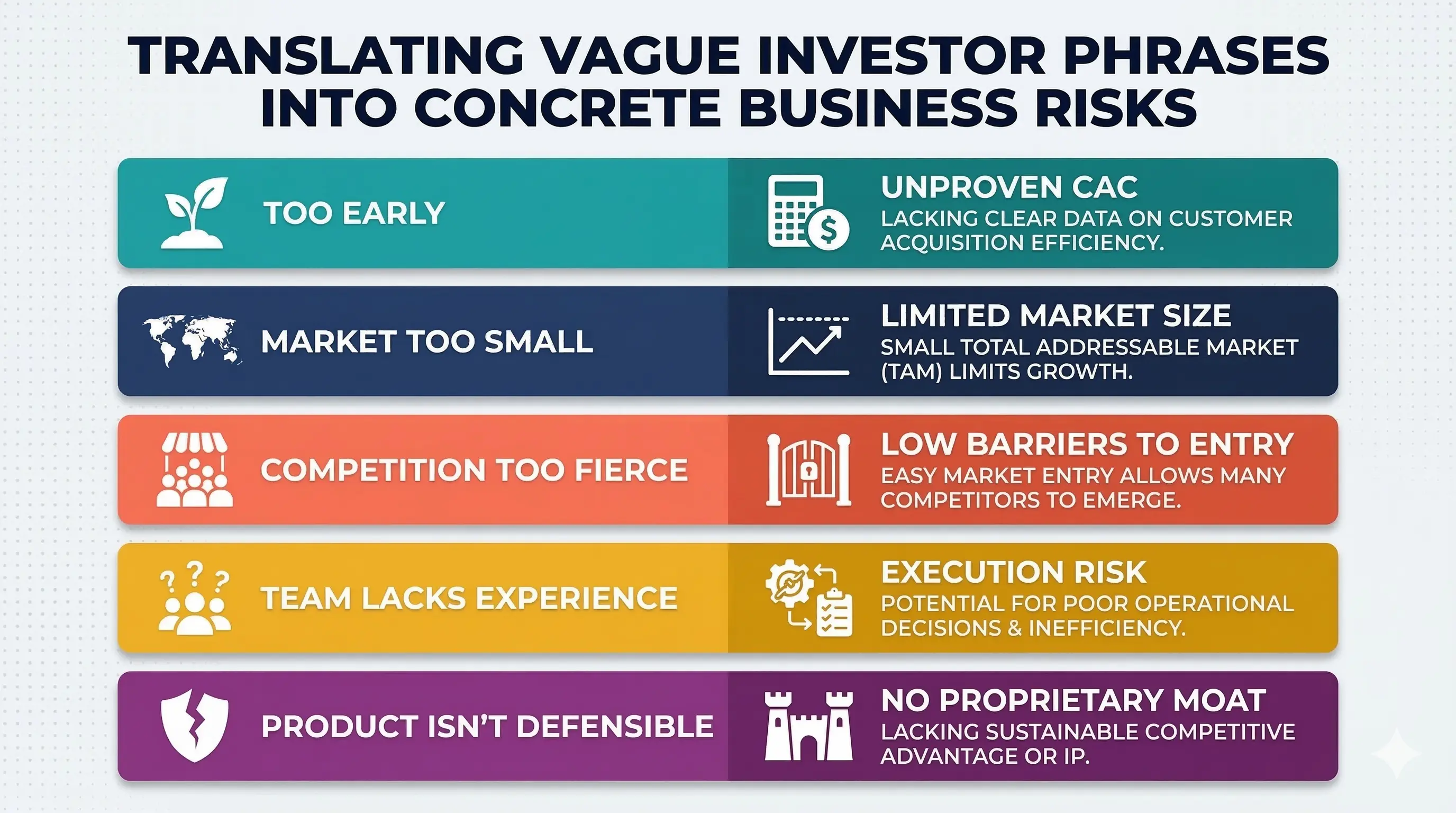
"Too early" is the venture capital equivalent of "it's not you, it's me." It is a polite, friction-free way to pass on a deal without starting an argument. To raise your round, you have to decode what "too early" actually means for your specific startup.
Quick Takeaways
"Too early" is almost always a polite rejection to avoid conflict.
The core issue is usually a lack of undeniable proof that customers want your product.
Investors use "too early" when they do not believe your business model is scalable yet.
If an investor loves the market but doubts the founding team's experience, they will say you are too early.
Often, you pitched a firm whose mandate fundamentally prevents them from investing at your stage.
Do not respond to a "too early" email by arguing; ask what specific milestones they need to see.
A polished brand and premium design can artificially accelerate an investor's perception of your maturity.
The Polite Rejection: Decoding "Too Early"
Venture capitalists are in the business of optionality. They never want to permanently burn a bridge with a founder because today's messy pre-seed startup might be tomorrow's unicorn.
If they tell you that your market size analysis is completely wrong, or that your co-founder seems unsuited for the role, they risk you getting defensive. It creates an uncomfortable email exchange, and it might deter you from coming back to them in a year when you actually have traction.
Saying "you are too early" solves this problem perfectly for the investor. It places the blame on timing rather than on the quality of your business. However, for a founder, this feedback is useless. It gives you no actionable path forward.
To fix your pitch, you have to look beyond the polite pass and identify the specific type of risk the investor was unwilling to take. Generally, it comes down to one of four areas: market validation, business model scaling, team experience, or a hard mandate mismatch.
Reason 1: Undeniable Proof Is Missing (Why Investors Said Too Early)
This is the most common reason why investors said too early. You painted a brilliant picture of the future, but you failed to prove that the present market actually cares.
Investors are hyper-aware of building solutions looking for problems. If your pitch deck relies entirely on industry growth reports (e.g., "The AI market will be worth $1 trillion by 2030") but lacks bottom-up evidence from real users, investors will pass. Ensure your revised pre-seed pitch deck slides address their concerns.
They want unmistakable proof that a specific group of people is desperate for what you are building.
What "Too Early" Means Here: "We do not have enough evidence that customers will actually pay for this to justify a $2M valuation."
How to Fix It: Stop pitching the vision and start pitching the traction. If you do not have revenue, show waitlist conversion rates. If you do not have a waitlist, show signed Letters of Intent (LOIs) from B2B buyers. You have to show that the market is pulling the product out of your hands, rather than you trying to push it onto the market.
Reason 2: Your Business Model Is Unproven
Sometimes an investor believes in the problem and likes the product, but they do not see how the math works at scale. Add in the current disciplined funding environment, and investors are demanding capital efficiency much earlier in a company's lifecycle.
If your Customer Acquisition Cost (CAC) is unknown, or if your pricing model is just a guess based on what your competitors charge, the investor cannot build a mental model of how your company grows from $1M to $100M in revenue.
What "Too Early" Means Here: "You have not figured out the unit economics yet, and we are not willing to fund the expensive trial-and-error phase."
How to Fix It: Replace your generic financial projections with a detailed, bottoms-up go-to-market strategy. Show them exactly how much it costs to acquire your current beta users. Explain the specific distribution channels you will use to acquire the next 1,000 users. Proving you understand your own growth levers is often enough to overcome the "too early" objection.
Reason 3: The Team Lacks Specialized Experience
Investors invest in lines, not dots. If this is your first time meeting them, you are just a dot. If you are also a first-time founder attacking a highly complex, regulated industry (like healthcare, fintech, or aerospace), the perceived risk skyrockets.
If an investor looks at your team slide and does not see deep domain expertise or a track record of scaling similar companies, their internal risk alert goes off. They love the idea, but they do not trust that this specific group of humans is the one that will successfully execute it.
What "Too Early" Means Here: "We need to watch you operate for six months to see if you can actually execute before we hand you a check."
How to Fix It: You cannot instantly generate ten years of industry experience. However, you can surround yourself with people who have it. Add heavyweight advisors to your advisory board who possess the exact domain expertise your founding team lacks. Highlight these advisors prominently in your pitch deck.
Reason 4: A Misaligned Investment Mandate
Sometimes "too early" actually means exactly what it sounds like.
Every venture fund has a mandate that dictates their thesis, their check size, and the stage they invest in. If you are raising a $500K pre-seed round on a basic prototype, and you pitch a Series A fund whose minimum check size is $3M for companies with $1M in Annual Recurring Revenue, they have to reject you. Their Limited Partners (LPs) legally restrict them from investing in your stage.
What "Too Early" Means Here: "Our fund economics literally do not allow us to invest in a company with zero revenue, regardless of how good the idea is."
How to Fix It: This is a targeting failure on your end. Stop pitching later-stage funds hoping they will make an exception for your brilliant idea. Do the research. Only pitch angels, micro-VCs, and pre-seed funds that actively write checks to companies at your exact maturity level.
How to Respond When an Investor Says You Are Too Early
When parsing why investors said too early, your immediate reaction is critical. Do not argue. Do not send a defensive five-paragraph email explaining why your traction is actually phenomenal.
Instead, use the rejection to gather intelligence. You want to force the investor to move past the polite template and give you the real reason they passed.
Reply promptly with a message like this:
"Thank you for the quick and honest feedback. We are iterating on our go-to-market right now. If you have two minutes, could you clarify what 'ready' looks like for your fund? Are you looking for a specific revenue milestone, or do you need to see a specific feature shipped before engaging again?"
This works because it asks a highly specific question. It forces them to give you a concrete number or milestone. If they say, "We need to see $10K MRR," you now have a target. When you hit $10K MRR three months later, you can email them back and secure a follow-up meeting.
The Role of Presentation Quality in Stage Perception
There is a psychological component to fundraising that is rarely discussed. Investors assess your stage not just by your metrics, but by your presentation.
If you bring a 15-slide deck built on a default PowerPoint template, with misaligned text, a logo you bought on Fiverr, and clunky website screenshots, the investor's brain immediately classifies you as "early stage and amateur."
Conversely, companies with premium visual branding, flawless pitch deck design, and sleek product UI feel more mature, even if their underlying revenue numbers are identical to the first startup. Good design artificially ages a company in the eyes of an investor, reducing the perceived execution risk.
If your team is highly technical but lacks design expertise, you are likely bleeding perceived value every time you pitch. This is why many YC-backed founders use Zyner. Zyner provides dedicated, dedicated design teams on a flat-rate subscription. Instead of spending weeks wrestling with pitch deck layouts or trying to manage unreliable freelancers, founders drop their raw content into Slack. A few days later, they get back an investor-ready deck, brand guidelines, or a Framer landing page that makes a pre-seed startup look like a Series A company. Upgrading your design is the fastest way to stop looking "too early."
Image Suggestion: A split-screen showing a pre-seed startup's original, messy slide deck next to a professionally redesigned version that clearly looks more mature and investable.
Moving Past the Rejection
Ultimately, do not let an investor telling you that you are too early paralyze your momentum.
Remember that investors are wrong constantly. Bessemer Venture Partners famously passed on Airbnb, Apple, eBay, and Google. An investor passing on your round does not mean your company is a failure; it simply means your risk profile does not currently match their fund mathematics.
Analyze the why, ask for the specific milestones they need, upgrade your visual presentation, and get back to building the product. The best way to prove an investor wrong is to close ten new customers and email them the update next quarter.
Frequently Asked Questions
What should I reply when an investor says it is too early?
Thank them, do not argue, and ask a clarifying question. Ask them exactly what "ready" looks like for their specific fund. Request a concrete milestone, such as a specific revenue target or a user engagement metric, so you know exactly when to follow up. When you are ready, learn how to email an investor again after 3 months.
Does "too early" mean my startup idea is bad?
No. It usually means you lack the data to prove the idea is good. Investors are risk-averse; they are dealing with other people's money. "Too early" simply means they need the market to validate your assumptions through revenue or usage before they are willing to write a check.
How do I figure out why investors said too early if they will not reply?
If an investor ignores your request for clarifying feedback, analyze their portfolio. Look at the last five companies they invested in. What revenue range were those companies in? What was their team background? Make an honest comparison between your startup and their recent investments to find the gap.
Can bad pitch deck design make my startup look too early?
Absolutely. Investors pattern-match. If your pitch deck, logo, and website look chaotic or amateur, investors naturally assume your internal operations and code quality are also chaotic. A premium design significantly improves the perceived maturity of your company.
How long should I wait to contact the investor again?
If an investor says you are too early, wait until you actually hit the milestone they requested before reaching out again. If they gave vague feedback, wait a minimum of three months. This gives you time to generate a meaningful trendline in your growth metrics that proves you are executing. Understanding why investors said too early is the first step toward getting their eventual yes.