You pitched an investor 90 days ago. They liked the team, they liked the market, but they passed. Their exact words were: "You are a bit too early for us. Keep us updated on your progress." Before you hit send on that follow-up, you need to decode what that feedback actually signifies and why investors said too early in the first place.
Now a full quarter has passed. You have closed new customers, shipped a major feature, and the bank account is slowly ticking down. You want to reach back out, but you are staring at a blank draft wondering: is it okay to email an investor again after 3 months, or will it look desperate?
Quick Takeaways
A three-month gap is the ideal timeframe to prove you can execute on the promises you made in your original pitch.
Never email an investor just to "check in" or "touch base." Only reach out when you have concrete data.
The perfect update email contains exactly three bullet points highlighting momentum.
Do not ask for money in your update email. Ask for 15 minutes to share context on your new metrics.
Forwarding your previous email thread provides necessary context and saves the investor from searching their inbox.
A visual asset, like a one-page traction tear-sheet, dramatically increases reply rates.
Why 3 Months Is the Magic Number
When an investor tells you "not right now," they are essentially saying they do not have enough conviction to write a check today based on your current data. They are waiting for the market to validate your claims.
If you email them two weeks later with a minor update, you look needy. You have not had enough time to generate meaningful momentum. If you wait a year to email them, they will have completely forgotten who you are and what you are building.
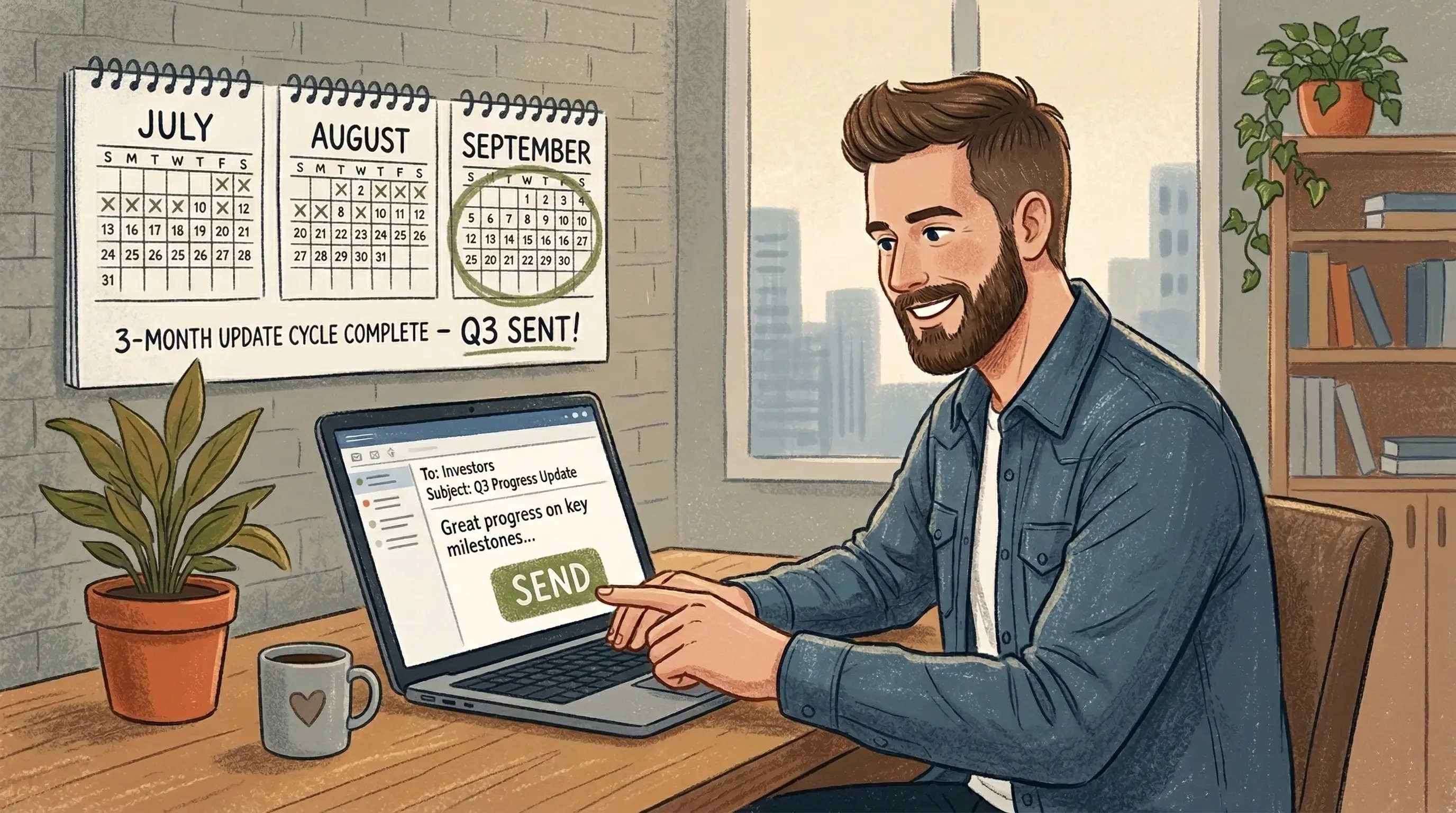
When you email an investor again after 3 months, you hit the sweet spot of early-stage venture capital. Ninety days is exactly one business quarter. It is enough time to:
Launch a product or major feature.
Close a pilot program and secure case study data.
Demonstrate a trendline in month-over-month revenue growth.
More importantly, it proves you are a founder who can execute consistently over time, which reduces the investor's perceived risk.
The Anatomy of the Perfect Update Email
There is a massive difference between an update email that gets a meeting and one that gets archived. The goal of this email is not to force a "yes" on funding. The goal is simply to secure a 15-minute catch-up call.
Here is the exact structure you should follow when you email an investor again after 3 months.
1. Reply to the Original Thread
Do not start a new email chain. Find the last email the investor sent you (even if it was a rejection) and reply directly to it.
Investors manage hundreds of active conversations. Replying to the old thread instantly provides context. They can scroll down, see their own notes, remember why they passed, and immediately compare your new progress against their old concerns.
2. Update the Subject Line
Change the subject line to signal that this is an update, but keep the original context.
Before: Pitch Deck: Acme Corp (Pre-Seed)
After: Q1 Update: Acme Corp + 45% MoM Growth (Was: Pitch Deck: Acme Corp)
3. The Opening Hook
Acknowledge the gap and state the purpose of the email in the first sentence. Do not apologize for reaching out.
"Hi Sarah, it has been a few months since we connected. You mentioned you wanted to see us prove out our enterprise acquisition strategy before engaging further. We just hit a major milestone on that front."
4. The 3 Bullet Points of Momentum
This is the core of the email. You get a maximum of three bullet points. Each point must contain a hard metric. No adjectives. No fluff.
Revenue/Users: "Crossed $10K MRR, growing 22% month-over-month since January."
Product: "Shipped the automated compliance module, reducing customer onboarding time from 4 days to 2 hours."
Team/Milestone: "Signed a letter of intent with our first Fortune 500 design partner."
5. The Low-Pressure Ask
End the email by asking for a brief conversation, completely disconnected from a formal pitch.
"I am opening up our seed round next month, but before I do, I would love to get your thoughts on our enterprise pricing strategy given your experience in this space. Do you have 15 minutes next Tuesday?"
Image Suggestion: A side-by-side comparison of a bad "just checking in" email versus a strong, metric-driven 3-month update email.
When NOT to Email an Investor Again After 3 Months
While reaching out quarterly is standard practice, there are specific scenarios where you should break this rule and stay completely silent.
Do not follow up if you have zero metrics to report. If the last 90 days were spent quietly refactoring code or dealing with co-founder conflict, and you have nothing new to show, do not hit send. An update with no progress confirms their original decision to pass. Wait until month four or five if that is what it takes to get a win on the board.
Do not follow up if they gave you a "Hard No." If an investor explicitly said, "We do not invest in consumer hardware" or "You are entirely outside our thesis," no amount of traction will change their mandate. Remove them from your CRM.
Do not follow up just to say you are fundraising. Saying "We are raising more money now" is not an update. Investors care about execution, not capital hunting. Focus the update on what you achieved with the resources you already had.
Using Visual Assets to Create FOMO
Text-based updates are standard, but the founders who stand out use visuals to bridge the execution gap.
When you email an investor again after 3 months, attaching a single, beautifully designed "Traction Tear-Sheet" or a highly polished 3-slide mini-deck can dramatically increase your response rate. Why? Because a visually premium asset signals operational excellence. It shows that your company is maturing.
If your original pitch deck was a clunky Google Slide file, and your 3-month update includes a sleek, beautifully branded traction report, the investor subconsciously registers that you are leveling up as a founder.
Pro Tip: Never attach a massive 20-slide deck to a follow-up email. Attach a 1-to-3 page PDF that highlights only the delta, which is the exact progress made since your last conversation.
If your team does not have the bandwidth or the internal skills to create premium visual assets, you are competing at a disadvantage. This is where Zyner steps in. Startups use Zyner to access a dedicated design team on a flexible, flat-rate subscription. You can drop your raw, updated metrics into Slack on a Monday, and have a pristine, investor-ready traction report by Wednesday without pulling your engineers off product work to fiddle with slide layouts. Making your momentum look undeniably professional is one of the highest ROI investments a founder can make during a raise.
Decoding the Investor's Response (Or Lack Thereof)
Once you send the 3-month update, the investor's behavior will fall into one of three categories. Here is how to handle each.
Scenario A: They Agree to the Meeting
This is a massive win. They are re-engaged. Do not treat this meeting like a formal pitch. Treat it like a strategy session. Walk them through the metrics you highlighted in the email, explain the friction points you overcame, and ask for specific advice on your next bottleneck. You are building a relationship, not just asking for a check.
Scenario B: The "Keep Me Updated" Reply
They reply within 48 hours, congratulate you on the progress, but say they want to wait a bit longer before jumping on a call.
This is still a win. You have successfully stayed on their radar and proven you can execute. Reply with a simple "Thanks, will do," and schedule a reminder in your CRM to send another metric-heavy update in exactly three months. You are building a track record of reliability.
Scenario C: Absolute Silence
You send the email and hear nothing for a week.
Wait 7 days and send a one-line reply to your own email: "Hi Sarah, wanted to float this to the top of your inbox. Let me know if you have 10 minutes to sync next week."
If they ignore the bump email, stop. Move them to your passive newsletter list (if you have one) and focus your energy on investors who are actively engaging with your momentum.
The Long Game of Investor Relations
Fundraising is rarely a transactional event where you meet an investor, pitch once, and get a check the next day. It is an ongoing campaign of building trust over time.
Startups pivot. Markets change. The investor who rejected your pre-seed round because you lacked enterprise traction might be the perfect lead for your Seed round once you close three Fortune 500 contracts.
By strategically deciding to email an investor again after 3 months, you stop treating rejections as final judgments. Instead, you treat them as the baseline measurement against which you will prove your inevitable future success. Keep building, keep tracking your metrics, and keep sending the updates. The data will eventually speak for itself.
Frequently Asked Questions
How long should an investor follow-up email be?
Keep it under 150 words. Investors skim emails on their phones between meetings. If your update requires them to scroll, it is too long. Use a short intro, three bullet points, and a single closing question.
What should I do if an investor passes because of market size?
If an investor rejected you due to market sizing, your 3-month update should specifically highlight new data that proves the market is larger or more accessible than they thought. Show rapid user acquisition in an adjacent demographic or a newly signed partnership that expands your reach.
Should I send investor updates if I am not actively raising?
Yes. Sending quarterly updates when you do not need money is the most powerful way to build relationships. It proves you are executing without the pressure of an active deal, which makes investors trust you more when you finally do open a round.
How do I follow up with an investor who ghosted me after a pitch?
If an investor completely ghosted you after a pitch (no rejection, just silence), you can still send a 3-month update. Reply to your last sent email with your new metrics. Often, they did not ghost you intentionally; they simply got distracted. A strong traction update can re-engage them.
What metrics matter most when you email an investor again after 3 months?
Investors care most about velocity. Showing $5,000 in monthly recurring revenue is okay, but showing that you grew from $2,000 to $5,000 in 90 days is exceptional. Always focus on month-over-month growth, active user retention, and enterprise pilot conversions.