
Getting into Techstars is harder than getting into Harvard. With an acceptance rate of just 1-2%, the global startup accelerator program rejects the overwhelming majority of applicants who apply each year. So what is Techstars, and why do tens of thousands of founders compete for a spot anyway?
Techstars is a global pre-seed venture capital firm and startup accelerator founded in 2006. In exchange for a small equity stake, it gives early-stage founders three months of intensive mentorship, a cash investment, and access to a network that follows them for the rest of their careers. Since its first cohort in Boulder, Colorado, Techstars has backed more than 3,500 companies across dozens of programs worldwide.
If you're evaluating whether Techstars is right for your startup, this guide covers everything: how the program works, what founders actually receive, how selective it is, and what you need to be ready before you apply.
Quick Takeaways
Techstars is a 3-month accelerator program that invests $220,000 in early-stage startups in exchange for approximately 6% equity.
The acceptance rate is around 1-2%, making it one of the most competitive accelerator programs in the world.
Founders get access to $5 million+ in perks (including $100K in AWS credits) and lifetime access to the Techstars alumni network.
Around 90% of Techstars alumni companies go on to raise follow-on funding, with an average raise of $2 million.
Techstars runs 45-50 accelerator programs per year globally, including city-based, corporate-powered, and remote options.
The program prioritizes team quality above everything else. A brilliant idea without the right founders won't get in.
Founders accepted into Techstars should arrive investor-ready: strong brand, clear narrative, and a polished pitch deck.
What Is Techstars?
Techstars is a global startup accelerator and pre-seed venture capital firm that provides early-stage founders with funding, mentorship, and network access through a competitive three-month program.
That's the short version. The longer one matters more for founders trying to decide whether to apply.
Techstars occupies a specific tier in the accelerator world: alongside Y Combinator, it's widely considered one of the two most prestigious startup programs on the planet. It operates differently from a traditional VC in that it works with companies at the earliest stage, often before product-market fit, and embeds directly into the team's work for three months rather than writing a check and stepping back.
It's also not an incubator. Incubators typically provide space and resources over a longer, looser timeline. Techstars is a structured, time-bound, mentorship-driven sprint with a specific end point: Demo Day, where founders pitch to a room full of investors.
The founding philosophy, coined by co-founder Brad Feld and adopted throughout the organization, is "give first." Mentors, alumni, and managing directors are expected to share knowledge without expectation of immediate return. That culture shapes the program's texture in ways that show up week to week.

How Techstars Works: The 3-Month Program
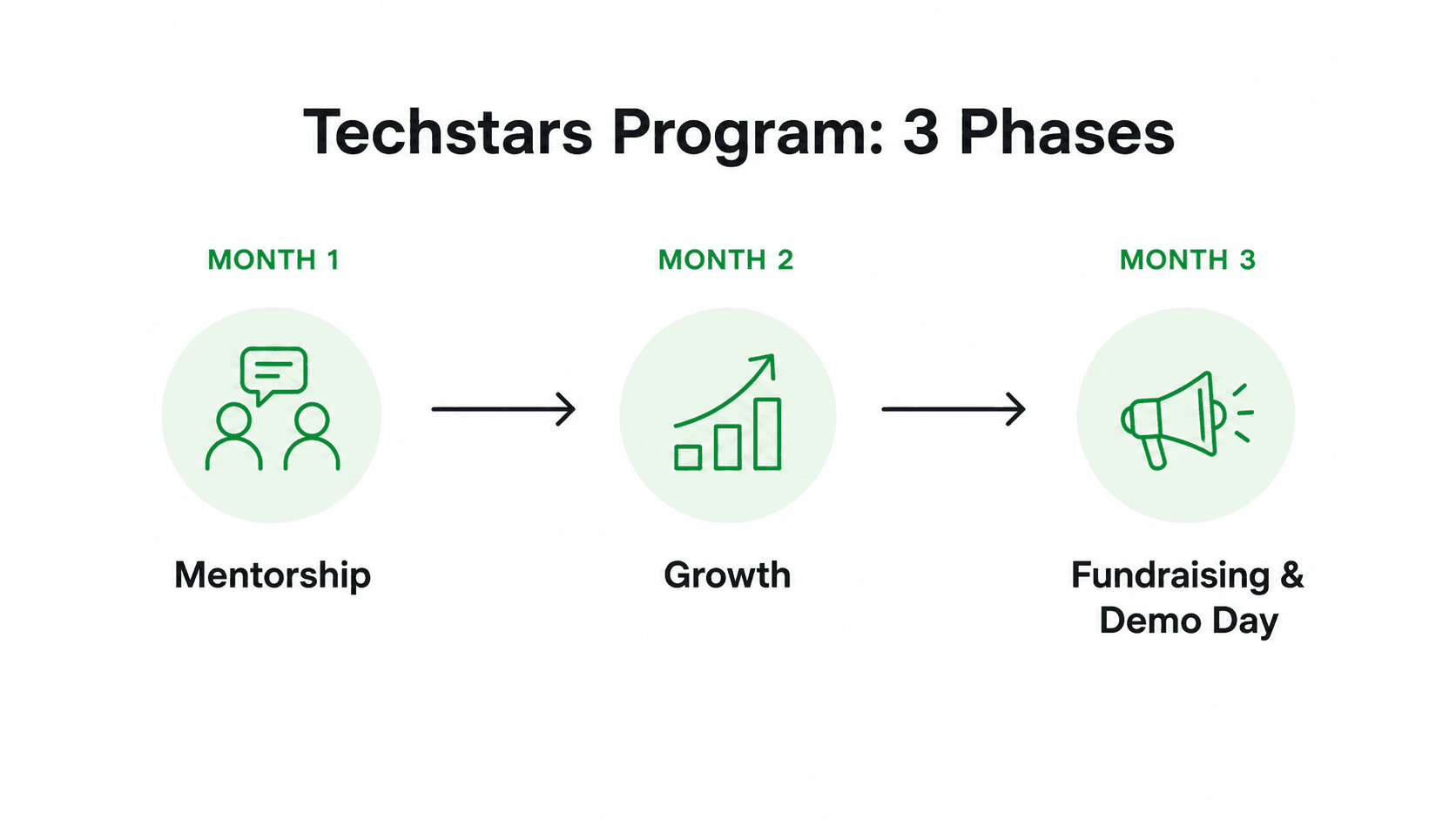
Every Techstars program runs for 90 days and is divided into three phases. The structure is consistent across programs whether you're in New York, London, or joining remotely through Techstars Anywhere.
Month 1: Mentorship Immersion
The first month is intentionally disorienting. Founders are introduced to dozens of mentors from across industries, functions, and geographies. Early-stage companies often discover during this phase that their assumptions about the problem, the customer, or the market are wrong.
Techstars calls this "mentor whiplash." Different mentors will give contradictory advice. That's intentional. The founders' job is to absorb the input, stress-test their thinking, and decide what to keep. By the end of Month 1, most teams have meaningfully refined their direction.
Month 2: Growth and Focus
Once the mentorship immersion winds down, the program shifts to execution. Founders spend Month 2 working with a smaller set of advisors on the most pressing issues: product development, customer acquisition, go-to-market strategy, or team dynamics.
This is where traction is built. Techstars looks for 20% month-over-month growth as a signal of product-market fit, and founders who arrive with validated demand have a significant advantage heading into the final phase.
Month 3: Fundraising Prep and Demo Day
The final month is about the raise. Founders work with the managing director and Techstars' investor network to sharpen their pitch, prepare financial projections, and get warm introductions to the right VCs and angels.
The program culminates in Demo Day: a live event where each company presents a short pitch to a curated audience of investors, press, and entrepreneurs. It's not a pitch competition. It's a structured introduction to capital, and for many Techstars companies it marks the beginning of their seed round.
What Founders Get: Funding, Equity, and Perks
The deal terms are transparent. Here's what Techstars offers every accepted company:
Cash investment: $220,000, structured as a convertible note or equity investment (updated as of April 2025).
Equity: Techstars takes approximately 6% common stock in exchange. This is the deal that generates the most discussion among founders. A Reddit thread on this topic has been active for years, with the consensus landing roughly where you'd expect: for a Tier 1 accelerator with genuine network effects, 6% is defensible. For a company that doesn't need mentorship or the brand signal, it's expensive capital.
Perks: Accepted companies receive benefits valued at over $5 million. This includes $100,000 in AWS credits, discounts on major software tools, and access to Techstars' corporate partner network.
Office space: Most in-person programs include dedicated co-working space for the duration of the program.
Lifetime alumni access: Once you're in the Techstars network, you're in it for life. This includes access to other alumni for hiring, intros, and co-investment, as well as ongoing events and resources.
The financial math is worth running honestly. 6% dilution at the pre-seed stage is meaningful. The counterweight is that 90% of Techstars alumni companies raise follow-on funding, with an average round of $2 million. The network effects and brand signal tend to compress the time it takes to get to a yes.
Is Techstars Hard to Get Into? Acceptance Rate and Selection
Yes. Techstars admits approximately 1-2% of applicants, selecting around 12 companies per cohort across each program. With tens of thousands of applications submitted globally each year, the odds are steep.
The selection process has three main stages:
Written application: Covers company basics, the problem being solved, the solution, traction, and team background. Sections on problem definition and team are weighted heavily.
Interview rounds: First-round interviews are two back-to-back 15-minute sessions. Second-round interviews run 30-40 minutes. Both are run by program managing directors.
Final panel: A screening committee of Techstars network members reviews finalists and makes the final call.
The selection criteria, ranked by importance according to Techstars' own managing directors:
Team (this appears three times on their internal rubric because it matters that much)
Market potential
Traction
Core idea
Founders who don't get in on the first try are actively encouraged to reapply. Many successful Techstars companies were rejected at least once before being accepted. The application process itself, with the interviews and feedback, is a useful forcing function for sharpening your story.
Types of Techstars Programs
Techstars runs 45-50 programs per year. They are not all the same, and choosing the right one matters.
City-Based Programs
These are Techstars' flagship programs, rooted in specific startup ecosystems. Boston, New York, London, Tel Aviv, and others each have local managing directors with deep ties to the regional investor and mentor community. City programs work best for founders who want immersion in a specific geography.
Note: as of early 2024, Techstars closed its Boulder and Seattle programs as part of a broader restructuring focused on cities with higher VC activity. The organization also moved its headquarters from Boulder to New York City. This is worth knowing if you're attached to a specific program that may no longer be active. [VERIFY: check current program list at techstars.com/accelerators]
Corporate-Powered Programs
Techstars partners with major corporations to run industry-specific programs. Past examples include the Nike Accelerator (sports tech), Disney Accelerator (entertainment), and Barclays Accelerator (fintech). These are branded with the corporate partner but run using the Techstars model. They're valuable for founders building in a specific vertical who want direct access to a major industry player.
Remote Programs (Techstars Anywhere)
Techstars Anywhere has been running since 2017. It's the flagship remote-first program, requiring founders to gather in person only three times during the three months. For international founders or those who can't relocate, this is the most accessible entry point.
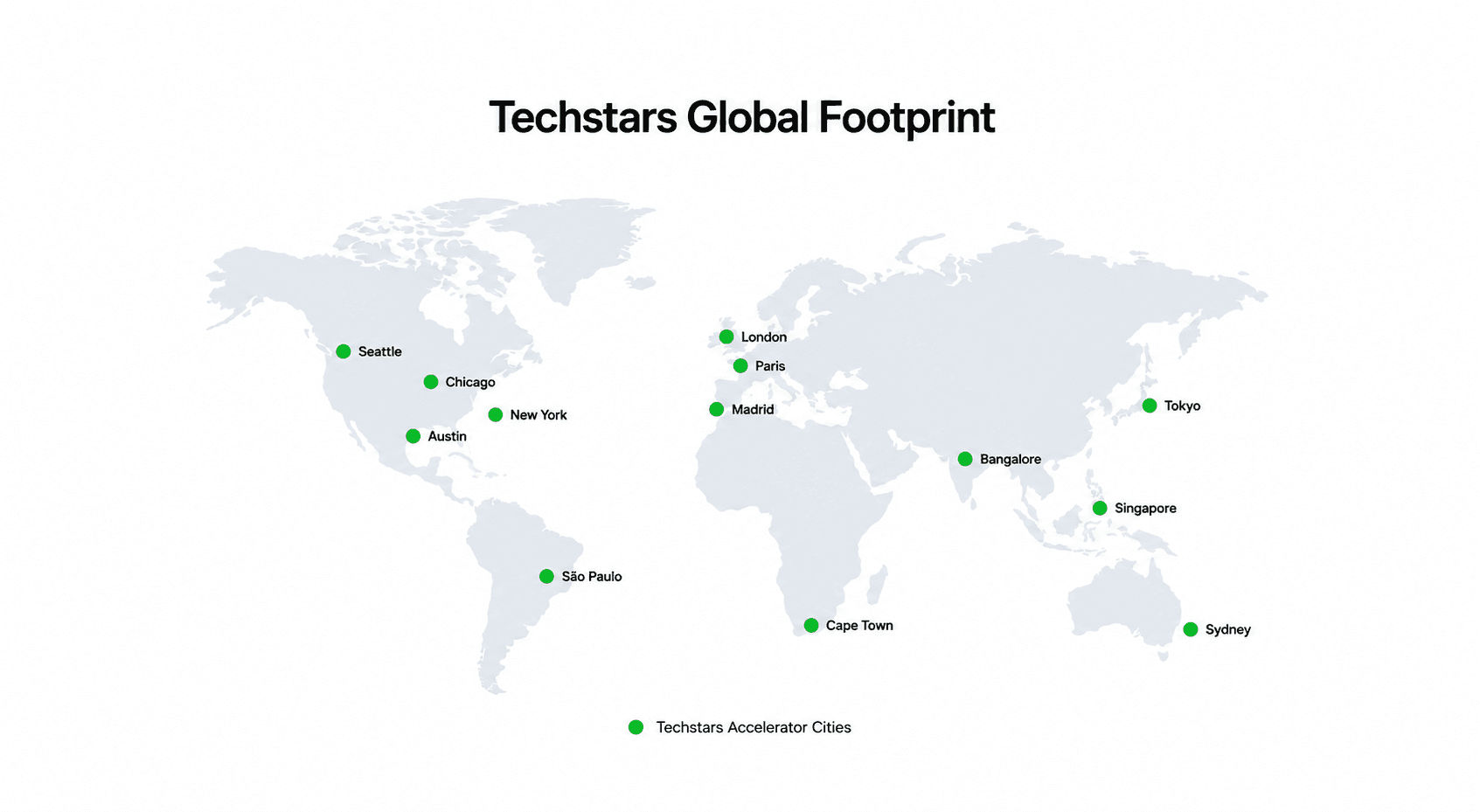
[IMAGE: Map showing the global footprint of Techstars accelerator programs across cities and continents]
How Prestigious Is Techstars in 2026?
Techstars sits in the same conversation as Y Combinator as one of the two most recognized startup accelerator brands in the world. The portfolio has produced notable companies across sectors: DigitalOcean (cloud infrastructure), SendGrid (now Twilio), Sphero (consumer robotics), and others that have gone on to IPOs, acquisitions, or major funding rounds.
The brand signal matters to investors. Being a Techstars company shifts the prior on whether a startup is worth taking a meeting with. That's worth something, particularly for founders without a warm network of VC connections.
That said, the 2024 restructuring was covered critically in the press. The closure of the Boulder and Seattle programs, the departure of CEO Maëlle Gavet after three years, and the return of co-founder David Cohen as CEO prompted public debate about whether Techstars had lost something in scaling. Former managing directors who had built programs over years spoke openly about concerns with the direction.
The honest read: Techstars is still a top-tier accelerator. The restructuring was real, and the landscape of active programs has shifted. Founders should verify which specific programs are currently accepting applications before targeting a location.
What Techstars Looks for in Founders
Team quality is the single most important factor in Techstars' selection process. It's listed first, and it's not close.
Here's what managing directors say they're looking for:
Obsession. Founders who go deep into their problem space, who can answer granular questions about customer behavior, competitive dynamics, and market structure without hesitation.
Founder-market fit. The right person for this specific problem. This often means lived experience, domain expertise, or an unusual angle of access.
Complementary strengths. The canonical pairing is a builder and a seller. Technical co-founder plus commercial co-founder. Teams where everyone does the same thing have an obvious gap.
Coachability. Techstars runs on mentorship. Founders who can't absorb feedback, adapt, and keep moving don't get the most out of the program. This shows up clearly in interviews.
Resilience. Accelerators are hard. The program condenses what would otherwise be a year of learning into three months. Founders who fold under pressure don't make strong candidates.
Solo founders can and do get accepted, but they need to demonstrate coverage across the missing skills and a clear plan for building out the team during or after the program.
How to Prepare Before You Apply
Most rejections aren't about the idea being bad. They're about the company not being ready. Here's what to get right before submitting your application.
Get proof of demand. Traction doesn't have to mean revenue. Validated letters of intent, active beta users, strong customer interviews with quantified pain, or a waitlist of qualified prospects all count. Techstars managing directors want to see that people want what you're building, not just that you believe they will.
Define the problem before pitching the solution. The application specifically asks founders to articulate the problem without reference to their product. Founders who skip this and jump to the solution look like they haven't done the customer work.
Know your market size, honestly. Techstars backs companies targeting billion-dollar markets. If your TAM slide is optimistic, it will get challenged in interviews. Know the numbers and be able to defend them.
Build a tight team narrative. Why are you the right people for this problem? What does each person bring? Where are the gaps and how are you addressing them? This is the core of what the selection committee is assessing.
Arrive with a polished brand and pitch deck. Founders applying to Techstars are, in effect, pitching for their first institutional money. Investors form impressions fast. A pitch deck that looks unfinished, a brand identity that looks cobbled together, or a website that doesn't match the product's ambition creates friction before you've said a word.
This is where a service like Zyner becomes directly useful. Zyner is an unlimited design subscription built for startups, pairing founders with senior designers and a dedicated project manager who turn around pitch decks, brand identities, and landing pages fast. Founders applying to Techstars who need to look investor-ready in days rather than months use it to compress that timeline without bringing on a full in-house design team.
Conclusion
Techstars is genuinely one of the highest-leverage opportunities available to early-stage founders. The combination of cash, mentorship density, investor access, and a permanent alumni network is hard to replicate independently.
Getting in requires more than a strong idea. It requires a team that investors want to back, a market worth pursuing, early evidence of demand, and a presentation that communicates all of it clearly. Founders who arrive at Demo Day having maximized those three months come out with a funded company and a network that compounds over years.
If you're targeting Techstars, start preparing earlier than you think you need to. The application process is also an audit of your business. Use it.
Frequently Asked Questions
What is Techstars and how does it work?
Techstars is a global startup accelerator and pre-seed venture capital firm. It runs 3-month programs for early-stage founders, investing $220,000 in exchange for approximately 6% equity. During the program, founders receive mentorship from experienced operators and investors, access to Techstars' global network, and preparation for Demo Day, where they pitch to investors. Programs run in cities worldwide and remotely through Techstars Anywhere.
How much does Techstars give you?
Techstars invests $220,000 in each accepted company, structured as a convertible note or equity investment, in exchange for approximately 6% common stock. Founders also receive perks valued at over $5 million, including $100,000 in AWS credits. Around 90% of Techstars alumni companies raise follow-on funding, with an average round of $2 million.
What is the acceptance rate for Techstars?
Techstars accepts approximately 1-2% of applicants, selecting around 12 companies per cohort per program. This makes it one of the most selective startup accelerators in the world, with a lower acceptance rate than many top universities. Founders who are not accepted on the first application are encouraged to reapply.
Is Techstars prestigious?
Yes. Techstars is consistently ranked among the top two startup accelerator programs globally, alongside Y Combinator. Its portfolio includes companies like DigitalOcean, SendGrid, and Sphero. The brand signal from being a Techstars company is meaningful with investors, particularly for founders without an existing warm VC network.
How does Techstars compare to Y Combinator?
Both are top-tier accelerators. Y Combinator runs larger cohorts, typically 200+ companies per batch, and has a heavier focus on Silicon Valley investor networks. Techstars runs smaller cohorts of around 12 companies, has a stronger global footprint with programs across dozens of cities and industries, and places particular emphasis on local mentorship networks. The decision between the two usually comes down to industry, geography, and the specific program cohort available at the time of application.