

Most founders walk into Techstars Demo Day thinking it's a funding event. It's not. It's a visibility event, and the difference matters.
The founders who treat demo day as a pitch competition stress about closing investors on the spot. The founders who treat it as a first impression campaign focus on being memorable, credible, and easy to follow up with. That second group almost always wins.
This guide covers everything you need to know about Techstars Demo Day in 2026: how it's structured, how it differs from other accelerator demo days, what investors actually look for, and how to prepare so you don't waste the moment.
Quick Takeaways
Techstars Demo Day is the graduation event at the end of the 13-week accelerator program, where founders pitch to a curated audience of investors, mentors, and corporate partners.
Unlike YCombinator's centralized batch event, each Techstars program runs its own separate demo day, which means audience size and investor type vary by program.
No checks get written on demo day. The goal is to generate interest, get meetings, and build momentum for your raise.
Investors at Techstars Demo Day prioritize team quality, traction, and market clarity, in that order.
Your pitch deck design matters more than most founders admit. Polished slides signal execution quality before you say a word.
The 48 hours after demo day are when deals actually start moving. Respond fast.
What Is Techstars Demo Day?
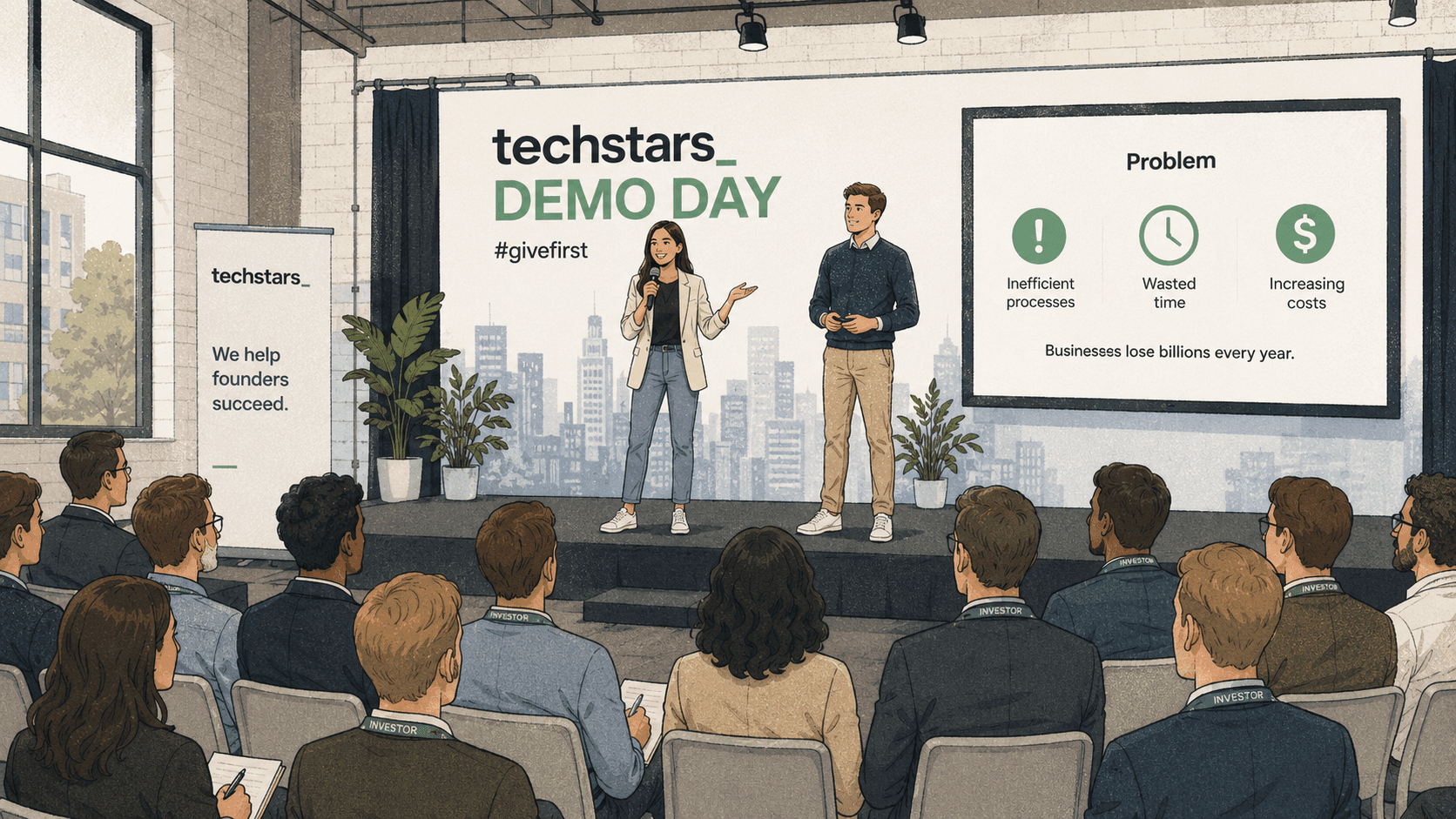
Techstars Demo Day is the culminating event of the Techstars accelerator program, where the current cohort of startups presents their companies to a live audience of investors, mentors, and industry professionals. Each startup gets a defined time slot to pitch their business, demonstrate traction, and make the case for why they're worth a meeting.
The event marks the official end of the 13-week program and the beginning of the most important fundraising window for most of those companies.
It's worth being clear on what demo day is not: it's not where you close a round. Investors don't write checks in the audience. They take notes, ask questions at the reception, and schedule follow-up meetings. The pitch on stage is the first impression. Everything that comes after is where the actual deal gets done.
How Techstars Demo Day Works
The 13-Week Program Context
To understand demo day, you need to understand what comes before it.
Techstars runs a 13-week accelerator program, and the structure builds directly toward demo day. The first few weeks involve what Techstars calls the "mentor whirlwind": founders take back-to-back meetings with mentors from the Techstars network, often 50 to 100 meetings in two or three weeks. The goal is rapid feedback on the business, positioning, and product.
After the whirlwind, cohort companies settle into focused execution: refining the product, tightening the pitch, building traction, and preparing for the fundraising conversations that will happen around demo day.
By the time demo day arrives, the pitch has usually been practiced dozens of times. The companies that perform best are the ones that spent those 13 weeks building something worth talking about, not just polishing their slide deck.
The Format on the Day
Here's where Techstars is fundamentally different from YCombinator: there's no single, centralized Techstars Demo Day.
Y Combinator runs two large cohort events per year with hundreds of companies all pitching in the same multi-day event. Techstars runs dozens of accelerator programs globally across different cities, industries, and corporate partnerships. Each program holds its own separate demo day.
That means Techstars Demo Day in Baltimore (healthcare-focused, in partnership with Johns Hopkins University and CareFirst BlueCross BlueShield) looks very different from Techstars Demo Day in Los Angeles or New York City. The investors in the room, the pitch expectations, and the follow-up dynamics all vary by program.
Pitch length at Techstars is typically 5 to 7 minutes per company, followed by a Q&A session. This is considerably longer than Y Combinator's 60-second format. You have enough time to build a real narrative, which means you also have enough time to lose the audience if you're not sharp.
The events can be in-person or virtual, depending on the program. Techstars has been hosting both formats regularly since 2020, and as of 2026, many programs offer a hybrid option.
Techstars Demo Day vs YC Demo Day
Founders often ask how these two compare. Here's a clean breakdown:
Feature | Techstars Demo Day | YC Demo Day |
|---|---|---|
Format | Per-program, separate events | Centralized batch events (2x/year) |
Pitch length | 5-7 minutes + Q&A | ~60 seconds, no live Q&A |
Audience size | 100-500 depending on program | 1,000+ investors |
Initial investment | $20K for 6% equity [VERIFY] | $500K on standard terms (as of 2024) |
Investor type | Mix of angels, VCs, corporate partners | Primarily institutional VCs |
Virtual option | Yes, many programs | Typically in-person |
Follow-up dynamic | Program-specific; often more personal | High volume, fast-moving |
The practical implication: at Techstars, you have more time and a smaller room. That's actually an advantage for founders who can tell a clear story and hold a conversation. The Q&A is where many Techstars investors make up their minds.
What Is a Demo Day?
A demo day is an event where startups pitch their companies to a live audience of investors, usually at the end of an accelerator program. It's a showcase event, not a funding event. Founders present their business model, product, and traction in a short time window. The goal is to generate investor interest and secure follow-up meetings, not to close deals on the spot.
The first startup demo day was held by YCombinator in 2005. The format has since become standard across accelerator programs globally, including Techstars, which runs demo days across dozens of cities and industries each year.
What Investors Look for at Techstars Demo Day
The single most important thing to know about Techstars investors: they invest in the team first.
Techstars has built its reputation on this explicitly. The program selects for founders, not just ideas. By demo day, investors in the audience already know the companies are Techstars-vetted, so they're evaluating which founders they want to bet on for the long run.
Beyond team, here's what moves the needle:
Traction over potential. Any investor can imagine what a company could become. What they can't fake is what it already is. Concrete numbers (monthly revenue, user growth rate, retention metrics) land harder than market size projections.
Market clarity. Founders who can explain who their customer is, why that customer has this problem, and why now is the right time to solve it get a second meeting. Founders who jump to "the market is $40 billion" without explaining the entry wedge don't.
Honest narrative. Techstars mentors spend 13 weeks helping founders stress-test their stories. Investors who attend regularly can spot a coached pitch. The founders who perform best are the ones who sound like they actually built the thing, because they did.
A clean, readable pitch deck. This one surprises founders. Investors are making rapid decisions across multiple pitches. A slide deck that's visually cluttered, uses tiny fonts, or has inconsistent branding signals that execution might be sloppy too. It's not fair, but it's real.
How to Prepare Your Techstars Demo Day Pitch
Structure Your Pitch Around Traction
The biggest mistake startup founders make with demo day decks is building them in chronological order: problem, solution, market, traction. That's how you think about your business, not how investors evaluate it.
Move your traction slide to the front. After your opening hook, show investors that something is already working. Growth charts, revenue numbers, user milestones. This earns you credibility before you ask them to believe in anything else.
Your opening hook has one job: make the investor stop looking at their phone. The best openers start with a direct, provocative question or a specific, surprising fact. "We've signed 40 enterprise contracts in 90 days" is a hook. "Good morning, we're solving the problem of..." is not.
Design Slides That Work in Any Room
Techstars Demo Days happen in conference rooms, auditoriums, and on Zoom calls. Your slides need to be readable in all three.
Use font sizes of 36pt or larger for body text. High contrast (dark backgrounds with bright text, or white backgrounds with bold dark text) reads cleanly on screens, on phones, and under stage lighting. Avoid gray on white; it disappears under any kind of projection.
Brand consistency matters more than founders expect. When every slide has the same visual language (consistent fonts, colors, and spacing) it signals that this team ships clean work. Investors notice when a company looks polished versus cobbled together, even if they couldn't articulate why.
Pro Tip: If you're in Techstars and demo day is six weeks away, this is the right time to get your deck professionally designed. The cost is trivial relative to the funding round you're trying to open. Services like Zyner work specifically with startups and can turn around a full deck redesign in days, not weeks.
Practice the Kipling Framework
For a 5-7 minute pitch, use six questions to structure what you cover. These come from author Rudyard Kipling, and they work because they map directly to what investors need to know:
Who is your customer?
What does your startup do?
When does the problem occur for them?
Where do they currently go to solve it?
Why does your solution win?
How will you scale from here?
This isn't a script. It's a coverage checklist. Every section of your pitch should map to at least one of these. If you have a section that doesn't answer any of them, cut it.
Research Your Specific Techstars Audience
Because each Techstars program attracts a different investor base, your pitch should reflect the program's focus.
A healthcare-focused Techstars cohort (like Techstars AI Health Baltimore) will have hospital systems, insurance companies, and health-tech VCs in the audience. Your market sizing, language, and traction metrics should be framed for them. A general program in a major tech hub will skew toward general-purpose VCs and angels.
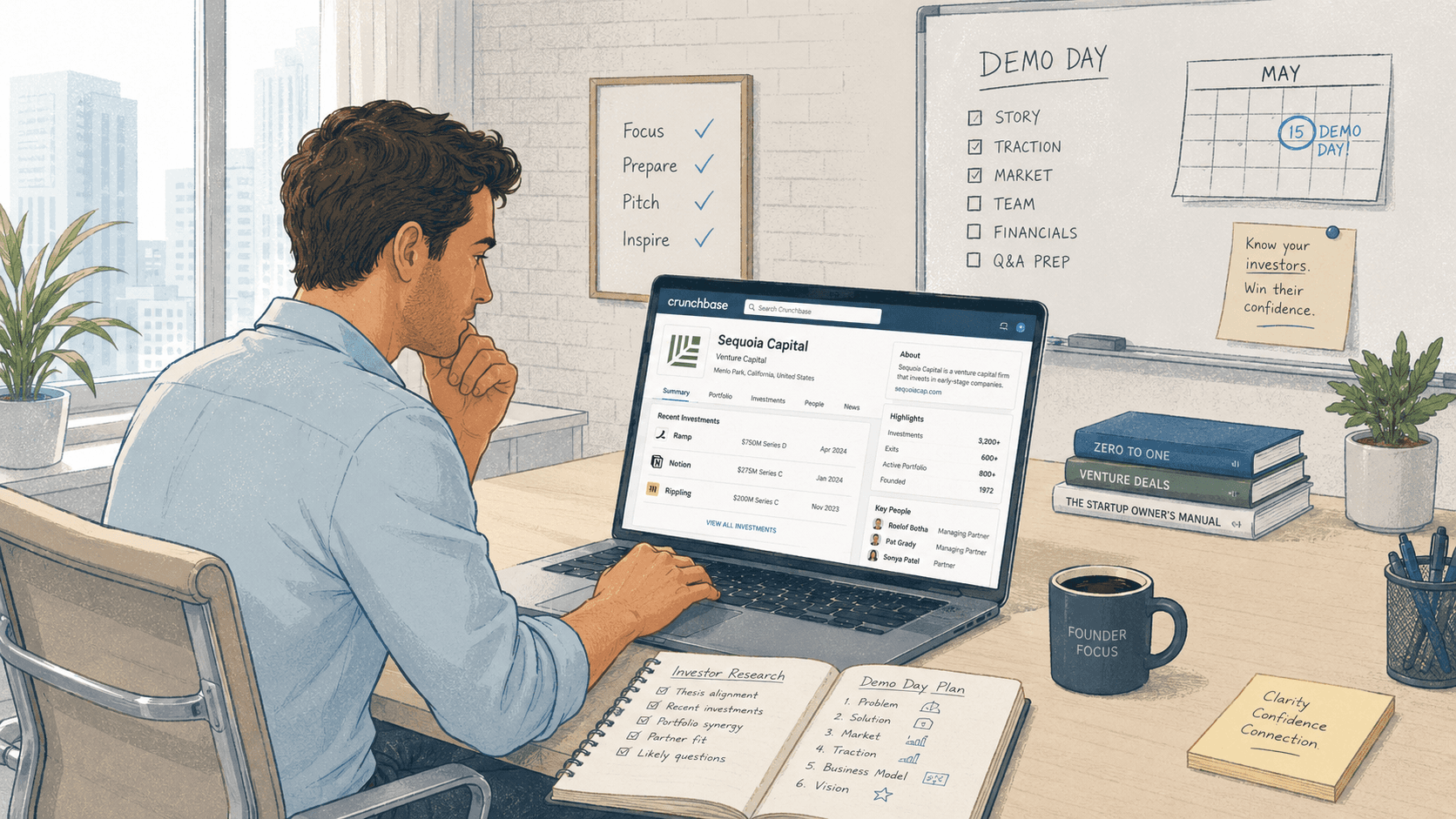
Look at who's attending your specific demo day. Research their portfolios on Crunchbase or LinkedIn before the event. If you know a specific investor in the audience has backed three healthcare data companies, you know how to frame your data strategy slide when you get to the reception.
Can Anyone Attend Techstars Demo Day?
Whether Techstars Demo Day is open to the public depends on the specific program and event format. Virtual demo days are typically open to anyone who registers through the Techstars website or the event listing (often on Luma). In-person demo days are usually invite-only or require registration, with priority access given to investors and corporate partners in the Techstars network.
To find upcoming Techstars Demo Days, visit techstars.com/demoday, where live events are listed as they're scheduled throughout the year.
What Happens After Techstars Demo Day
No checks get written on the day. Set that expectation now.
What does happen on demo day: investors take notes, pick up business cards, scan QR codes, and have short conversations at the reception. Some will send a quick email that night. Most won't. The follow-up window that matters is the 48 hours after the event.
In that window, you need to send a follow-up email to every investor you spoke with. Keep it short: who you are, what you're building, one traction number, and a calendar link. Don't send a wall of text. Investors move fast in the days after a demo day, and a long email is easy to defer and forget.
When you get a meeting, that's when the real fundraising begins. Demo day gives you warm introductions. The actual round closes through multiple follow-up meetings, due diligence, and investor-to-investor social proof (investors tend to wait for someone else to commit first).
One thing that sets Techstars apart from other accelerators: the alumni network and the ongoing relationship with Techstars itself. Many Techstars companies get follow-on introductions through the network months or even years after demo day. The event is an important milestone, but it's not the end of the Techstars relationship.
How Your Brand Shows Up on Demo Day
Investors form impressions fast. Before your third slide, they've already made a preliminary judgment about whether this team looks credible.
A pitch deck is not just a communication tool. It's a brand signal. Fonts that clash, slides that are hard to parse, colors that look like defaults: these things create friction. And friction makes investors work harder to see your potential, rather than being drawn toward it.
The companies that stand out on demo day tend to have decks that feel intentional. Clean hierarchy. Consistent color. Slides that guide the eye to the number or claim that matters. None of this requires a design team in-house. It requires getting the right help before the day comes.
If you're heading toward a Techstars Demo Day and your deck still looks like a Figma template you downloaded last week, now is the time to fix it. Zyner works with early-stage startups specifically: unlimited design requests, senior talent, 24-48 hour onboarding, and no long-term lock-in. Book a call and get your deck ready before it matters.
Frequently Asked Questions
What is Techstars Demo Day?
Techstars Demo Day is the final event of the Techstars 13-week accelerator program, where cohort startups pitch their companies to investors, mentors, and corporate partners. Each Techstars program runs its own separate demo day, rather than one centralized event. The goal is to generate investor interest and secure follow-up meetings, not to close funding on the day itself.
How long is a Techstars demo day pitch?
Techstars pitches are typically 5 to 7 minutes per startup, followed by a Q&A session. This is much longer than the 60-second format used at Y Combinator Demo Day, giving founders time to build a real narrative and handle investor questions directly on stage.
How is Techstars Demo Day different from YC Demo Day?
The core difference is structure. Y Combinator runs two large centralized batch events per year with 100+ companies pitching in a single multi-day event, with 60-second pitches and no live Q&A. Techstars runs dozens of separate demo days across its global programs throughout the year, each with a curated audience relevant to that program's focus, and a longer pitch format with live Q&A.
Do you get funded on Techstars Demo Day?
No. Investors at Techstars Demo Day don't write checks during the event. Demo day generates investor interest and opens the door to follow-up meetings. The actual fundraising happens in the days and weeks that follow, through one-on-one meetings, due diligence, and relationship-building. Founders who go in expecting a check on the day leave disappointed. Founders who go in focused on generating meetings leave with a pipeline.
What should I do the week after Techstars Demo Day?
Send follow-up emails within 48 hours to every investor you connected with. Keep each email short: your name, company, one traction metric, and a calendar link. Track who responds and who doesn't, and send a single polite follow-up to non-responders after five to seven days. Use the investor interest from demo day to create social proof with other investors: "We've had strong interest from [type of investor] and are finalizing our round" is a legitimate signal that accelerates decisions.
The companies that get the most out of Techstars Demo Day are the ones who treat it as a launch pad, not a finish line. The 13-week program gets you ready. Demo day puts you in the room. What you do in the 48 hours after is what closes the round.
If your deck and brand aren't where they need to be before the day comes, that's the one thing you can fix right now. Everything else (traction, market, team) takes longer to build. Your pitch materials don't have to.


