

Between 35% and 66% of web projects experience partial or total failure, according to industry analyses published in 2025 and 2026. Half of all website redesigns miss their launch deadline. And the majority of that pain traces back to one root cause: choosing the wrong agency.
If you're a startup founder weighing your options in 2026, the stakes are even higher. A bad agency pick doesn't just waste money. It burns runway, delays your go-to-market, and leaves you with a site that fails to convert the traffic you're fighting to earn. The good news: you can avoid most of these outcomes by following a structured selection process before you sign anything.
This guide walks you through exactly how to choose a web design agency, from defining what you actually need to comparing proposals and spotting red flags before they become expensive mistakes.
Quick Takeaways
Define your specific deliverable (landing page, full site, rebrand) before you start searching. Your answer determines which agency type to shortlist.
There are four main options: freelancers, boutique studios, full-service agencies, and subscription design services. Each fits different budgets and project scopes.
Always shortlist 3 to 5 agencies and evaluate portfolios for relevance, results, and recency, not just visual appeal.
Discovery calls matter more than most founders realize. Ask about process, team composition, revision policies, and what happens when things go wrong.
Compare proposals on scope and value, not just price. The cheapest quote almost always means the narrowest scope.
Red flags include overpromising timelines, vague contracts, poor communication during the sales process, and an inability to provide references.
Subscription design services offer a flexible alternative to traditional agencies, with flat monthly pricing and no long-term lock-in.
What Is a Web Design Agency?
A web design agency is a company that designs, builds, and (in many cases) maintains websites for businesses. The scope varies widely. Some agencies focus purely on visual design. Others handle everything from brand strategy and UX research to front-end development and post-launch performance tuning.
For founders, the important distinction isn't "what is an agency" but rather "what type of agency fits my situation." The web design market is more fragmented than ever, and the differences between options are significant.
Types of Web Design Agencies
There are four main categories to consider. Each has a different cost structure, strengths, and limitations.
Type | Typical Cost | Best For | Limitations |
|---|---|---|---|
Freelancers | $2,000 to $15,000 per project | Simple sites, tight budgets, single-skill needs | No backup if unavailable, limited scope, quality varies |
Boutique Studios (5 to 15 people) | $15,000 to $75,000 per project | Custom design, close collaboration, mid-range budgets | Limited bandwidth, fewer specialists on staff |
Full-Service Agencies (20+ people) | $50,000 to $250,000+ per project | Complex builds, multi-discipline needs, enterprise clients | Higher cost, potential for junior team assignment, longer timelines |
Subscription Design Services | $4,995 to $5,495 per month (flat rate) | Startups needing ongoing design across branding, web, UI/UX, and more | One active request at a time, best for continuous needs |
Most "how to choose a web design agency" guides skip the subscription model entirely. That's a blind spot worth noting, especially if your startup needs more than a one-time website build.
Why Hire a Web Design Agency Instead of Doing It Yourself?
You can build a website yourself. Tools like Squarespace, Wix, and Framer have made that possible. So why hire anyone?
Because a website that looks "fine" and a website that actually converts visitors into customers are two very different things. The gap between them is strategy, user experience research, performance tuning, and design quality, all of which require specialized skill.
For founders specifically, the real cost of DIY isn't the $20/month platform fee. It's the hours you spend learning layout principles, debugging responsive issues, and iterating on a design that still doesn't instill confidence in investors or customers. Those are hours that could go toward product, sales, or fundraising.
Pro Tip: If your website is a core part of how customers discover, evaluate, or buy from you, treat it as a strategic investment, not a weekend project. A site that costs $15,000 but generates consistent pipeline is worth infinitely more than a free template that generates nothing.
A professional web design agency brings three things most founders can't replicate alone: strategic thinking (what should this site accomplish and for whom?), technical execution (performance, accessibility, SEO architecture), and design quality (the kind that builds instant trust with a first-time visitor).
How to Choose a Web Design Agency (Step by Step)
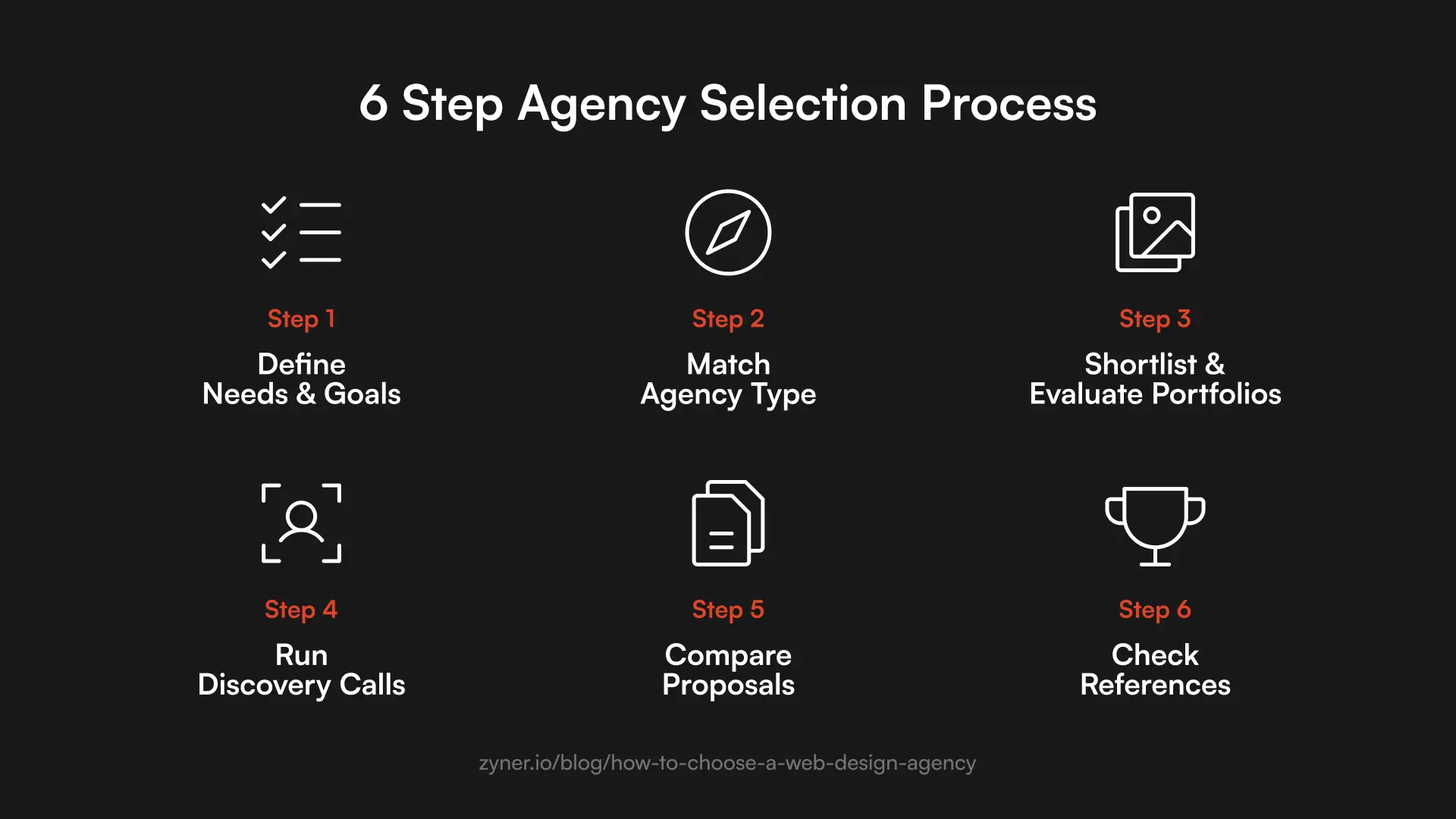
Choosing a web design agency doesn't need to take months. But it does need structure. Here are six steps that separate founders who find great partners from founders who end up writing angry Reddit posts about their agency experience.
Step 1: Define What You Actually Need
Start with your problem, not with agency websites.
What's the actual deliverable you need? A single landing page for a product launch? A full multi-page website with CMS? A complete rebrand with a new site built on top? Ongoing design support that includes web, pitch decks, and brand collateral?
Your answer determines which type of agency belongs on your shortlist. A founder who needs a one-time landing page is shopping in a completely different market than a founder who needs brand identity, a website, pitch deck design, and ongoing creative support.
Write down three things before you search:
The deliverable: What exactly needs to be designed and built?
The timeline: When does this need to go live?
The budget: What range are you comfortable with?
Most founders skip this step and end up comparing agencies that serve completely different needs at completely different price points. That's like comparing a Honda to a helicopter because they both get you from A to B.
Step 2: Match Your Needs to the Right Agency Type
Once you know what you need, match it to the right category.
If you need a simple, one-off landing page and your budget is under $10,000, a skilled freelancer or a boutique studio is likely the right fit. You don't need a 30-person agency for a five-section landing page.
If you need a complex custom website with integrations, CMS, and multi-page architecture, a boutique studio or full-service agency is the better choice. Look for agencies with technical depth, not just strong visual portfolios.
If you need a B2B web design agency that understands how to structure pages for lead generation, demo requests, and long sales cycles, prioritize agencies with B2B case studies in their portfolio. Knowing how to choose a B2B web design agency comes down to one thing: look for proven experience with long sales cycles and complex buyer journeys. B2B web design has specific conversion patterns that consumer-focused agencies often miss.
If you need a product interface designed rather than a marketing site, the shortlist is a different one and the two barely overlap. Start with UI/UX agencies ranked with verified offices and published minimums, where firms are judged on product design work rather than website builds.
If you need ongoing design beyond just a website (brand identity, pitch decks, product UI, social assets, and web design under one roof), a subscription design service gives you continuous access to a design team at a flat monthly rate, without per-project billing or long-term contracts.
The key insight: the right agency type depends on your situation, not on who has the flashiest website.
Step 3: Shortlist 3 to 5 Agencies and Evaluate Their Portfolios
Once you've narrowed the category, build a shortlist of 3 to 5 agencies and dig into their portfolios.
Most founders look at portfolios the wrong way. They browse, think "that looks nice," and move on. That tells you almost nothing about whether the agency can deliver results for your project.
Here's how to read a portfolio like a buyer, not a browser:
Relevance. Have they worked with companies at your stage or in your industry? An agency that designs enterprise SaaS dashboards may not be the right fit for a pre-seed consumer product.
Results. Do their case studies mention measurable outcomes (conversion rate improvements, lead generation numbers, performance metrics), or do they only show screenshots? Pretty designs that don't convert are expensive brochures.
Recency. Is the work from the past 12 to 18 months? Design trends, performance standards, and platform capabilities change fast. A portfolio filled with 2021 work should raise questions.
Range vs. house style. If every project in the portfolio looks identical, the agency is likely applying a template aesthetic rather than designing for each client's brand and goals. You want evidence of customization.
Technical complexity. Do the projects demonstrate the technical capabilities your build requires? If you need custom integrations or advanced animations, look for evidence of that work.
Step 4: Run Discovery Calls and Ask the Right Questions
If there's one step that determines whether you've figured out how to choose a web design agency correctly, it's this one. Schedule 30 to 60 minute discovery calls with your shortlisted agencies. This is where you separate polished sales pitches from genuine capability.
Here are the questions that matter most, along with what good and bad answers sound like:
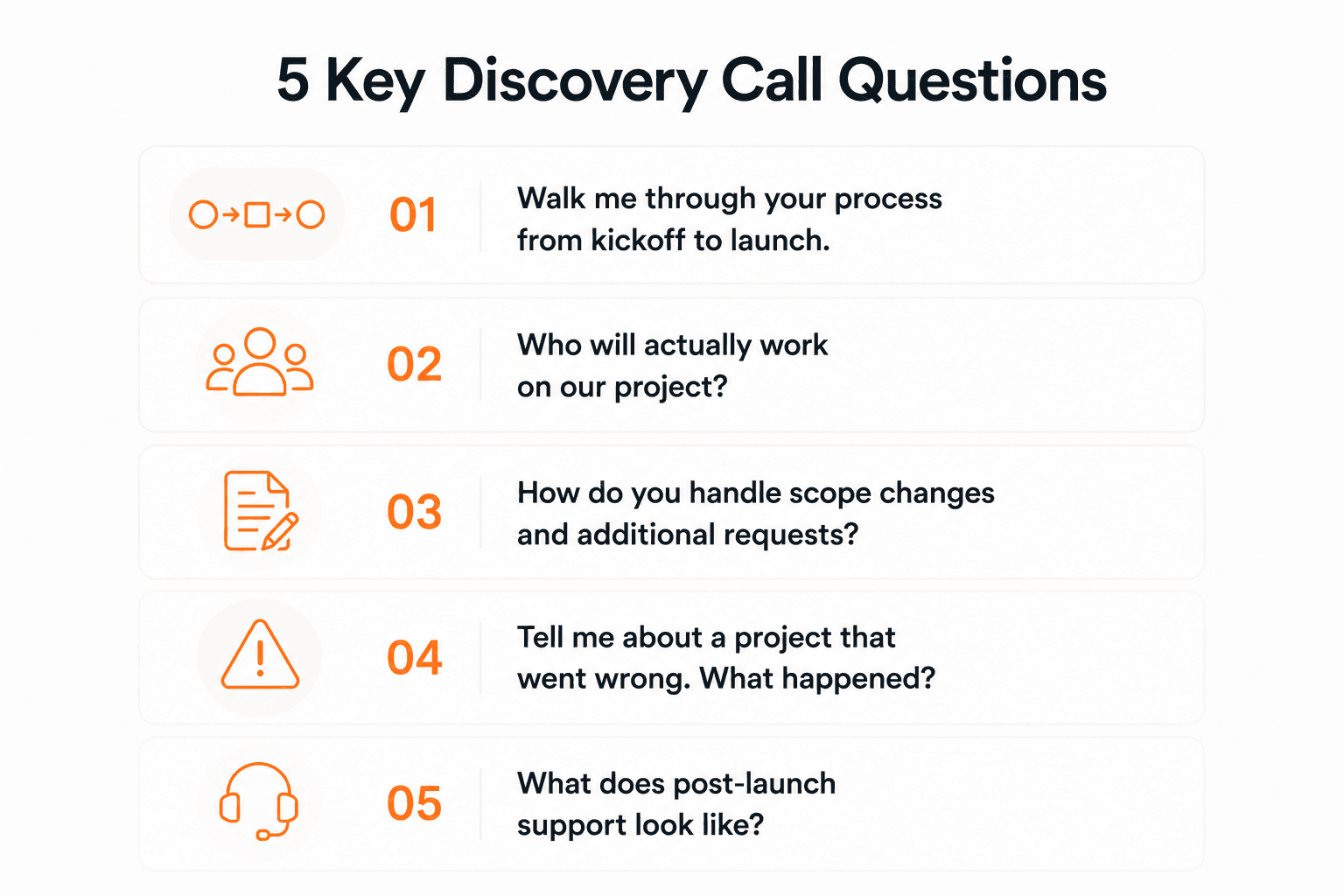
"Walk me through your process from kickoff to launch."
Good answer: A clear, step-by-step breakdown with defined milestones, approval gates, and your role at each stage.
Bad answer: Vague generalities like "we collaborate closely" without specifics.
"Who will actually work on our project?"
Good answer: Specific names, roles, and experience levels. Ideally, you get to meet the team before signing. Bad answer: "Our team of talented designers." If they won't tell you who's doing the work, you may end up with junior staff.
"How do you handle scope changes and additional requests?"
Good answer: A documented change order process with clear pricing.
Bad answer: "We're flexible" with no detail. Flexibility without structure becomes scope creep and surprise invoices.
"Tell me about a project that went wrong. What happened?"
Good answer: An honest story with specific lessons learned.
Bad answer: "We've never really had that happen." Every experienced agency has managed difficult projects. If they can't share one, they either lack experience or lack self-awareness.
"What does post-launch support look like?"
Good answer: Defined options for maintenance, hosting, updates, and response times.
Bad answer: Silence or a vague "we're always here for you."
Pay attention to how the agency communicates during the sales process. If responses are slow, answers are surface-level, or the call feels like a pitch rather than a conversation, those patterns will not improve after you sign a contract.
Step 5: Compare Proposals on Scope, Not Just Price
When proposals come back, resist the urge to compare on price alone. The lowest quote almost always means the narrowest scope.
Here's what to compare across proposals:
Scope clarity: Is what's included (and excluded) explicitly stated?
Team composition: Who's assigned, at what seniority level, and for how many hours?
Timeline: Are milestones defined and realistic?
Deliverables: What specific outputs will you receive at each phase?
Revision policy: How many rounds of revisions are included? What happens after that?
Post-launch support: What's covered after the site goes live?
Ownership: Who owns the design files, the code, and the domain after the project ends?
Payment structure: Fixed fee, hourly, milestone-based? What's the payment schedule?
If one proposal is significantly cheaper than the others, ask what's different. The answer is usually one of three things: a narrower scope, a less experienced team, or a compressed timeline that will create problems later.
A custom website build from a credible agency in 2026 typically ranges from $15,000 to $75,000 for small to mid-sized businesses, with enterprise-level projects exceeding $150,000 depending on complexity and integrations.
Step 6: Check References and Run a Background Check
This is the final step in learning how to choose a web design agency, and it's the one most founders skip. Don't. It takes an hour and can save you months of pain.
Ask for three references from projects similar to yours. When you talk to them, ask: Would you hire this agency again? What surprised you (positively or negatively)? Did the project stay on budget and timeline?
Go beyond their hand-picked references. Check the agency's Glassdoor and LinkedIn profiles. High staff turnover is a warning sign. If designers and developers are cycling through every six months, the team working on your project may not be the team that finishes it.
Run their portfolio sites through PageSpeed Insights. This is a tactic recommended by web developers on forums and in industry discussions. It reveals build quality in a way that screenshots never can. If the agency's clients have slow, poorly performing sites, you can expect the same.
Search for the agency name plus "review" or "complaint." Sometimes a five-minute search surfaces patterns that a polished sales process would never reveal.
Red Flags to Watch for When Choosing a Web Design Agency
Knowing how to choose a web design agency is as much about spotting warning signs as it is about finding strengths. Not every red flag is obvious. Some only show up when you know what to look for.
Overpromising timelines. A full custom website in two weeks? That's either a template with your logo swapped in or a project that will quietly slip to month three. Realistic timelines for a custom build typically range from 8 to 16 weeks depending on scope.
Vague contracts. If the statement of work doesn't clearly define deliverables, revision rounds, ownership, and payment terms, you're signing up for disputes. Every ambiguity in a contract becomes a negotiation later.
No relevant portfolio work. If they haven't built websites for businesses at your stage or in your category, you're their experiment. Experience with similar projects is one of the strongest predictors of a smooth engagement.
Pushing a single platform regardless of your needs. If the agency only builds on WordPress and can't explain why that's the right choice for your specific project, the platform is driving the recommendation rather than your requirements. The best agencies match the tool to the problem.
Poor communication during the sales process. This is the biggest leading indicator of project trouble. If they take four days to respond to a pre-sale email, expect worse once they have your deposit.
Significantly cheaper than every other quote. Corners are being cut somewhere: scope, team seniority, quality control, or all three. Ask specifically what's different.
No questions about your business. A good agency should dig into your goals, audience, competitors, and success metrics before they propose anything. If they jump straight to a quote without understanding your situation, they're selling a commodity, not a partnership.
Web Design Agency Selection Checklist
If you take one thing from this guide on how to choose a web design agency, make it this checklist. Use it before signing with any agency. Print it, share it with your co-founder, and score each agency against it.
Before you search:
Defined the specific deliverable (landing page, full site, rebrand, ongoing support)
Set a realistic budget range
Established a target launch date
Identified 2 to 3 reference websites you admire
During evaluation:
Reviewed portfolio for relevance, results, recency, and range
Ran portfolio sites through Google PageSpeed Insights
Completed a discovery call and asked about process, team, scope changes, failures, and post-launch support
Verified who will actually work on the project (names and seniority levels)
Confirmed revision policy and what happens when revisions exceed the included rounds
Before signing:
Compared proposals on scope, deliverables, and value, not just price
Checked 3 references from similar projects
Reviewed Glassdoor and LinkedIn for staff turnover signals
Confirmed you own all design files, code, and domain after the project ends
Reviewed the contract for clear deliverables, timelines, payment terms, and cancellation terms
Why Startups Choose Design Subscription Services Over Traditional Agencies
If you've made it this far, you've probably noticed a theme: the traditional agency model has friction. Long sales cycles, per-project pricing, unpredictable costs, and rigid contracts don't align well with how startups actually operate. That's why, for many founders, the question of how to choose a web design agency leads them to an entirely different model.
That's why a growing number of founders are choosing subscription design services instead.
Zyner is an unlimited design subscription built specifically for startups. Instead of scoping individual projects and negotiating per-deliverable pricing, you pay a flat monthly fee and get access to a dedicated team of senior designers and a project manager who handles everything: web design and development in Framer, brand identity, pitch decks, UI/UX design, motion design, social media creatives, and more.
The model solves the three biggest problems founders face with traditional agencies:
Unpredictable costs become a flat rate. Every Zyner plan includes unlimited requests and unlimited revisions under one monthly price (starting at $4,995/month on the annual plan). No surprise invoices. No scope creep charges.
Long onboarding becomes fast execution. Zyner onboards new clients within 24 to 48 hours and starts shipping designs within the first week. Compare that to the 4 to 8 week ramp-up of a typical agency engagement.
Rigid contracts become flexible terms. All plans allow you to pause or cancel anytime. If your startup's needs shift after a fundraise or a pivot, your design support shifts with you.
Zyner has worked with 320+ startups, including multiple YC-backed companies across cohorts from W14 through X25. The team already knows what a strong fundraising deck looks like, how fast startup timelines move, and what investors and customers expect from a startup's visual presence.
If your design needs go beyond a single website project, book a call with Zyner to see if the subscription model fits your situation.
Frequently Asked Questions
How much does it cost to hire a web design agency?
Costs vary significantly based on agency type and project complexity. Freelancers typically charge $2,000 to $15,000 per project. Boutique studios range from $15,000 to $75,000. Full-service agencies start around $50,000 and can exceed $250,000 for enterprise builds. Subscription design services like Zyner offer a flat monthly rate starting at $4,995/month, which includes unlimited requests and revisions across web design, branding, and other creative work.
What is the difference between a freelancer and a web design agency?
A freelancer is a single individual handling your project. An agency is a team with multiple specialists (designers, developers, strategists, project managers). Freelancers are typically cheaper and work well for simple, single-deliverable projects. Agencies bring more depth, better project management, and redundancy if a team member is unavailable. The tradeoff is cost and communication layers.
How long does it take to build a website with an agency?
A typical custom website build takes 8 to 16 weeks from kickoff to launch. Simple landing pages can be completed in 2 to 4 weeks. Complex sites with custom integrations, CMS setup, and content migration can take 4 to 6 months. Be skeptical of any agency promising a full custom build in under four weeks, as that usually indicates a template-based approach or an unrealistic timeline that will slip.
What should I look for in a web design agency?
Focus on five things: relevant portfolio work (have they built sites for companies like yours?), a clear and documented process, transparent pricing with defined scope, strong communication during the sales process, and post-launch support options. Awards and flashy branding matter less than a proven track record with clients at your stage and in your industry.
How do I evaluate a web design agency's portfolio?
Look beyond aesthetics. Check for relevance (your industry or stage), results (measurable outcomes, not just screenshots), recency (work from the past 12 to 18 months), and range (custom designs vs. a repeated house style). Visit live portfolio sites and run them through Google PageSpeed Insights to assess technical build quality. Ask the agency to walk you through a specific project during your discovery call to understand their problem-solving process, not just the final design. Knowing how to choose a web design agency starts with knowing how to read the work they've already done.


