

You need a pitch deck for your Series A meeting in three weeks. Your landing page hasn't been touched since you launched. Your LinkedIn presence is held together by Canva templates, and you know it shows.
Hiring a senior designer will take four to eight weeks and cost you $120,000 a year before benefits. A traditional agency will quote you $30,000 for a project scope and deliver the first version in a month. A freelancer might get you there faster, but you've been burned before.
This is exactly the problem the design subscription agency model was built to solve. One flat monthly fee. Unlimited requests. A real team, not a solo contractor, handling everything from your brand identity to your pitch materials to your website.
But not all subscription design services are built for the same customer. If you're a startup founder, picking the wrong one is an expensive mistake. This guide covers how the model works, who it's right for, and which services are worth your money in 2026.
Quick Takeaways
A design subscription agency charges a flat monthly fee for unlimited design requests and revisions, with no per-project billing.
The model is faster to start (24 to 48 hours) and significantly cheaper than hiring in-house or working with a traditional agency.
Most affordable services under $900 per month are generalists. They work well for recurring marketing assets but often exclude pitch decks, brand identity, or web design at their base tier.
Startup-specialized services cost more but cover fundraising-critical assets like pitch decks, brand identity systems, and Framer websites.
The right service depends on your current stage, what you actually need design for, and whether you can afford to trade scope for price.
Most reputable services let you pause or cancel anytime. Verify this before committing to a quarterly or annual plan.
Series A and beyond may need multiple designers or higher-volume tiers. Seed-stage is the sweet spot for startup-focused subscription services.
What Is a Design Subscription Agency?
A design subscription agency is a service that gives you access to professional designers for a flat monthly fee, including unlimited design requests and unlimited revisions, with no contracts tied to individual projects.
Instead of billing you per deliverable or per hour, you pay once a month and submit as many requests as you need. Most services work on one active request at a time, completing and iterating on it before moving to the next. Communication typically happens through Slack, with async video updates via Loom and bi-weekly check-ins.
How the Model Compares to Other Options
The subscription design model sits between DIY tools (Canva) and traditional agencies. Here's how it stacks up:
Option | Time to Start | Monthly Cost (est.) | Strengths | Weaknesses |
|---|---|---|---|---|
In-house hire | 4-8 weeks | $10,000+ (salary + overhead) | Deep context, full-time focus | Expensive, slow to hire |
Traditional agency | 1-3 weeks | $5,000-$30,000+ | Strategic input, senior talent | High cost, rigid scopes |
Freelancer | 1-5 days | Varies widely | Flexible, fast for one-offs | Inconsistent quality, scope creep |
Design subscription | 24-48 hours | $400-$5,500 | Fast onboarding, flat pricing, ongoing | One active request at a time |
The subscription model wins on speed and predictability. It loses on volume (one request at a time) and occasionally on strategic depth, depending on the service.
Why Founders Are Switching to Design Subscriptions
The practical reasons are straightforward. You can start in 24 to 48 hours instead of waiting months for a hire. You pay a flat monthly fee instead of a salary with benefits and overhead. You can pause when runway tightens without severance conversations. And you get access to a coordinated team rather than a solo contractor who disappears between projects.
But there's a deeper reason founders are making this switch. Design is not a one-time problem.
You need a pitch deck for this round. Then a new website when you rebrand. Then social assets for your launch. Then updated sales collateral as your messaging evolves. Then UI mockups for your next feature. That's not a freelance engagement; that's an ongoing creative function. The subscription model is built for exactly that.
What You Save Compared to Hiring In-House
Building a two-to-four person in-house design team comes with salary, benefits, equipment, and management overhead that adds up fast. Zyner estimates that clients who switch from in-house teams to a subscription model save between $250,000 and $450,000 annually, depending on team size and seniority. The ROI typically lands within two to three months of subscribing.
Even comparing to a single senior designer hire at $120,000 to $150,000 per year, a startup-tier subscription at around $5,000 per month comes out at roughly $60,000 annually while covering the full breadth of a small design team.
Pro Tip: If you're mid-fundraise, speed matters more than cost. A subscription service that can turn around pitch deck revisions in 48 hours is worth significantly more than a cheaper option that takes four to five days per iteration.
The Best Design Subscription Agencies in 2026
These services are ordered by startup relevance, not price. The cheapest option is rarely the right one if it can't handle the assets that actually move the needle for you.
Zyner
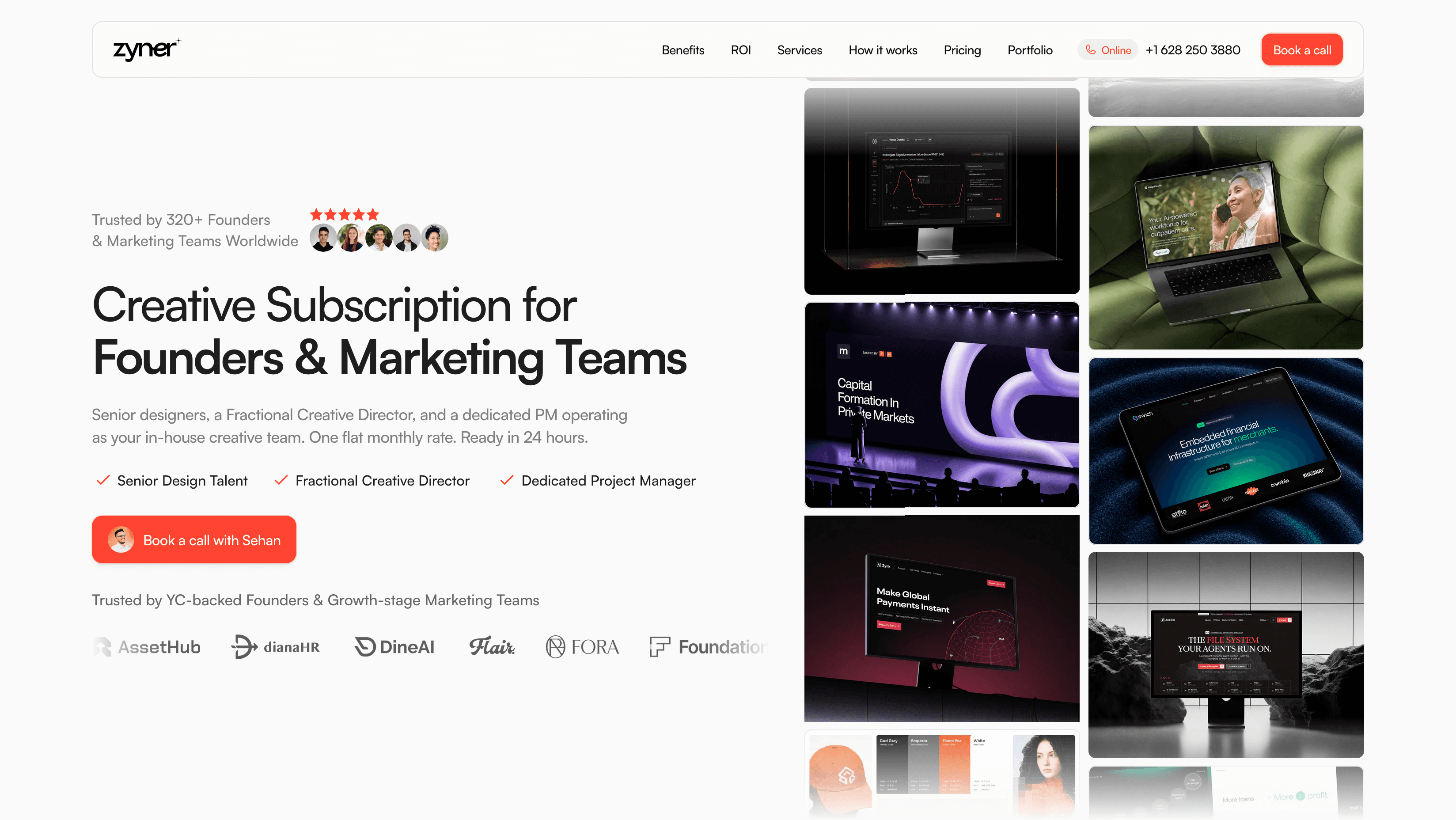
Best for: Startups that need pitch decks, brand identity, and go-to-market design under one roof.
Zyner is a design subscription agency built specifically for startups. The team has worked with 320+ startups, including companies from multiple Y Combinator cohorts (W14, W22, W23, W24, W25, F24, S24, S25, X25). Every client gets a dedicated senior design team paired with a project manager, so founders aren't managing designers directly.
The scope covers everything a startup needs: brand identity from scratch, fundraising pitch decks, Framer website development, UI/UX for web and mobile products, motion design, and social media creatives. All communication runs through Slack. Onboarding takes 24 to 48 hours.
Services Offered:
Branding Services: Logo Design, Brand Identity, Brand Collateral, and more.
Design Systems: Component Libraries, UI Kits, Typography, and more.
Web Design: Landing Pages, Full Websites, Framer Development, and more.
Product Design: App UIs, Prototyping, Mobile UI, Web UI, and more.
Ad Creatives: Static Creatives, Motion Creatives, Meta ads, LinkedIn Ads and more.
Social Media Creatives: Posts, Reels, Stories, Videos, Carousels and more.
Presentation Designs: Business Presentations, Webinar Slides and more.
Pitch Deck Design: Fundraising Decks, Sales Decks, Data Rooms and more.
Illustration Design: Icons, Characters, Illustration Systems, and more.
Print Design: Flyers, Events, Billboards and more.
Packaging & Merchandise: Apparel & Merch, Brand Collateral and more.
Motion Design: Product Animations, Explainer Animations, UI/UX motion and more.
Launch Video: Launch Videos, Demo Videos, Promo Videos and more.
Creative Subscription for
Startups & Marketing Teams
Senior designers, a Fractional Creative Director, and a dedicated PM operating as your in-house creative team. One flat monthly rate. Ready in 24 hours.
Get 2000$ off for the first month.
Starting price: $4,995/month (yearly plan) | $5,495/month (month-to-month)
Strength: Deep startup context. The team understands what a seed-stage pitch deck needs to accomplish, not just how to make slides look good.
Limitation: Premium pricing. Not the right fit if your design needs are limited to recurring social graphics or simple marketing collateral.
Book a call with Zyner today to get 2000$ off!
Designjoy
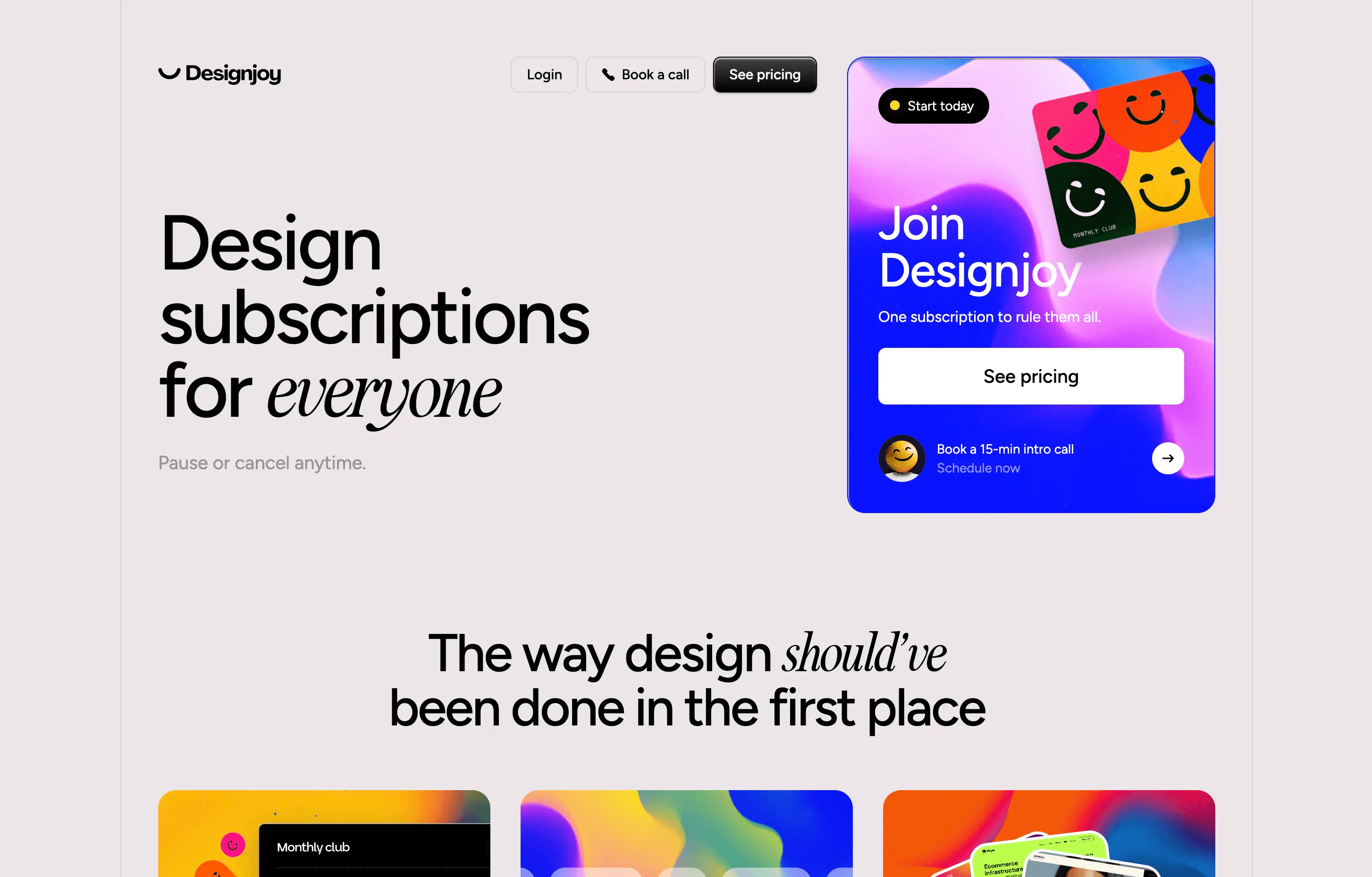
Best for: Founders who need consistent UI/UX and landing page work from a single high-quality designer.
Designjoy is operated by a single designer with no outsourcing. Clients submit requests through a Trello board. Most are completed within 48 hours. Services cover UI/UX, landing pages, and Webflow development.
Strength: High consistency. You know exactly who is working on your project and what their standard looks like.
Limitation: One designer's bandwidth is finite. If you need parallel workstreams or a range of design types (pitch deck, website, social), you'll hit the ceiling quickly. No strategic input on positioning or conversion.
Superside
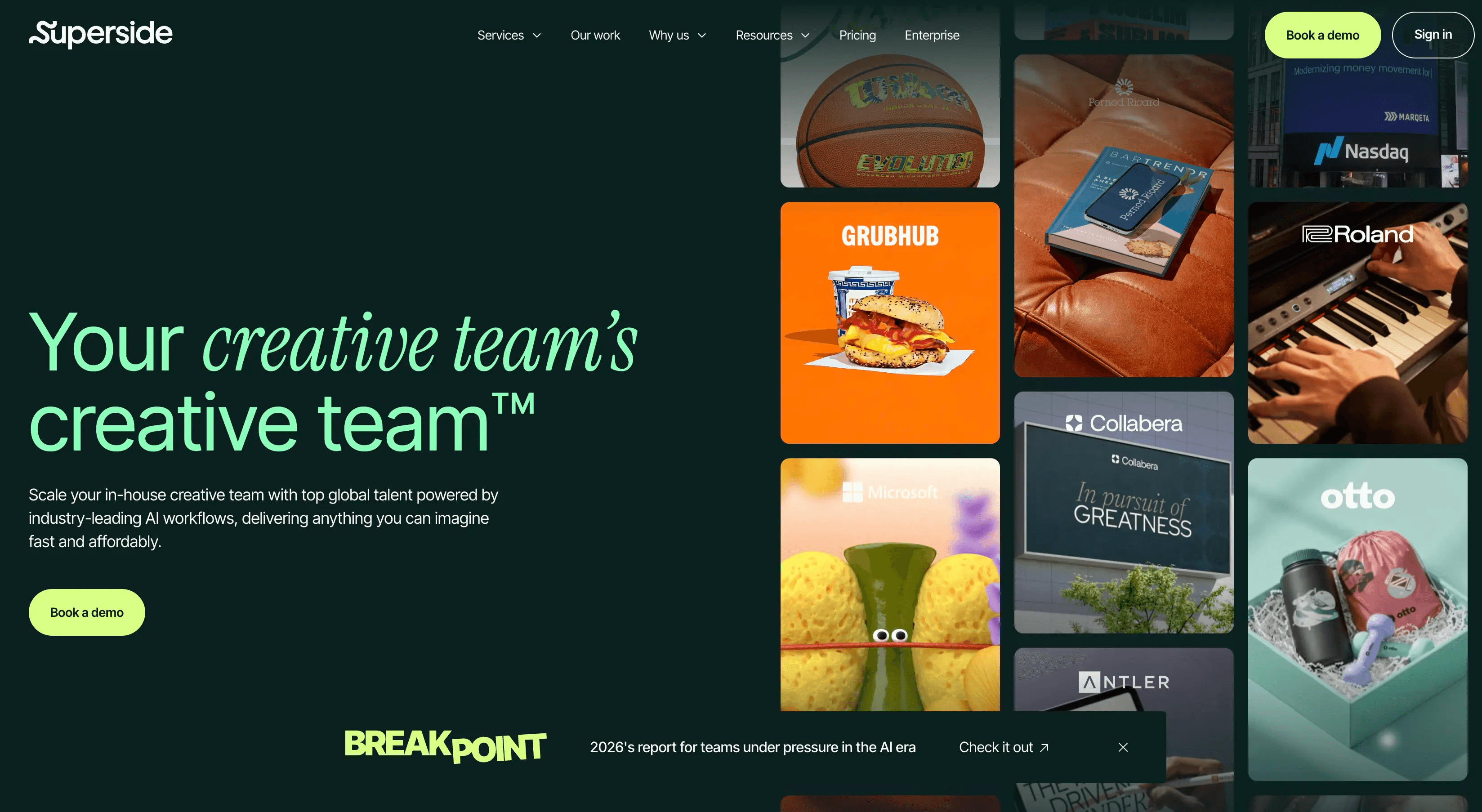
Best for: Growth-stage startups and scale-ups with high-volume creative production needs.
Superside provides access to a distributed team that handles ads, web pages, presentations, and brand assets at scale. It's designed for volume and speed across multiple channels simultaneously.
Strength: Handles large amounts of creative output across channels without missing a beat.
Limitation: The focus is on execution, not strategy. If you need a partner that understands where your pitch deck sits in your fundraise narrative, Superside is not that.
Design Pickle
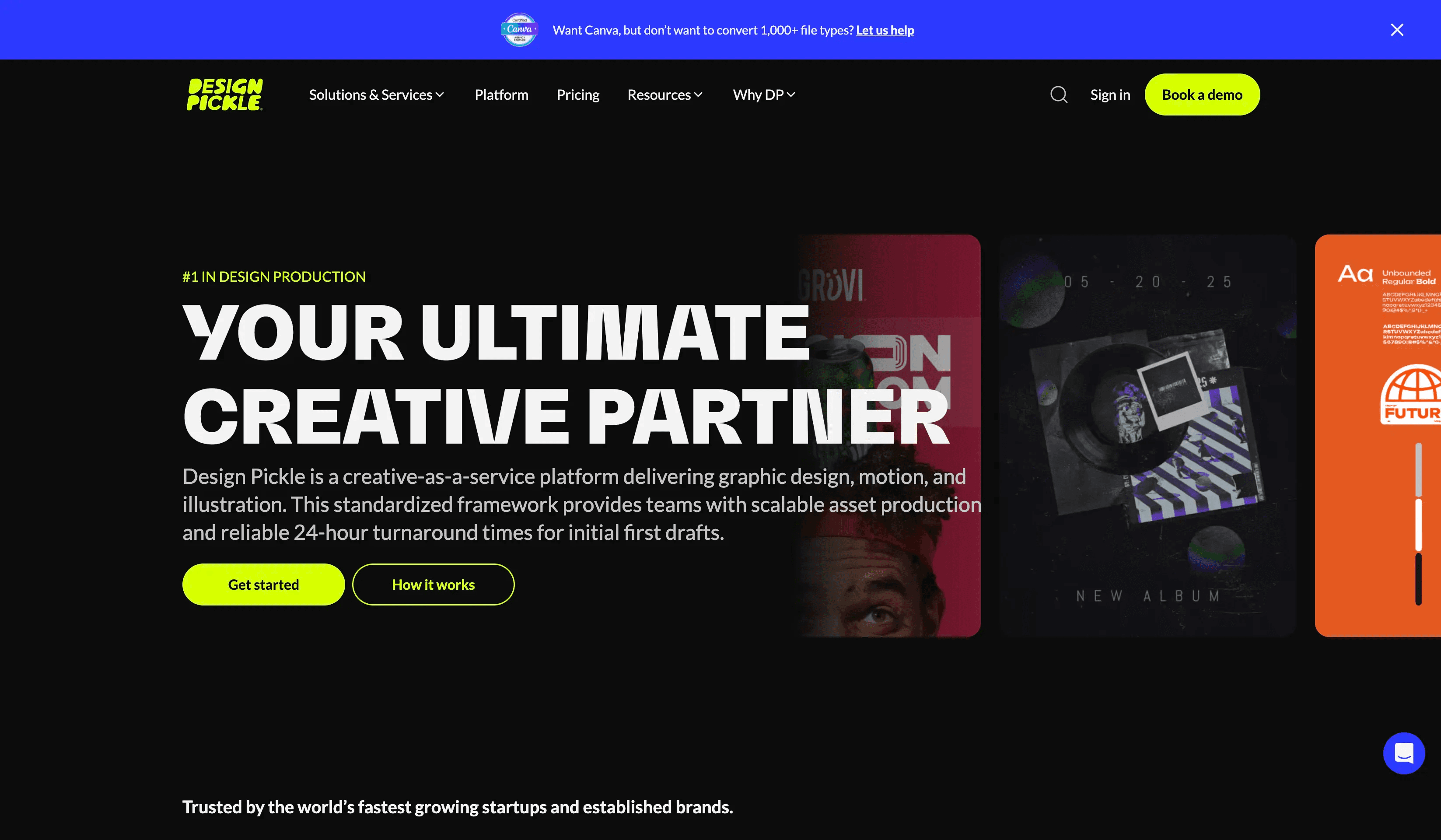
Best for: Startups with a defined brand system and predictable, repeatable design tasks.
Design Pickle offers a structured platform for submitting and managing requests. Turnaround for standard tasks is typically within 24 hours.
Strength: Reliable for high-volume, repetitive work once your brand guidelines are locked. Good for teams that need consistent social media and marketing collateral at scale.
Limitation: Output quality depends entirely on the quality of the brief. If you don't know exactly what you want, you'll spend more time going back and forth. Not specialized for startup-context design like pitch decks or product UI.
ManyPixels
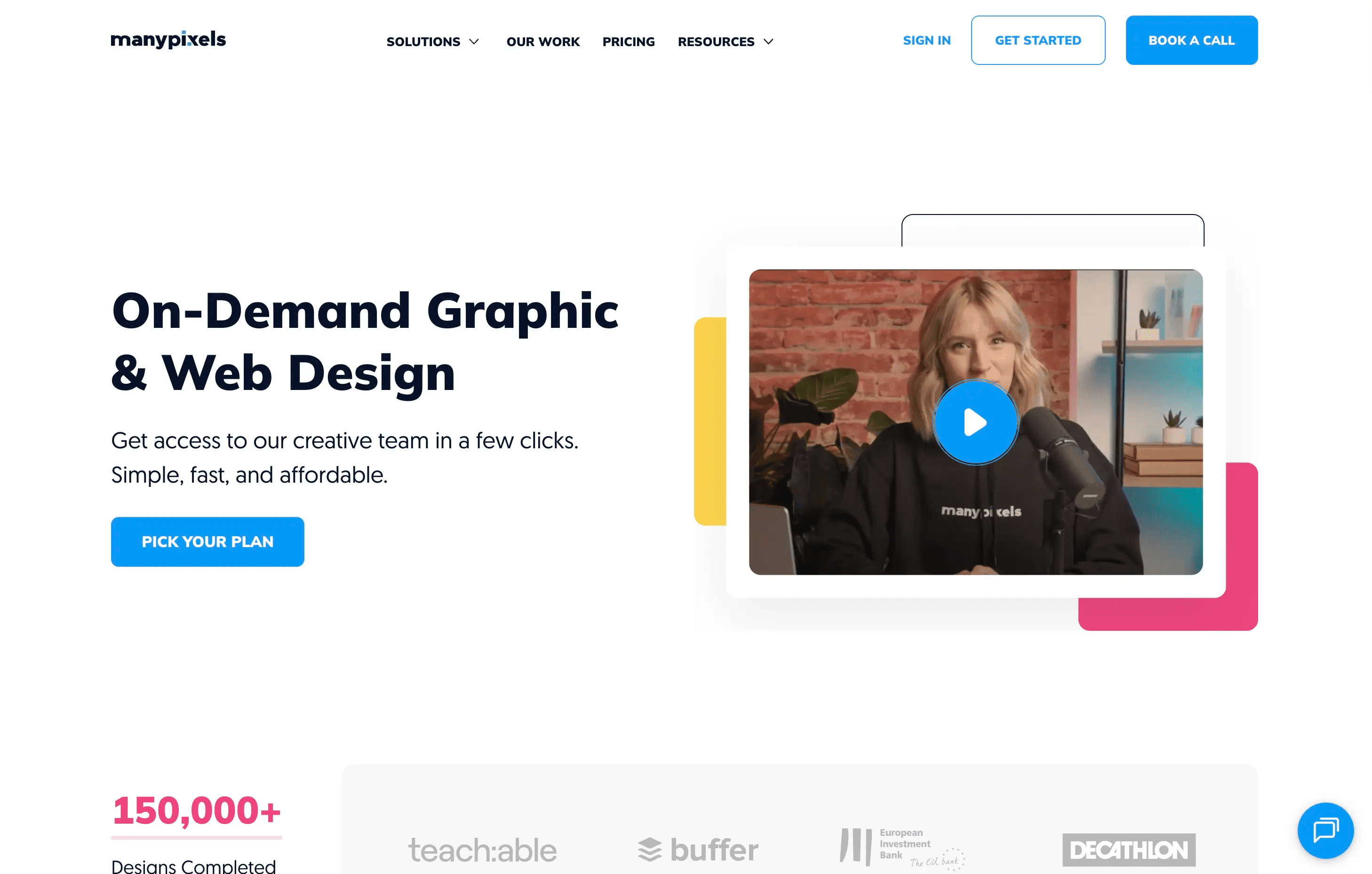
Best for: Small teams and agencies that need broad design coverage at a lower monthly cost.
ManyPixels covers a wide range of work: logos, brand identity, website design, UI, illustrations, and marketing assets, all included in their Advanced plan at around $699 per month. Every plan includes a dedicated project manager.
Strength: The broadest scope relative to price among affordable options. Good for teams that need a range of design types without a large budget.
Limitation: Less specialized in startup or SaaS contexts. Quality is consistent, but the service isn't built around the specific needs of a pre-seed or seed founder (fundraising materials, investor-ready decks, startup branding).
Eleken
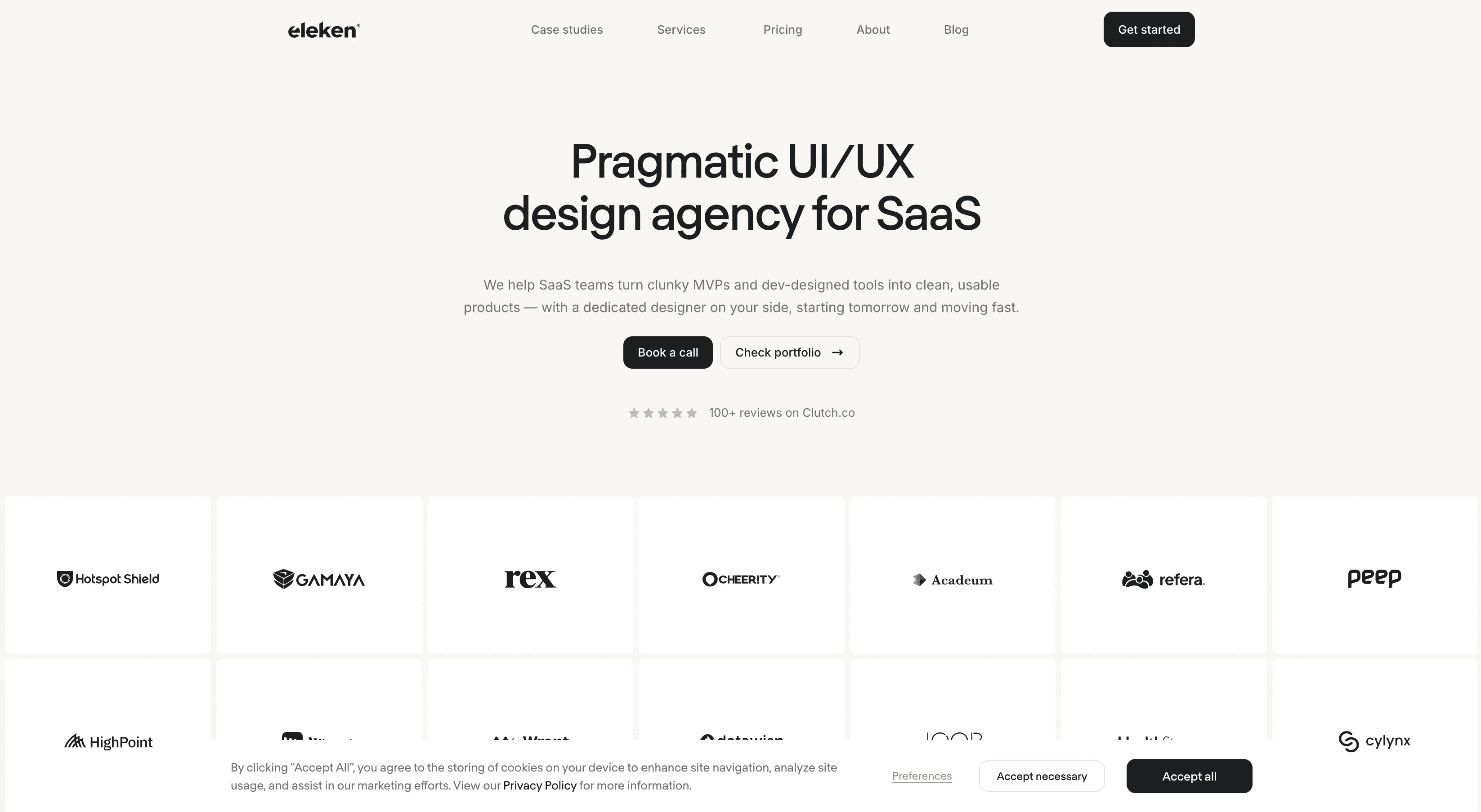
Best for: SaaS companies that need embedded product design support within their development workflow.
Eleken assigns designers who integrate directly into your team and collaborate with your product managers and engineers. The focus is SaaS UX and interface design.
Strength: Strong alignment with SaaS product design patterns. Good at working inside existing product workflows.
Limitation: Not focused on marketing, go-to-market design, pitch decks, or brand identity. If you need a partner across multiple design functions, Eleken is too narrow.
Payan
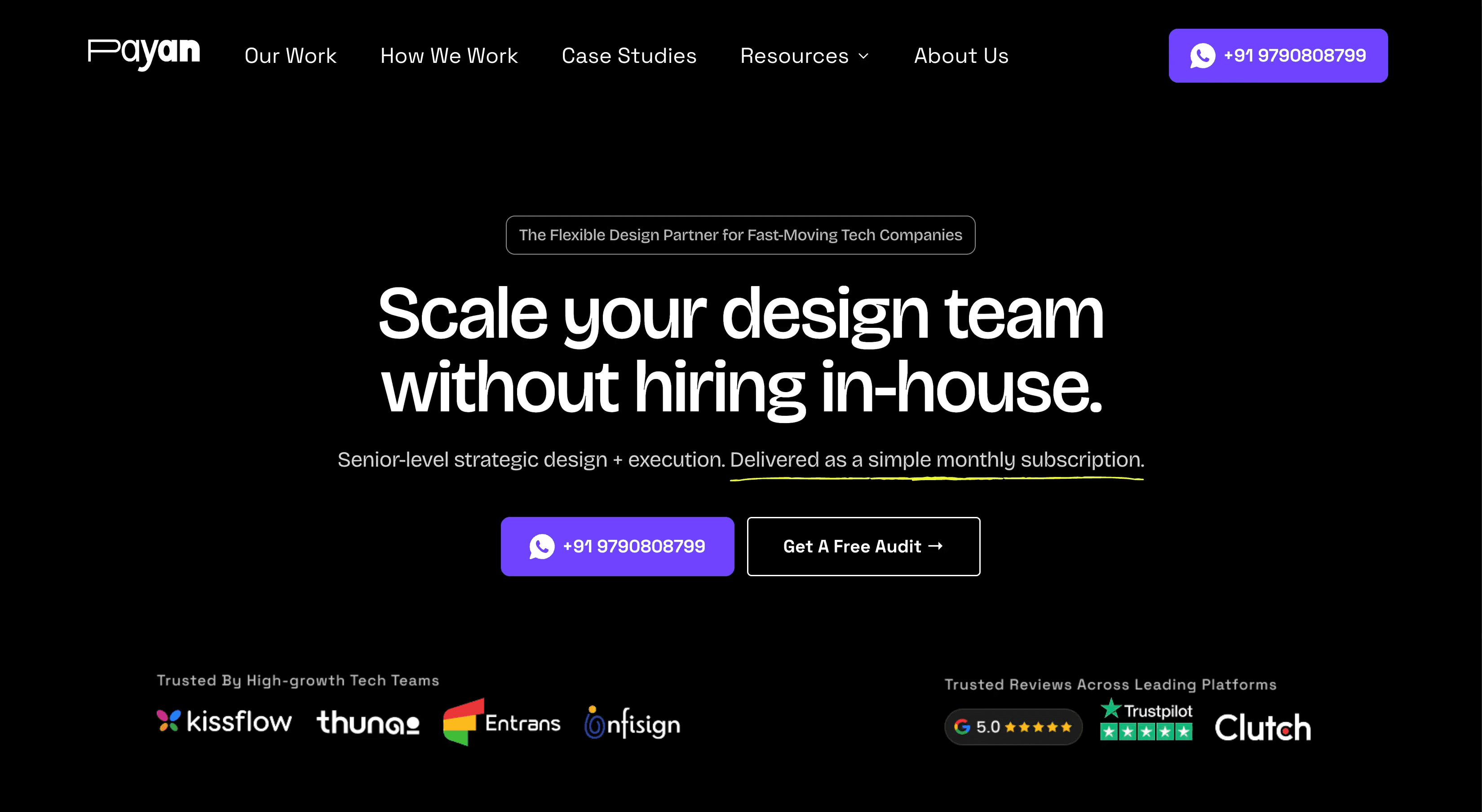
Best for: B2B SaaS companies focused on conversion, messaging clarity, and buyer trust.
Payan treats design as a decision system. The focus is on how design affects buyer understanding and action, covering messaging hierarchy, page structure, and conversion paths across websites and landing pages.
Strength: Direct impact on conversion and positioning. Strong if your biggest design problem is that visitors aren't understanding or trusting your product.
Limitation: Not suited for high-volume asset production. If you need a range of creative output across brand, product, and social, Payan's scope is too narrow.
Service | Best For | Starting Price | Startup Fit |
|---|---|---|---|
Zyner | Startups: pitch decks, brand, GTM | $4,995/month | Excellent |
Designjoy | Consistent UI/UX, single designer | $4,995/month | Good |
Superside | High-volume growth-stage teams | ~$10,000/month | Moderate |
Design Pickle | Repeatable tasks, defined brand | ~$1,918/month | Moderate |
ManyPixels | Broad scope, lower budget | $549/month | Fair |
Eleken | SaaS product design | ~$5,000/month | Narrow |
Payan | B2B SaaS conversion/messaging | Not publicly listed | Narrow |
Who Is a Design Subscription For?
The model works for a wide range of teams, but the right tier and service type depends heavily on where you are right now.
Pre Seed Founders
At pre seed, budget is near zero and design needs are often limited. A cheap generalist service can cover basic marketing collateral and a simple landing page. The problem is that most services under $700 per month exclude pitch deck design, logo work, or brand identity at their base tier.
If you're raising, even at pre-seed, you need something that can handle investor materials properly. A $400 plan that can't touch your pitch deck isn't a bargain; it's a mismatch.
Seed Stage Startups
This is the sweet spot for startup-specialized design subscriptions. Go-to-market pressure is real. You're building brand, refining positioning, launching the product, and preparing for your next raise simultaneously. Everything needs to pull in the same direction visually.
At seed, a startup-focused subscription covers everything in a single workflow: brand identity, pitch deck, website, and launch assets. That coordination matters more than the per-month savings from a cheaper generalist.
Series A and Beyond
At Series A, volume increases. You have more channels, more stakeholders, and a brand system that needs to be applied consistently at scale. Higher-volume tiers from services like Superside start making more sense. Some teams at this stage use a startup-specialized subscription for strategic creative work and a lower-cost service for high-volume asset production.
How to Pick the Best Design Subscription for Your Startup
The biggest mistake founders make is choosing based on price first. Here's a better framework.
Define What You Actually Need Design For
Start with a list of your next ten design requests. Are they mostly social media posts and ad creatives? A lower-cost generalist service covers that well. Do you need a pitch deck revision, a new landing page, and a brand refresh? You need a service with demonstrated depth in those areas.
Generalist services at $400 to $800 per month are built for recurring marketing assets. If your list includes fundraising materials, product UI, or a full website build, you need a service priced and scoped accordingly.
Check Scope Before Committing
Most affordable plans exclude website design, logo work, or motion design. This is buried in the plan details, not the headline. A $440 plan that can't touch your website or pitch deck isn't a cost-effective option if those are the things you actually need.
Before signing up, match your ten-request list against the plan's listed scope. If more than two or three requests fall outside the plan's coverage, move up a tier or choose a different service.
Pro Tip: Ask the service for examples of pitch decks or brand identity work before committing. Any reputable design subscription agency will have a portfolio you can review. If they can't show you work that matches your specific needs, that's your answer.
Consider Turnaround and Communication Style
Most subscription services operate asynchronously through Slack and Loom. This works well for founders who don't want to manage meetings. Some services, like Designjoy, use Trello boards instead. Verify the workflow matches how your team actually operates.
If you're on a fundraise timeline with hard deadlines, ask about average turnaround times for your specific request types. A 48-hour turnaround for social graphics is not the same as a 48-hour turnaround for a 30-slide pitch deck.
Think About Flexibility
All reputable design subscription services offer pause or cancel options. Verify this before committing to a quarterly or annual plan. The monthly savings from an annual plan only make sense if you're confident you'll need design consistently for the next twelve months. If runway is a concern, stay month-to-month until you have more visibility.
Frequently Asked Questions
What is a design subscription agency?
A design subscription agency is a service that provides unlimited access to professional designers for a flat monthly fee. You submit as many design requests as you need, receive completed work, and request unlimited revisions, all without per-project billing. Most services work on one active request at a time and communicate primarily through Slack.
How much does a design subscription cost per month?
Design subscriptions range from around $399 per month for affordable generalist services to $5,495 per month for startup-specialized agencies with senior talent and dedicated project management. The price difference reflects scope, seniority of designers, turnaround speed, and specialization. Most affordable plans under $900 per month exclude pitch decks, brand identity, or website design at their base tier.
Can a design subscription replace an in-house designer?
For most early-stage startups, yes. A subscription design agency can cover the full range of design work a startup needs at a fraction of the cost of an in-house hire. Startup-focused services like Zyner handle everything from brand identity to fundraising pitch decks to Framer website development, with senior design talent and a dedicated project manager included. In-house hiring takes four to eight weeks. A subscription starts in 24 to 48 hours.
What does unlimited revisions actually mean?
Unlimited revisions means you can request changes to any delivered design as many times as you need until the output meets your standard, with no additional fees. The constraint is that most services work on one active request at a time. You can't have five designs in simultaneous revision; the service completes and iterates on one before moving to the next. Read your service's terms to confirm how revision cycles work in practice.
Which design subscription is best for pitch decks?
Startup-specialized services with a track record in fundraising design are the right choice for pitch decks. Zyner has worked with 320+ startups across multiple Y Combinator cohorts and covers pitch deck design as a core service. Generalist services at lower price points often exclude presentations at their base tier or lack the context to understand what a fundraising pitch deck needs to accomplish for an investor audience.
The Decision You're Actually Making
The design subscription model is no longer a niche workaround. As of 2026, it's a mainstream alternative to both in-house hiring and traditional agency engagements, with a range of services sophisticated enough to cover even the most demanding startup design needs.
The question isn't whether to use a subscription design agency. The question is which type matches your stage and priorities.
If you're at pre-seed and your needs are simple, an affordable generalist gets you moving. If you're at seed, raising capital, building your brand, and launching to market simultaneously, a startup-specialized service is the only one built to handle all of it in a single workflow.
The founders who move fastest don't spend six months managing a hire and three weeks iterating with an agency. They plug in a subscription service that already knows how to operate inside a startup and ship what they need.
If that sounds like what you're looking for, book a call with Zyner to see how the team works and what they've delivered for startups at your stage.


