

You've decided Techstars is worth a shot. You've done your research, you know what you're building, and now you're staring at the apply page wondering: When is the actual Techstars application deadline?
Here's the tricky part: Techstars doesn't run a single program with a single deadline. It operates multiple accelerators across different cities, verticals, and formats, each with its own open date, final deadline, and cohort start. Miss the deadline for one program and you might still be in time for another. Get confused between them and you might miss all of them.
This guide fixes that. Below you'll find the exact Techstars application deadline for every open program, a breakdown of how the two cohort cycles work, what Techstars actually looks for, and a timeline to get your application in strong shape.
Quick Takeaways
Techstars runs two main cohort cycles per year: Spring (programs start March) and Fall (programs start September).
The Spring 2027 cohort is open now. Applications opened August 24, 2026 and the final deadline is November 18, 2026, with programs running March 8 to June 3, 2027.
The Fall 2026 cohort closed on June 10, 2026 and those programs started September 8, 2026.
Techstars invests $220,000 in accepted startups: $200,000 via an uncapped MFN SAFE plus $20,000 for 5% equity.
Asia-Pacific programs invest $120,000 rather than $220,000: $100,000 on the SAFE, plus the same $20,000 for 5%.
The selection criteria follow one consistent priority: team, team, team, then market, traction, and idea.
Applying early matters. Techstars has said its applications have tripled since 2021, which means competition has never been tighter.
Rejection is not the end. Many portfolio companies applied two, three, or four times before acceptance.
Techstars Application Deadline Dates at a Glance
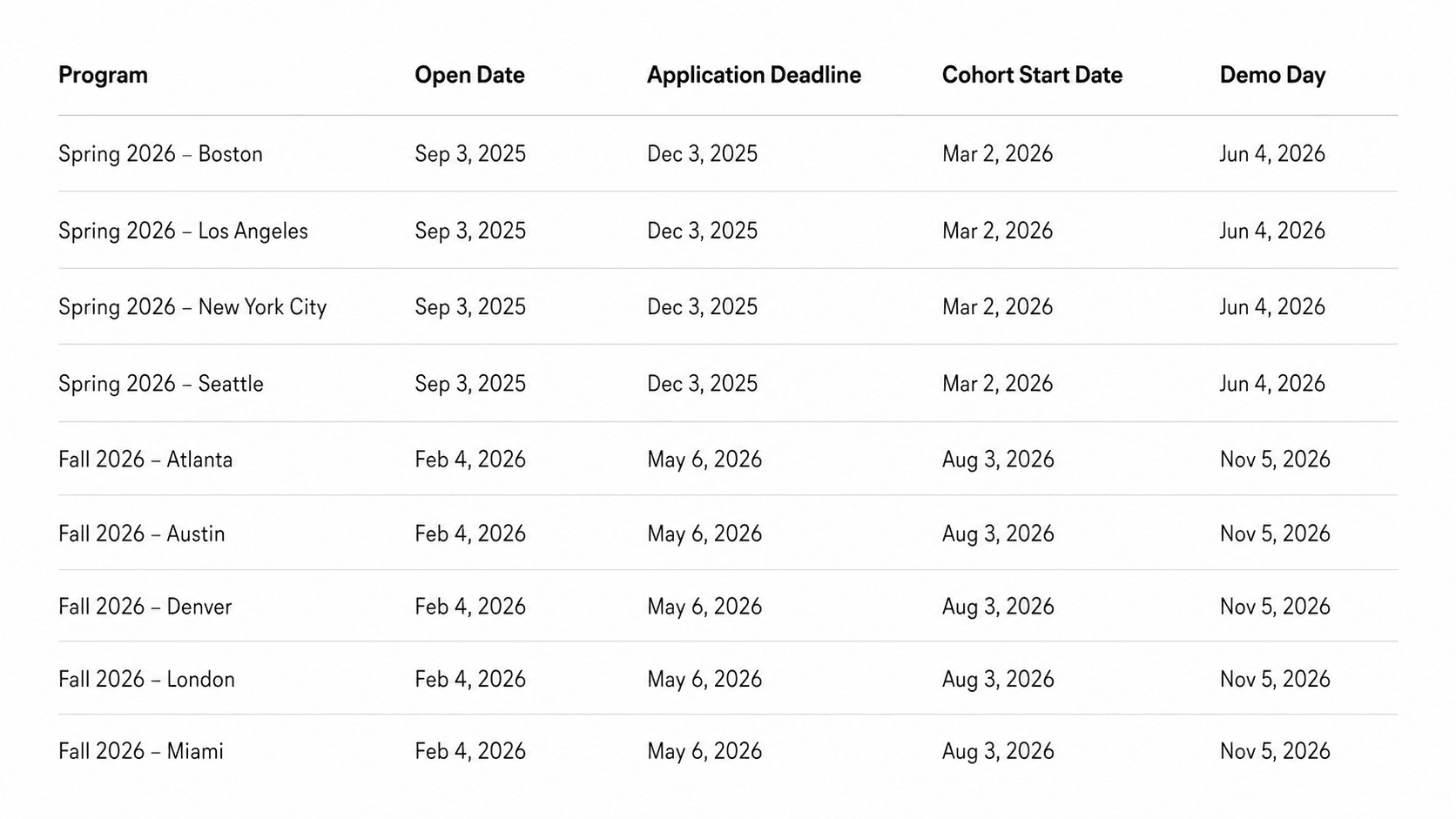
Techstars structures its accelerator calendar around two cohort seasons. The Spring cohort runs from March through June, while the Fall cohort runs from September through December.
Programs inside the same cohort share one deadline, but the two cohorts are six months apart and a handful of programs sit outside both, so the deadline that applies to you depends on which program you are applying to, not on when you happen to be reading this.
Spring 2027 programs: Applications are open until November 18, 2026
This is the live opportunity. Applications for the Spring 2027 cohort opened on August 24, 2026 and close on November 18, 2026. Accepted companies start on March 8, 2027 and present at Demo Day on June 3, 2027. Every program below carries the same four dates, confirmed on each program's own page.
The programs that ran for the Spring 2026 cohort include:
Program | Location | Deadline | Cohort Start | Demo Day |
|---|---|---|---|---|
Techstars Anywhere Accelerator | Remote | Nov 18, 2026 | Mar 8, 2027 | Jun 3, 2027 |
Techstars New York City Accelerator | New York, NY | Nov 18, 2026 | Mar 8, 2027 | Jun 3, 2027 |
Techstars London Accelerator | London, UK | Nov 18, 2026 | Mar 8, 2027 | Jun 3, 2027 |
Techstars Boston Accelerator | Boston, MA | Nov 18, 2026 | Mar 8, 2027 | Jun 3, 2027 |
Techstars Chicago | Chicago, IL | Nov 18, 2026 | Mar 8, 2027 | Jun 3, 2027 |
USC and Techstars Accelerator | Los Angeles, CA | Nov 18, 2026 | Mar 8, 2027 | Jun 3, 2027 |
Northwestern Medicine & Techstars Healthcare Accelerator | Chicago, IL | Nov 18, 2026 | Mar 8, 2027 | Jun 3, 2027 |
Fall 2026 programs: Closed, and now running
The Fall 2026 cohort closed on June 10, 2026 and those companies started on September 8, 2026, with Demo Day in December.
If one of these programs is the one you want, the next window for it opens around March 2027. This is the half of the calendar that catches founders out: two waves run six months apart, so a program being closed does not mean Techstars is closed.
Program | Location | Deadline | Cohort Start | Demo Day |
|---|---|---|---|---|
Techstars Boulder | Boulder, CO | Jun 10, 2026 (closed) | Sep 8, 2026 | Dec 7, 2026 |
Techstars Future of Food Powered by Ecolab | Minneapolis-St. Paul, MN | Jun 10, 2026 (closed) | Sep 8, 2026 | Dec 10, 2026 |
ABN AMRO + Techstars Future of Finance Accelerator | Amsterdam, Netherlands | Jun 10, 2026 (closed) | Sep 8, 2026 | Dec 10, 2026 |
Pro Tip: Bookmark apply.techstars.com and the individual program pages for each accelerator you're targeting. Each program page carries its own four dates, and those pages are the source of truth. The dates above were read off each program's page and confirmed individually, but Techstars adds and retires programs between cycles, so check the page before you plan around a date.
How the Techstars Application Cycle Actually Works
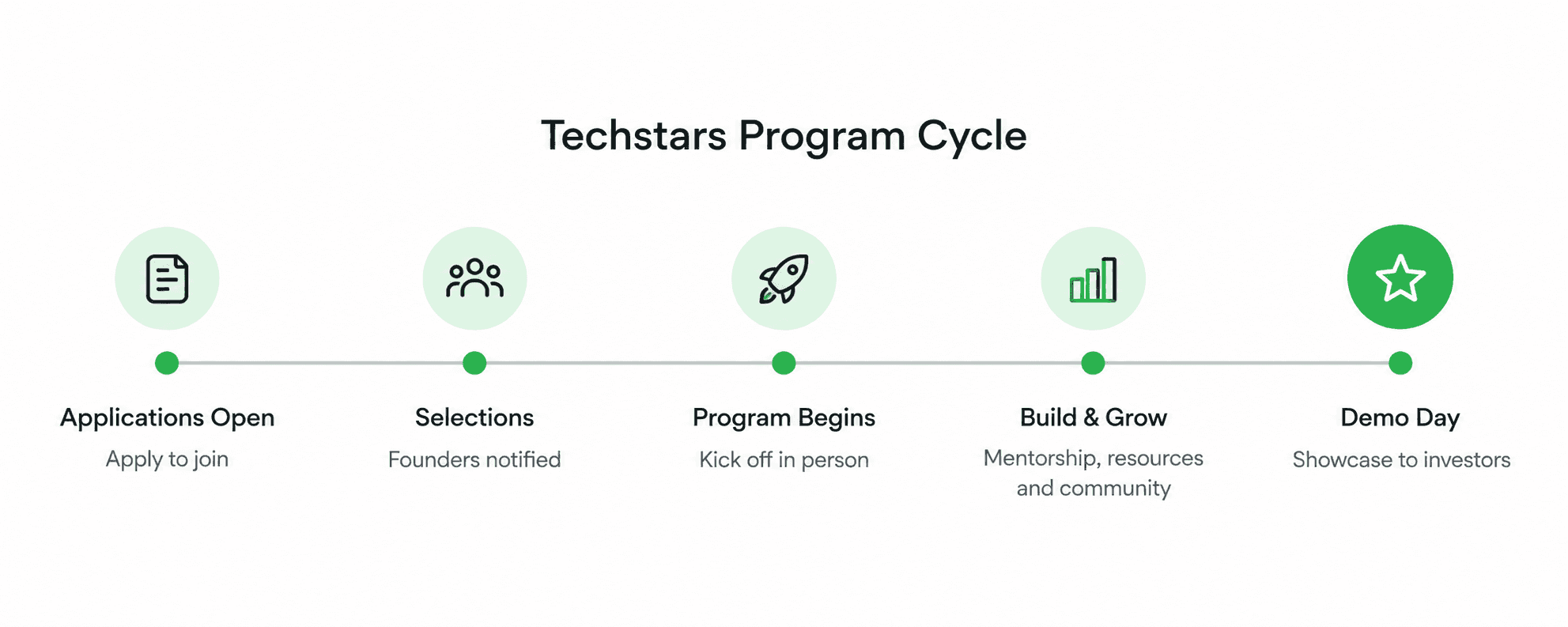
Techstars is not a rolling admissions program like YC. Each program operates on a fixed cycle with a hard Techstars application deadline. Applications open, the window runs for roughly three to four months, and then it closes. After the deadline, Techstars reviews all submissions and extends interview invitations, typically within four weeks of the close date.
Here's what the full pipeline looks like from submission to acceptance:
Application submitted before the final deadline.
First-round review by the program team. They read every application and are looking for strong signals in three areas: team, market, and traction.
First interview invitation sent within one to four weeks of the deadline closing.
First-round interview: A short conversation to get to know the team and dig into the business.
Second-round interview: A deeper session focused on market understanding, traction, and fit.
Acceptance decision and terms offered.
One important point: each program has its own managing director and team. The NYC program and the London program are not the same process. Techstars allows you to submit a general application, and the teams will connect you to relevant programs, or you can apply directly to specific accelerators.
What Techstars Actually Looks for in Applications
The selection framework Techstars uses has been consistent for years and is worth understanding before you sit down to write a single word of your application.
Team First, Always
Techstars has been explicit about this. Their managing directors and alumni consistently describe the priority as: team, team, team, then market, traction, and idea. As one Techstars London managing director put it, the founding team is the single most important element of any application.
What does a strong team look like to Techstars? They want to see:
A track record of working together (how long have you known each other, what have you built before?)
Complementary skills across technical and business dimensions
Domain expertise in the market you're entering
Evidence of resilience, specifically that you've faced obstacles and kept going
This is exactly why the team video carries so much weight. It's not a pitch deck. Techstars wants to see how you interact, how you communicate, and whether you're people they'd want to work with for three months.
Execution Over Ideation
Techstars is not looking for founders with the best ideas. They're looking for founders who execute. As Techstars founder David Cohen has said, some companies get in despite their idea, because the team is that strong. A barely-functional MVP with real users tells a much more compelling story than a polished deck with no product.
Before you submit, ask yourself: what have we actually shipped? What have we learned from customers? What changed because we went out and talked to the market?
Stage Flexibility, but Progress Is Non-Negotiable
Techstars accepts companies across a range of stages, from pre-revenue to post-seed. They've been clear that there is no minimum revenue requirement. What they do require is evidence of progress, whether that's user interviews completed, a product launched, customers signed, or metrics that have moved.
Pre-revenue is fine. No progress is not.
The Investment: What Accepted Startups Receive
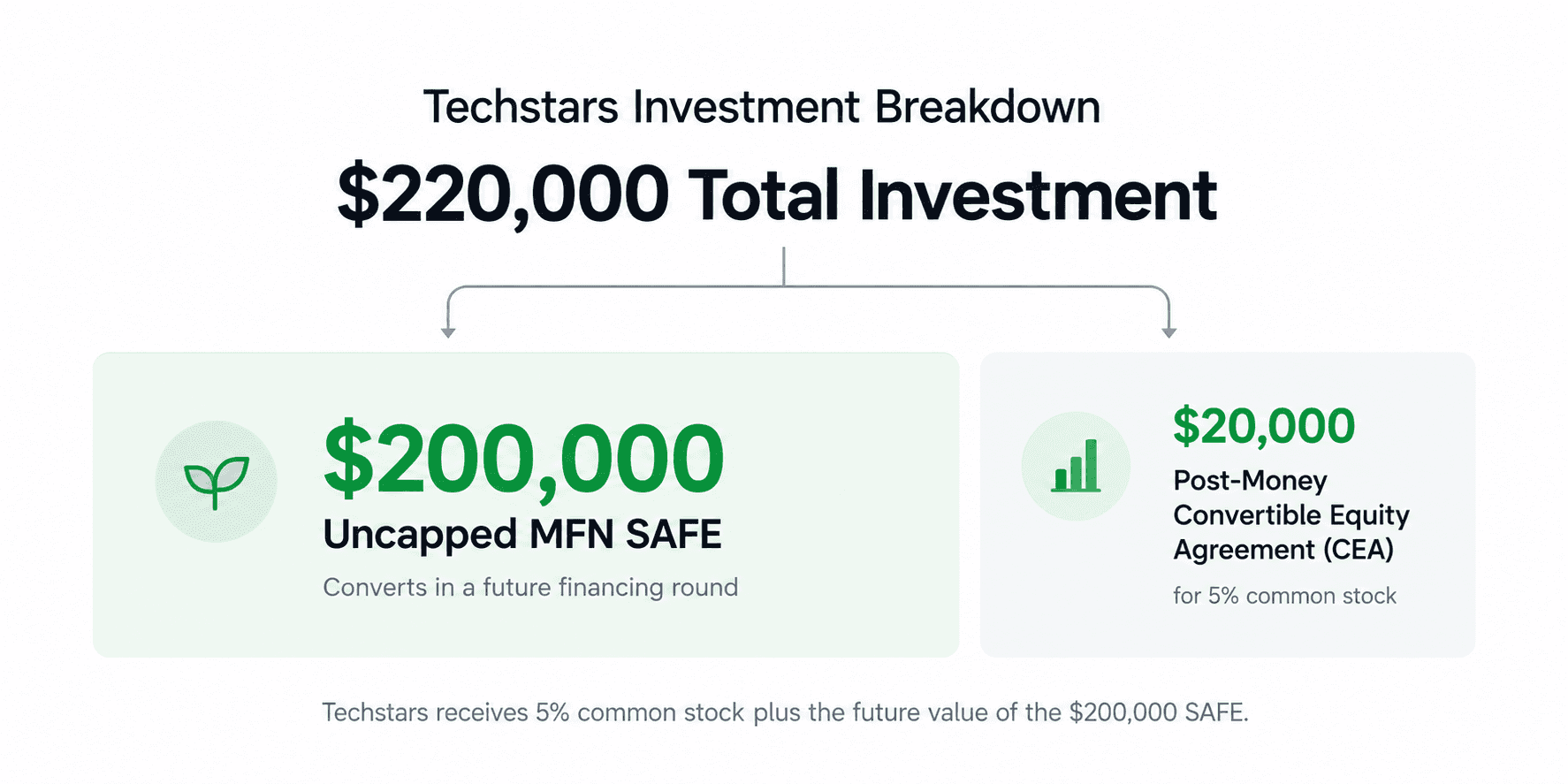
In April 2025, Techstars updated its investment terms. Starting with the Fall 2025 batch (and continuing into 2026), every accepted startup now receives $220,000, up from the previous $120,000 offer.
Here's how the deal is structured:
$200,000 via an uncapped MFN SAFE (Simple Agreement for Future Equity). This converts at your next priced round, with Techstars receiving the same terms as your best investors (the MFN clause).
$20,000 via a Post-Money Convertible Equity Agreement (CEA), in exchange for 5% common stock. The CEA converts when you raise a priced round of at least $1M.
To illustrate: if your Series A closes at a $20M pre-money valuation, the $200,000 SAFE would convert into approximately 1% additional equity. So total dilution at that point would be around 6%, split across the equity and the SAFE conversion.
This structure is a significant step up from what Techstars offered historically, and it mirrors the type of uncapped SAFE structure that YC pioneered. For early-stage founders, more capital with flexible conversion terms is a meaningful improvement.
Beyond capital, accepted startups also receive:
Access to $2M+ in partner perks
A mentor-driven three-month program
Access to Techstars' global alumni and investor network
Lifetime support from the Techstars community
Asia-Pacific programs run different numbers. Techstars Tokyo invests $120,000: $100,000 on an uncapped MFN SAFE or a J-KISS, plus the same $20,000 CEA for 5% common stock.
Choosing the Right Techstars Program for Your Startup
With 16 programs across the two cohorts, the first question isn't "when is the deadline?" It's "which program should I apply to?"
Location and Network
Each Techstars program is built around a specific city and ecosystem. Techstars NYC emphasizes enterprise buyers, healthcare, fintech, and climate. Techstars London pulls from Europe's diverse founder talent and gives access to a global investor base. The Anywhere program is built for founders who cannot or do not want to relocate, and it runs entirely remote with optional in-person offsites.
If your business depends on relationships with specific institutions, hospitals, or corporations in a given city, applying to the program based there gives you direct access to that network during the three months when introductions matter most.
Vertical Programs vs. General Programs
Some Techstars programs are vertical-specific. The Northwestern Medicine Healthcare Accelerator focuses on health technology startups. The AI Health Baltimore program, powered by Johns Hopkins University and CareFirst Blue Cross Blue Shield, is built for AI-driven healthcare companies specifically. The Workforce Development Accelerator targets companies solving labor market challenges.
If your startup fits squarely inside one of these verticals, applying to the matching program gives you a better shot at a yes, because the managing director's network, mentors, and corporate partners are all aligned with your space.
General Application vs. Targeted
You can apply to Techstars through a general application at apply.techstars.com, and the teams will work to connect you to programs that fit. Alternatively, apply directly to a specific program page. If you have a clear preference for location or vertical, apply directly. It signals conviction and shows you've done the research on what that program offers.
A 60-Day Countdown to a Strong Techstars Application
The Spring 2027 window closes on November 18, 2026. Work back from your program's deadline rather than from a calendar month, and give yourself sixty days. Here's how to use that time.
60 Days Out: Get Your Story Straight
Write down the answers to these questions without looking at the application:
Why this problem?
Why this team?
Who has the most domain expertise and how did they get it?
What have you shipped, and what did users do with it?
What does your traction look like, even if it's small?
If you can't answer these clearly in conversation, you won't answer them clearly in the application. Talk to at least five founders who've gone through an accelerator application process and ask them to poke holes in your story.
30 Days Out: Write and Record
Fill out the application draft. Be concise. The people reading these applications have seen thousands; dense, jargon-heavy answers work against you. Short, specific, and honest answers work in your favor.
Record your team video. Techstars explicitly says it doesn't need to be polished. They want to see who you are, how you interact, and whether you can communicate clearly. One minute, natural conversation, no scripts. The demo video follows the same principle.
14 Days Out: Get Feedback
Find someone who has been through Techstars or another top accelerator. Ask them to read your draft. Specifically ask: "Which part confused you?" and "Where did you stop believing us?" Those two questions will surface the weakest parts of your application faster than any other review method.
1 Week Out: Lock and Submit
Stop editing for perfection. The marginal improvement from another pass is much smaller than the strategic advantage of submitting before the final rush. Submit and get back to building.
Pro Tip: After submission, you can update your application. Techstars values momentum. A concise update showing a new customer signed, a revenue milestone hit, or a product launched can move your file from "maybe" to "yes." Don't send updates for every minor feature; save them for real progress signals.
What Happens After You Submit
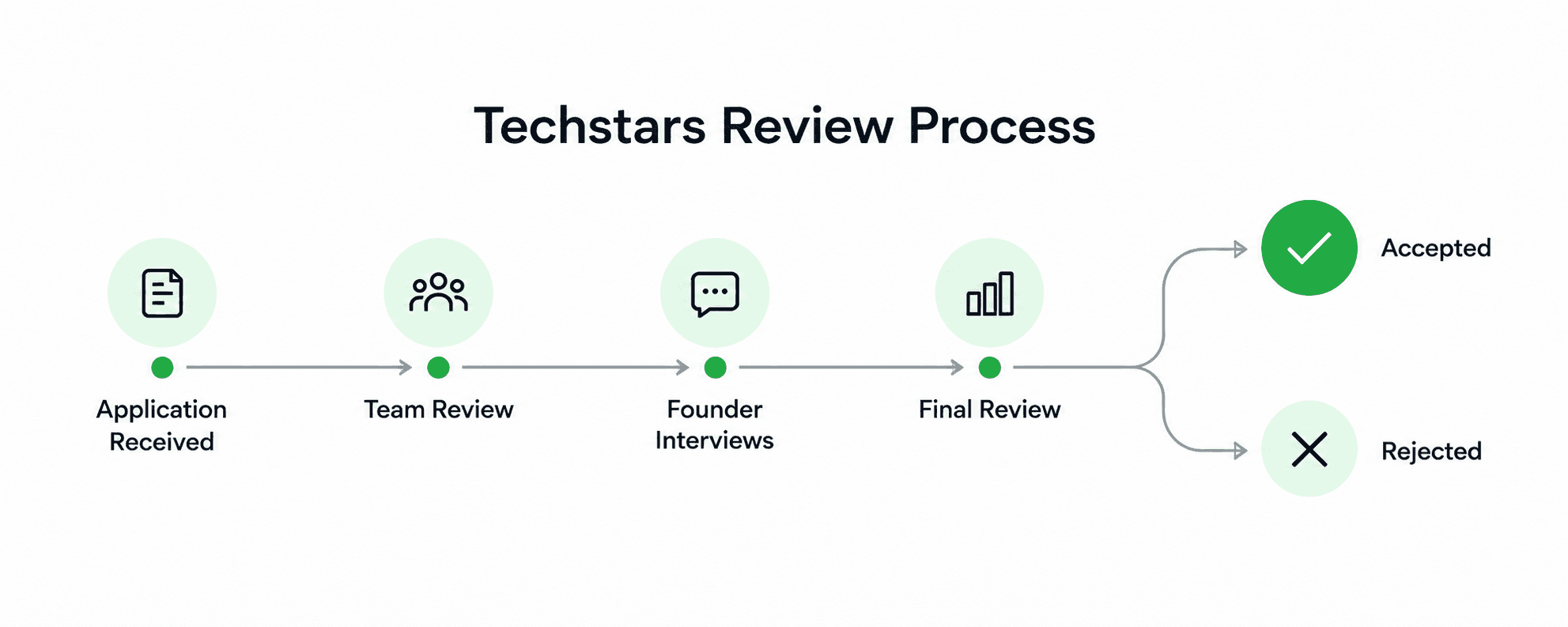
Techstars commits to reviewing all applications within four weeks of the deadline closing. You'll receive one of three outcomes: an interview invitation, a pass, or silence while they continue reviewing.
If you get an interview invitation, move fast. Slots fill quickly and showing urgency matters. Prepare to talk about your team's history, your specific market thesis, and where your traction stands today. Don't over-prepare a scripted pitch. Techstars interviews are conversations, and scripted answers are easy to spot.
If you receive a rejection, it is worth noting that many companies in the Techstars portfolio applied multiple times before acceptance. The feedback you receive, even if brief, is a signal. Build on it. Techstars looks for lines, not dots, meaning they want to see a trend of improvement over time. A company that applied, got rejected, made significant progress, and reapplied with better numbers tells a compelling story.
Techstars vs. Other Accelerators: What's Different
Techstars alumni consistently point to two things that differentiate the program: the depth of the mentor network and the lifetime access to the community.
Most accelerators front-load their value into the program itself. Techstars is structured differently. The "give first" mentality across its alumni network means that reaching out to a Techstars alum years after your cohort ends still carries weight. That's a network effect that compounds over time, not something you exhaust in three months.
The recent investment increase to $220,000 also changes the competitive calculus. More capital at better terms means less dilution pressure early, which gives founders more room to hit the metrics that attract their next round on better terms.
Techstars Application Deadline: Frequently Asked Questions
What is the current Techstars application deadline?
The Spring 2027 final deadline is November 18, 2026. Applications opened on August 24, 2026, and accepted companies run from March 8 to June 3, 2027. The Fall 2026 cohort closed on June 10, 2026 and is now running. Check each program's page at techstars.com/accelerators, because a few programs run their own calendar.
Can I apply to multiple Techstars programs at the same time?
Yes. Techstars allows founders to apply to multiple programs simultaneously through a single application at apply.techstars.com, or by applying directly to each program's page. If you have strong preferences for location or vertical, applying directly to specific programs is recommended.
Does Techstars have a minimum revenue requirement?
No. Techstars accepts companies across all stages, including pre-revenue. What they do require is evidence of progress, whether that's a product built, users acquired, customer conversations completed, or any other signal that the founding team executes. Pre-product teams are rarely accepted.
How competitive is the Techstars application process?
Techstars has stated that applications have tripled since 2021. Historically, acceptance rates across programs have been in the low single digits. Each program typically accepts 10 companies per cohort, selected from hundreds to over a thousand applicants depending on the program.
What happens if I miss the Techstars application deadline?
Each Techstars program has a hard Techstars application deadline. Unlike some accelerators that review on a rolling basis, Techstars closes each application window at the deadline and reviews submissions together. Missing the Spring 2026 deadline means waiting for the Fall 2026 cycle. The good news: that time can be used to build traction, which often makes for a stronger second application.