Feb 24, 2026
You have the vision. You have the prototype (maybe). But you don’t have the slides.
For a pre-seed founder, the pitch deck is the product. It is the only tangible thing you can show investors to prove your billion-dollar hypothesis is worth $500k right now. But you are stuck in a catch-22. You cannot afford a $10,000 agency, but you cannot afford to look like an amateur with a DIY PowerPoint.
Freelancers are hit-or-miss. Agencies are too slow.
Enter the Pitch Deck Design Subscription.
This model has quietly become the secret weapon for YC-backed founders and bootstrapped teams alike. It solves the three things that kill deals: bad design, slow iteration, and unpredictable costs.
This guide is not a sales pitch. It is a resource. We will break down exactly how these subscriptions work, compare the top providers in a transparent table, and help you decide if this model fits your current burn rate.
What is a Pitch Deck Design Subscription?
Most founders are used to two options:
Project-Based: You pay a fixed fee (e.g., $3,000) for one deck. If you need changes next month, you pay again.
Hourly: You pay a freelancer $50-$150/hour. If you iterate a lot, you bleed cash.
A Design Subscription (often called "Design-as-a-Service") is different. You pay a flat monthly fee. In exchange, you get access to a design team that works on your requests every day.
The "Unlimited" Reality
You will see the word "Unlimited" thrown around a lot. Here is the truth: it refers to requests and revisions, not speed. You can queue up 50 slides, but the team will work on them sequentially (usually 1-2 active tasks at a time).
Why this works for Pre-Seed:
Iteration: You pitch on Tuesday. Investors hate slide 7. You request a redesign on Wednesday. You have the new version for your Thursday meeting. No extra invoices.
Predictability: You know exactly what your burn is. $1,900/month (or whatever the fee is). No surprises.
Scope Flexibility: Once the deck is done, you don't cancel. You use the same subscription for your landing page, social assets, or sales sheets.
The Top Pitch Deck Design Subscriptions (Ranked)
We analyzed the market based on three factors critical to founders: Turnaround Time, Design Quality, and Seniority of Talent.
Here is how the top players stack up.
Comparison Matrix
Service | Best For | Pricing Model | Turnaround | Talent Level | Revisions |
Zyner | High-Growth Startups | Flat Monthly | 24-48 Hours | Senior Only | Unlimited |
Slidebean | DIY + Consulting | Per Project / Sub | Varies | Mixed | Limited |
Design Cloud | General Graphics | Flat Monthly | 24 Hours | Junior/Mid | Unlimited |
Pitch Deck Studios | Narrative Focus | Per Slide / Proj | 3-5 Days | Specialist | Project-Based |
Crappy Presentations | Fix-Ups | Per Project | 1-2 Weeks | Specialist | Unlimited |
1. Zyner (Best for Speed & Senior Talent)
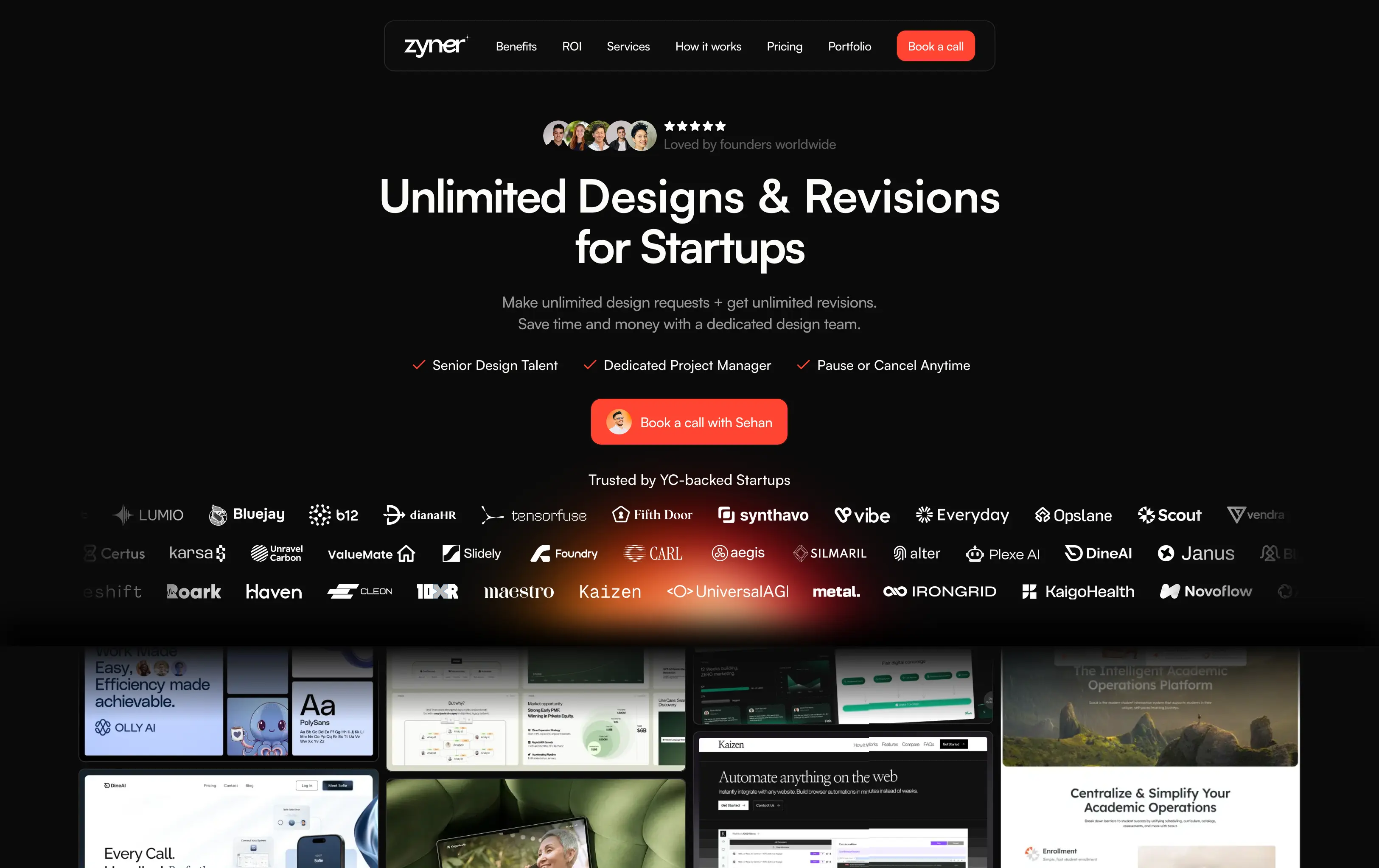
Zyner was built specifically for the startup ecosystem. Unlike generalist design sites that handle everything from t-shirt designs to restaurant menus, Zyner focuses heavily on the needs of high-growth tech companies.
The Pro: You get access to Senior Design Talent and a Dedicated Project Manager. This is rare in the subscription world, where junior designers are the norm.
The Con: Zyner is a design-only partner. They do not write your script. You need to come with your content ready (even if it's just bullet points).
Key Stat: Zyner has served 320+ startups, including YC alumni from batches S25, W24, and F24.
Verdict: If you have your story straight but need "insane design quality" delivered fast, this is the top pick.
2. Slidebean (Best for DIY + Guidance)
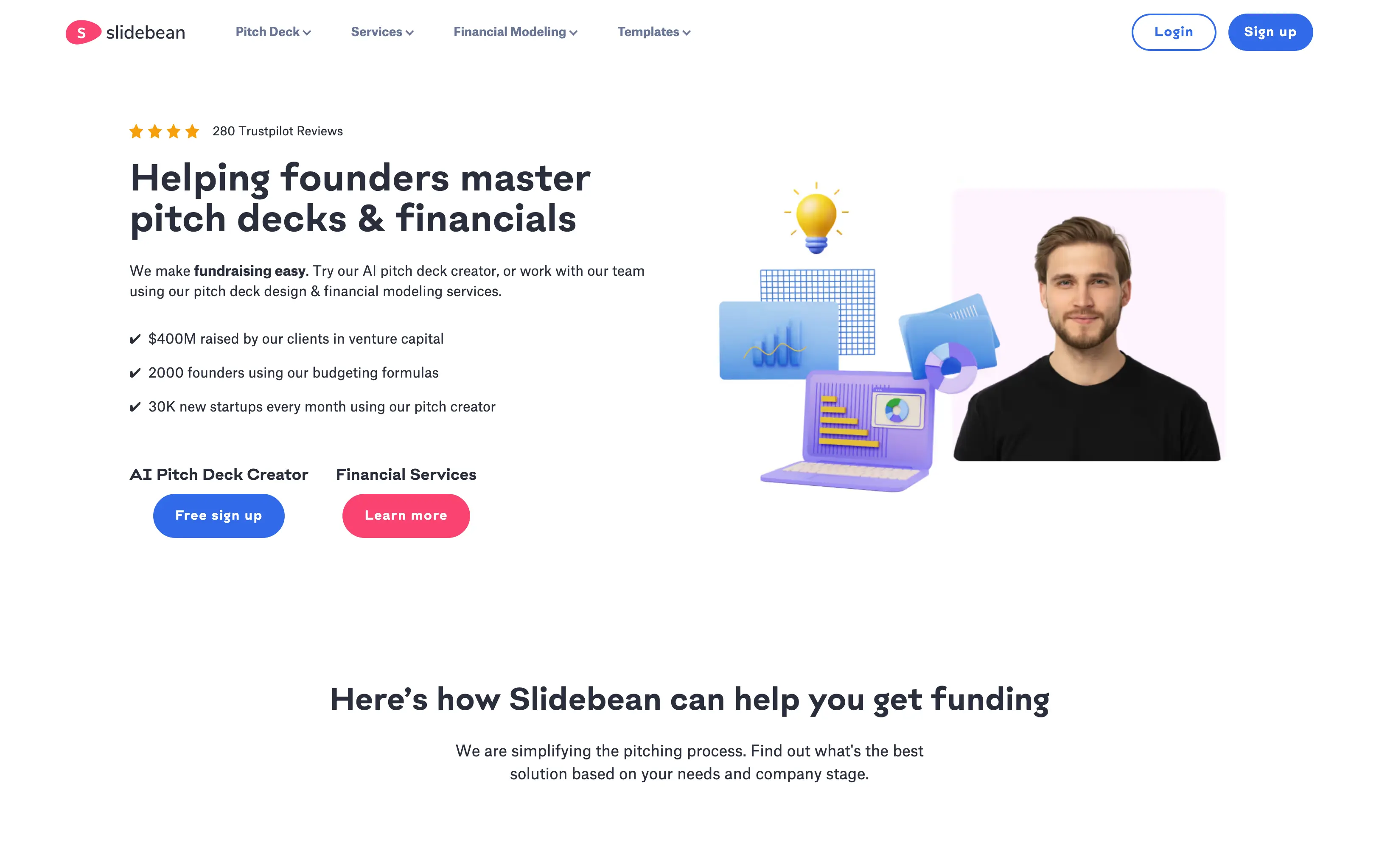
Slidebean is famous for its AI-powered deck builder. They also offer a service component where humans polish your slides.
The Pro: Great if you are starting from zero and need software to help you structure the story.
The Con: Their agency services can get expensive quickly if you move away from the automated tools, and the subscription often tiers strictly based on speed.
3. Design Cloud (Best for General Graphics)
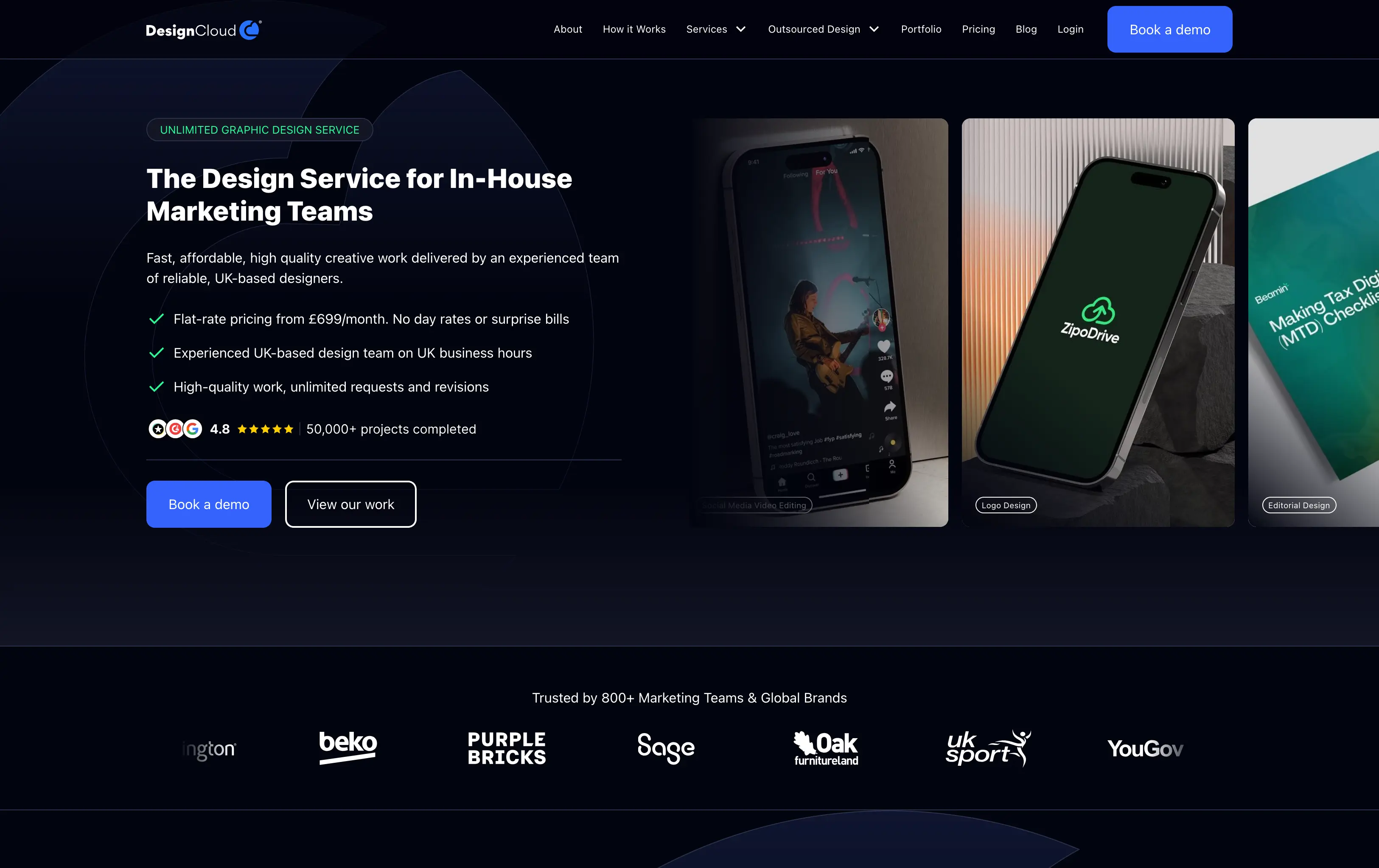
A UK-based unlimited graphic design service. They are a volume player.
The Pro: Affordable and reliable for general day-to-day graphics (social media, blog headers).
The Con: Pitch decks require a specific skill set (data visualization, narrative flow). Generalist designers often struggle to make complex financial models look good without breaking the data.
4. Pitch Deck Studios (Best for Storytelling)
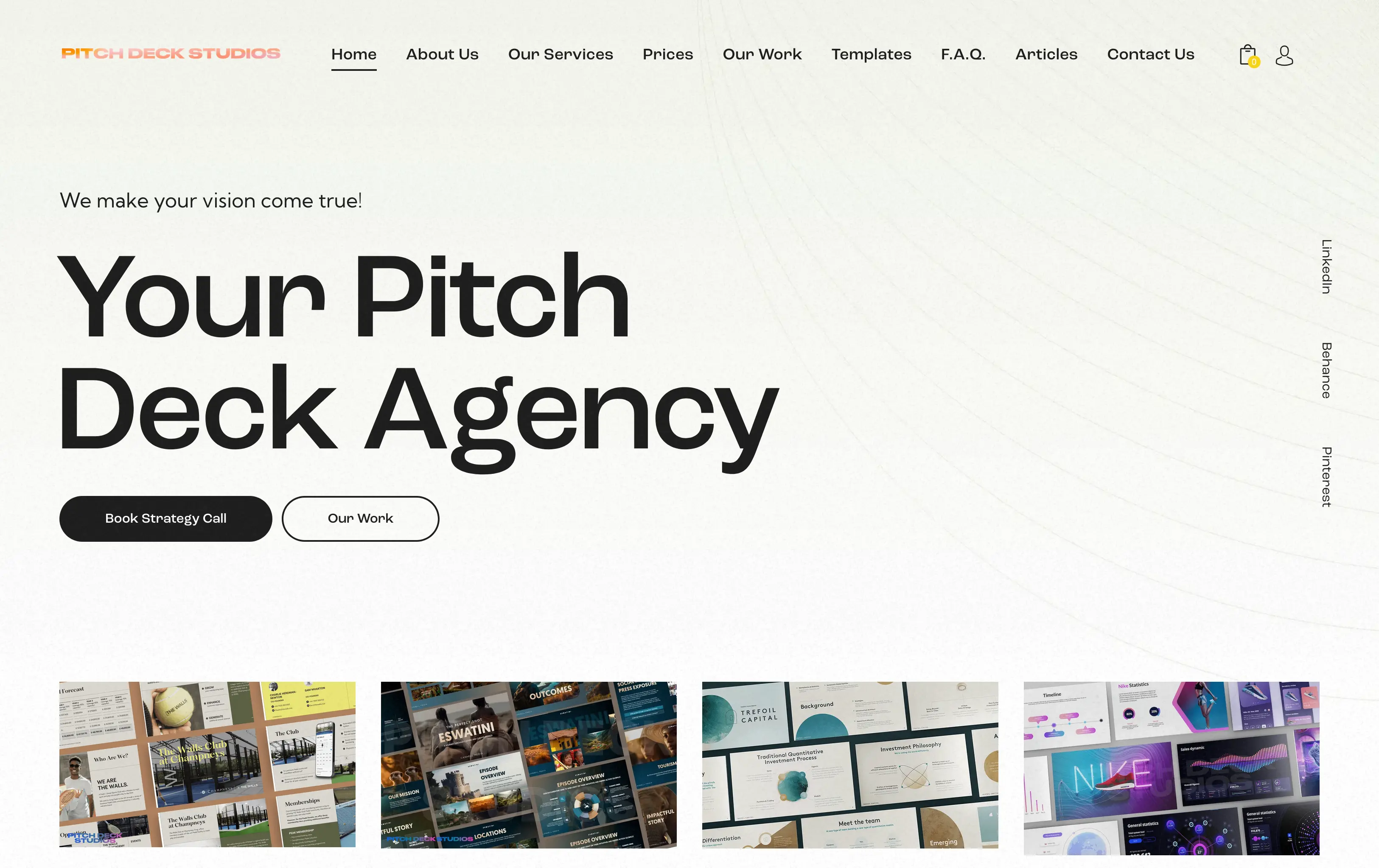
These guys are specialists. They don't just design; they think about the pitch.
The Pro: Deep expertise in fundraising narratives.
The Con: Usually operates on a project basis or high-retainer model, which lacks the "pause or cancel anytime" flexibility of a true subscription.
Why Smart Founders Are Switching to Subscriptions
You might be thinking, "I just need one deck. Why subscribe?"
That is the "Waterfall" mindset. Startups operate in "Agile."
1. The "Deck" is Never Done
Your seed round might take 3 months. In that time, you will talk to 50 investors. You will learn that your "Problem" slide is confusing or your "Market Size" is unbelievable.
Agency Model: You gather feedback, pay a change fee, wait 3 days, and get a new PDF.
Subscription Model: You slack your designer: "Hey, swap the market slide for the version we discussed and highlight the TAM in orange." It’s done the next morning.
2. Speed to Market (GTM)
Waiting on design bottlenecks kills momentum. When you are launching a Product Hunt campaign or needing a one-pager for a conference, you cannot waste time interviewing freelancers.
Zyner’s data shows that startups execute 2-4x faster GTM strategies when they remove design bottlenecks.
3. Cost Efficiency
Hiring a senior designer in the US costs $100k/year minimum. Agencies charge $150/hour.
A subscription gives you the output of a 2-4 person internal team for roughly 50% less spend. You save $250k-450k annually compared to building an in-house department.
How to Evaluate a Design Partner
Not all subscriptions are equal. If you choose the wrong one, you will burn a month of runway managing a junior designer who doesn't understand what "SaaS metrics" are.
Use this checklist before you swipe your card:
1. Do they understand Startups?
Look at their portfolio. Do you see flyers for local pizza shops, or do you see SaaS dashboards and Series A decks?
Why it matters: A designer who knows what "ARR" and "CAC" mean will highlight the right data. One who doesn't will just make the font pretty.
Note: Zyner is trusted by founders from B12, Vibe, Bluejay, and Metana.io. That is the caliber of peer validation you want.
2. What is the "Kickoff" time?
Some agencies have a 2-week onboarding queue. You don't have that time.
Look for a 24-48 hour kickoff. You should be able to sign up today and have a designer working on your files tomorrow.
3. Can you "Pause" the subscription?
Fundraising is intense, but then it stops. You don't want to be locked into a 12-month contract.
Ensure the service allows you to Pause or Cancel Anytime. This turns the expense from a fixed cost into a variable one you control.
Deep Dive: The Zyner Approach
We mentioned earlier that Zyner is the best option for founders who have their content ready. Here is exactly how that workflow looks, so you can see if it fits your style.
The Workflow:
Onboarding (Day 1): You fill out a brief. Zyner assigns a dedicated Project Manager and a Senior Designer.
The Request: You upload your ugly Google Slides or a text document to their Trello/Slack board.
The Design: The team works on your slides. They focus heavily on clean typography, data visualization, and consistent branding.
Review: You get the designs. If you hate a color, you ask for a revision. They don't argue; they just fix it.
Handoff: You get the editable source files (Figma, etc.).
What they DON'T do:
They do not write your pitch. If you send them a blank page and say "Make me sound like Airbnb," they can't help you. You need to provide the text and the structure. They provide the visual firepower.
Beyond the Deck:
Once your deck is locked, you can use the same subscription for:
Landing Page Design (Framer/Webflow)
Social Media Branding
Product UI/UX Wireframes
Merch and Swag (for when you close that round)
Quick Takeaways
Agencies are out, Subscriptions are in: For pre-seed founders, the flexibility of a monthly flat rate beats the rigidity of project-based pricing.
Content First: No designer can save a bad business model. Write your script and validate your numbers before you hire a design team.
Look for Seniority: Cheap unlimited subscriptions use junior talent. For a pitch deck, you need someone who understands visual hierarchy and data.
Zyner wins on specialized focus: If you want a partner that acts like an extension of your team—with senior talent and zero contracts—Zyner is the current market leader for startups.
FAQ
Q: Can a design subscription really replace a full-time hire?
A: For early-stage startups, yes. A subscription like Zyner matches the output of a 2-4 person internal team but costs a fraction of the salary. Plus, you don't pay for benefits or idle time.
Q: Do these services write the pitch deck text for me?
A: Most design subscriptions (including Zyner) are design-only. You must provide the copy. There are separate "Pitch Deck Consulting" firms that handle the writing, but they typically charge $5k-10k just for the story.
Q: What if I only need the subscription for one month?
A: That is the beauty of the model. You can subscribe for one month to get your deck done, then pause your membership. You save your remaining days for when you need to update the deck for your Series A.
Q: What file formats will I receive?
A: Professional services should provide editable source files. Zyner delivers in formats like Figma, ensuring you own the work and can make small text edits yourself later.
Q: How does the "Unlimited Revisions" policy work?
A: It means you can ask for as many changes as you want until you are happy. However, speed depends on the complexity. Small text changes might happen same-day; a full visual overhaul will take longer.