
You built the product. You practiced the pitch. You finally landed the meeting. Then, two days later, the email arrives: "We love what you are building, but it is not a fit for us right now." Decode this phrase with our guide on how to handle not a fit investor feedback.
A rejection from an investor stings, especially when it is your first company. But an early rejection is rarely a reflection of your startup's ultimate potential. Instead, it is your first real data point on how the market receives your story. The founders who eventually get funded are the ones who know how to rewrite a deck after a rejection, turning a polite "no" into an actionable blueprint for their next "yes."
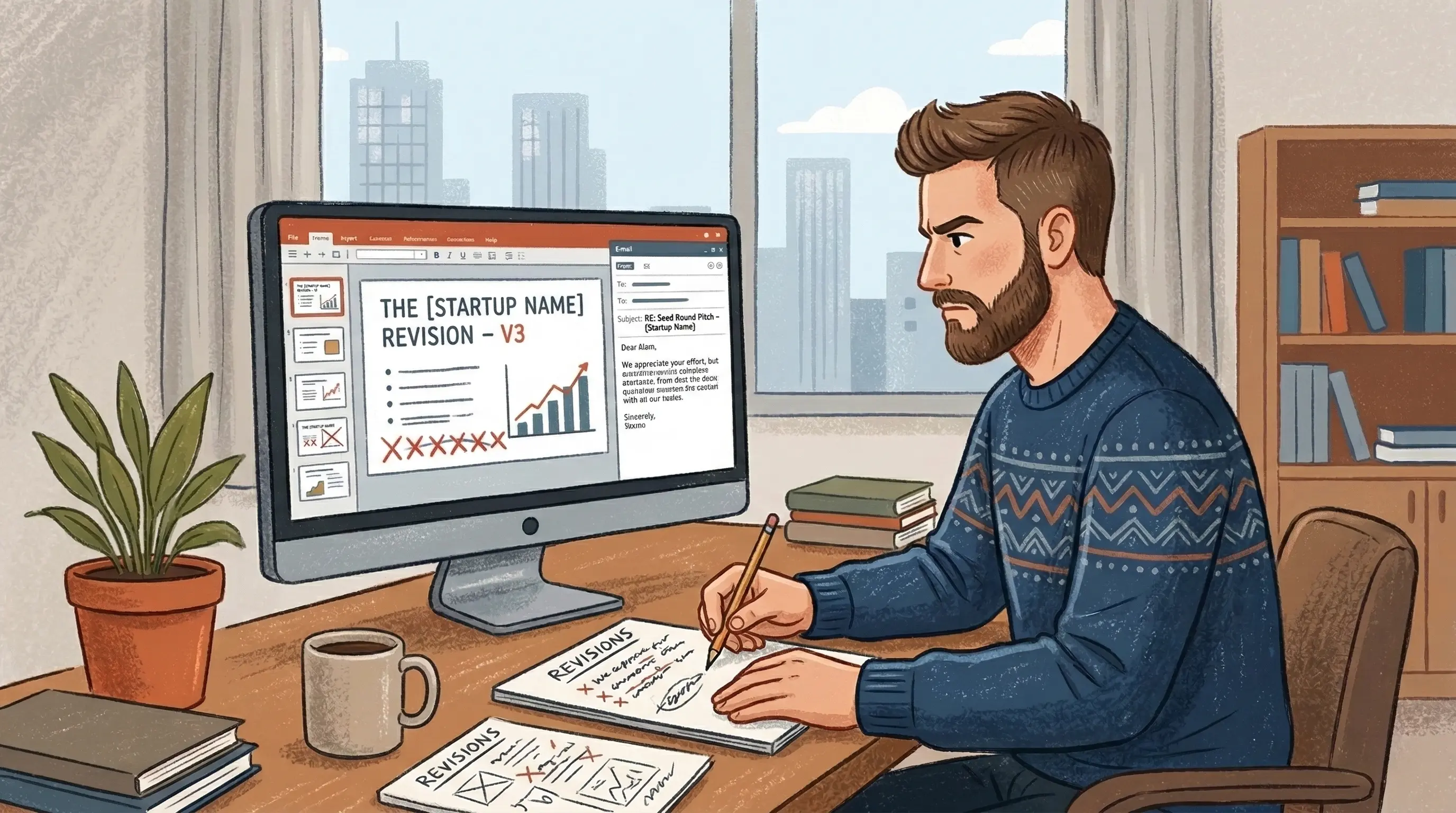
Quick Takeaways
A rejection is a data collection event, not a personal failure.
"Too early" usually means your deck failed to show credible traction or a clear path to revenue.
Never rewrite your deck immediately after a rejection; take a day to separate emotion from logic.
Ask for specific, actionable feedback rather than accepting a polite pass.
Focus on strengthening your narrative arc before touching the visual design.
Delete any slide that does not directly support your core value proposition.
Poor design signals sloppy execution, which makes investors doubt your product.
How to Rewrite a Deck After a Rejection
To rewrite a deck after a rejection, you must first solicit specific feedback from the investor, identify recurring patterns in their concerns, and strip your narrative down to its core value proposition. From there, you rebuild the slides to directly confront the objections you uncovered, backing every claim with concrete data before refining the visual design.
This process requires shifting your mindset from defensiveness to curiosity. You are not defending your old deck. You are diagnosing it.
Step 1: Decode the Rejection Email
Investors send hundreds of rejection emails every month. Most read exactly the same. They use polite, templated language to preserve the relationship while closing the door. If you want to fix your deck, you have to decode what they are actually saying.
Here is a breakdown of common rejections and their real meanings based on analysis of early-stage funding cycles.
What the Investor Said | What It Actually Means | Which Slide Needs Rebuilding |
|---|---|---|
"You are too early for us." | We do not believe your traction yet, or your business model feels unproven. | Traction / Business Model |
"It is not a fit for our current mandate." | Your market size looks too small, or your narrative is confusing. | Market Sizing / The Problem |
"We are passing due to conflict of interest." | They actually have a conflict, or they just wanted a polite exit. (Move on). | N/A |
"We need to see more revenue first." | Your path to monetization is vague, or your unit economics look broken. | Financial Projections |
"We do not have conviction in the market." | You failed to prove that the problem is a "hair-on-fire" issue for buyers. | The Problem / The Solution |
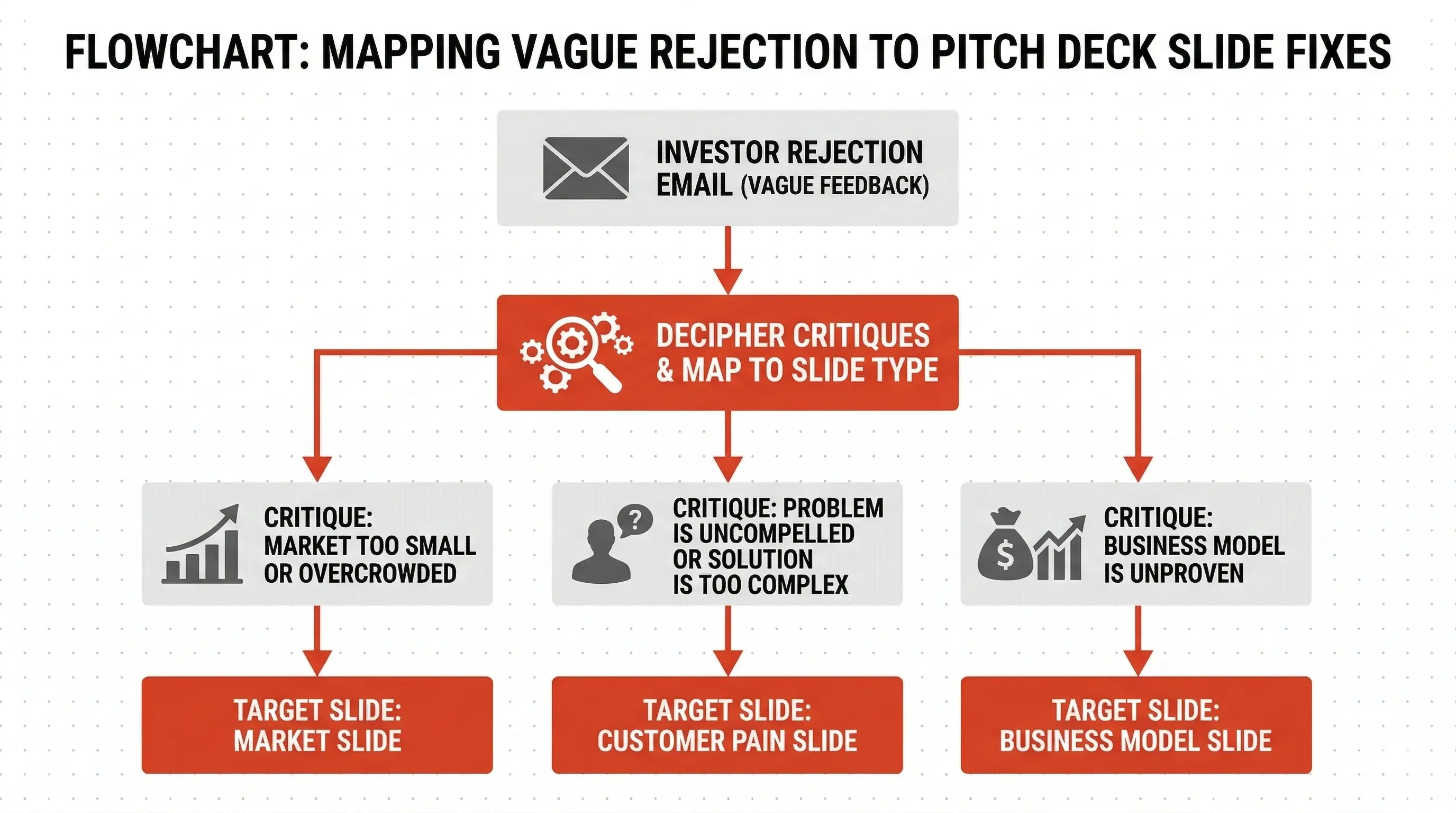
When an investor says your startup is too early, they are usually expressing a lack of sufficient, actionable data to justify the risk. They want evidence like paying customers, letters of intent, or consistent user growth.
How to Ask for Real Feedback
Do not accept a generic rejection. Reply promptly while the pitch is still fresh in their mind. Keep it short, professional, and specific.
Try a message like this: "Thank you for the quick the update. We are iterating on our narrative right now. If you have two minutes, was there one specific area (market size, traction, or go-to-market) where you felt the most hesitation?"
This lowers the barrier for them to give honest feedback because you provided multiple-choice categories.
Pro Tip: Never argue with the feedback. If an investor tells you your market is too small, do not send back a spreadsheet proving them wrong. Accept the feedback, thank them, and figure out why your deck failed to make the market size obvious in the first place.
Step 2: Audit Your Underlying Narrative
Before you open presentation software, you must fix the story. A beautiful deck will not save a confusing business model.
Print your deck out or view all the slides in a grid. Read just the headlines of each slide in order. Does it tell a complete, logical story?
A funded pitch deck follows a predictable narrative arc. It establishes a massive problem, introduces a unique solution, proves the solution is working, and explains why this specific team can capture the market.
If your headlines read like a random collection of facts, you do not have a narrative problem. You have a structure problem.
The Three-Minute Rule
Investors spend an average of under three minutes reviewing a pitch deck, according to DocSend's benchmark reports. They do not read your paragraphs. They scan your headlines, look at your charts, and decide if they want to take a meeting.
If your deck requires someone to read bullet points to understand the core concept, cut the text by 50%. Every slide should communicate one specific idea.
Step 3: Confront the Fatal Flaws
Most rejections stem from one of four fatal flaws in the pitch deck. You must be brutal about finding and fixing these.
Flaw 1: The "Top-Down" Market Size Delusion
Saying you operate in a $500 billion market means nothing. Investors know you are not going to capture 1% of the global software industry in year one.
Replace top-down market sizing with a bottoms-up analysis. Show exactly how many customers you can realistically reach in the next three years, multiplied by your actual pricing model. This proves you understand your unit economics.
Flaw 2: The Missing "Hair on Fire" Problem
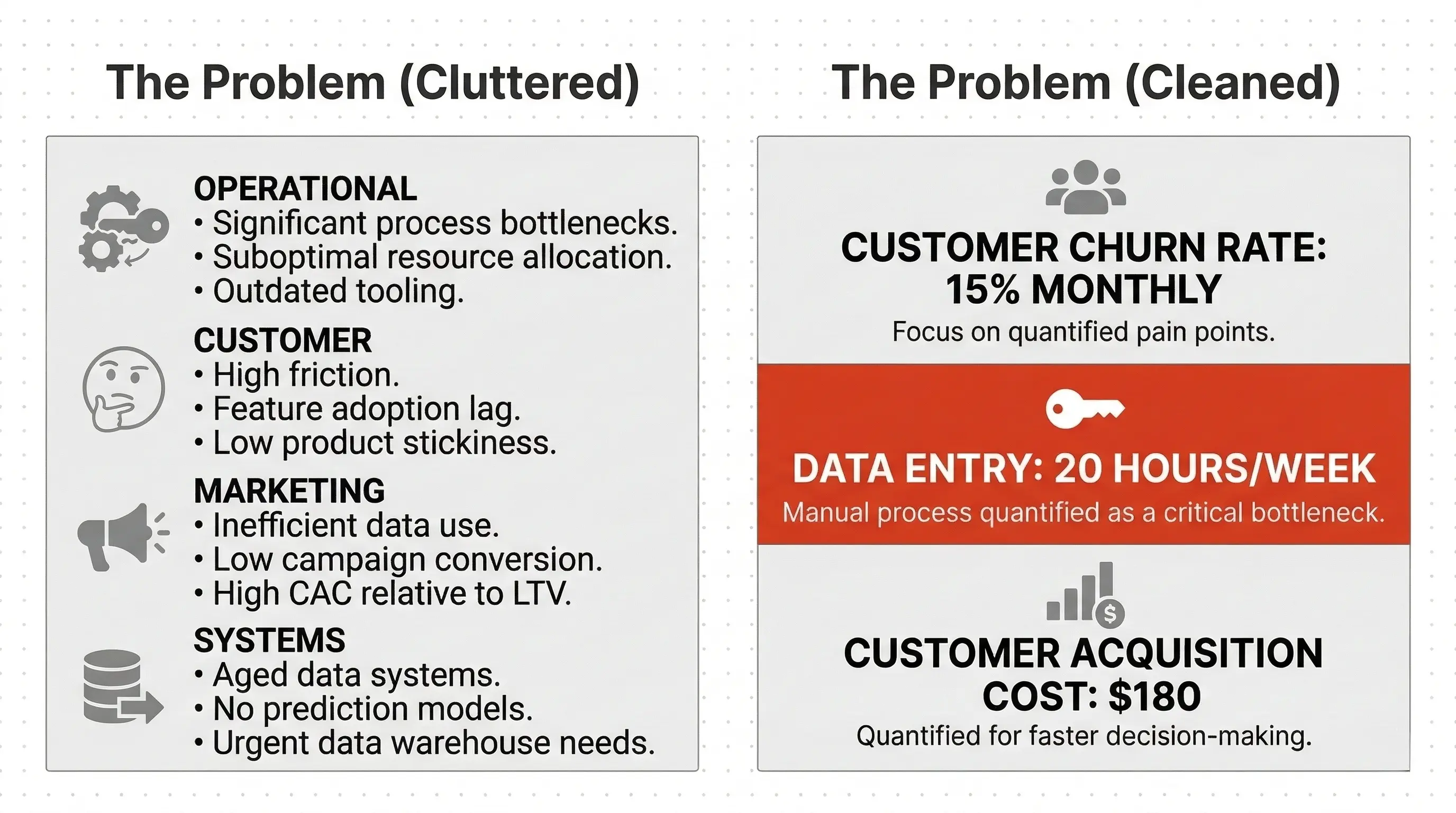
If your solution is a "nice to have," investors will pass. You have to prove that the problem you solve is actively causing your target audience significant pain or costing them money right now.
Quantify the pain point. Do not say "manual reporting is slow." Say "compliance teams waste 40 hours per month copying data, costing the average mid-market firm $25,000 annually."
Flaw 3: Vague Go-To-Market Strategies
"We will use digital marketing and SEO" is not a go-to-market strategy. It is a list of channels.
A real strategy names the exact steps you will take to acquire your first 100 or 1,000 customers. Name the specific communities you will target. Explain your distribution advantage. Show how you will bring your customer acquisition cost down over time.
Flaw 4: Burying the Traction
If you have revenue, users, or successful pilots, put that information in the first three slides. Do not make an investor flip to slide eight to find out your product is actually live and generating cash. Early-stage traction reduces investor risk immediately.
Step 4: Add Concrete Data to Every Claim
Investors buy execution, not ideas. Execution requires data.
Rewriting your deck means hunting down every subjective adjective and replacing it with a hard number.
Change "We have a fast-growing waitlist" to "We added 450 users to our waitlist in 14 days with zero ad spend."
Change "Our platform is highly accurate" to "Our platform processes transactions with 99.8% accuracy, reducing error-related churn by half."
Change "Experienced team" to "Team with 15 years of combined experience scaling infrastructure at Stripe and AWS."
Data builds trust. Adjectives build skepticism.
Step 5: Fix the Visual Execution Gap
Once your narrative is tight and your data is locked, you must look at the design.
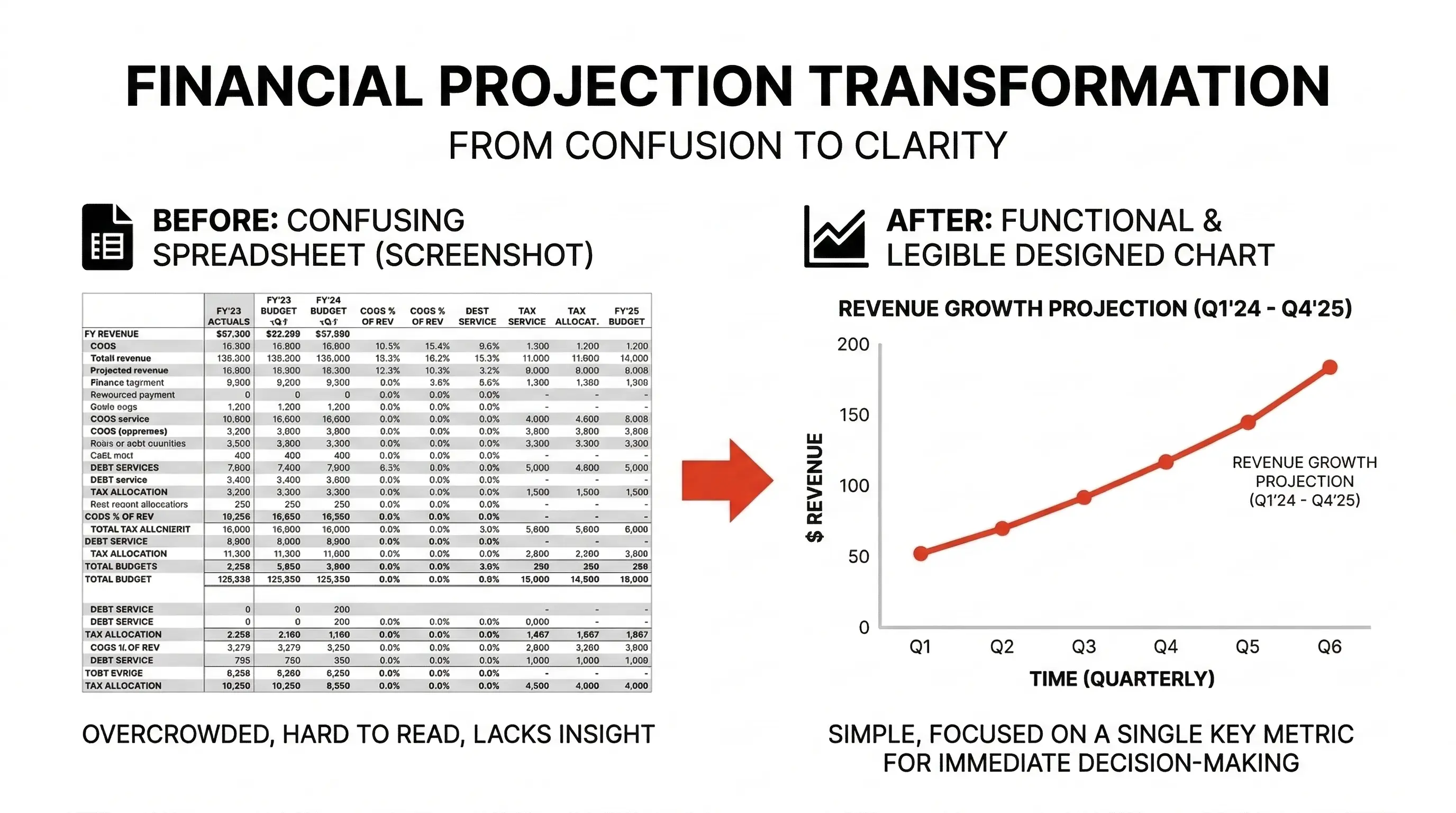
For first-time founders, design is often an afterthought. However, investors pattern-match constantly. If your deck looks like a template from 2012, with inconsistent fonts, misaligned text, and blurry screenshots, investors consciously or subconsciously assume your code, your hiring process, and your product will be equally sloppy.
A polished design signals operational excellence.
This is where many technical founders get stuck. You know how to build the product, but making a slide look premium takes hours you do not have. This creates an execution gap. You understand the advice on how to structure a deck, but executing it visually is a completely different skill set.
If you are burning days nudging text boxes instead of talking to users, it is time to bring in help. Zyner provides startups with experienced design talent through a flat-rate subscription, so you can hand off your raw copy and get back a deck that looks like it belongs at a Sequoia partner meeting. Working with a dedicated team means your deck gets the premium polish investors expect, while you stay focused on growth.
Creating a Standalone Presentation
Keep in mind that the deck you email an investor is different from the one you present in person.
When you send a deck ahead of a meeting, it needs to be entirely self-contained. The investor must be able to understand the entire business model without your voiceover.
When you rewrite, create a "Reading Deck" with slightly more context, and a "Presentation Deck" with fewer words, allowing you to be the focal point in the room.
Finding Your Next Lead Once You Know How to Rewrite a Deck After a Rejection
Rewriting your deck is only useful if you put it in front of the right people.
If you pitched 10 investors and got 10 rejections, your problem was likely the deck. If you pitched 100 investors and got 100 rejections, your problem might be the business model or your targeting strategy.
Look closely at the investors who passed. Were they actually the right fit for your stage and sector? Pitching a Series A SaaS fund when you are a pre-seed hardware startup guarantees a rejection, regardless of how good your deck is. Narrow your focus to funds that explicitly invest in your stage and industry.
Overcoming the Rejection Mindset
A rejection does not mean your startup is doomed. Many iconic companies, from Airbnb to Canva, famously collected dozens of rejections before securing their first true check.
Treat your pitch deck like a product. Launch it, gather user feedback (from investors), find the bugs in your narrative, and ship a new version. The market will tell you when you have reached product-market fit with your story.
You have the feedback. You know the flaws, and you now know exactly how to rewrite a deck after a rejection. Open a new document, strip your story down to the studs, and start rebuilding. Your next "yes" depends on it.
Frequently Asked Questions
How long should I wait before pitching the same investor again?
Wait at least three to six months before re-engaging an investor who passed. You must have significant new data to share, such as major revenue growth, a key hire, or a successful product launch. Pitching them the exact same business with a prettier deck will not change their mind.
Should I send my pitch deck as a PDF or a link?
Always send your pitch deck as a PDF or through a tracked link service like DocSend. A PDF ensures your formatting looks identical on every device and does not require the investor to log into anything.
What is the most important slide in a pitch deck?
The Problem slide and the Traction slide carry the most weight. If the investor does not believe the problem is real and urgent, they do not care about the rest of the deck. If your traction is undeniable, it forces them to pay attention even if your problem slide is weak.
How many slides should my rewritten deck have?
A standard early-stage pitch deck should contain 10 to 13 slides. If your deck currently has 20 slides, you are including too much detail. Move technical architecture, deep competitive feature matrices, and extended financial models to an appendix.
Do I need a different pitch deck for different investors?
Your core narrative remains the same, but you should adjust the emphasis based on the investor. If you are pitching a fund known for deep technical expertise, spend more time on your solution slide. If you are pitching a generalist fund, ensure the market size and problem are incredibly easy to understand.