

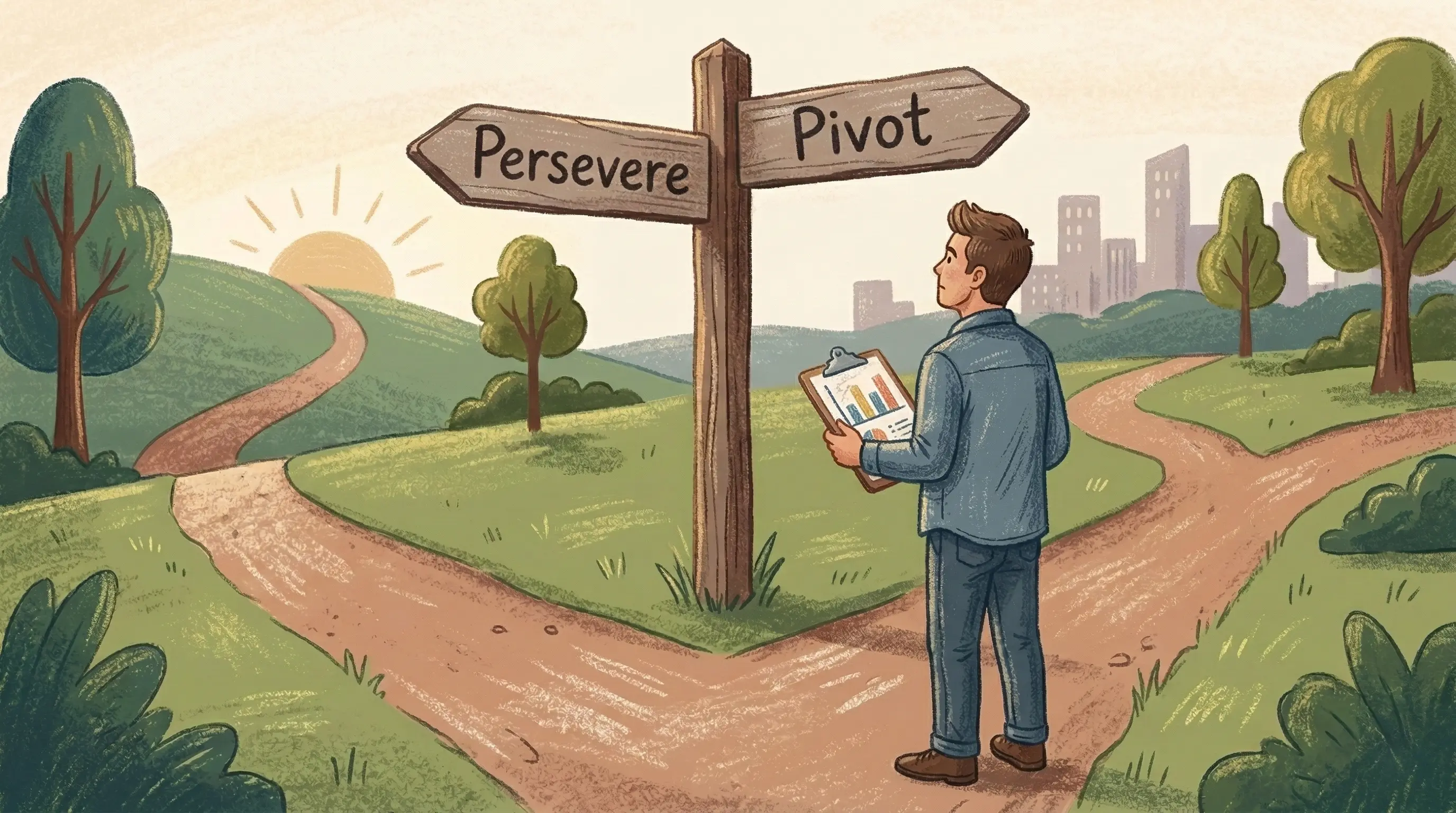
One in three B2B startups pivots before finding its big idea. For consumer startups, it's closer to one in five. That's not a small rounding error. Pivoting is one of the most common and consequential decisions you'll make as a founder.
Yet most of the advice out there treats it like a binary: stay the course or blow everything up. The reality is far more nuanced. The best pivots in history (Instagram, Slack, Shopify, YouTube) didn't throw away everything. They kept something: a feature, a technology, a team, or a customer insight, and they built something better on top of it.
This guide covers how to pivot your startup the right way: how to recognize the signals before it's too late, which type of pivot actually fits your situation, and how to execute the change without losing your investors, your team, or your mind. Whether you're pre seed or Series A, the same core principles apply.
Quick Takeaways:
A pivot is a structured course correction based on validated learning, not a reaction to pressure or boredom
There are two distinct types of pivots: ideation pivots (early, fast, near-total changes) and hard pivots (deeper changes from a product with real users)
The six clearest signals it's time to pivot include low retention, no market need, broken unit economics, stalled growth, competitive displacement, and team misalignment
Most successful pivots kept one element from the original idea: a feature, a technology, or the core problem
Startups that pivot once or twice raise 2.5x more money and have 3.6x better user growth than those that never pivot or pivot too many times
The biggest mistake is waiting too long. Most founders who pivoted successfully say they should have done it sooner
What Does It Mean to Pivot a Startup?
A startup pivot is a structured change in one key aspect of your business strategy, based on what you've learned from customers and the market. Not a random change when things get hard. Not a complete reinvention. A deliberate shift.
Eric Ries, author of The Lean Startup, coined the term to describe a "structured course correction designed to test a new fundamental hypothesis about the product, strategy, and engine of growth." The operative word is structured. You're not panicking. You're applying what you've learned and changing direction on purpose.
Two things define a real pivot. First, you're changing one key component, not everything at once. Second, you're doing it because the data or customer feedback told you to, not because you're bored or a competitor scared you.
Ben Yoskovitz, an experienced startup advisor, puts it cleanly: if you change product, price, and market at the same time, that's not a pivot. That's a reset. The most powerful pivots are surgical.
Two Types of Pivots Founders Actually Make
Not all pivots are created equal. Lenny Rachitsky, who compiled the most detailed dataset on startup pivots available, identified two fundamentally different categories:
Ideation Pivots
These happen when an early-stage startup changes its idea before it has a fully formed product or meaningful traction. They tend to be fast, often happen within the first three months of launching, and the new idea is frequently unrelated to the old one.
Brex went from VR headsets to business banking in two months. Retool switched from a "Venmo for the U.K." to a no-code internal tools platform in three months. YouTube abandoned its video dating concept in under a week.
In ideation pivots, you're not really pivoting in the classic sense. You're still figuring out what to build. The old idea just helped you learn something useful.
Hard Pivots
These happen when a company has a live product and real users, but changes direction anyway. Here, you are keeping something: one feature, one technology, one customer insight, and going all-in on it.
Instagram stripped out everything except photo sharing. Slack killed its gaming product and bet the entire company on the internal chat tool it had built for its team. Loom dropped its marketplace concept and focused on the screen recording feature that users actually kept coming back to.
Hard pivots typically happen within two years of launch, with most occurring around the one-year mark.
The practical implication: If you're three months in and nothing is working, that's an ideation pivot conversation. If you have users, revenue, or real engagement but the overall direction feels off, that's a hard pivot conversation. The timing, the process, and the emotional stakes are very different.
When to Pivot Your Startup: 6 Signals to Watch
Knowing when to pivot is harder than knowing how. Here are the clearest signals, drawn from both data and founder experience.
1. Your Product Isn't Solving a Real Problem
According to CB Insights, 35% of startups fail because there is no market need for their product. That's the single most common cause of startup failure. If customer feedback consistently shows users won't pay, won't return, or can't explain what problem the product solves, this is the signal to take seriously first.
2. Low Retention and Flat Growth
Low retention is the clearest quantitative signal across nearly every successful pivot story. You launch, you get some early interest, and then... people just stop using it. The growth curve goes flat. If you've tried multiple approaches to improve retention and nothing is moving, the product probably isn't solving a problem people care enough about.
3. Unit Economics Don't Work
If customer acquisition cost (CAC) consistently exceeds lifetime value (LTV), the business model is structurally broken. More marketing spend won't fix it. A pivot to a different customer segment, a different pricing model, or a different distribution channel might.
4. Competitive Pressure Has Made Your Position Untenable
Sometimes the market changes around you. A better-funded competitor enters your space, or a platform you depend on builds your feature natively. If you can't win the current game, find a different game. Narrowing your niche or shifting to an underserved adjacent market is often the right move.
5. Persistent Lukewarm Interest
This is more qualitative, but founders who've been through it describe it clearly. It's not that people hate the product. They just don't care enough. There's no pull. Users try it once and drift away. Investors are polite but not excited. The data is neither bad enough to kill the idea nor good enough to justify doubling down. That "meh" signal, sustained over months, is a strong indicator that the core hypothesis is off.
6. Team Misalignment or Collapsing Morale
When the team stops believing in the direction, productivity drops and the best people start looking elsewhere. A clear pivot, even a hard one, often reinvigorates a team because it restores a sense of direction. Stagnation is demoralizing. Movement, even uncertain movement, is not.
What Founders Feel Right Before Pivoting
The data points matter. So does the reality of what it feels like from the inside. Here's what founders said, in their own words, just before they decided to change course:
Instagram: "We knew it wasn't working when we would give it to people and they'd just keep bouncing off." (Kevin Systrom, CEO)
Loom: "Seven months in, we only made $600." (Shahed Khan, co-founder)
Segment: "At the beginning of class about 60% of students were on Facebook, and by the end about 80% were on Facebook." (Peter Reinhardt, co-founder)
Slack: The team realized the game they'd built "just wasn't ever going to scale," despite raising $17.2 million in venture capital. (Stewart Butterfield, founder)
Yelp: "The data coming in... it's like people don't like the site very much." (Jeremy Stoppelman, CEO)
The pattern here isn't dramatic failure. It's quiet, persistent evidence that something isn't connecting. Most founders say they knew something was wrong before the data confirmed it, and that they waited too long to act on the feeling.
Types of Startup Pivots (And When to Use Each)
Eric Ries identified several distinct pivot types in The Lean Startup. Here's how each applies in practice:
Pivot Type | What Changes | When to Use It |
|---|---|---|
Zoom-In | One feature becomes the entire product | When one part of your product gets disproportionate engagement |
Zoom-Out | Your product becomes one feature of a larger platform | When users want more than your product does |
Customer Segment | Same product, different target user | When your product works, but not for the customer you assumed |
Business Model | How you make money (pricing, B2B vs. B2C, SaaS vs. one-time) | When the product is right but the monetization is broken |
Channel | How you sell or distribute | When your product works but your GTM isn't reaching the right buyer |
Revenue Model | Subscription to flat fee, freemium to paid, high margin to volume | When CAC/LTV math is wrong but the product has real value |
Ben Yoskovitz frames it even more simply: you can change product, price, or market. Change one. That's a pivot. Change all three at once and you're starting over.
How to Pivot Your Startup: A Step-by-Step Process
Ready to make the call? Here's how to do it without burning down what you've already built.
1. Identify the real problem before changing the answer
Before changing anything, make sure you understand what's actually broken. Is it the product? The target customer? The pricing model? The channel? Founders often change the product when the real issue is that they're talking to the wrong customer. Run customer interviews. Analyze your retention data. Look at who is using the product, even if it's not who you expected.
2. Find what's already working
Almost every successful pivot preserved one element. Slack kept its internal chat tool. Instagram kept photo sharing. Shopify kept its e-commerce infrastructure. Before deciding what to change, be very clear about what you're keeping. This is your starting point, not your endpoint.
3. Define your riskiest assumptions about the new direction
Before pivoting, list the three or four things that need to be true for the new direction to work. Then design small experiments to test each one. You're not pivoting on a hunch. You're pivoting toward a validated hypothesis. If you can't test an assumption cheaply before committing, that's a red flag.
4. Test with a minimum viable product, not a full build
Before reorienting the entire team and burning runway on a full rebuild, test the new direction with the smallest possible version. Dropbox famously tested demand with an explainer video before writing a line of code. Airbnb tested with a simple website before building a platform. The goal is to get a signal, not to ship a polished product.
5. Communicate early and execute decisively
Once you've validated the direction, move fast. Tell your team, investors, and key customers what you're doing and why. Transparency builds trust, even in hard moments. Then execute without looking back. One of the most common pivot failures is half-committing: the team is still working on the old roadmap while leadership is talking about the new vision. Shut down the old direction cleanly.
Pro Tip: Dalton Caldwell, Managing Director at Y Combinator, describes pivoting as an opportunity cost decision: "It gets more shots on goal to try to find this elusive thing called product-market fit. It's much easier to be lucky when you get half a dozen shots on goal than one."
30+ Successful Startup Pivots: The Complete Table
The following table compiles data from Lenny Rachitsky's research on 30+ successful startup pivots, including what triggered each pivot, how long it took, how founders found the new idea, and what they carried forward.
Company | Current Idea | Original Idea | Reason for Pivot | Time to Pivot | How They Found the New Idea | What They Kept |
|---|---|---|---|---|---|---|
Amplitude | Analytics platform | Hands-free texting app (Sonalight) | Low retention | 1 year | Noticed internal analytics tool getting interest from other founders | Their internal analytics tech |
Box | Enterprise cloud content management | Consumer cloud file storage (Box.net) | Realized bigger B2B opportunity | 2 years | Noticed the business segment pulling harder | Core product, new persona |
Brex | Business credit card | VR headset (Veyond) | Realized it was a bad idea | 2 months | Brainstorming from personal experience and frustrations | Nothing |
Coinbase | Cryptocurrency exchange | Hosted Bitcoin wallet | Low retention | 2 years | Users kept asking if they could buy Bitcoin directly | The product |
Discord | Group messaging (voice, video, text) | Mobile multiplayer game "Fates Forever" | Realized it wasn't going to scale | 1 year | Engineer suggested building a piece of internal tech | One piece of tech |
Flickr | Online photo-sharing platform | Online RPG "Game Neverending" | Growth plateaued | 3 months | Noticed one feature of the game getting disproportionate use | One piece of tech |
Hugging Face | Collaborative ML hub | AI Tamagotchi | Lukewarm interest | 2.5 years | Co-founder spent a weekend building a piece of tech he found interesting | One piece of tech |
Social photo-sharing app | Location check-in app (Burbn) | Low retention | 1 year | Noticed users were using and loving just one element: photo sharing | One feature | |
Lattice | Performance management platform | OKR software | Low retention | 9 months | HR leader founder noticed broader demand for performance management | Core product, expanded scope |
Loom | Video messaging and screen recording | Subject-matter-expert marketplace | Low retention | 9 months | Noticed users loved one feature (video recording) and went all in | One feature |
Lyft | On-demand ridesharing | Peer-to-peer carpooling (Zimride) | Growth plateaued | 5 years | Internal hackathon prototype got founders excited | Ridesharing concept |
Notion | All-in-one productivity platform | No-code app/website builder | Low retention | 4 years | Noticed users loving editor + collaboration feature combination | One feature |
Okta | Cloud identity management | Reliability monitoring for cloud (SaaSure) | Lukewarm interest | 3 months | Talked to 100 people; they kept asking about identity | One feature |
PayPal | Online payments | Encryption for handheld devices (PalmPilots) | Realized it was a bad idea | 1 year | Nonstop ideation and exploration looking for big opportunities | Mobile as a concept |
Social platform for saving visual content | Digital retail catalog app (Tote) | Low retention | 1 year | Noticed users collecting images on their own | One feature | |
Plaid | Financial services APIs | Tried 5-6 ideas including spend-less app | Low retention | 5 months | Venmo asked about licensing their backend infrastructure | One piece of tech |
Retool | No-code internal tool builder | Venmo for the U.K. (Cashew) | Low retention | 3 months | Brainstorming from personal experience and problems | Nothing |
Segment | Customer data platform | University classroom lecture tool | Little to no interest | 1.5 years | Co-founder spent a weekend on a piece of tech and launched it to immediate interest | One piece of tech |
Shopify | E-commerce platform | Online snowboard store (Snowdevil) | Realized bigger opportunity in the infrastructure | 2 years | Noticed their e-commerce infrastructure getting interest from other sellers | One piece of tech |
Slack | Online enterprise communication | Massively multiplayer game (Glitch) | Realized it was never going to be a big business | 9 months | Noticed employees loved the internal chat tool they had built | Their internal analytics tech |
Twitch | Live streaming for games | Big Brother-style show (Justin.tv) | Growth plateaued | 4 years | Noticed a small percentage of users streaming games; founders got excited | Core product, different problem |
Social network | Podcasting platform (Odeo) | Realized it was a bad idea after Apple launched a competitor | 1 year | Internal hackathon; Jack Dorsey built a prototype | Nothing | |
Vanta | Automated security and compliance | B2B Alexa | Lukewarm interest | 3 months | Nonstop ideation and talking to people in founder's network | Nothing |
Messaging app | App for showing friend statuses | Lukewarm interest | 3 months | When Apple launched push notifications, founder explored sharing status proactively | The problem | |
Yelp | Online reviews of local businesses | Tool to automate emailing friends for recommendations | Lukewarm interest | 9 months | Noticed people leaving reviews on their own and went all in | Recommendations as a concept |
YouTube | Online video platform | Video dating site | Lukewarm interest | 1 week | Realized there was no value in the dating concept; the video tech could be generalized | Core product, different problem |
PayPal | $308B valuation | Security software for handheld devices (Confinity) | — | 1 year | — | Mobile as a concept |
Shopify | $185B valuation | Online snowboard shop (Snowdevil) | — | 1 year | — | E-commerce infrastructure |
Airbnb | $100B valuation | Roommate matching service (Nicheclique) | — | 1 year | — | Marketplace model |
Slack | $27.7B (acquired by Salesforce) | Gaming company (Tiny Speck / Glitch) | — | 3 years | — | Internal chat tech |
Twitch | $15B (acquired by Amazon) | General live streaming (Justin.tv) | — | 4 years | — | Streaming infrastructure |
What Successful Pivots Have in Common
After reviewing 30+ pivots, a few patterns stand out clearly.
Most kept something. The common assumption is that a pivot means starting over. In reality, the vast majority of successful pivots preserved one element: a piece of technology, a single feature, or the core customer problem. Full resets are rare and risky.
Low retention was the most common trigger. Across the dataset, "low retention" appears more frequently than any other reason for pivoting. Not low sales, not investor pressure. Just users simply not coming back. If you see a flat retention curve and you've already tried multiple fixes, trust what it's telling you.
Ideation pivots were fast and total; hard pivots were slower and more surgical. Companies like Brex, Retool, and YouTube pivoted within weeks or months of their first idea and kept almost nothing. Companies like Instagram, Slack, and Loom took six to twelve months, had real users, and preserved a specific element. The type of pivot should match the stage you're in.
The best new ideas came from watching users, not brainstorming. In case after case, the new direction emerged from noticing what users were actually doing, not from a whiteboard session. Slack noticed its team loved its internal chat tool. Instagram noticed users only cared about photos. Yelp noticed users were writing reviews unprompted. The next idea was already in the data.
When NOT to Pivot: The Case for Staying the Course
Not every slow period is a signal to change direction. There are also strong reasons to stay the course.
You haven't given it enough time. Most products take six to twelve months to find an audience, even ones that eventually succeed. If you're three months in and discouraged, that's not a pivot signal. That's the normal difficulty of early-stage growth.
You're solving a real problem people pay for. If you have customers, even a small number, who are paying and coming back without being pushed, that's signal worth building on. Don't pivot away from real traction.
Your marketing is the problem, not the product. Sometimes the issue isn't what you're building, it's who you're selling it to and how you're reaching them. Changing the go-to-market motion is not a pivot. It's an experiment worth running before making bigger changes.
You're pivoting toward a trend, not toward customers. This is what Ben Yoskovitz calls a "lazy pivot." Jumping onto AI, crypto, or whatever is currently attracting venture money without customer validation is how startups waste the runway they were trying to save.
The best test: are you pivoting because the data is telling you something, or because you're uncomfortable? Discomfort is not a pivot signal. Persistent, quantifiable lack of traction is.
The Pivot Is Never the Ending
The pivot isn't the story. The pivot is the part between the first guess and the real answer.
Every company in this guide that successfully pivoted did one thing consistently: they acted on what they learned faster than the fear of being wrong could stop them. YouTube pivoted in a week. Brex pivoted in two months. Instagram took a year. The timeline matters less than the decision to move.
If you're seeing the signals (low retention, lukewarm interest, broken unit economics), don't wait for permission. Start talking to customers today. Look at your data. Find what's already working. Then make the smallest possible bet in a new direction and watch what happens.
The companies that win aren't the ones with the best original idea. They're the ones that stayed in the game long enough to find the idea that was actually right.
Frequently Asked Questions
What does it mean to pivot a startup?
A startup pivot is a deliberate, data-driven change to one key aspect of your business strategy: the product, the target customer, the pricing model, or the distribution channel. The term was popularized by Eric Ries in The Lean Startup, who defined it as a "structured course correction" based on validated learning from customers and the market. A pivot is not a random change when things get hard. It's an intentional shift based on evidence.
When should a startup pivot?
The clearest signals include persistent low retention, no market need (customers don't see the value or won't pay), broken unit economics where acquisition costs exceed lifetime value, stalled growth despite multiple experiments, competitive displacement that makes your current position untenable, and team misalignment. Lenny Rachitsky's research suggests founders should schedule a serious conversation about direction at the three-month mark and annually after launch.
What are the different types of pivots in startups?
Eric Ries identified several types: the zoom-in pivot (turning one feature into the whole product), the zoom-out pivot (making your product one feature of something bigger), the customer segment pivot (same product, different target user), the channel pivot (changing how you sell or distribute), and the revenue model pivot (changing how you make money). Ben Yoskovitz simplifies this further: you can pivot product, price, or market, but changing all three at once is a reset, not a pivot.
How long does it take to pivot a startup?
It depends on the type. Ideation pivots, where an early-stage company changes its idea before meaningful traction, typically happen within three months of launch. Hard pivots, where a company with real users changes direction, typically happen within one to two years of launch, most often around the one-year mark. Companies that take longer than two years often report wishing they had moved sooner.
Should you tell your investors before you pivot?
Yes. Transparency with investors during a pivot is not only ethical, it's strategic. Investors who understand why you're changing direction, and see that the change is grounded in data, are far more likely to support the new direction than investors who feel blindsided. Most experienced investors have seen pivots before and understand they're part of the process. What they lose confidence in is lack of self-awareness or dishonesty, not the pivot itself.