

You got in. Now count the weeks.
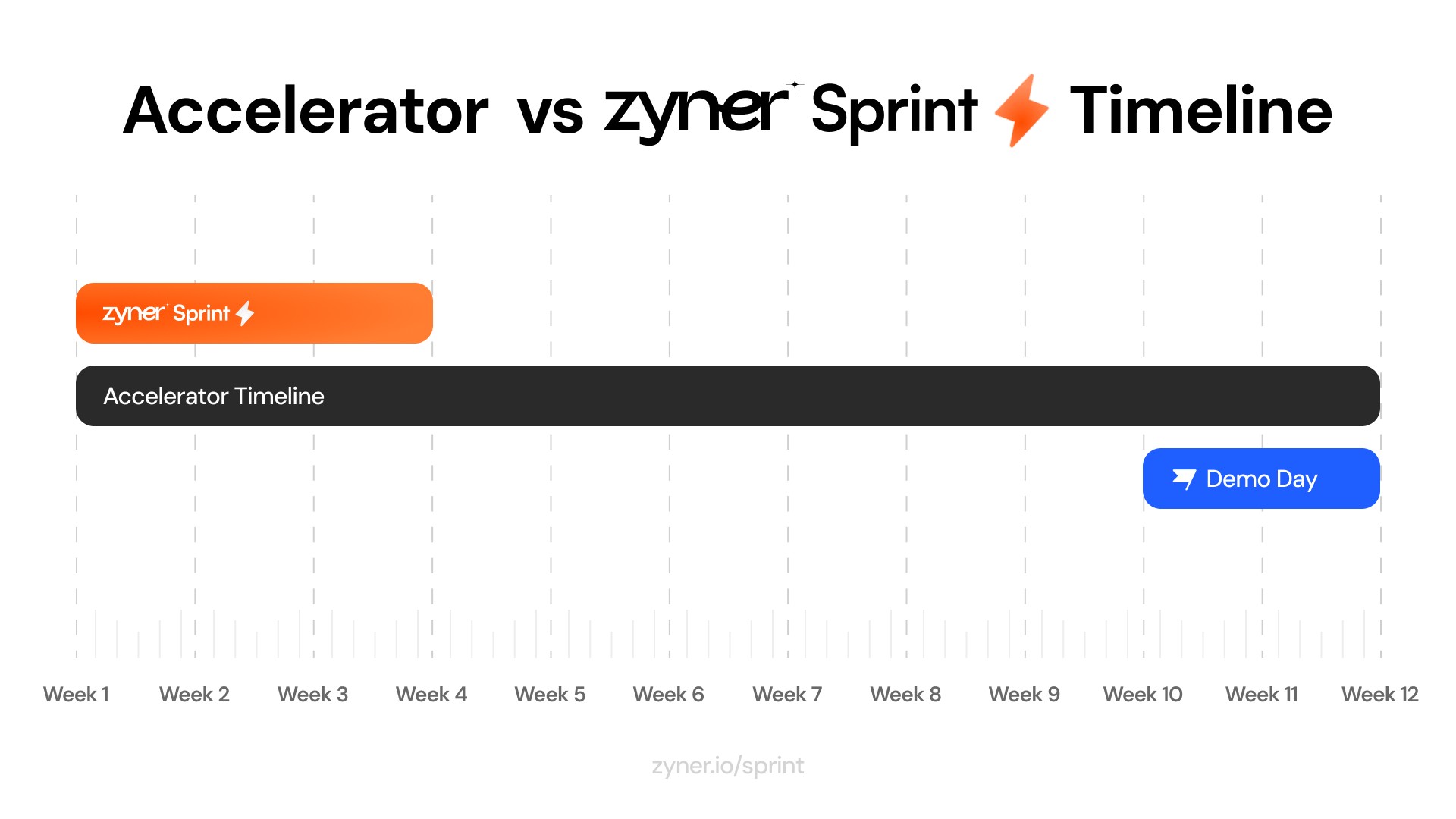
If you are in a16z Speedrun's SR007 cohort, the program runs July 27 through October 11, 2026. If you are heading into Y Combinator's Fall batch, Demo Day is December 2. Either way you have roughly twelve weeks to build a product, find customers, prepare a raise, and become a company that a room full of investors can tell apart from the one that pitched ninety seconds earlier.
Most founders spend those twelve weeks on the product and leave the brand for later. Then Demo Day arrives, an investor clicks the link in your one-liner, and the thing they see is a page that looks like it was assembled the night before. Or worse: a page that looks exactly like four other pages they opened that morning.
This is an argument for spending two to three weeks of that window on a brand sprint, and specifically for spending it early. It is also a straight answer to the question most first-time founders are actually asking right now, which is whether AI can just do this.
TL;DR
YC's Winter 2026 batch had 196 companies, and a16z Speedrun runs 60–70 teams per cohort. On Demo Day you are one tab among hundreds, and the tab is the first thing anyone evaluates.
DocSend's 2026 data has VCs spending an average of 3 minutes 44 seconds on a seed deck, with only 58% of decks viewed to completion. Peer-reviewed research puts the first aesthetic judgment of a web page at 50 milliseconds. You are being sorted long before you are being read.
AI design tools are genuinely fast and genuinely cheap, and they have a specific failure mode: they converge. Anthropic's own documentation says Claude has "a consistent default house style" that is "persistent," and designers have started calling the result Claudian sameness. Sameness is the one thing a category leader cannot afford.
The alternatives do not fit the calendar. Hiring a product designer takes 6–8 weeks before day one. The average branding agency engagement on Clutch costs $71,651.70 and runs 8 months. Both land after your Demo Day.
The Zyner Sprint delivers brand strategy, visual identity, copy, a designed and developed landing page, and (on the larger tier) a pitch deck and launch video, in 2–3 weeks, for $9,000 or $14,000 fixed.
The clock you just started
Accelerators compress everything, including the parts founders assume they can defer.
Y Combinator runs a three-month batch four times a year. In 2026 the Demo Days are March 24, June 16, September 10, and December 2. a16z Speedrun runs twelve weeks, twice a year, both cohorts in San Francisco, with an acceptance rate the program states is below 0.4%.
Two numbers from those programs matter more than the rest.
The first is batch size. 196 companies presented in YC's Winter 2026 batch. Speedrun keeps cohorts to 60–70 teams. Demo Day is not a stage where an investor discovers you in isolation. It is a list. Investors work down that list, open tabs, and triage. Your website is not marketing collateral in that moment. It is the primary artifact by which you are compared to a hundred other companies who are also smart, also technical, also funded by the same people.
The second is time commitment. Speedrun tells founders the program requires "one focused day per week" of sessions, leaving the rest of the week for building. That sounds generous until you list what has to happen in the other four days: ship the product, talk to users, hire, prepare the raise. There is no fifth day where you learn typography.
So the real constraint is not whether brand matters. It is that the window to do anything about it is short, shared, and closing on a fixed date that someone else picked.
What actually happens in the three minutes you get
There is a lot of soft language written about first impressions. The underlying research is more specific than the marketing that quotes it.
Gitte Lindgaard and colleagues at Carleton University ran three studies on how quickly people form an opinion about a web page's visual appeal. Participants rated pages shown for 500 milliseconds, then for 50 milliseconds. The 50 ms ratings correlated closely with the 500 ms ratings, and both held up against judgments made after longer scrutiny. The paper's title is not subtle: "Attention web designers: You have 50 milliseconds to make a good first impression", published in Behaviour & Information Technology in 2006.
A separate Stanford study asked 2,684 people to evaluate the credibility of live websites and then coded what they actually wrote. The single most frequently mentioned factor was "design look", appearing in 46.1% of comments. Not the claims on the page. Not the team. The look.
An earlier Stanford-Makovsky survey of 1,481 people scored individual site attributes on a −3 to +3 believability scale. "The site looks professionally designed" scored +1.54. A typographical error scored −1.26, roughly the same damage as a site representing "a company that is having financial or legal difficulties" at −1.08. A broken link scored −1.42. That study was preliminary and not peer reviewed, so treat the exact figures loosely, but the direction is consistent with everything that followed it.
Now put an investor in that seat. DocSend's 2026 seed deck research puts average VC time on a seed deck at 3 minutes 44 seconds, and finds that only 58% of decks are viewed to completion. Nearly half of founders lose the room before the last slide. The team slide, the one investors are supposedly there for, gets 38 seconds.
DocSend's pre-seed report added an uncomfortable wrinkle: decks from companies that successfully raised were viewed for an average of 3 minutes 21 seconds, while decks from companies that did not raise were viewed for 3 minutes 30 seconds. Longer was not better. The extra nine seconds belonged to the people getting passed on.
Under four minutes on the deck. Fifty milliseconds on the site. That is the whole evaluation window, and design occupies the front of it whether you designed anything or not.
The same research explains why founders who do have traction still get overlooked. DocSend found 35% of companies that raised pre-seed had a live product in market, against 9% of those that did not. Having the product is the hard part and you may already have it. Losing to a company that has less product but communicates it better is an avoidable way to waste that work.
The AI question, answered properly
Here is the honest version, because you will get the dishonest version from every design agency with a blog.
AI design tools are fast. They are cheap. For internal work, for exploring directions, for getting an ugly first draft of a layout out of your head, they are excellent, and any designer telling you otherwise is protecting their invoice. If you are building an internal dashboard, prompt away.
The problem is specific and it is not about quality. It is about convergence.
In July 2026, independent designer Matt Ström-Awn sat through two separate meetings with founders of unrelated startups. Both presented a polished sales deck. Both decks had a bright first page with three declarative bullets, an identical four-rectangle market layout, and centered text reading "our move." Different logos. Everything else the same. Both had been built with Claude Design. As reported by The New Yorker's Kyle Chayka and summarized here, the decks looked like "they were generated by the same company."
Designers have started calling it Claudian sameness: beige and cream backgrounds, rusty orange accents, italic serif display type, wide-tracked subheads, ticker-style scrolling bars. Anthropic's own guidance documents acknowledge it, stating that the model "has strong design instincts, with a consistent default house style" that is "persistent." The documentation also warns that generic corrective instructions like "don't use cream" will "shift the model to a different fixed palette rather than producing variety."
Read that last sentence again, because it is the whole issue. Telling the model to stop doing the obvious thing does not produce a decision. It produces a different default.
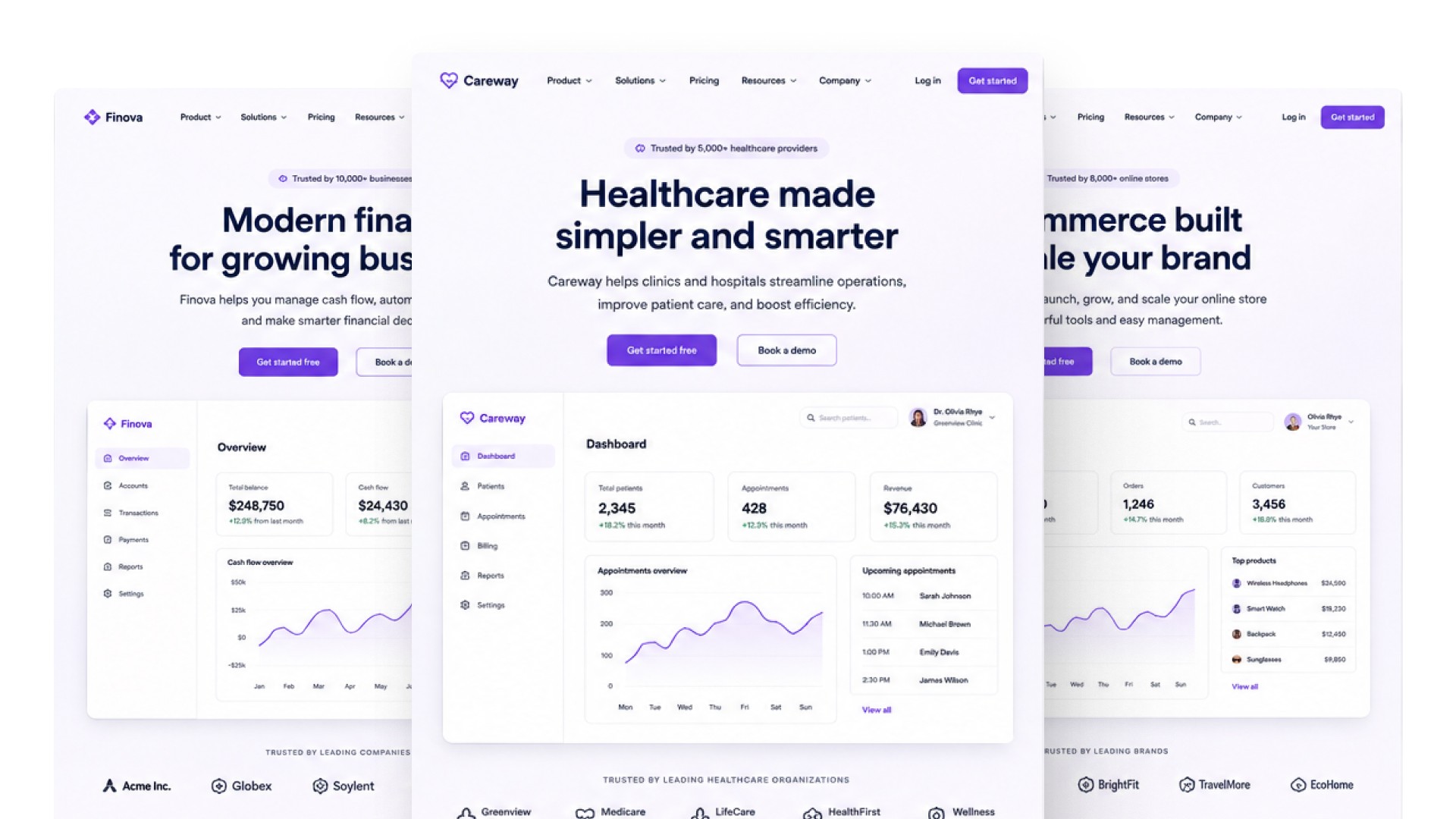
That is what people mean when they say AI has no taste, and it is not an insult to the technology. A language model predicts the most likely next thing. Averaged across everything it has seen, the most likely design is, by construction, the average design. Taste is the opposite operation. Taste is a deliberate refusal of the most likely option in favor of a specific one, made by someone who can defend why.
Ström-Awn put it plainly: "The preferences and tendencies and aesthetics are deeply baked into its machinery; it is always going to struggle to produce something that doesn't look like A.I."
Category leadership is a positioning claim, and the average cannot make it
Your pitch is that you see something the market has not seen yet. That is the entire premise of an accelerator application. Then you render that claim in a visual language shared by every other company that opened the same tool this quarter.
The mismatch is the problem. Not ugliness. Investors and customers are not consciously grading your kerning. They are running a very fast pattern match, and "I have seen this exact page four times this week" resolves as unremarkable before it resolves as anything else. You do not get flagged as bad. You get filed as one of many, which on a list of 196 companies is materially worse.
The perception data has moved, and not in AI's favor
This is where founders are working from 2024 assumptions.
Gartner surveyed 1,539 US consumers in October 2025 and found that 50% prefer to give their business to brands that do not use generative AI in consumer-facing messages, advertising, and content. In the same survey, 68% said they frequently wonder whether the content they see is real.
The IAB, with Sonata Insights, surveyed 505 Gen Z and Millennial consumers alongside 104 advertising executives between October 2025 and January 2026. The results are worth sitting with:
82% of ad executives believe young consumers feel positive about AI-generated advertising. Only 45% of those consumers actually do. The gap widened from 32 points in 2024 to 37 points in 2026.
39% of Gen Z respondents feel somewhat or very negative about AI-generated ads, nearly double the 20% of Millennials.
30% of Gen Z describe brands that use AI for advertising as "inauthentic." 26% say "disconnected." 24% say "unethical."
The share of consumers who call an AI-using brand "innovative" fell from 30% in 2024 to 23%, while advertiser belief that AI signals innovation rose from 40% to 49%.
Cost efficiency became the top stated benefit for advertisers in 2026 at 64%, up from fifth place in 2024.
Klaviyo and Datalily found something narrower and sharper in December 2025: 7% of consumers say visible AI-generated marketing makes them trust a brand more, and 31% say it makes them trust the brand less.
None of this says AI is bad. It says the perception gap runs in one direction: the people making the decision to use it consistently overestimate how it lands with the people receiving it. If you are pitching investors who see AI-generated material all day and customers who are increasingly primed to spot it, betting your first impression on the default output is a strange risk to take with a $500K check on the line.
And the "free" option is not free
The subscription is twenty dollars a month. The cost is your weeks.
Founders who go the AI route rarely spend an afternoon on it. They spend evenings across a month prompting, regenerating, nudging the palette, rebuilding the hero, discovering that the mobile layout broke, and arriving at something that is fine. Fine, in week ten, in a batch of 196, against a competitor who spent the same month talking to customers.
Designer and writer Celine Nguyen framed the trade honestly: what these tools deliver is "the pretty good for the most for the least effort, and pretty low cost. You're just paying a twenty dollar a month Claude Pro subscription instead of hiring a designer."
Pretty good is a fine standard for an internal tool. It is a poor standard for the one asset that has to make a stranger with capital stop scrolling.
Founders should not be doing this, for a reason that has nothing to do with skill
The common framing is that founders are bad at design. Some are, some are not, and it is beside the point.
The point is allocation. During a twelve-week program, founder hours are the scarcest asset in the company, more constrained than money, because Speedrun already wired you up to $1M and $5M in credits. What you cannot buy back is October.
Every hour you spend fighting a model's default palette is an hour not spent on the customer conversation that becomes your traction slide. DocSend found that VCs spend 80% more time evaluating the traction section of companies that did not raise, which tells you where a weak traction story sends the conversation. "We spent five weeks on our own logo" does not improve that read.
There is also a signal problem that founders underrate. A deck or a site that visibly came out of a generator communicates something beyond aesthetics. It says this was the cheapest available option and we took it. Investors are pattern-matching on judgment, and the first judgment call they can observe is what you decided to spend real effort on before they gave you anything.
The four real options, priced
Set aside the arguments and put the calendar and the invoice side by side. Your Demo Day is fixed. Work backward.
Hire a designer
A product designer in San Francisco averages $145,649 per year on Glassdoor as of July 2026, $157,850 on Built In, and $189,434 on Indeed. Levels.fyi puts total compensation in the Bay Area between $175,000 and $330,000.
Sourcing, interviewing, and onboarding a full-time product designer takes 6–8 weeks. If you start today, they begin work around week eight of your batch, then need to learn your company before producing anything. You will also need more than one person: brand identity, copywriting, and Framer development are three different skills, and the designer who is excellent at product UI is frequently not the person you want writing your hero headline.
Right answer eventually. Wrong answer for this quarter.
Hire a branding agency
Clutch aggregates verified client reviews across branding agencies. Their 2026 pricing guide reports an average project cost of $71,651.70, an average monthly spend of $8,868.33, and a typical project timeline of 8 months. US agency rates run $100–$149 per hour.
Eight months from today is April 2027. Your Demo Day was in the autumn.
Even the compressed end of the market does not fit cleanly. A logo and basic identity refresh runs 3–6 weeks; a full rebrand covering strategy, identity, guidelines, and implementation typically runs 8–12 weeks, and that is before the website is designed or built.
If a sprint is not for you, check our roundup on Branding Agencies for Startups to find the most suitable Branding Partner for your Startup's branding project.
Freelancers
Cheaper per hour and faster to start. The cost moves rather than disappears: you become the project manager. You are now briefing a brand designer, a copywriter, and a Framer developer separately, resolving the inconsistencies between their work, and absorbing the schedule risk when one of them goes quiet. That is a part-time operations job during the twelve weeks you have least capacity for one.
Do it yourself with AI
$20 a month, available immediately, and the failure mode is documented above at length.
Run a sprint
Option | Cost | Time to finished, live brand and site | Founder hours required |
|---|---|---|---|
$9,000 or $14,000 fixed | 2–3 weeks, live | Low, structured input only | |
Hire in-house | $145k–$190k salary, plus 2–3 more roles | 6–8 weeks to hire, then months of work | High, ongoing |
Branding agency | $71,652 average project | 8 months average, 8–12 weeks compressed | Moderate |
Freelancers | $5k–$25k typical | 6–12 weeks, coordination dependent | High, you manage it |
DIY with AI | $20/month | Weeks of evenings, converges on the default | Very high |
What the sprint actually does in fourteen days
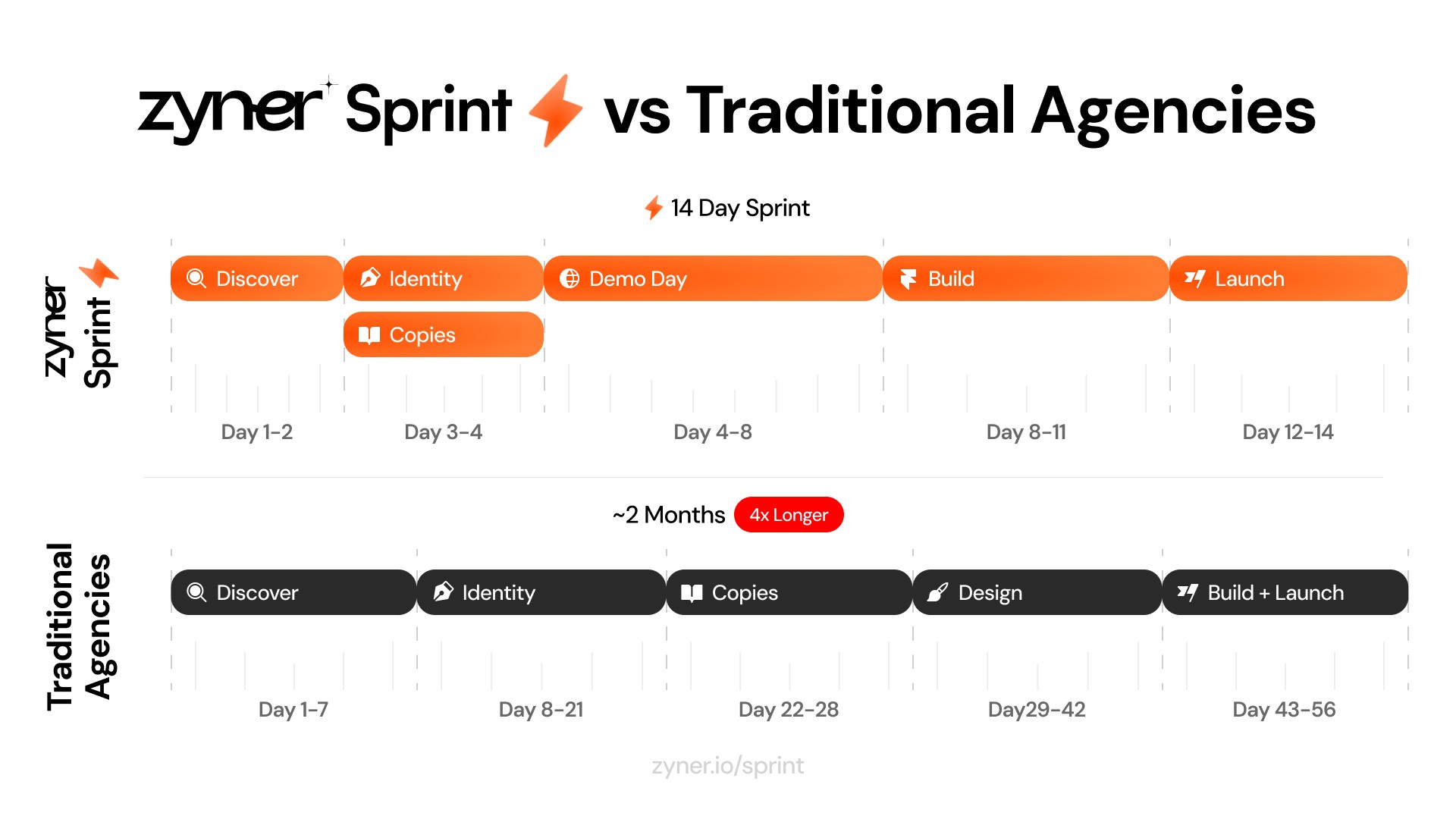
Speed here is not a claim about working faster. It comes from running workstreams in parallel that most agencies run in sequence, and from removing the two things that consume the calendar in a normal engagement: waiting and rework.
Days 1–2. Discovery and strategy.
Positioning, audience, and creative direction get decided before anything is designed. This is the step that prevents week-three backtracking, and it is the step DIY and AI approaches skip entirely, which is why they backtrack.
Days 3–4. Identity and copy, at the same time.
Two workstreams run simultaneously. While the visual identity takes shape, the landing page copy is being written against the same approved positioning. Most agencies finish branding before starting copy, and copy before starting design. That sequence is where months go.
Days 4–8. Brand system and page design.
The identity expands into logo, color, typography, and guidelines. The landing page is designed in Figma using the approved brand and the approved copy, so the design is not a placeholder waiting for real words.
Days 8–11. Development in Framer.
The page is built live, responsive, SEO-ready, and performance-optimized. Brand assets are packaged for handoff in parallel with the build.
Days 12–14. QA, launch, handoff.
Final QA, then live. You receive source files, brand guidelines, and the Framer project in full.
Three specialists work on it: a creative director, a senior designer, and a dedicated project manager. Scope, timeline, and price are fixed on day one.
What you actually get out of it
Credibility, before you need it
The research above is unambiguous that professional design is read as competence. The practical version: when an investor forwards your link to a partner, when a candidate checks you out after a recruiter email, when a design partner's procurement team googles you, the page carries the argument without you in the room. Zyner client Manil Lakabi, co-founder of FoundryAI (YC F24), put it directly: "If you're a founder who needs to look credible before your next investor meeting, the Zyner Sprint is exactly what you need."
A category-leader position you have not earned yet
Perception moves faster than traction. A creative-director-led identity lets a nine-week-old company sit credibly next to competitors that have existed for four years. That is not a trick; it is what a deliberate visual position does. It is also precisely the thing a model trained on the average cannot produce, because the average is the position everyone already occupies.
Investors who read you as serious
A sharp brand tells an investor that the team is deliberate before you have said a word about the product. The inverse also transmits. Sending an investor material that visibly came from a generator says you optimized for cheap on the one artifact you controlled completely. Given the IAB data on how "inauthentic" and "disconnected" land as descriptors, that is an expensive signal to send during a raise.
Pipeline, not just polish
The landing page is built to convert, not to be admired: conversion-focused copywriting, a designed page rather than a template, illustrations and micro-animations, and a Framer build that is responsive and fast. It ships live before Demo Day, so the traffic from your launch, your batch listing, and your founder posts lands somewhere that works.
Months back
The comparison that matters is not $9,000 against $20 a month. It is $9,000 against the eight-month agency average, the 6–8 week hiring cycle, or the five weeks of your own evenings. Zyner's internal figures put client go-to-market execution at 2–4 times faster than the equivalent in-house build, with annual savings of $250,000–$450,000 against staffing the same capability, and return on the engagement inside two to three months. Zyner has worked with 320+ startups, including YC companies across W14 through S25.
Who this is for
Founders who are not sure what to do first.
You know the site needs to change, you have four opinions from four advisors, and you have not started. A sprint removes the decision. Positioning is settled in days 1–2 and everything downstream follows from it.
Teams internally debating "should we just use AI for this."
Have the debate with the 2026 numbers rather than the 2024 ones. Use AI for internal tools and iteration speed. Do not use it for the one artifact that decides how strangers with capital categorize you.
Founders who believe AI is fast and good.
It is fast. It is good at the average. Your entire pitch is that you are not the average.
First-time founders trying to hack their way into fundraising properly.
The legitimate version of the hack is doing the unglamorous thing early instead of late: settle positioning, ship a page that converts, walk into the raise with materials that do not need an apology.
Who this is not for
If you have a design team you trust and a brand that already holds up, this is not a good use of $9,000. If your positioning is genuinely unresolved because you are still searching for the product, spend the money on customer conversations and run the sprint once you know what you are selling. If your timeline is longer than a year, a full agency engagement with research and implementation phases may serve you better.
Sprints work when there is a fixed date, a real product, and a founder who can make decisions quickly.
Pricing
Two tiers, both scoped and priced upfront.
Brand & Web Sprint, $9,000.
Brand strategy and full visual identity, landing page design and Framer deploy, copy, illustrations and micro-animations, a dedicated creative director, a dedicated project manager, senior design talent, and Framer Pro free for a year.
Launch & Raise Sprint, $14,000.
Everything above plus an investor-ready pitch deck design and a launch video, designed, animated, and shipped.
Zyner takes three founders per month. If you are in SR007 or a Fall YC batch, the useful move is to start in the first weeks of the batch, not the last, so the page is live and indexed while you still have runway to point traffic at it.
Brand & Web Sprint
$9000
Brand and landing page, done.
Brand strategy and full visual identity
Landing page design and Framer deploy
Copy, illustrations & micro-animations
Dedicated creative director
Dedicated project manager
Senior design talent
Framer Pro, free for 1 year ($360 value)
Launch & Raise Sprint
$14000
Launch and raise, covered.
Everything in the Brand & Web Sprint
Investor ready pitch-deck design
Launch video - design, animate & launch!
Dedicated creative director
Dedicated project manager
Senior design talent
Framer Pro, free for 1 year ($360 value)
What to do this week
Open your calendar and mark your Demo Day. Count backward three weeks and mark that too. That second date is the last point at which a brand sprint still produces a live site with time to iterate before anyone important looks at it.
Then look at your current landing page and ask one question: if an investor opened this next to five other companies from your batch, would anything about it be memorable ten minutes later? If the honest answer is no, that is a fixable problem with a fixed price and a known timeline, and it is the only problem on your list this quarter that is.
FAQs
Do I need my messaging and positioning figured out before the sprint?
No. Positioning is the first thing the sprint does. Days 1–2 cover audience, market, and creative direction before any design work starts. Founders who arrive with strong opinions move faster, but arriving undecided is normal and expected.
What if we are still pre-launch or pre-product?
That is a common starting point, and it is often the right time. A landing page that clearly explains what you are building is useful during a batch, for waitlist capture, for recruiting, and for early design partners. What matters is that you know who you are building for. If that is still unresolved, resolve it first.
Is 2–3 weeks realistic for brand and a website?
It is realistic because of how the work is sequenced, not because corners are cut. Identity and copy run in parallel rather than in series, positioning is locked before design begins so there is no mid-project reversal, and three specialists work only on your project for the duration. The compression comes from removing wait states, which is where most of an eight-month agency timeline actually goes.
Can I not just do this with AI for twenty dollars a month?
You can produce something. The documented risk is that it looks like everyone else's, because the model's defaults are, in Anthropic's own words, "persistent," and generic corrections shift it to a different fixed default rather than to variety. In a batch of 196 companies pitching the same investors on the same day, resembling the field is the specific failure you are trying to avoid. Use AI for internal work and iteration. Do not use it for the artifact that decides how you get categorized.
What do I own at the end?
Everything. Source files, brand guidelines, and the full Framer project. There is no dependency on Zyner to make changes afterward, and no license that limits how you use the identity.


