

58% of consumers say trust is among the most important factors when choosing a financial services provider, according to research from MX. For fintech founders, that stat should shape every brand decision you make.
Your product might be technically superior. Your pricing might be sharper. But if your brand doesn't communicate credibility, you're fighting an uphill battle before a single sales call happens. Investors read the same signals your customers do.
This guide compares the 10 best fintech branding agencies available to founders in 2026, with a particular focus on options that work well at the seed and Series A stage. Whether you're looking for a San Francisco fintech branding agency or a remote-first team, the right fit depends on your stage, product type, and what "branding" actually means for your business right now. We've looked at agency portfolio depth, process rigor, funding stage fit, and whether they understand the compliance constraints that shape fintech messaging.
If you are looking for a Branding Agency for your Startup, it's worth to check our Best Branding Agencies for Startups roundup.
Quick Takeaways:
The best fintech branding agencies combine positioning and messaging before touching visuals
Trust signals, compliance fluency, and sub-sector specificity separate good fintech agencies from generic ones
Agency timelines run 6 to 16 weeks for a full brand engagement; subscription models can cut that to days
Pricing ranges from $10,000 for scoped identity work to $100,000+ for comprehensive strategy and rollout
San Francisco has a strong cluster of fintech branding firms, including Ramotion, Born & Bred, and Clay
Zyner offers an alternative to project-based agencies: an unlimited design subscription that onboards in 24 to 48 hours
What Is a Fintech Branding Agency?
A fintech branding agency is a firm that specializes in building the positioning, messaging, and visual identity for financial technology companies. The work goes well beyond logo design. A strong fintech branding agency builds a complete brand system: the words you use, the trust signals you deploy, the visual language that communicates stability and competence, and the guidelines that keep everything consistent as your team grows.
What makes this categorically different from working with a general branding firm?
Three things: compliance, complexity, and credibility. Fintech products operate in regulated environments, which limits how you can describe your product and what claims you can make. The products themselves are often technically sophisticated, requiring a translation layer between what the product does and what the customer understands. And the trust bar is simply higher. Someone choosing a fintech tool is trusting you with sensitive financial data, critical infrastructure, or their money. Every visual and verbal decision either builds or erodes that trust.
A specialist fintech branding agency understands all three constraints and prices their process accordingly. A generalist often doesn't, which means you're paying them to learn on your time.
What to Look for in a Fintech Branding Agency
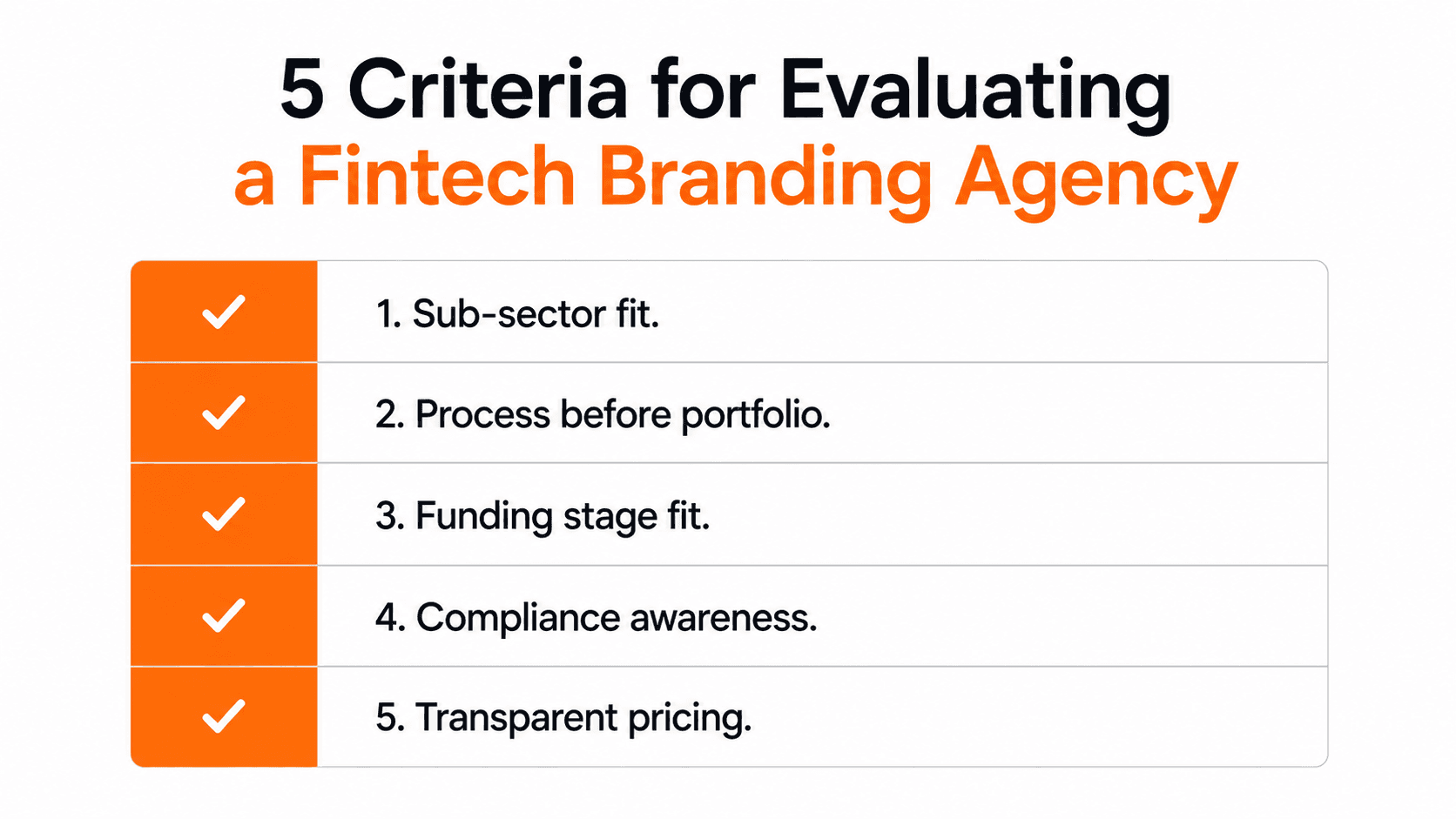
Before reaching out to any firm, get clear on what you actually need. Here are the criteria that matter most:
Sub-sector fit. Fintech is broad. A firm that has done consumer neobank rebrands has developed different instincts than one that has built positioning for B2B payments infrastructure. Ask to see work in your specific vertical, not just "fintech."
Process before portfolio. The best agencies start with positioning research and stakeholder interviews before any visual work begins. If an agency jumps to logo concepts in the first conversation, that's a sign they're design-led rather than strategy-led. In fintech, unclear positioning is a much bigger problem than unpolished visuals.
Funding stage fit. Not every agency is built for every stage. Some are designed for late-stage companies preparing for IPO or institutional scrutiny. Others specialize in early-stage clarity, helping pre-product founders build a story that works for both investors and early customers. Match the agency to where you are, not where you hope to be.
Compliance awareness. Regulated language requirements, disclosure obligations, and financial claims standards are real constraints in fintech. The right fintech branding agency treats compliance as a core part of protecting the brand, not a blocker to route around marketing.
Transparent pricing. Many agencies quote custom scopes that are hard to compare. Be direct about your budget early and ask what you can get within it. Agencies that won't give a range until deep into a discovery process are often not a fit for early-stage startups.
The 10 Best Fintech Branding Agencies in 2026
1. Zyner: Best for On-demand Fintech Brand Execution
Location: San Francisco (remote-first)
Best for: Seed to Series A fintech startups that need brand identity, pitch decks, UI/UX, and ongoing design execution under one subscription
Pricing: From $4,995/month (yearly plan) to $5,495/month (monthly)
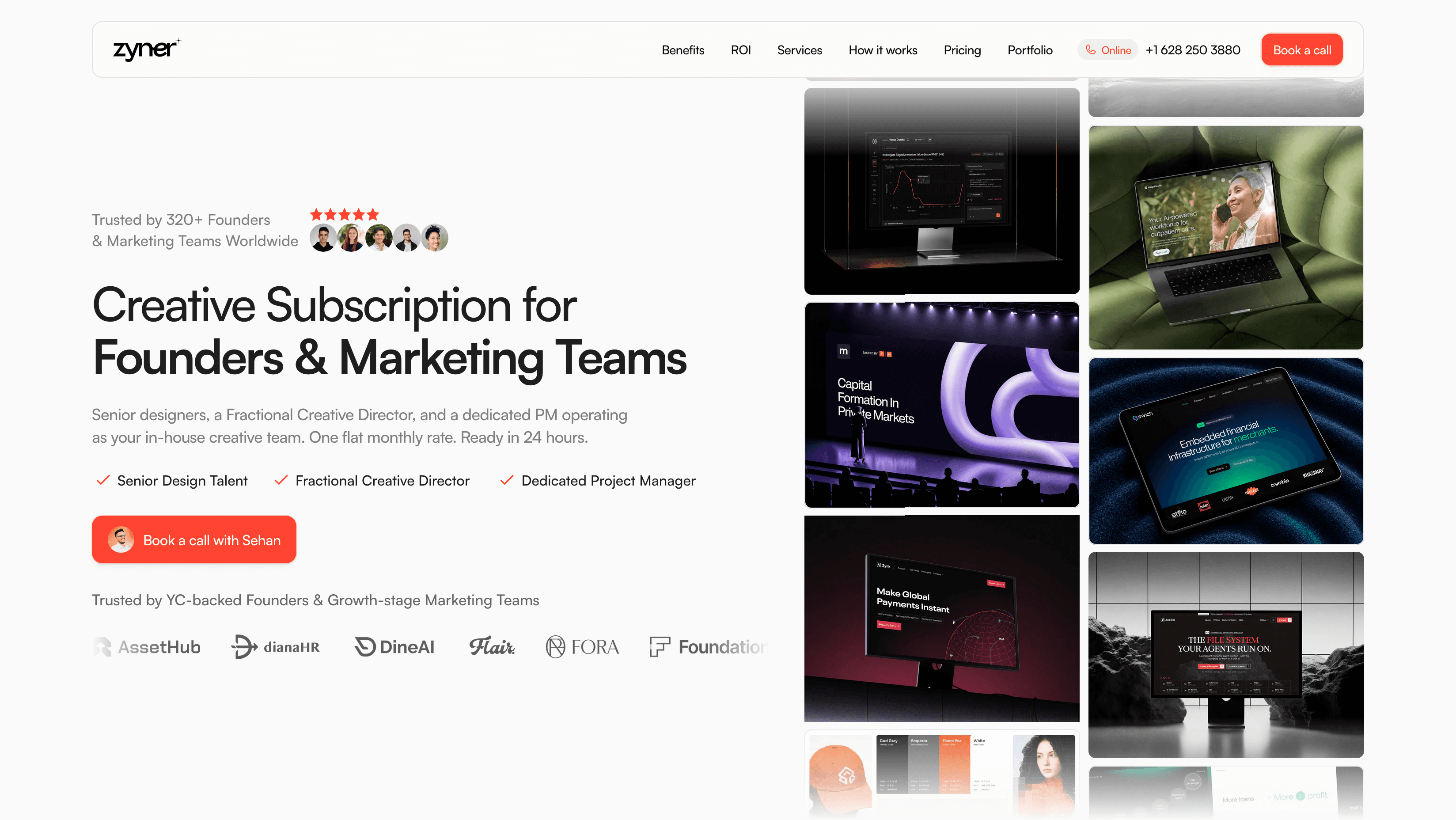
Most fintech branding agencies hand you a finished brand and walk away. Zyner works differently. It's an unlimited design subscription built for startups, which means you get a dedicated team of senior designers and a project manager handling all your creative work, from the initial brand identity through pitch deck iterations, website builds, and UI/UX work, on an ongoing basis.
For fintech founders, that continuity matters. Your brand doesn't stop evolving after the logo is done. You'll need it applied to product UI, compliance-ready marketing materials, investor updates, and growth campaigns. Zyner covers all of it under one flat monthly rate, with onboarding in 24 to 48 hours and no long-term lock-in.
Zyner has worked with 320+ startups, including multiple YC-backed companies across cohorts from W14 through X25. Founders report 2 to 4x faster go-to-market execution by removing the design bottleneck.
Compared to building an in-house design team or running back-and-forth with a project agency, Zyner saves founders an estimated $250,000 to $450,000+ annually.
Services Offered:
Branding Services: Logo Design, Brand Identity, Brand Collateral, and more.
Design Systems: Component Libraries, UI Kits, Typography, and more.
Web Design: Landing Pages, Full Websites, Framer Development, and more.
Product Design: App UIs, Prototyping, Mobile UI, Web UI, and more.
Ad Creatives: Static Creatives, Motion Creatives, Meta ads, LinkedIn Ads and more.
Social Media Creatives: Posts, Reels, Stories, Videos, Carousels and more.
Presentation Designs: Business Presentations, Webinar Slides and more.
Pitch Deck Design: Fundraising Decks, Sales Decks, Data Rooms and more.
Illustration Design: Icons, Characters, Illustration Systems, and more.
Print Design: Flyers, Events, Billboards and more.
Packaging & Merchandise: Apparel & Merch, Brand Collateral and more.
Motion Design: Product Animations, Explainer Animations, UI/UX motion and more.
Launch Video: Launch Videos, Demo Videos, Promo Videos and more.
Book a quick intro call to see if it fits where you're at.
Creative Subscription for
Startups & Marketing Teams
Senior designers, a Fractional Creative Director, and a dedicated PM operating as your in-house creative team. One flat monthly rate. Ready in 24 hours.
Get 2000$ off for the first month.
2. Ramotion: Best for Scalable Fintech Brand Identity Systems
Location: San Francisco, CA
Best for: Fintech companies that need a strategic brand identity that scales across digital products and marketing
Notable clients: Firefox, Salesforce, Clearbit, Netflix
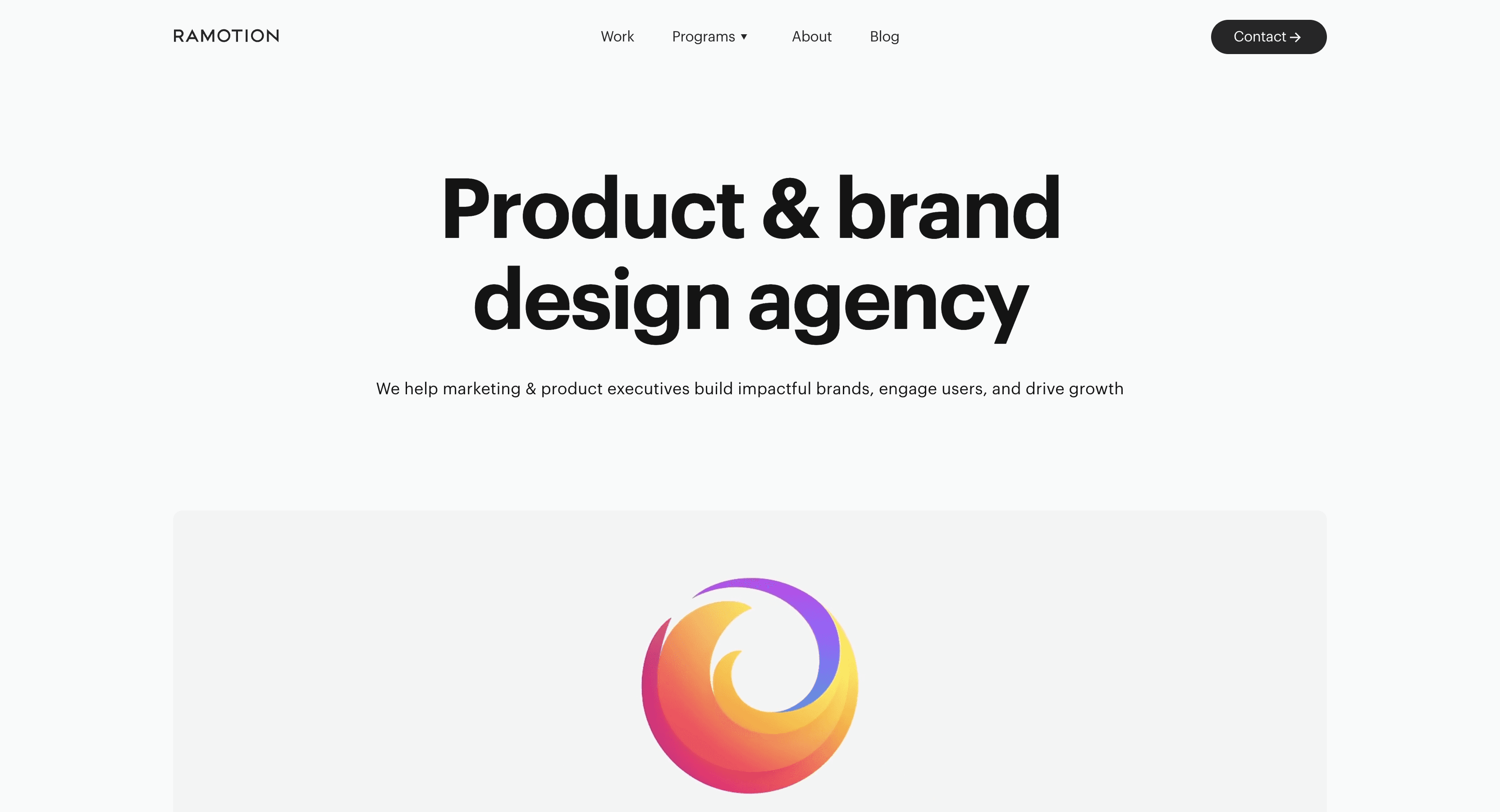
Ramotion builds strategic brand identities by combining positioning and naming work with user-focused visual systems. For fintech companies, their San Francisco location gives them proximity to the startup density where many early-stage fintech decisions get made.
Their process starts with positioning, then moves through naming and visual identity development, producing scalable brand frameworks designed to hold up as the product and team grows. Their client list spans major tech companies and financial tools.
Best for: Series A fintech companies that need a durable brand system, not a quick logo refresh.
3. Born & Bred: Best for Fintech Positioning and Messaging
Location: San Francisco, CA
Best for: Fintech companies that need to clarify who they serve and why they win, before getting into visual execution
Notable clients: Discord, Conduit, Epic Cleantec, Sequel
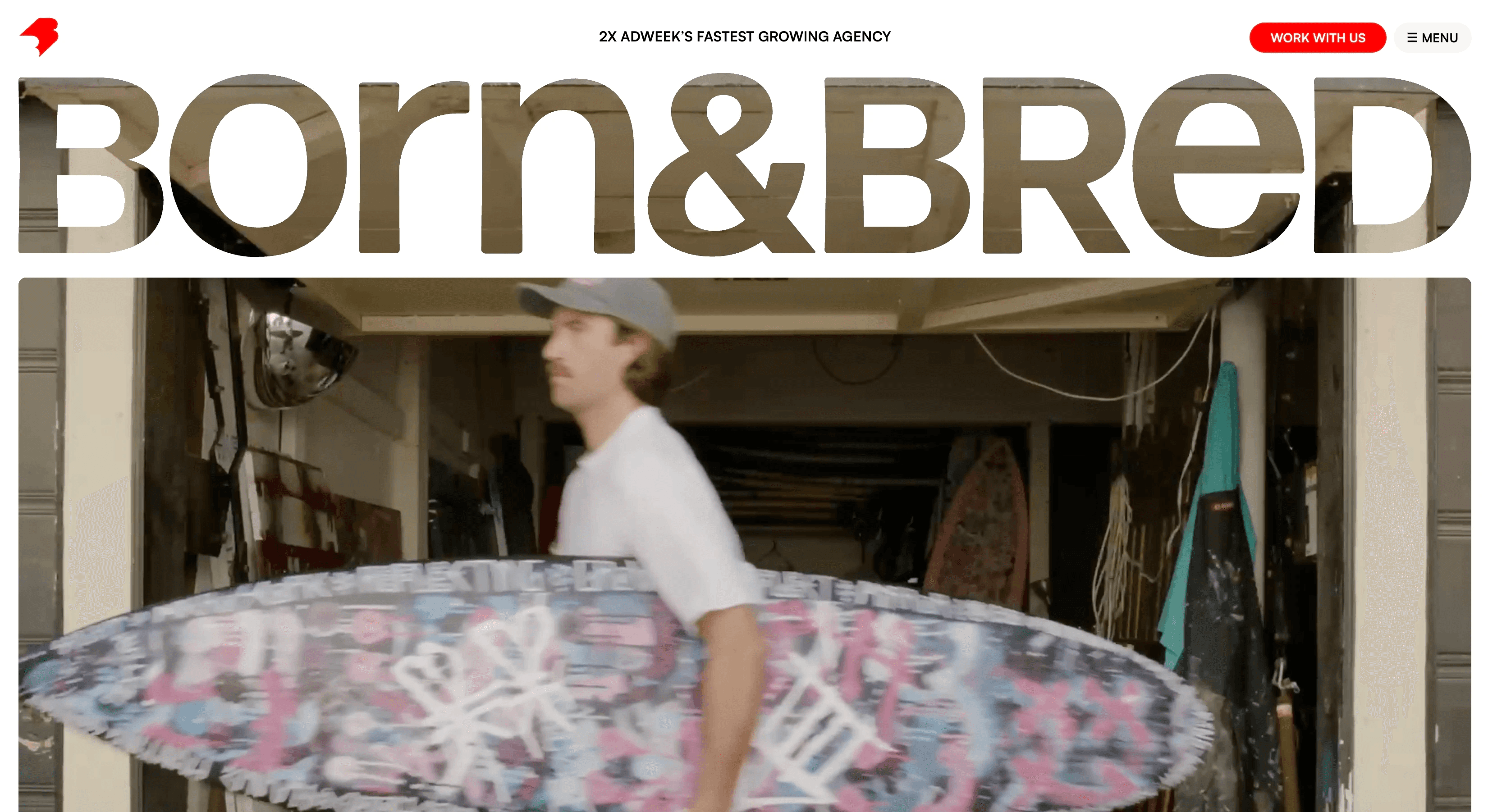
Born & Bred focuses on clear messaging and strong positioning before any visual work begins. Their work in payments, lending, and financial platforms reflects an understanding of how fintech buyers evaluate credibility: they look for precision and authority in the language before they look at the logo.
The San Francisco-based team specializes in brands where complexity is the enemy. If your fintech product is genuinely hard to explain, Born & Bred has the process to turn that complexity into a clear positioning statement your sales team can actually use.
Best for: Seed to Series B fintech companies where positioning clarity is the bottleneck.
4. Clay: Best for Brand and UX Integration
Location: San Francisco, CA
Best for: Fintech companies building consumer-facing products where brand and product experience need to feel unified
Notable clients: Discover, Coinbase, Stripe, Slack
Clay is a design-first agency that blends behavioral research with visual craft. For fintech products, that matters because the brand isn't just on the website. It's inside the product itself: in the error messages, the onboarding flow, the confirmation screen after a large transfer. Clay builds brand systems that hold up through all of it.
Their clients include some of the best-known names in fintech and payments. If you're building a consumer-facing product where the product experience is the brand, Clay's integration of UX thinking with identity work is a significant advantage over agencies that treat brand and product as separate workstreams.
Best for: Consumer fintech startups from seed onward, particularly those where the product UI is the primary brand touchpoint.
5. Block Club: Best for B2B Fintech with Content Systems
Location: Brooklyn, NY
Best for: B2B fintech companies at Series A and beyond that need brand positioning AND a content system to support demand generation
Notable clients: Plaid, Alloy, Argyle, Codat, Middesk, Lithic, Pigment
Block Club is a B2B-focused branding and content agency with a strong track record in fintech infrastructure. Their client list reads like a who's who of fintech plumbing: Plaid for data connectivity, Alloy for identity decisioning, Argyle for income verification.
What distinguishes Block Club from other firms on this list is how tightly they connect brand positioning to content strategy. The brand system they build feeds directly into the content engine that supports pipeline. For B2B fintech companies where long sales cycles require consistent thought leadership, that integration is valuable.
Best for: B2B fintech companies at Series A and beyond, particularly those selling to banks, fintechs, or enterprise buyers where brand authority drives deal velocity.
6. Fintech Branding Studio: Best for Fast Rebranding Sprints
Location: New Zealand (remote-first)
Best for: Fintech companies that need to rebrand quickly, often ahead of a fundraise or market pivot
Notable clients: BlackBull, Pepperstone, Triple-A, Flowdesk
Fintech Branding Studio works exclusively in financial technology, which gives them a depth of domain knowledge that shows in execution. They specialize in brand development, rebranding, and sprint-based execution, meaning they're built for the situation where you need a new brand system fast, not a 16-week discovery process.
Their focus on clear positioning and scalable design systems means the output isn't just visually polished. It's built to grow with the company.
Best for: Fintech companies pre-launch or pivoting that need to reboot their brand story fast.
7. Ragged Edge: Best for Consumer and Challenger Fintech
Location: London, UK
Best for: Consumer fintech and challenger financial brands targeting everyday people
Notable clients: Wise, Marshmallow, Tilt, Salary Finance
Ragged Edge has built some of the most recognizable consumer fintech brands in Europe. Their rebrand of Wise (formerly TransferWise) is a widely cited example of how to take a complex financial product and make it feel accessible and trustworthy. Their work on Marshmallow, the insurance brand targeting underserved drivers, shows the same approach applied to a different compliance-heavy vertical.
At around 38 people, they run senior-led engagements without the overhead of a large consultancy. If you're building a consumer product that needs to compete with incumbent banks while feeling modern and digital-first, Ragged Edge understands that tension better than most.
Best for: Series A to C consumer fintech companies, particularly in the UK and European markets.
8. DeSantis Breindel: Best for Late-Stage and Enterprise Fintech
Location: New York, NY
Best for: Late-stage fintech companies preparing for IPO, major fundraise, M&A, or institutional sales
Notable clients: OneMain Financial, Guggenheim Partners, LPL Financial, Goldman Sachs
DeSantis Breindel is one of the most established B2B branding firms in financial services. Their process is research-heavy and stakeholder-intensive, built for the kind of organizational scrutiny that comes with high-stakes transitions. Board members, investors, and regulators are all part of the audience they design for.
This makes them a poor fit for early-stage startups that need speed. But for later-stage fintechs where the brand needs to perform under institutional review, their rigor is the point.
Best for: Series C and beyond, particularly companies preparing for IPO, large capital raises, or enterprise sales cycles with multiple stakeholder layers.
9. CSTMR: Best for Full-Service Fintech Marketing
Location: Austin, TX
Best for: Fintech companies that want branding and performance marketing from a single firm
Notable clients: Credit Karma, Bankuity, LendingTree
CSTMR combines brand strategy with performance marketing, which makes them useful when you need a tighter brand and more acquisition simultaneously. Their services span positioning, visual identity, UX design, content strategy, and growth marketing.
The risk with full-service agencies is that depth gets spread thin. CSTMR's exclusive focus on the financial services sector helps them avoid this. Their team understands the constraints and buyer psychology of fintech without needing to be educated on the basics.
Best for: Fintech companies moving past MVP that want to tighten their brand while also running paid and organic acquisition.
10. Koto: Best for Global Fintech Brand Systems
Location: New York, Los Angeles, London, Berlin, Sydney
Best for: Venture-backed fintech companies that need a brand to perform across product, marketing, and global markets
Notable clients: Fluz, Workday, Index Ventures, Google
Koto operates at the intersection of brand strategy, visual identity, and digital product design, with offices across four continents. For fintech companies scaling internationally, a brand system that holds up across markets and contexts is a meaningful competitive advantage.
Their consumer fintech work (including Fluz) shows an ability to build brands that feel credible in financial contexts while remaining engaging to everyday users.
Best for: Series A to D fintech companies with global ambitions or significant product surface areas.
How to Choose the Right Fintech Branding Agency
With this many options, the real question is how to narrow them down quickly. Here's a decision framework by situation:
You're pre-seed or seed, with limited runway: Look for a fintech branding agency with explicit startup experience and ask about sprint-based or phased engagements. Better yet, consider a subscription model like Zyner that gives you senior design talent at a predictable monthly cost without a large upfront project commitment.
You're Series A, scaling fast: You need a brand system that can support hiring, customer acquisition, and investor communications simultaneously. Block Club, Born & Bred, or Ramotion are worth evaluating here. Look for demonstrated experience translating technical fintech products into positioning that non-technical buyers understand.
You're building a consumer product: The brand lives inside your product UI as much as it does on your website. Clay, Ragged Edge, and Koto all have experience with consumer-facing fintech, where the product experience and brand identity need to feel unified.
You're late-stage, preparing for IPO or a large raise: DeSantis Breindel is the clearest fit. The research-heavy, stakeholder-driven process is exactly what that moment requires.
You need speed above all else: A traditional agency engagement runs 6 to 16 weeks from kickoff to final delivery. If you need a brand in weeks, not months, Zyner's 24 to 48 hour onboarding and active design queue gets you moving faster than any project-based firm.
How Much Does Fintech Branding Cost?
Cost varies significantly based on scope, agency tier, and what "branding" means in your context.
A focused brand identity engagement from a senior-led fintech branding agency typically starts in the low five figures and can reach $50,000 to $100,000 for comprehensive strategy, visual systems, and rollout support. Full brand strategy, identity, and website design from an established firm like Block Club or DeSantis Breindel runs higher, depending on scope.
For early-stage startups, that pricing can be a barrier. A project engagement at that range is a significant spend before you've validated product-market fit.
Zyner's subscription model offers a different approach. At $4,995 to $5,495 per month (depending on the plan), you get a dedicated team of senior designers and a project manager for all your creative work, with unlimited requests and revisions, no project scope creep, and the flexibility to pause or cancel anytime. For fintech founders who need brand identity, pitch decks, landing pages, and product UI on an ongoing basis, the economics of a subscription typically beat repeated agency engagements within the first few months.
For context, Zyner estimates that clients save $250,000 to $450,000+ annually compared to maintaining an in-house design team with comparable output.
The Bottom Line
The right fintech branding agency depends on your stage, your product type, and whether you need a one-time brand build or ongoing creative execution.
If you're building a B2B payments product at Series A, Block Club is worth a serious look. If you're a consumer fintech in London, Ragged Edge has built some of the best brands in your category. If you're preparing for an institutional raise, DeSantis Breindel's process is built for that moment.
And if you're an early-stage fintech founder who needs fast, high-quality brand execution without the overhead of a large agency engagement, Zyner is worth a conversation. You get senior designers, a dedicated project manager, and the flexibility to build your brand as your product and positioning evolve, all under one flat monthly rate.
The companies that get their fintech brand right early are the ones that close investors faster, convert users at higher rates, and build the credibility that makes every other part of the go-to-market easier. Whether you go with a specialist fintech branding agency or a subscription model like Zyner, the worst move is treating brand as something to figure out later. Don't. Book a call with Zyner and get your brand where it needs to be.
Frequently Asked Questions
What does a fintech branding agency do?
A fintech branding agency builds the positioning, messaging, and visual identity that determines how your company is perceived by customers, investors, and regulators. The work typically includes brand strategy, competitive analysis, messaging architecture, logo and visual identity systems, brand guidelines, and rollout support. The best agencies also connect brand work to content strategy and sales materials so the identity performs across the full buyer journey.
How is fintech branding different from general branding?
Fintech branding operates under constraints that general branding doesn't. Compliance requirements limit what claims you can make. The products are often technically complex, requiring careful translation for non-technical buyers. And the trust bar is higher: customers are making decisions about their money or sensitive financial data, which means every brand signal either builds or erodes credibility. A specialist fintech branding agency understands these constraints. A generalist typically learns them on your budget.
How long does fintech branding take?
A focused brand identity engagement (positioning, messaging, and visual identity) at a senior-led boutique agency typically runs six to twelve weeks. Full brand strategy, identity, and website can run twelve to sixteen weeks depending on scope and how many revision cycles the client needs. Sprint-based studios like Fintech Branding Studio can compress this significantly. Subscription models like Zyner onboard in 24 to 48 hours and begin active design work within the first week.
Do fintech startups really need a specialist branding agency?
Not always, but the risk of going generalist is real. A generalist agency will spend part of your budget getting up to speed on compliance constraints, buyer psychology in regulated markets, and the trust signals that matter to financial services customers. A specialist already knows these things. For early-stage startups on a tight runway, the faster time-to-competence with a specialist typically justifies the search time required to find the right one.
What's the fastest way to get fintech branding done in 2026?
The fastest traditional fintech branding agency engagements run four to six weeks for a scoped brand identity. Sprint-based studios can deliver in two to three weeks. For founders who need speed without sacrificing quality, a design subscription like Zyner gets a dedicated senior team working on your brand within 24 to 48 hours of signing up, with no project scope negotiation, no agency procurement process, and unlimited revisions until the output is right.