Last updated on:
Best DesignJoy Alternatives for Startups 2026

Madushan Kavisekara
Growth Manager
The best Designjoy alternative depends on what you want to change. Choose Zyner when you need creative direction and project management, ManyPixels or Penji when a lower starting price matters, Kimp when graphics and video share the same queue, or Superside when you need an enterprise creative partner. The real comparison is not “unlimited design” versus “unlimited design.” It is solo designer versus managed team, one active request versus parallel capacity, and production support versus strategic ownership.
TL;DR
Designjoy remains a strong fit when direct access to one known designer matters more than parallel capacity, management support, or a broader specialist team.
The right alternative depends on your actual bottleneck: creative direction, project management, specialist scope, concurrency, budget, or enterprise scale.
“Unlimited requests” describes how much work you can add to a queue, not how many projects a provider will complete at the same time.
Starting prices become meaningful only after you compare included services, active capacity, commitment length, and the time your team must spend managing work.
A paid test using the same representative brief is more reliable than choosing a provider from a generic “best” ranking.
Why do you need an alternative to DesignJoy?
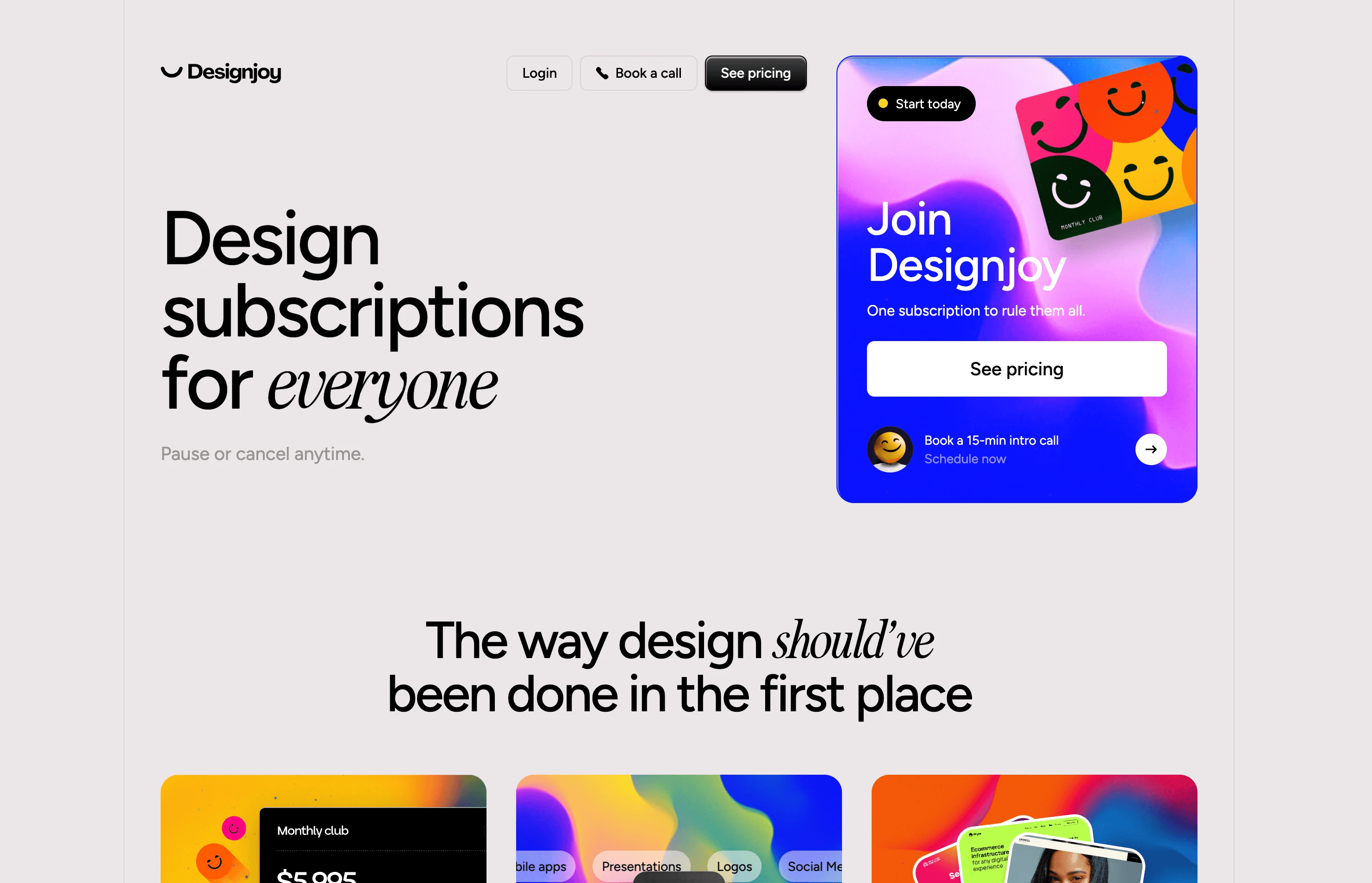
Designjoy is a one-person design subscription run by founder Brett Williams. At the time of verification, its Monthly Club was advertised at a limited-time $4,995 per month, with one active request, average 48-hour delivery, unlimited brands, Webflow development, and up to two users. Customers can add unlimited work to Trello, but requests are completed one by one.
That operating model has a clear advantage: you know who will do the work. There is no handoff between an account manager and a rotating design pool. If Brett's portfolio fits your taste and you are comfortable managing priorities asynchronously, Designjoy may be exactly what you need.
The same model creates reasons to compare alternatives:
You need a project manager or creative director to turn rough inputs into useful briefs.
You need several workstreams moving at once.
Your recurring work spans disciplines such as motion, video, copy, product design, or a development platform other than Webflow.
More than two stakeholders need direct access to the workflow.
You want a lower entry price, a team-based model, or a different commitment structure.
A larger provider is not automatically better. It can offer more coverage and capacity, but it may introduce more handoffs or less continuity with one designer. The right choice follows the constraint you are trying to remove.
A first-hand customer account provides a more useful view of Designjoy's throughput. Failory founder Nicolás Cerdeira hired Designjoy to redesign a website with more than 25 pages and said he was happy with the direction and finished work. He also explained how the advertised turnaround translated across the larger project:
“In my case, as it was a whole website (+25 pages) redesign, it took them one whole month.”
Nicolás Cerdeira, describing Failory's redesign in his Designjoy review
The project began in 2020, and the review contains affiliate links, so it should not be treated as a current independent benchmark. It does clarify an important distinction: Designjoy's average 48-hour delivery refers to individual requests, not completion of an entire multi-page project.
If your bottleneck is getting several pages or campaign assets moving at once, compare models with more active capacity. Penji publishes higher tiers with two or three active projects, Kimp runs several active requests depending on the plan, and Zyner sells capacity upgrades. Superside uses project budgets for larger programs. If you prefer one designer's continuity and can sequence work through a single queue, Designjoy may still be the better fit.
Flexible talent models are also becoming more common: Upwork's 2026 survey of 2,400 skilled United States workers found that 38% were freelancing, up from 28% in 2025. The study covers skilled work broadly rather than design subscriptions, but it shows that businesses now have a growing range of flexible staffing options to compare. (Upwork Research Institute)
How these Designjoy alternatives were selected
Each provider on this list differs meaningfully from Designjoy in at least one area:
Operating model: solo designer, shared team, dedicated team, or enterprise creative partner.
Management: self-managed queue, project manager, creative director, or strategic team.
Active capacity: one request, multiple workstreams, or flexible project budgets.
Scope: graphics, brand, product UI/UX, web development, video, motion, copy, and strategy.
Commercial terms: public price, custom quote, refund policy, pause options, and minimum commitment.
The list is organized by use case, not by a claim that one service is best for every buyer. Portfolio fit and output quality require your own evaluation.
The Best DesignJoy Alternatives in 2026
Most design subscriptions can handle a queue of common creative requests. The real differences appear in team structure, management support, active capacity, specialist scope, and commitment.
Zyner: Best for creative direction and project management
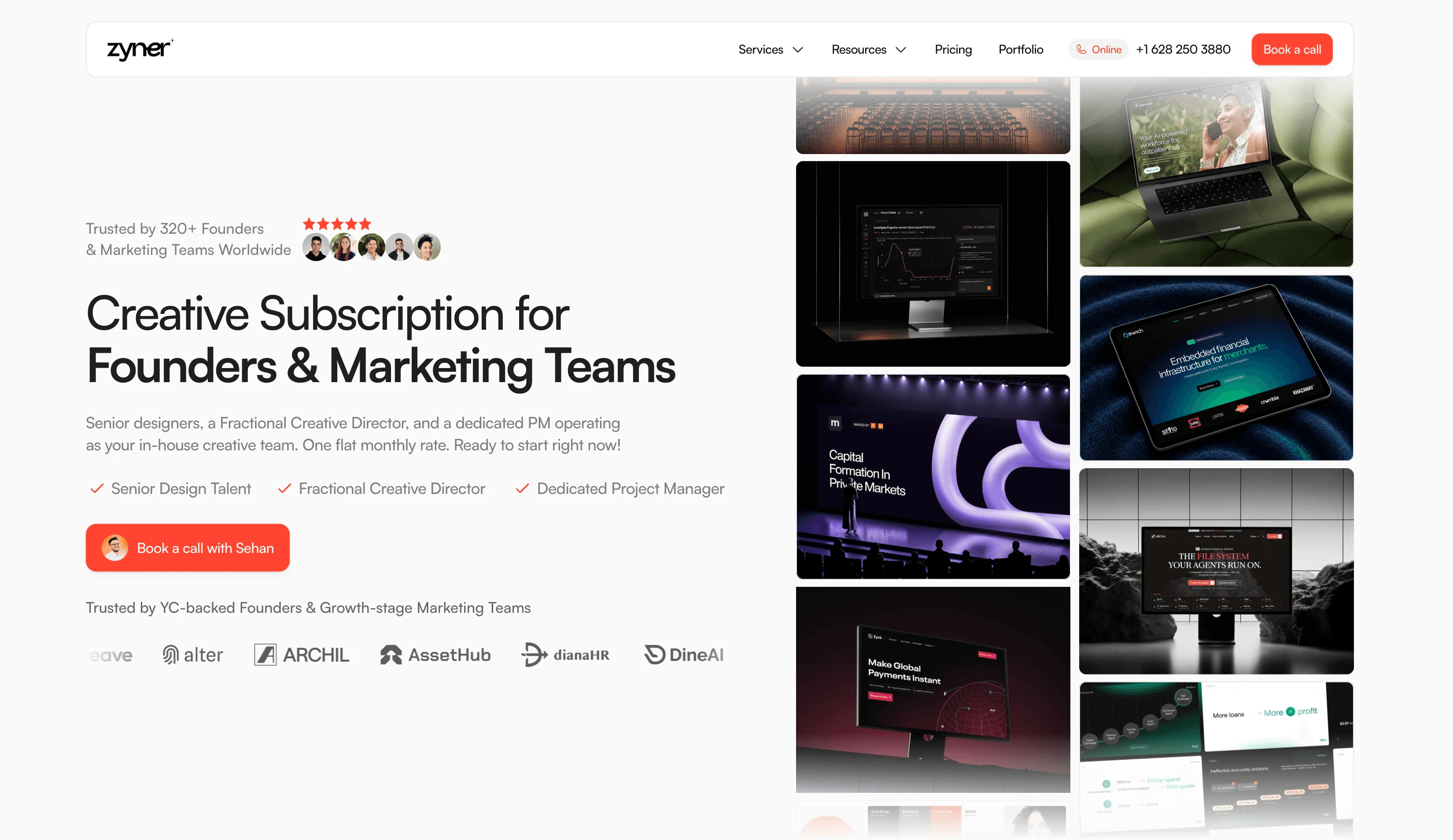
Zyner is built for founders and marketing teams that need more than design execution. The subscription combines senior designers with a fractional creative director and a dedicated project manager, so the team can help shape requests, manage priorities, and coordinate delivery.
Requests run through Slack, Loom, and meetings rather than a self-managed Trello board. The standard plan handles one active request at a time, with upgrades available for more capacity.
Services Offered:
Branding Services: Logo design, brand identity, visual systems, brand guidelines, and collateral.
Web Design and Development: Landing pages, multi-page websites, Framer development, and web animations.
Product Design: Web and mobile UI/UX, user flows, wireframes, design systems, and prototypes.
Presentation Design: Fundraising pitch decks, sales decks, business presentations, and slide redesign.
Motion and Video: Launch videos, product animation, social motion, promotional videos, and video editing.
Marketing Creative: Paid ads, social posts, carousels, email design, lead magnets, and campaign assets.
Print, Packaging, and Merchandise: Event collateral, packaging, labels, apparel, signage, brochures, and other print work.
Illustration and Digital Design: Custom illustrations, icons, ebooks, newsletters, and supporting digital assets.
Best for: Growth-stage founders and marketing teams that have plenty of requests but do not want to write every brief, route every task, or manage every revision themselves.
Watch out for: The base plan still has one active request. If your main problem is parallel production, price the required capacity rather than comparing base subscriptions. Zyner also publishes this article, so evaluate its portfolio and process with the same test you use for every provider.
ManyPixels: Best for lower-cost, multi-format production
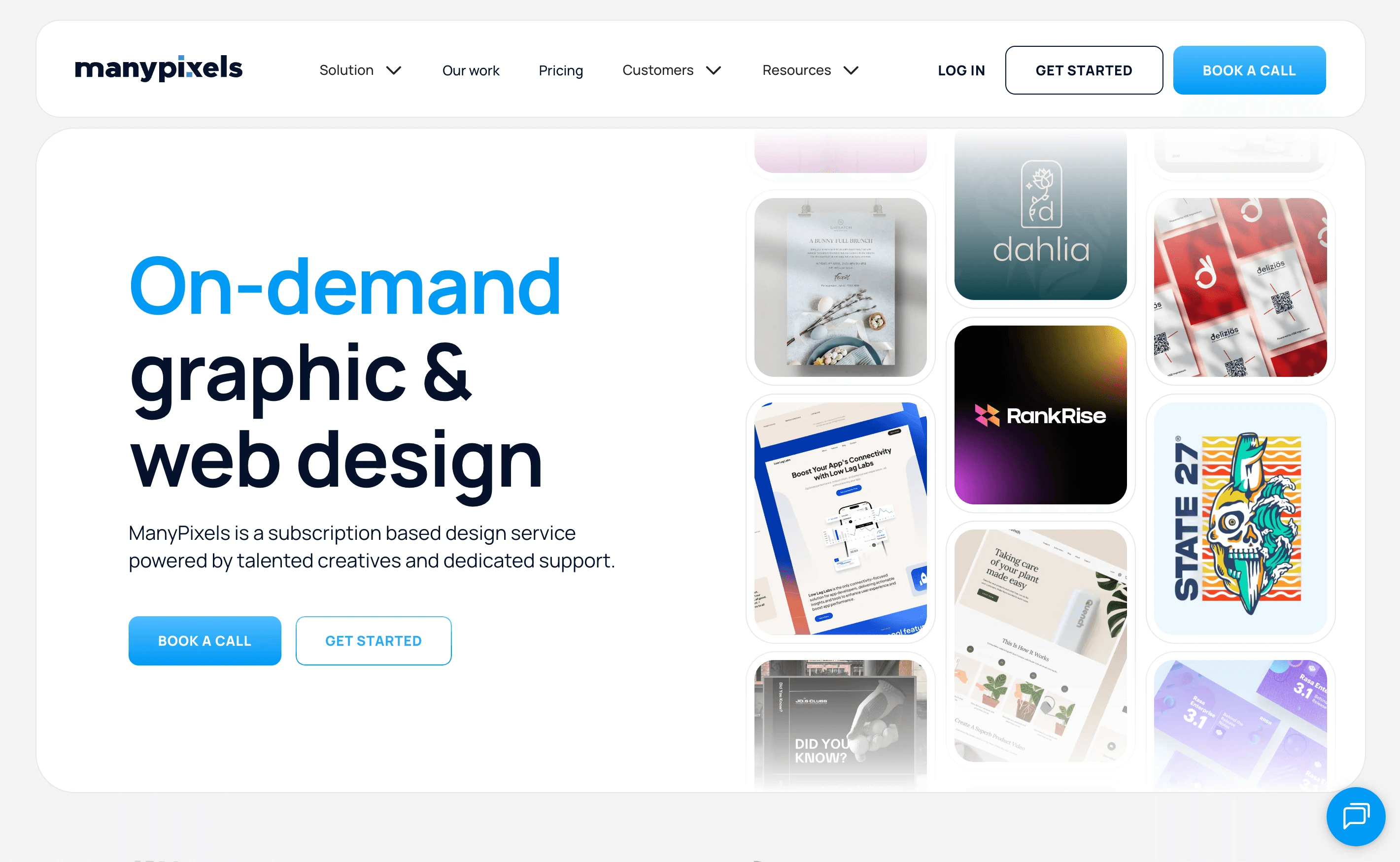
ManyPixels is a queue-based design subscription for teams with a steady flow of recurring creative requests. Its model combines a shared design team with project management and quality control.
Its Advanced plan includes one daily output, next-business-day first drafts, a project manager, quality control, and a platform for requests and feedback. The team works on one project at a time at this tier. Smaller revisions may share the daily output, while identities, long decks, and websites take several days. Higher plans increase output or provide an assigned designer and real-time collaboration.
ManyPixels advertised the Advanced plan at $699 per month when verified. That creates a much lower entry point than Designjoy, but it does not remove the sequential-capacity constraint.
Services Offered:
Graphic Design: Social graphics, ads, brochures, posters, reports, email graphics, ebooks, and everyday marketing assets.
Brand and Presentation Design: Logos, brand guides, business presentations, stationery, and related collateral.
Web Design: Websites, landing pages, and supporting web graphics.
Illustration: Custom illustrations, icons, infographics, and other drawn assets.
Motion and Video: Motion graphics, GIFs, and video editing within the published service scope.
Best for: Marketing teams with recurring, multi-format production needs that can move through a prioritized queue.
Watch out for: The entry plan works on one project at a time. Review portfolios for the exact work you need, especially if brand identity, product UI, or web design matters more than routine marketing production.
Penji: Best for transparent tiers and parallel marketing work
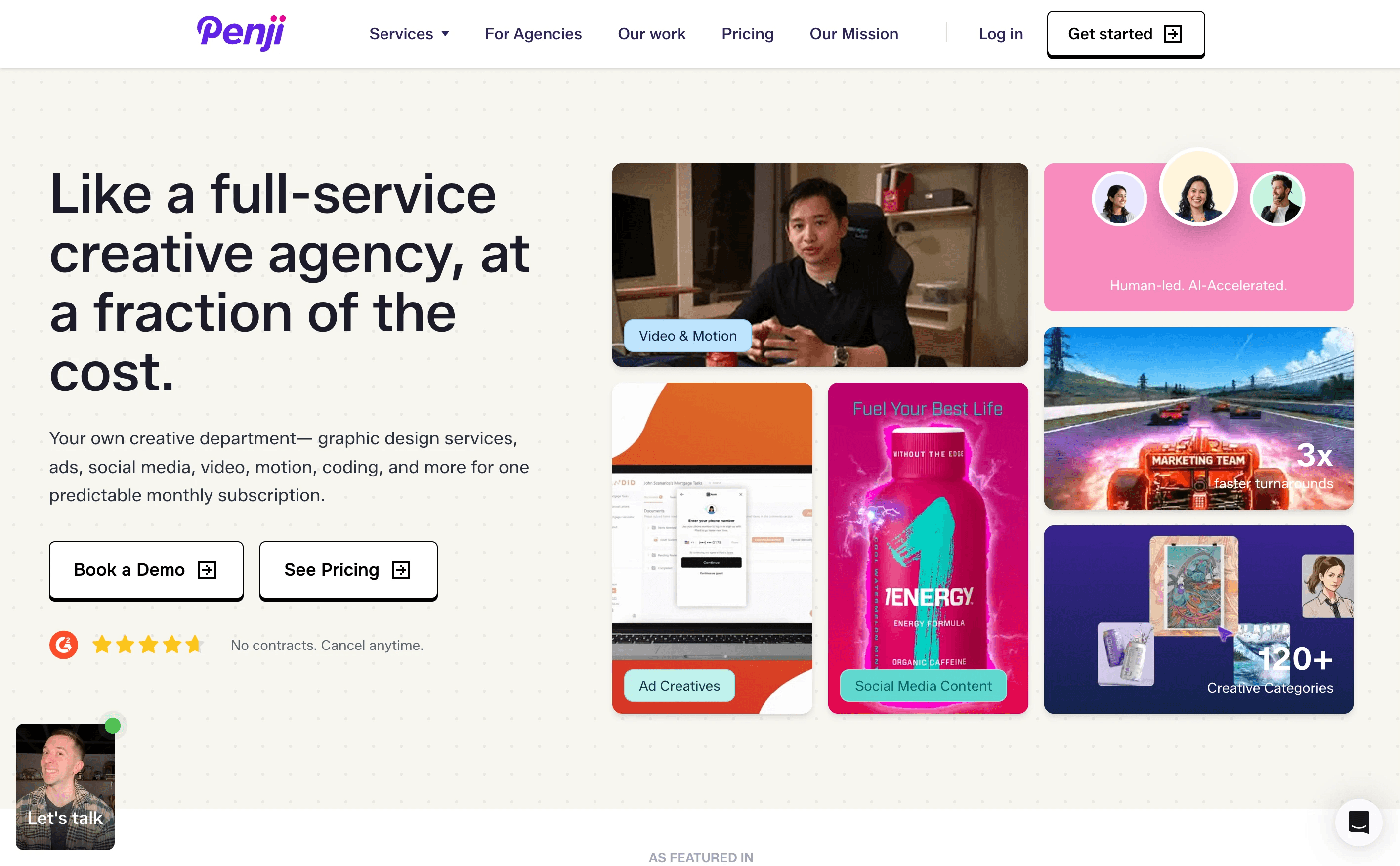
Penji is one of the clearer options for teams that want pricing, scope, and active capacity tied together. It moves from a self-managed single-project plan to managed and agency tiers with more parallel work.
Penji advertised three monthly plans when verified:
Business at $499: one active project, self-managed workflow, and everyday brand and marketing design.
Marketing & Ads at $995: two active projects, managed workflow, presentations, infographics, and web and landing-page design.
Agency at $1,995: three active workstreams, a dedicated team, motion, animation, short-form video, and a white-label portal.
Penji says most projects on its first two plans return in one business day, while complex work takes longer. It also advertises a 30-day refund policy and month-to-month cancellation.
Services Offered:
Branding and Logos: Logo design, brand assets, and everyday brand-support materials.
Marketing and Advertising: Ad creative, social assets, email design, and routine campaign production.
Print and Packaging: Product packaging, print collateral, and supporting promotional materials.
Presentations and Infographics: Slide decks, documents, illustrations, and infographics on eligible plans.
Web Design: Websites and landing-page design on the Marketing & Ads and Agency plans.
Motion and Video: Motion graphics, animation, and short-form video editing on the Agency plan.
Best for: Marketing teams and agencies that want to add parallel capacity without moving straight to an enterprise contract.
Watch out for: Penji does not guarantee the same designer on its lower self-managed offering. Its cheapest plan also excludes several categories available on higher tiers. Compare the plan that covers your real queue, not the headline $499 price.
Kimp: Best for combined graphics and video demand
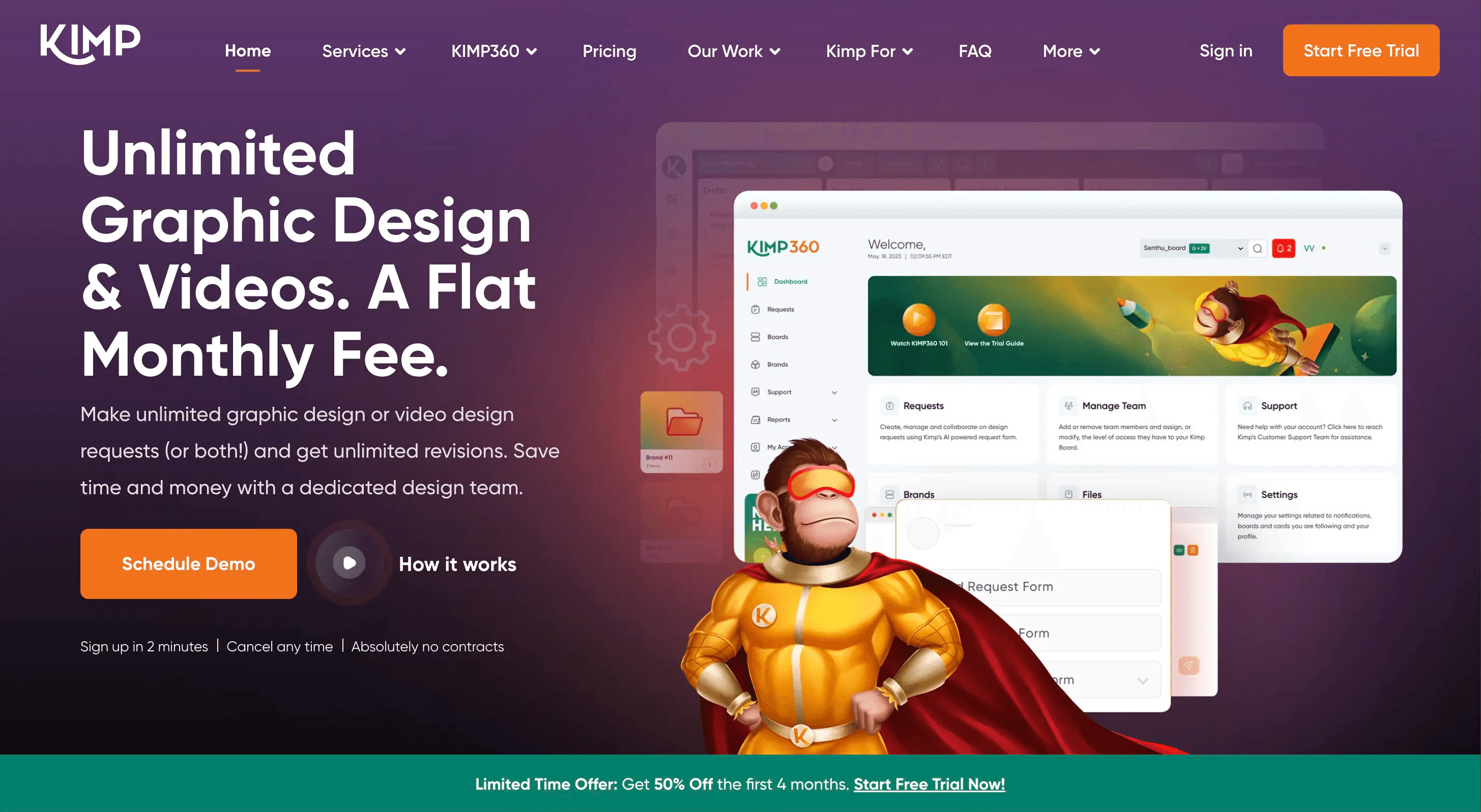
Kimp is designed for teams whose content queue includes both static design and motion. It separates its offer into Graphics, Video, and a combined Graphics + Video subscription.
Plans list a dedicated team and project manager, unlimited queued requests and revisions, unlimited brands and collaborators, source files, and the KIMP360 request platform.
Kimp's numeric prices were not exposed in the accessible page text during verification, so confirm the current rate directly. The same page also gave conflicting descriptions of active capacity.
Services Offered:
Marketing Design: Social posts, digital ads, email assets, ecommerce graphics, blog graphics, and campaign collateral.
Branding and Illustration: Logos, icons, custom illustrations, characters, mascots, and brand-support assets.
Web and UI Design: Landing pages, website designs, app screens, and UI layouts. Development is not included.
Presentation Design: Slide decks, reports, infographics, and presentation templates.
Print and Packaging: Brochures, signage, packaging, labels, merchandise, and large-format design.
Motion and Video: Video editing, animated ads, logo animation, GIFs, product videos, and motion graphics through the relevant plan.
Canva Design: Custom Canva graphics and editable Canva-based creative.
Best for: Content and marketing teams with recurring static design, video editing, animation, and motion requests.
Watch out for: The plan cards listed three active Graphics requests, five for Graphics + Video, and two for Video. The FAQ instead described two tasks in progress for Graphics or Video and two graphic plus two video requests for the combined plan. Ask Kimp to confirm the current price, daily production time, and active-request count in writing.
Awesomic: Best for product teams needing several disciplines
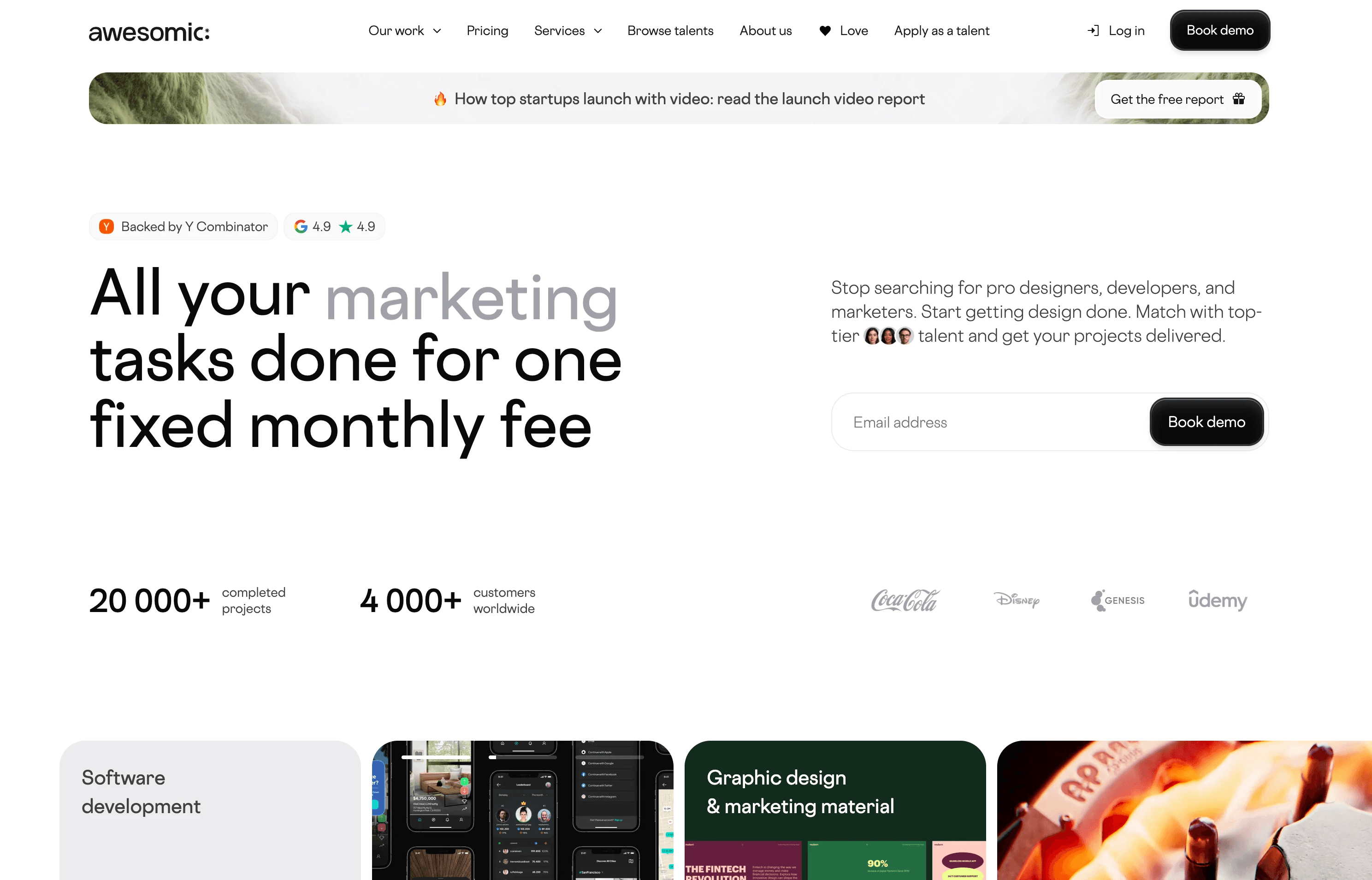
Awesomic uses a talent-subscription model for startups that need several creative disciplines. The service matches clients with part-time talent rather than routing every request through one solo designer.
Slack collaboration is part of the workflow. This gives product and marketing teams a broader talent mix than Designjoy's single-designer model, but buyers still need to understand how much talent time and active work each plan includes.
The Graphic Pack was displayed at about $1,499 per month, although another section on the same page showed $1,490. All-in-one was listed at $2,995 per month, with a lower effective rate for quarterly billing.
Services Offered:
Graphic Design: Banners, ads, email graphics, print collateral, packaging, and everyday marketing assets.
Product Design: Web-app and mobile-app UI/UX, product screens, and related interface work.
Web Design: Landing pages, marketing websites, and supporting web visuals.
Webflow Development: Webflow implementation through the All-in-one plan.
Copywriting: Website and marketing copy support through the All-in-one plan.
Best for: Startups that want graphic design, product UI/UX, copy, and Webflow without sourcing each discipline separately.
Watch out for: The published monthly Graphic Pack prices were slightly inconsistent. Quarterly savings require a three-month commitment, and the public page does not make plan capacity as easy to compare as a simple active-request count.
Design Pickle: Best for a managed creative system
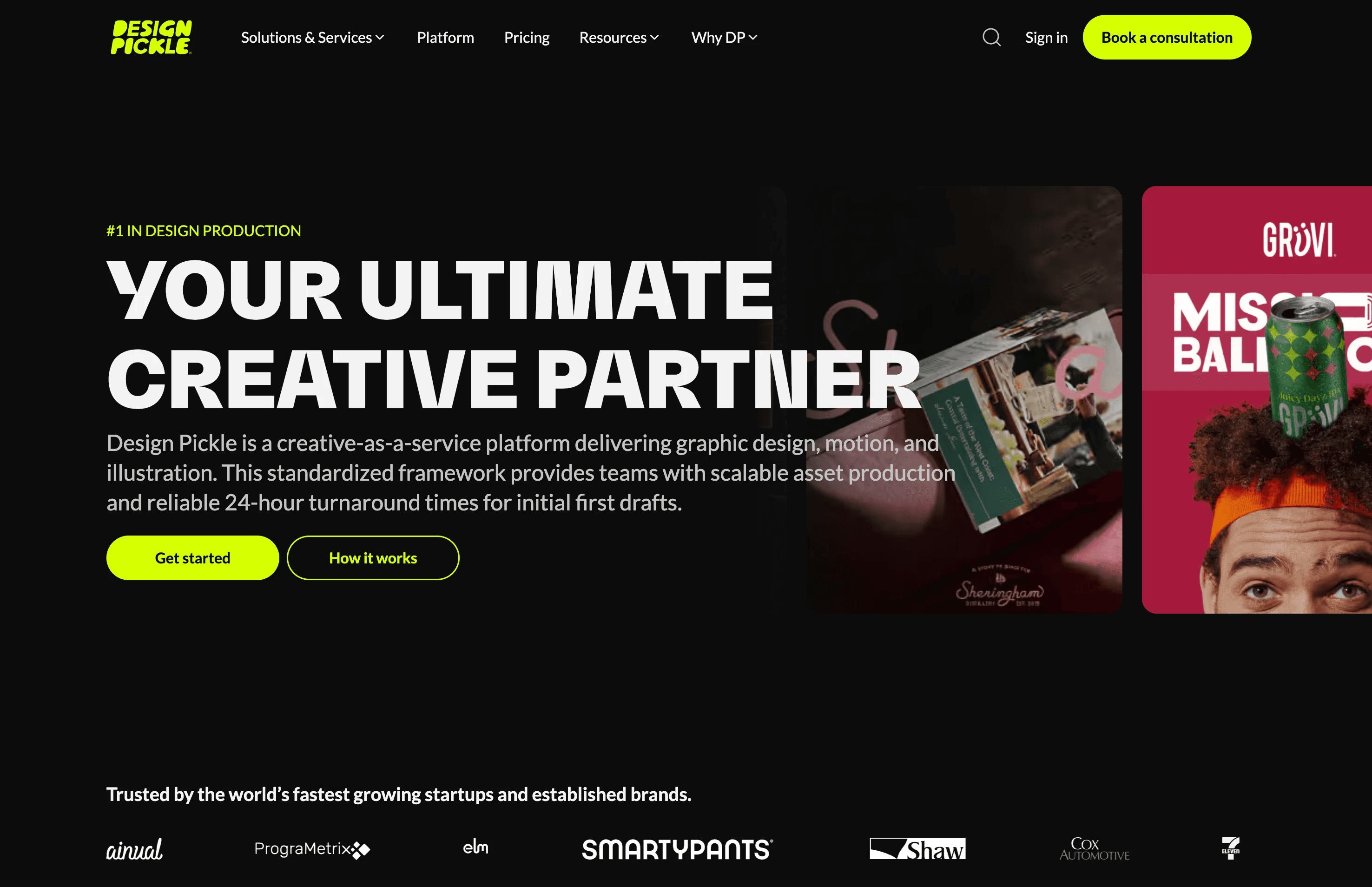
Design Pickle is positioned around the system surrounding creative production. The offer includes a brand-trained team, human review, request routing, an approval and asset platform, Slack and other integrations, and AI-assisted briefs and production.
That structure suits organizations with several requesters, approval paths, or brand-governance requirements. The company says most requests return within one to two business days, depending on scope.
Design Pickle no longer shows a standard public price on the page. Plans are sized through a consultation and use quarterly or annual billing. You can cancel before renewal, but service continues through the current paid term.
Services Offered:
Brand and Identity: Logos, guidelines, stationery, and supporting visual-identity assets.
Marketing and Advertising: Ad creative, social graphics, email assets, campaign production, and light digital design.
Digital and Light Web Design: Website graphics, landing-page design, blog assets, ecommerce graphics, and other non-development web work.
Presentations and Reports: PowerPoint, Google Slides, Canva presentations, ebooks, white papers, case studies, and internal documents.
Motion and Video: Motion graphics, animated ads, GIFs, explainers, video editing, titling, and captioning.
Illustration and Artwork: Characters, icons, patterns, custom illustrations, and supporting artwork.
Print, Packaging, and Merchandise: Books, brochures, banners, packaging, labels, apparel, event graphics, and large-format collateral.
Design Pickle's team model reduces Designjoy's single-person availability risk, but routing work across several designers can create a different bottleneck. One mid-market G2 reviewer said, “The resulting designs can sometimes look very different and lack cohesiveness.” The reviewer was describing campaign requests assigned to different designers. G2 labels the review as validated, incentivized, and collected through a seller invite, so treat it as one customer's experience rather than a typical result. (G2 review)
If cross-project consistency is the problem you are trying to solve, Designjoy's single-designer model preserves the clearest continuity. Among team services, compare Zyner's creative-direction layer, ManyPixels' assigned-designer plans, or Superside's Dedicated model, then ask each finalist how it keeps one campaign visually consistent across specialists.
Best for: Larger marketing organizations that care about onboarding, governance, integrations, and asset management as much as individual deliverables.
Watch out for: You cannot compare budget or capacity from the public page alone. Design Pickle's published scope also excludes mobile-app design, advanced web design, UI/UX, and coding or development. Ask for the price, included services, expected monthly throughput, assigned roles, service levels, and renewal terms in one written proposal.
Superside: Best for enterprise creative operations
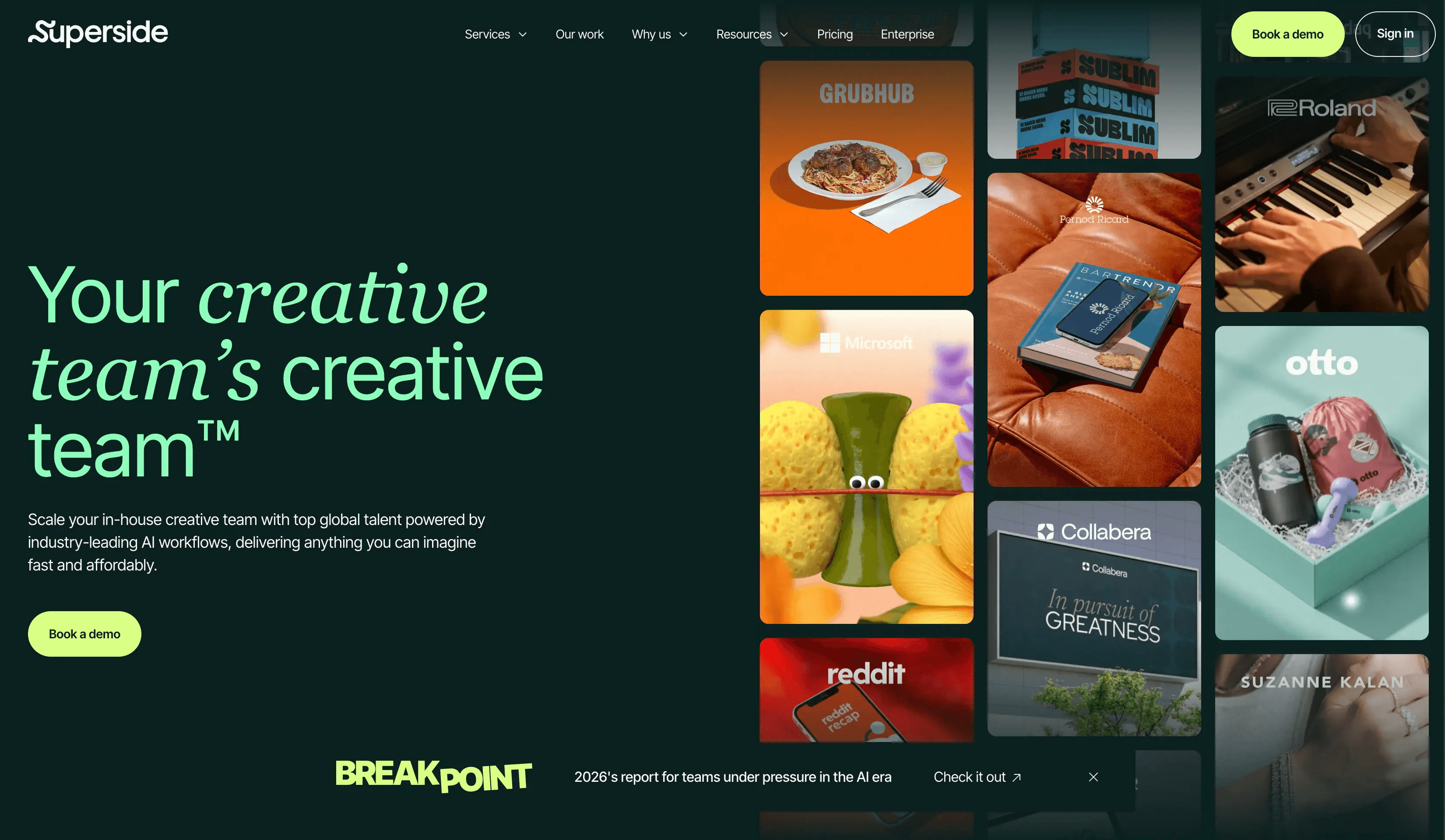
Superside operates more like an external creative department than a lightweight unlimited-design queue. Its Flex model assembles a senior team around changing project needs and allows unused budget to roll over for up to three months. Dedicated plans provide a consistent team for predictable workloads.
Its breadth is designed for organizations managing several formats, markets, or stakeholder groups under one commercial relationship.
Superside states that subscriptions start at a $15,000 monthly minimum on an annual term. Dedicated teams begin at a higher monthly commitment.
Services Offered:
Performance Marketing Creative: Paid-media concepts, ad variants, social creative, and ongoing campaign production.
Brand and Campaign Strategy: Brand services, concept development, campaign strategy, and creative direction.
Web and Product Design: Websites, landing pages, design systems, product design, and UI/UX.
Presentation and Sales Collateral: Presentations, reports, ebooks, ABM materials, and sales-enablement creative.
Video, Motion, and 3D: Video production, editing, motion design, animation, 3D, audio, and specialist production.
Copy and Localization: Copywriting, multi-market adaptation, and localization support.
AI Creative Services: AI-powered production, consulting, automation, custom brand models, and team upskilling.
Enterprise scale does not automatically remove the work of writing a strong brief. One small-business G2 reviewer said, “We often feel like we need to be much closer and detailed on what we need in order to feel things are successful.” G2 labels the review as validated, incentivized, and collected through a seller invite, so treat it as one customer's experience. (G2 review)
If your bottleneck is turning rough requests into clear creative direction, compare Superside's scoping process with Zyner's fractional creative director and dedicated project manager or Design Pickle's managed request-routing system. If your team already has strong internal creative leadership and mainly needs specialist depth and enterprise capacity, Superside's broader model may still be the better fit.
Best for: Enterprise marketing and creative teams with multi-market campaigns, specialist needs, strategy work, and sustained annual demand.
Watch out for: This is not a lower-cost like-for-like replacement. The annual minimum is a major step up from Designjoy and most other providers on this list. Model expected utilization before committing.
Flocksy: Best for a consistent multidisciplinary team
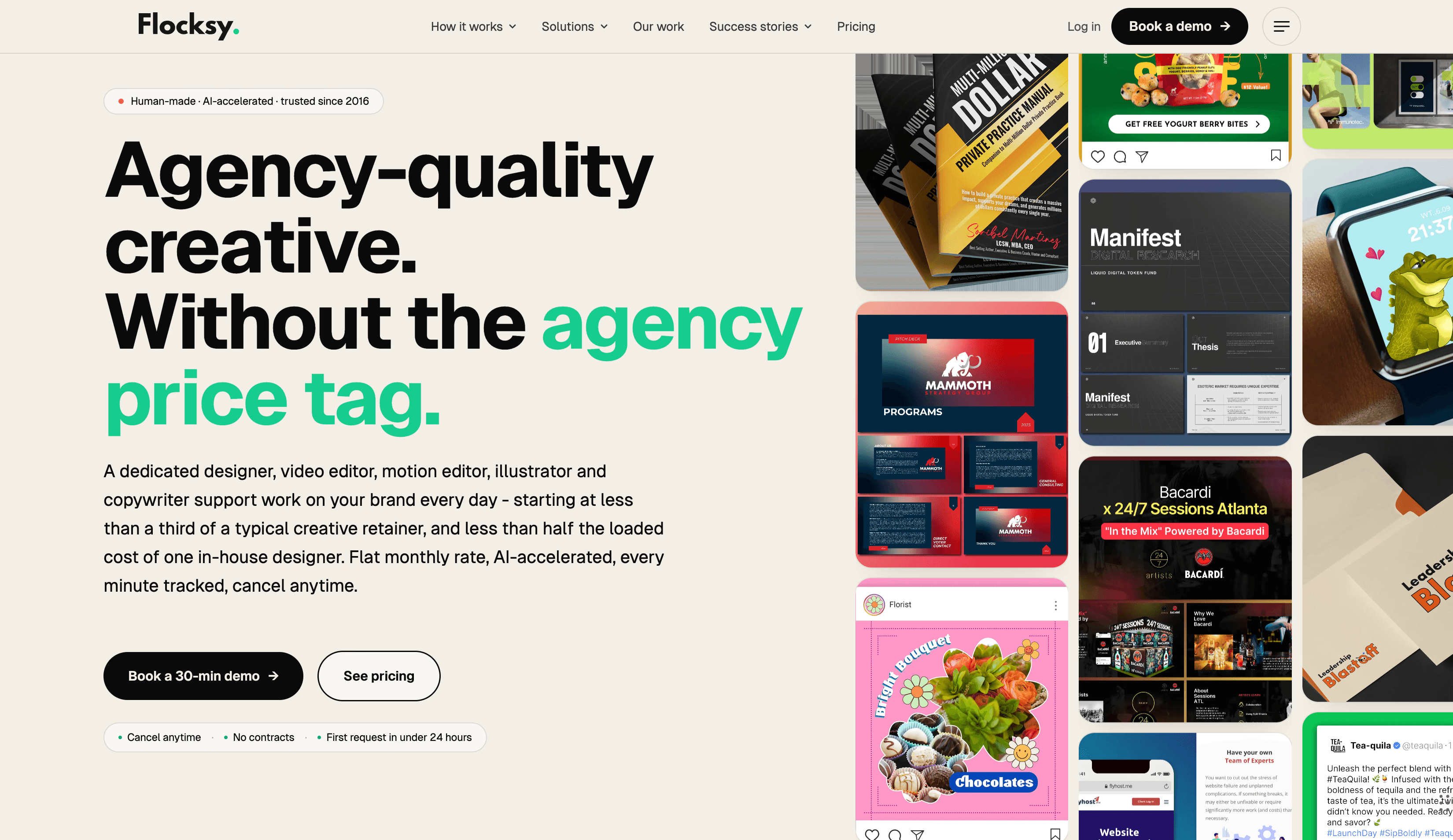
Flocksy combines subscription pricing with a consistent multidisciplinary team. Every plan includes the same dedicated designer, video editor, motion editor, illustrator, and copywriter support, rather than routing each brief to an unrelated available creative.
Capacity is sold in daily creative hours instead of a fixed number of active requests. Flocksy says its team can move several projects during the same workday, but actual throughput depends on the plan's hours, project complexity, and team availability. Unused hours roll over for up to 30 days while the subscription remains active.
When verified, Flocksy's published annual-billing prices included:
2 Daily Hours at $1,199 per month: about 42 creative hours per month and the dedicated creative team. The same plan was $1,699 month-to-month.
4 Daily Hours at $2,199 per month: about 84 hours per month and a dedicated production coordinator.
6 Daily Hours at $2,999 per month: about 126 hours per month, a production coordinator, and an art director.
The displayed prices above require annual billing. Flocksy also publishes quarterly and month-to-month options, allows cancellation, and offers a 14-day money-back guarantee.
Services Offered:
Marketing and Advertising Design: Digital ads, email graphics, campaign assets, lead-generation creative, and recurring marketing production.
Branding and Identity: Logos, visual identities, brand guidelines, and supporting brand assets.
Video and Motion: Video editing, short-form content, motion graphics, animated assets, and other video production.
Web and Digital Design: Landing pages, website layouts, web graphics, Figma design, and Canva production.
Presentation and Long-form Design: Presentations, ebooks, infographics, reports, and supporting information design.
Social Media Content: Social graphics, written social content, platform variations, and recurring content assets.
Illustration, Print, and Merchandise: Custom illustrations, print collateral, apparel, merchandise, and related artwork.
Copywriting Support: Marketing copy and other written creative requests through the plan's copywriter support.
Best for: Marketing teams that want the same multidisciplinary creatives learning their brand while design, video, motion, illustration, and copy projects move within a predictable daily-hour allowance.
Watch out for: The $1,199 headline price requires annual billing, and the entry plans do not include a production coordinator or art director. Multiple projects can move in one day, but output is still limited by purchased hours, project complexity, and team availability.
All 8 Designjoy alternatives compared
“Starting price” means the provider's advertised entry point at the time of verification. Promotional rates, taxes, add-ons, and longer commitments can change the effective cost.
Provider | Starting price | Active capacity | Management model | Best for |
|---|---|---|---|---|
$3,495/month promotional rate | 1 active request, upgradable | Fractional creative director + dedicated PM | Startups wanting creative direction and delivery management | |
$699/month | 1 daily output on Advanced | Project manager + quality control | Lower-cost, multi-format design production | |
$499/month | 1 to 3, depending on plan | Self-managed to dedicated team | Transparent tiers and parallel marketing production | |
Check live price | Published figures conflict; confirm | Dedicated team + project manager | Recurring graphics plus video or motion | |
About $1,499/month | Talent-time model; confirm plan capacity | Talent matching + Slack collaboration | Product teams needing several creative disciplines | |
Custom quote | Sized during consultation | Brand-trained team + workflow platform | Larger teams wanting a managed creative system | |
$15,000/month minimum on annual term | Budget and project based | Senior team + strategy + project management | Enterprise and multi-market creative operations | |
$1,199/month billed annually; $1,699 month-to-month | Daily-hour model; parallel work within available time | Dedicated multidisciplinary team; coordinator from 4 hours/day | Consistent cross-format creative production |
How to choose the right alternative
Start with the bottleneck, not the provider list.
If your team spends too much time managing design
Prioritize a dedicated project manager, creative director, or both. Zyner, Design Pickle, Superside, and Duck.design publish clear management layers. Ask who turns an incomplete request into a usable brief, who protects brand consistency, and who resolves conflicting stakeholder feedback.
If projects wait behind one another
Compare active work, daily production time, and upgrade costs. Penji publishes plan-level concurrency. Other providers use outputs, assigned talent time, or flexible budgets instead. Translate every model into the same practical question: “How many of our typical requests can move meaningfully in one week?”
If your workload crosses specialist disciplines
Map the next 90 days of expected requests. A team that mainly needs ads and social graphics should not pay for enterprise strategy. A product launch that needs brand, a landing page, product UI, a pitch deck, and motion may justify a broader team such as Zyner, Awesomic, Superside, Kimp, or Duck.design.
If budget is the main constraint
Compare the plan that contains your required scope. Penji's $499 plan and ManyPixels' $699 plan are lower public entry points, but capacity and category exclusions still matter. A $499 plan that cannot handle your landing pages or motion work is not cheaper if you need another vendor beside it.
If continuity with one designer matters most
Designjoy's solo model remains unusually clear. Some team services offer an assigned designer, while others route each request to an available specialist. Ask whether you can choose, retain, or replace a designer and what happens during leave or capacity spikes.
Test two finalists with the same brief
A portfolio proves that a provider can produce good work. It does not show how well the team will interpret your brand, respond to feedback, or fit your workflow.
Use one paid test that resembles your recurring work. A useful brief might be a campaign landing-page concept plus three paid-social variants, using an existing brand system and a real deadline. Give each finalist the same inputs, then score:
interpretation of the business goal
questions asked before work begins
first-draft usefulness, not just visual polish
adherence to the brand system
revision accuracy
communication and status visibility
source-file quality and handoff
useful output per week
management time required from your team
Do not choose from turnaround alone. A fast first draft followed by three avoidable revision cycles can be slower than a thoughtful draft delivered a day later.
Frequently asked questions
What is the closest alternative to Designjoy?
There is no exact substitute for Designjoy's combination of direct founder access, one-person delivery, Trello workflow, broad design scope, and Webflow development. ManyPixels and Penji are closer on the queue-based subscription model. Zyner is closer for broad startup creative scope but adds creative direction and project management. Choose based on which part of Designjoy you want to preserve.
What is a cheaper Designjoy alternative?
Based on public monthly prices checked on July 21, 2026, Penji starts at $499 and ManyPixels at $699, compared with Designjoy's advertised promotional $4,995 rate. Those entry plans differ in scope, capacity, designer continuity, and management. Compare the plan that covers your actual request mix.
Does unlimited design mean unlimited output?
No. It usually means you can add unlimited requests and revisions to a queue. Output remains limited by active-request rules, designer hours, request complexity, feedback speed, and the number of revisions. Ask every provider for a realistic example based on your own workload.
Is a design subscription better than a freelancer?
A subscription can work well when you have a predictable, recurring queue and value fixed pricing and an established workflow. A freelancer may be a better choice for occasional projects, a narrow specialist need, or close collaboration with one person. A scoped agency may be more suitable for high-stakes strategy or a one-time transformation.
Should I choose the cheapest design subscription?
Only if its scope, capacity, and workflow fit your work. Track the total cost of useful output, including your team's time spent briefing, coordinating, reviewing, and correcting work. The lowest subscription price can become expensive when it creates more management or requires extra vendors.


