

A design team structure is the arrangement of four jobs: direction, production, coordination, and system ownership. Every company that produces design work covers those four somehow. Most guides on this topic show you an org chart instead.
The org chart advice fails at your size. You have one designer, a freelancer you like, and an agency you inherited. Nobody needs to tell you whether to centralise them.
The useful question is different. Which of the four jobs is actually covered at your company, and who is holding the ones that are not? At most growth-stage startups, production is staffed and the other three land on the marketing lead.
TL;DR
A design team structure covers four jobs: direction (what good looks like), production (making the work), coordination (what gets made next), and system ownership (keeping work reusable). Most startups staff production only.
The centralised, embedded, and hybrid models split almost evenly in practice. Nielsen Norman Group's survey of 557 professionals across 356 organisations found 29% centralised, 32% decentralised, and 31% hybrid, so no model has won.
Those models start to matter at roughly five designers. Below that, they describe an allocation problem you do not have yet.
An in-house designer costs more than the salary. US graphic designers had a median wage of $61,300 in May 2024, and benefits add about 30% on top, before you count recruiting time and the coordination hours that land on you.
Pick your structure by which of the four jobs you can keep covered when you get busy. A structure that only works in a quiet month is not a structure.
What a design team structure actually is
Strip away the titles and four jobs remain. Someone decides what good looks like. Someone makes the work. Someone decides what gets made next. Someone keeps the output reusable so the next project starts further along.
Titles move between companies. The jobs do not. A creative director and a senior designer with taste can both hold direction. A project manager, an ops lead, or a marketing coordinator can all hold coordination.
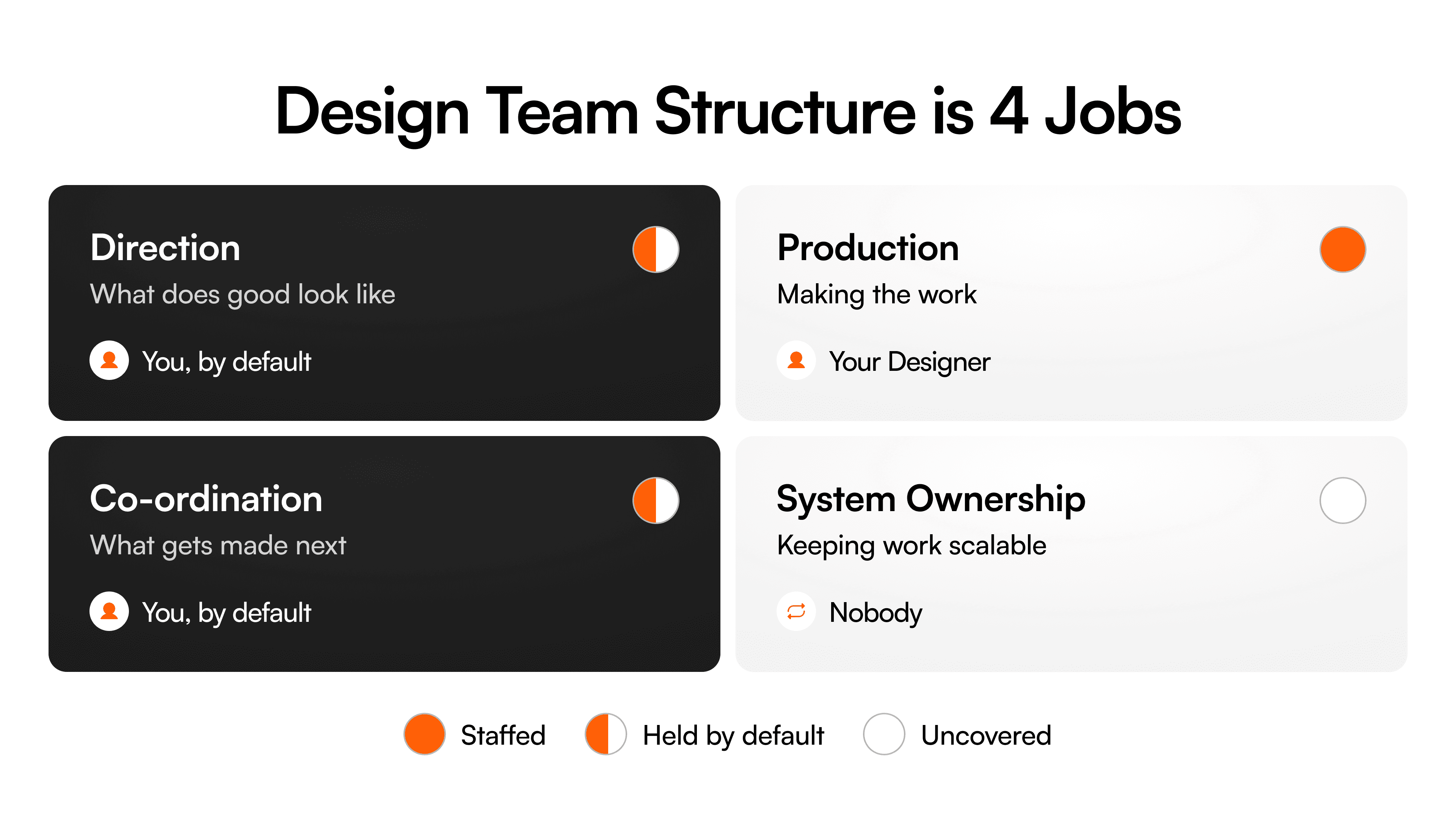
Job | What it means | Fails like this when uncovered |
|---|---|---|
Direction | Deciding what good looks like and holding that standard across every asset | Work varies by whoever made it. Approval becomes a debate about taste. |
Production | Designing the actual asset, at the required quality, on a date | Requests queue. Deadlines slip. You buy freelance capacity in a panic. |
Coordination | Intake, priority order, scheduling, chasing, delivery | Requests arrive by DM. The loudest stakeholder wins. You become the router. |
System ownership | Templates, brand files, the design system, the single source of truth | Every project starts from scratch. Vendors work from different logo files. |
Write your four names down before anything else. Take a sheet and put a name against each job. The gaps show up in about ten minutes.
Most marketing leads discover their own name in three of the four boxes. That is the real structure, and it explains the calendar.
Your design team includes people who are not employees
Draw the boundary wider than the org chart. Your design capability includes the in-house designer, the freelancer doing motion, the agency running campaign creative, and the Framer contractor who owns the site. It probably includes an engineer shipping UI without a designer in the room.
Every one of those people produces work customers read as your brand. Every one sits inside your structure whether you planned it or not. Friction concentrates at the seams between them.
That matters because vendors are the usual failure point for system ownership. An outside team works from their own files, their own version of the brand, and their own idea of finished. Nobody assigned them the job of keeping things consistent.
Why the standard models do not fit you yet
Search this topic and you get three or four models. Centralised means designers sit together under one design lead. Embedded means designers report into the teams they serve. Hybrid mixes both.
The models are real. They are also close to evenly split in practice. Nielsen Norman Group surveyed 557 UX and design professionals across 356 organisations in 59 countries and found 29% centralised, 32% decentralised, and 31% hybrid. (NN/g, 2020, n=557)
No model has won, which tells you the choice is not the important one. The same survey found hybrid structures at statistically larger companies, so the model tracks headcount more than strategy.
These frameworks solve an allocation problem. They answer where your twelve designers should sit. With one designer and two vendors, allocation is not your constraint.
Use headcount as the trigger. Below roughly five designers, work on coverage of the four jobs. At five and above, the centralised versus embedded question starts to earn its keep.
The one statistic everyone quotes, quoted correctly
You will see this line on almost every article about design teams: companies that invest in design see 32% higher revenue. The underlying study says something narrower.
McKinsey tracked 300 publicly listed companies over five years in medical technology, consumer goods, and retail banking. Top-quartile scorers on its design index showed revenue growth 32 percentage points higher than industry counterparts, and total returns to shareholders 56 percentage points higher. (McKinsey, 2018, n=300)
Percentage points of growth differential over five years is a different claim from a 32% revenue lift. The industries studied also look nothing like a B2B software startup. Treat the study as directional support for taking design seriously, not as a forecast for your company.
Map your current structure in 30 minutes
Do this before you change anything. It costs half an hour and it usually settles an argument you have been having for months.
Step 1. List every person who touched design in the last 90 days.
Include employees, freelancers, agencies, and the engineer who built that pricing page. Write the list without judging it.
Step 2. Assign the four jobs.
Put one name against direction, production, coordination, and system ownership. Write "nobody" where nobody holds it, because "nobody" is the most useful answer on the page.
Step 3. Count the routes in.
Add up the places a design request can arrive: Slack DMs, email, a form, a standup, your calendar. Three or more routes means intake is the problem before capacity is.
Step 4. Time one repeating project.
Take your last five landing pages or decks. Note the request date and the delivery date, then estimate how many of the working days in between were spent waiting on a person rather than on design.
A large waiting fraction points at coordination and direction. A small waiting fraction with slipped dates points at production capacity. Those two problems have different solutions, and buying the wrong one is expensive.
The four structures that actually exist at your stage
Forget the textbook models for a moment. Growth-stage companies run one of four arrangements, and each one covers a different set of the four jobs.
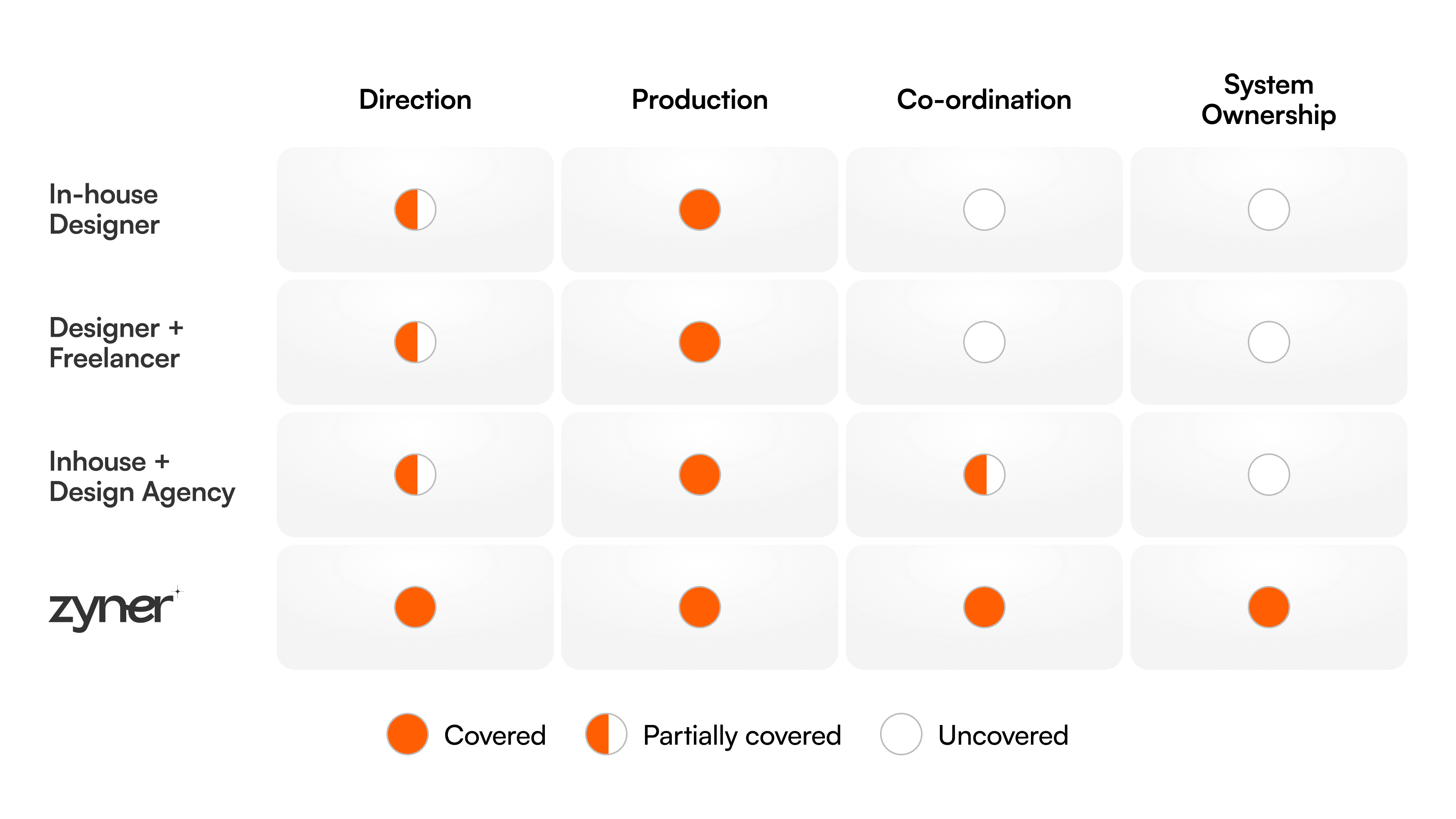
Structure | Covers well | Leaves uncovered | Breaks when |
|---|---|---|---|
Solo in-house designer | Production, some direction | Coordination, system ownership | Demand exceeds one person, or that person takes leave |
In-house designer plus freelance bench | Production, surge capacity | Direction across vendors, system ownership | Freelancers rotate and context resets each time |
In-house team plus agency | Production, specialist depth | Coordination between the two, consistency | Agency work and in-house work stop looking related |
Outsourced design team | All four, if the partner is structured for it | Deep internal product context | The partner sells hours rather than a team |
The solo designer is the most common and the most fragile.
One person holds production and inherits direction by default. Coordination and system ownership fall to you. The structure works until two campaigns overlap.
The freelance bench solves capacity and creates a consistency problem.
You buy hours quickly, which is the point. Each new freelancer needs the same briefing about product, audience, and brand. Context leaves when they do.
The agency arrangement buys depth and adds a seam.
Agencies bring specialists your team does not have, such as motion, packaging, or a full brand system. Somebody now has to keep agency output and in-house output looking like one company. That somebody is usually you.
What each option really costs
Marketing leaders compare a salary against a monthly invoice. That comparison misses most of the cost on both sides.
Start with the fully loaded salary.
US graphic designers had a median annual wage of $61,300 as of May 2024 (BLS), and art directors $111,040 (BLS). Benefits then add roughly a third. The Bureau of Labor Statistics puts private-industry benefits at 30.1% of total employer compensation as of March 2026. (BLS ECEC, March 2026)
Then price the hiring itself.
Ashby analysed 32,000 hires across more than 1,200 venture-backed startups. Companies under 25 employees averaged 62 days to hire without a recruiter, against 42 days with one. (Ashby, 2026) Two months of open headcount is two months of campaigns you still have to ship.
Then price the coordination.
Every vendor relationship adds briefing time, review time, and chasing time. That time lands on the person who owns the outcome. It rarely appears in any budget line.
Then check the budget context you are working inside.
Gartner surveyed 402 CMOs and marketing leaders in early 2025 and found marketing budgets flat at 7.7% of company revenue. In the same survey, 39% planned to cut agency budgets and 39% planned to reduce labour spend. (Gartner, 2025, n=402)
Most leaders in your position are being asked to produce more creative with the same money. That constraint shapes the structure decision more than any framework does.
Sequence your hires, or decide not to hire
The order of the first three additions matters more than the total number.
First addition: a generalist who can hold direction.
Hire someone who designs well and has opinions about what good looks like. First Round's guide to the founding designer role makes the same call, describing the trait as comfort with ambiguity and range across brand, product, and marketing. (First Round Review) A specialist as your first hire covers one channel and leaves the rest exposed.
Second addition: complement, do not clone.
Your instinct will be to hire someone like the first person, because that person is good. Look instead at the work you keep sending out of house. That backlog names the gap.
Third addition: coordination, not more production.
By the time three or more people make design work, someone has to own intake, priority, and delivery. Cella's 2025 industry report, its fifteenth annual benchmark of in-house marketing and creative teams, found 61% of teams using flexible staffing to scale output and 55% moving toward an in-house agency model. (Cella, 2025) Mixed staffing needs a producer more than a pure in-house team does.
A note on ratios.
People ask for a designer-to-developer number. NN/g found half of respondents had at least one designer per ten developers, with a typical extended pattern of one researcher to five designers to fifty developers. (NN/g, 2020, n=377) Those ratios describe product design teams. For marketing design, request volume and channel count predict need far better than engineering headcount.
Where marketing design should report
This question causes more internal friction than the structure itself. Reporting lines in the wild are genuinely mixed. NN/g found 27% of design teams reporting into product management and 23% reporting directly to the C-suite, with the remainder split, fluctuating, or undefined. (NN/g, 2020, n=557)
At your size, a simpler rule works. Marketing design reports to marketing, because the work is judged on marketing outcomes. Product design reports wherever product sits.
Protect one thing: a shared brand standard across both.
The two functions can report separately and still share one design system and one definition of on-brand. Split reporting causes damage only when it splits the brand as well.
What breaks at each stage
Company size | Typical setup | What breaks first | The fix that usually works |
|---|---|---|---|
20–50 people | One designer, occasional freelancer | Intake. Requests arrive from everywhere | One channel for requests, one named approver per work type |
50–150 people | Two or three designers, one agency | Consistency across sources | A shared design system and a named owner for it |
150–400 people | A small team, several vendors | Priority and capacity planning | A dedicated coordinator, and a limit on parallel work |
Each stage exposes the job you left uncovered at the previous one. The intake problem at 40 people becomes a consistency problem at 100.
Three mechanisms that beat a restructure
An org chart does not fix a bad brief. Three mechanisms do more for your output than any reshuffle, and they cost nothing to adopt.
One route in.
Pick a single channel where design requests arrive. Every other route gets redirected until the habit sticks. This alone removes most of the routing work from your week.
One named approver per work type.
Decide in advance who signs off on landing pages, on decks, and on ad creative. Approval by committee is the most expensive step in most creative workflows.
A limit on work in progress.
Cap how many requests are active at once. A shorter queue delivers faster than a longer one with the same capacity, and it makes priority conversations honest.
If you want the detail behind those mechanisms, our guides to design ops and creative operations go deeper on intake, review, and asset governance.
One more thing that changed recently
AI has moved from a side conversation to the default working method. Designer Fund and Foundation Capital surveyed more than 900 designers across 60+ countries and found 91% using AI weekly for design tasks, up from 54% a year earlier. (Designer Fund, May 2026, n=900+)
The same research found 73% of designers feeling higher expectations while only 28% of leaders had updated any formal policy. Faster production raises the value of the two jobs AI does not do. Direction and system ownership matter more now, not less.
Where Zyner fits
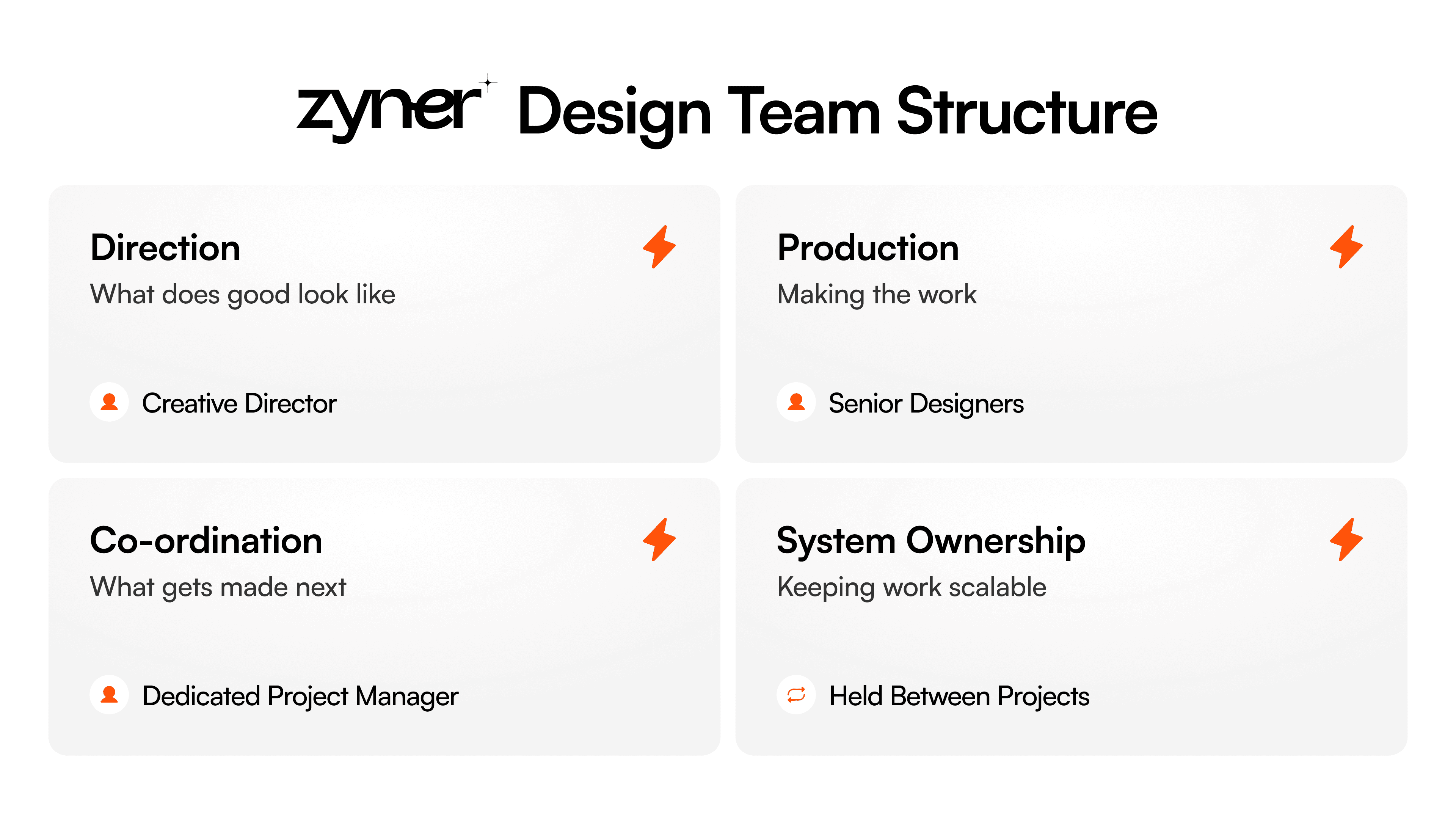
Zyner replaces the whole structure. You get a creative director holding direction, senior designers handling production, and a dedicated project manager owning coordination. The team also holds your brand system between projects, which covers the fourth job.
Requests come in through Slack, so your team has one route instead of four relationships to manage. The queue runs one active request at a time, which is a work-in-progress limit written as a policy. Revisions are unlimited, which moves the pressure onto writing a good brief.
What leaves your calendar is the point. You stop triaging requests, chasing files, re-briefing freelancers, and reviewing work that should never have reached you. Design stops being something you manage.
Those four mechanisms work whether or not you outsource anything. One intake route, a named producer, a hard limit on parallel work, and unlimited revisions cost nothing to adopt in-house. Copy them if you would rather build the structure yourself.
Your first 30 days
Week 1. Map it.
Run the four-job exercise and the 90-day people list. Count your intake routes. Time your last five repeating projects. Change nothing yet.
Week 2. Name the gap. Write one sentence stating which of the four jobs is uncovered and what it is costing. Show that sentence to your designer and to one stakeholder outside marketing. Adjust it based on what they say.
Week 3. Close one gap.
Pick the single cheapest fix for that job. Coordination gaps usually need one intake route and one approver. Direction gaps usually need a written standard and a person who owns it.
Week 4. Remeasure.
Rerun the project timing from week one. Keep the change if the numbers moved. Remove it openly if they did not, because a team that sees a failed change reversed will cooperate with the next one.
Then decide about headcount. A hire made after this exercise is a different hire from one made during a bad month.
Frequently asked questions
What is a design team structure?
It is the arrangement of four jobs: direction, production, coordination, and system ownership. Titles and reporting lines are how a company expresses that arrangement. Every company covers all four somehow, including companies with one designer.
How many designers does a 100-person startup need?
There is no reliable rule, and headcount is a weak predictor. NN/g found designer numbers correlated with company size at roughly one additional designer per 200 employees, which describes averages rather than a target. (NN/g, 2020, n=557) Count your recurring monthly deliverables instead, then work out how many days of production they require.
Should marketing design report to marketing or to product design?
Marketing design should report to marketing at your size, because it is judged on marketing outcomes. Keep one shared brand system across both functions. Reporting can split as long as the brand standard does not.
Centralised or embedded, which should I pick?
Neither until you have about five designers. Below that, the choice describes an allocation problem you do not have. NN/g's data shows the three models split almost evenly in practice, so there is no correct answer to inherit.
What is the right designer-to-developer ratio?
For product design, half of NN/g's respondents reported at least one designer per ten developers. (NN/g, 2020, n=377) For marketing design the ratio is close to useless. Channel count and campaign cadence drive the need instead.
Should I hire a designer or use an agency?
Answer it by which job is uncovered. Missing production capacity with everything else in place points to a hire or a freelancer. Missing direction, coordination, and system ownership at once points to a partner who covers all three. Three separate hires is a bigger project than most marketing teams can run.
What should my first design hire be?
A generalist with strong taste who can hold direction. That person needs range across brand, web, and campaign work, plus comfort with ambiguity. Hire the specialist second, once your backlog shows which specialism you keep sending out.
Do I need a design ops or creative ops person?
Usually not as a title. You need the practices: one intake route, a definition of ready for briefs, one named approver per work type, and a cap on parallel work. Fund the role when running the system becomes continuous work rather than a few hours a week.
How much does an in-house designer actually cost?
Take the salary and add about 30% for benefits, using the BLS figure of 30.1% of total employer compensation as of March 2026. (BLS ECEC) Then add the hiring gap, which averaged 62 days for startups under 25 employees without a recruiter. (Ashby, 2026) Then add the tools, the ramp, and the management time.
How do I keep the brand consistent across freelancers and an agency?
Give every outside contributor the same three things your internal team uses. That means the design system, the definition of done, and the intake route. Then name one person who owns those files. Consistency failures are almost always a system ownership gap in disguise.
Does AI change how many designers I need?
It changes the mix more than the count. Production gets faster, so the bottleneck moves to deciding what good looks like and keeping output on brand. Designer Fund found 91% of designers using AI weekly in 2026, and the same research found expectations rising faster than policy. (Designer Fund, May 2026)
When should I restructure rather than add people?
Restructure when your last five projects spent most of their elapsed time waiting on a person. Add people when the same projects spent most of their time in active production and still missed the date. Run the timing exercise before deciding, because the two look identical from the outside.


